Marketers: Rubric Workflow to Prove AI Visibility Across Markets
Run 20 to 30 buyer intent prompts per market, score multilingual answers with a rubric, and track a Visibility Score plus cited sources to prioritize fixes.
· 14 min read

Measure AI visibility by running standardized buyer-intent prompts across each target language and market, scoring the answers with an explicit rubric, and tracking a Visibility Score alongside evidence level citations. The immediate first step is simple: pick your highest-value intents, run them in each language and market, and log every mention, cited page, and sample answer. You need both an aggregate dashboard for trends and case-level evidence to know what to fix.
TL;DR:
- Tracking mention rates and cited pages across markets reveals whether your brand appears frequently and where the actual citation sources are coming from.
- A high variability in answer quality scores suggests the need for manual review, especially for responses that fall below groundedness and factuality thresholds.
- Technical discoverability issues like incorrect hreflang, canonicalization, or missing localized sitemaps can silently reduce AI citation and visibility across regions.
- Running 20 to 30 high-value prompts per market, localized with native input, balances coverage with manageable review time and uncovers actionable insights.
- Comparing visibility scores across different markets requires normalization for prompt count, engine availability, and language nuances to ensure meaningful analysis.
Table of Contents
- Core metrics to track and the dashboard model
- A practical rubric for scoring multilingual answers
- Technical discoverability checks that change what AI engines can cite
- Step by step: building and running a cross-market prompt set
- How to interpret visibility results and decide what to fix first
- Challenges and limitations in measuring AI visibility across languages and cultures
- Best practices for normalizing and comparing visibility data across markets
- Impact of regional language nuances and dialects on AI visibility measurement
- Legal and privacy considerations when collecting AI visibility data internationally
- AuthorityLayer perspective: operationalizing AI Visibility Intelligence
- A quick next step if you want this running without building it yourself
- Sources
- FAQ
Core metrics to track and the dashboard model
A workable AI visibility dashboard needs an aggregate layer and an evidence layer, not one or the other. The aggregate layer answers "are we improving," the evidence layer answers "why."
- Visibility Score: a composite of how often and how prominently a brand appears across sampled prompts.
- Mention Rate: the share of prompts in a given market or language where the brand appears at all.
- Estimated audience: a directional measure of how many buyers likely saw that answer, where the data source supports it.
- Cited pages: the specific URLs an AI engine pulled from, which tell you what content is actually earning citations.
- Competitive share: how often you appear relative to named alternatives in the same answer set.
A practical AI visibility dashboard exposes both aggregate scores and evidence-level detail, including overall visibility, mentions, cited pages, and market comparisons, according to Adobe's documentation for its AI visibility dashboard. That same documentation recommends filtering by engine and market so a team can see, for instance, strong presence in one assistant and a gap in another.
Build your dashboard around filters for engine, market, language, topic, and reporting period, with drilldowns from every card to the underlying prompts and cited sources. AuthorityLayer's own breakdown of recommendation share metrics covers how competitive share numbers are typically constructed.
A practical rubric for scoring multilingual answers
Counting mentions tells you that you appeared. It does not tell you whether the answer was accurate, fluent, or useful to a buyer in that market, which is why a rubric matters more once you move past one language.
- Groundedness and factuality: does the answer's claim about your brand match what is actually true and verifiable on your site or in public records?
- Instruction-following and relevance: does the response actually address the buyer's intent, not just mention the brand in passing?
- Fluency and coherence: is the localized answer natural in that language, or does it read like a machine translation?
- Local availability correctness: does the answer correctly state whether your product, service, or pricing applies in that market?
- Citation validity: do the cited sources actually support the claim, and are they reachable, current pages rather than dead links?
Vertex AI's evaluation service describes rubrics built around exactly this mix: groundedness, instruction-following, and text quality, with the option to supplement with computation-based metrics like BLEU and ROUGE for translation-heavy content. Static rubrics work well for routine monitoring; adaptive rubrics or human case review earn their cost when a market shows unexpected scores.
Once scores are in, aggregate with a mean and a standard deviation rather than a mean alone. A high average with wide variance usually means a handful of prompts are failing hard, and that is where the fix is, not in the average.
Pro Tip: Flag any answer scoring below your groundedness threshold for manual review before it ever reaches a trend chart.
Technical discoverability checks that change what AI engines can cite
An AI assistant cannot cite a page it cannot find or cannot correctly attribute to the right language and market, which makes technical QA part of visibility measurement rather than a separate SEO task.
- Hreflang and x-default: confirm every language variant points to the correct alternate and that the default is set deliberately, not left to chance.
- Canonical logic: check that language variants are not accidentally canonicalized to a single version, which erases the other markets from search and AI indexes alike.
- Localized sitemaps: submit market-specific sitemaps so crawlers can find the regional pages without relying on internal link discovery alone.
- Structured data validity: validate product, organization, and FAQ markup per locale; Google's structured-data documentation recommends checking Search Console after any template change.
- Index coverage: review coverage reports by market to catch pages that were crawled but excluded.
Run this checklist after any template, CMS, or hreflang change, not just on a quarterly schedule, since a single deployment can silently drop a market's indexing overnight. Technical failures are a common reason visibility looks asymmetric across languages even when the content itself is equally strong, which is why understanding how AI search is changing local SEO helps inform your technical discoverability checks.
Pro Tip: Re-run your structured-data validator immediately after any localization deployment, not on the next scheduled audit.
Step by step: building and running a cross-market prompt set
A repeatable workflow turns one-off checks into a measurement program you can trust quarter over quarter.
- Define the business questions: which products, categories, or comparisons matter most to revenue in each market.
- Assemble representative intents: build a master prompt list covering discovery, comparison, and decision-stage questions.
- Translate and localize, not just translate: adapt terminology, product names, and local phrasing with native speakers rather than literal translation, since idioms and business names rarely survive word-for-word conversion.
- Run across engines and languages: execute the same intent set on each assistant and market combination you track.
- Archive raw answers and citations: store full response text, cited URLs, and timestamps with immutable IDs so any score can be reproduced later.
- Score via rubric: apply your groundedness, relevance, fluency, and citation checks to each response.
- Feed the dashboard: roll scored results into aggregate cards while keeping the case-level evidence linked underneath.
For sampling, most teams find 20 to 30 high-value prompts per market enough to spot real patterns without drowning in review time, weighted toward the intents closest to purchase decisions. AuthorityLayer's guidance on tracking AI prompts covers how to balance breadth across markets against depth within any one of them.
How to interpret visibility results and decide what to fix first
A low Visibility Score is not automatically urgent, and a market with high estimated audience value is not automatically worth more attention if the fix is nearly free elsewhere.
- Prioritization matrix: rank gaps by Visibility Score shortfall, estimated audience or deal value, and the effort required to close the gap.
- Technical fixes first: an hreflang or indexing error that suppresses an entire market usually beats a single weak answer in priority, since fixing it restores visibility across every prompt at once.
- Content and localization next: when the content exists but scores poorly on groundedness or fluency, rewrite or re-localize rather than rebuild from scratch.
- Earned citations last but ongoing: when competitors dominate citations, outreach and publishing in formats AI engines favor can shift the balance over months, not days.
Repeat sampling after any fix and compare the delta in Visibility Score and cited pages rather than assuming a change worked. AuthorityLayer's AI Search Strategy playbook frames this distinction between presence in AI answers and traditional ranking metrics, which is also covered in the practitioner's guide to AI visibility metrics. When competitors keep showing up instead of you, the causes are usually traceable; why ChatGPT recommends competitors walks through the common ones.
Challenges and limitations in measuring AI visibility across languages and cultures
Cross-market measurement runs into problems that single-market tracking never faces. Prompt equivalence is the first: a question that sounds natural in English often sounds stilted or oddly formal once translated, which can itself change how an AI engine answers, independent of your actual brand presence.
Cultural framing is the second. Buyers in different markets ask about the same product category in genuinely different ways, comparing on price in one market and on warranty or service in another, so a single global prompt set risks measuring the wrong intent in half your markets.
Model and engine inconsistency compounds both problems. The same assistant can behave differently by region due to localized training data, regional content partnerships, or simply uneven crawl coverage, meaning a low score might reflect a content gap or a data gap the model has for that language.
Finally, sample sizes get thin fast. Running the same depth of prompts across ten markets multiplies review time linearly, which pushes many teams toward shallower coverage in smaller markets exactly where errors are hardest to catch. National-level AI ecosystem indices such as Stanford HAI's Global AI Vibrancy Tool describe how mature a country's AI ecosystem is overall, but that context does not substitute for prompt-level measurement of your own brand's visibility within it.
Best practices for normalizing and comparing visibility data across markets
Comparing a Visibility Score from Japan against one from France only works if the underlying measurement is apples to apples, which takes deliberate normalization.
Start by fixing the prompt count and intent mix per market before comparing scores, since a market tested with 15 prompts will naturally look noisier than one tested with 40. Normalize for engine availability too: not every assistant operates identically in every country, so a market missing one major engine should be flagged rather than silently scored lower on an average that assumes full coverage.

Use relative, not absolute, thresholds when markets differ structurally. A market with a smaller digital content footprint may have a lower achievable ceiling for mentions, so compare a market against its own baseline over time more often than against another market's raw number.
Keep one rubric version per reporting period across all markets. Changing scoring weights mid-quarter and then comparing scores across the change invalidates the comparison entirely, so version your rubric and timestamp which version produced each score.
Finally, document estimated audience or reach calculations clearly, since these figures are directional rather than exact and vary by data source, which makes it easy to mistake a methodology difference for a real market difference if the basis is not stated plainly.
Impact of regional language nuances and dialects on AI visibility measurement
Dialects and regional usage change both the prompt and the answer in ways a single-language testing plan misses entirely. Spanish prompts written for Spain can read oddly to a Mexican or Argentine buyer, and the AI engine's answer may shift tone, vocabulary, or even which local competitors it surfaces based on that regional variant.
Formality conventions matter too. Languages with formal and informal registers, such as German's "Sie" versus "du" or Japanese's layered politeness levels, can produce meaningfully different answers depending on which register the prompt uses, and buyers in that market are likely to use the register that matches how they actually search.
Transliteration and script variants add another layer for languages like Arabic or Chinese, where romanized queries and native-script queries can return different cited sources entirely. A measurement plan that tests only one script or one dialect variant per language is measuring a slice of the market, not the whole of it.
The practical fix is involving native speakers in prompt construction rather than relying on direct translation, since idiom, local business terminology, and regional product names rarely survive literal conversion. A prompt set built this way costs more time upfront but avoids the false negatives that come from testing a dialect nobody in that market actually uses.

Legal and privacy considerations when collecting AI visibility data internationally
Running prompts across borders touches data protection rules that vary by jurisdiction, and the obligations depend on what you collect and where your organization or vendor processes it. If your prompt logs or stored answers include any personal data, even incidentally through examples or cited user content, rules like the EU's data protection framework can apply to how that data is stored, retained, and transferred.
Scraping AI interfaces at scale can also intersect with a platform's own terms of service, which differ by assistant and change over time, so a measurement program built on UI scraping should review those terms periodically rather than once at setup.
Cross-border data transfer rules matter when your evaluation pipeline, dashboard, or storage sits in a different country than the market you are measuring. This is a legal question specific to your organization's structure and the jurisdictions involved, and it is worth a conversation with legal counsel rather than a generic policy, since the right answer depends on your specific data flows.
Retention policy deserves the same deliberate attention. Keeping raw answers and citations for audit purposes is good practice for reproducibility, but retention periods should follow your organization's data governance policy and the applicable rules in each market where data originates, not a single global default.
AuthorityLayer perspective: operationalizing AI Visibility Intelligence
Evidence-level reporting is valuable in AI visibility scores: mentions, cited pages, and prompt-level examples underneath each aggregate number help a marketing team see exactly which answer produced which result. That pairing, an AI Authority Index alongside case-level evidence, is what turns a dashboard number into an actionable fix rather than a static scorecard.
For teams building their own prompt playbook, AuthorityLayer's guidance on data sources that feed AI assistants and its monthly AI visibility report are reasonable starting points before running a full program internally.
— Geraldine
A quick next step if you want this running without building it yourself
Everything in this piece can be built in-house with a spreadsheet, an evaluation API, and patience. Some platforms offer immediate visibility scores, cited pages, and competitive share so teams can start tracking AI visibility without building tooling from scratch.
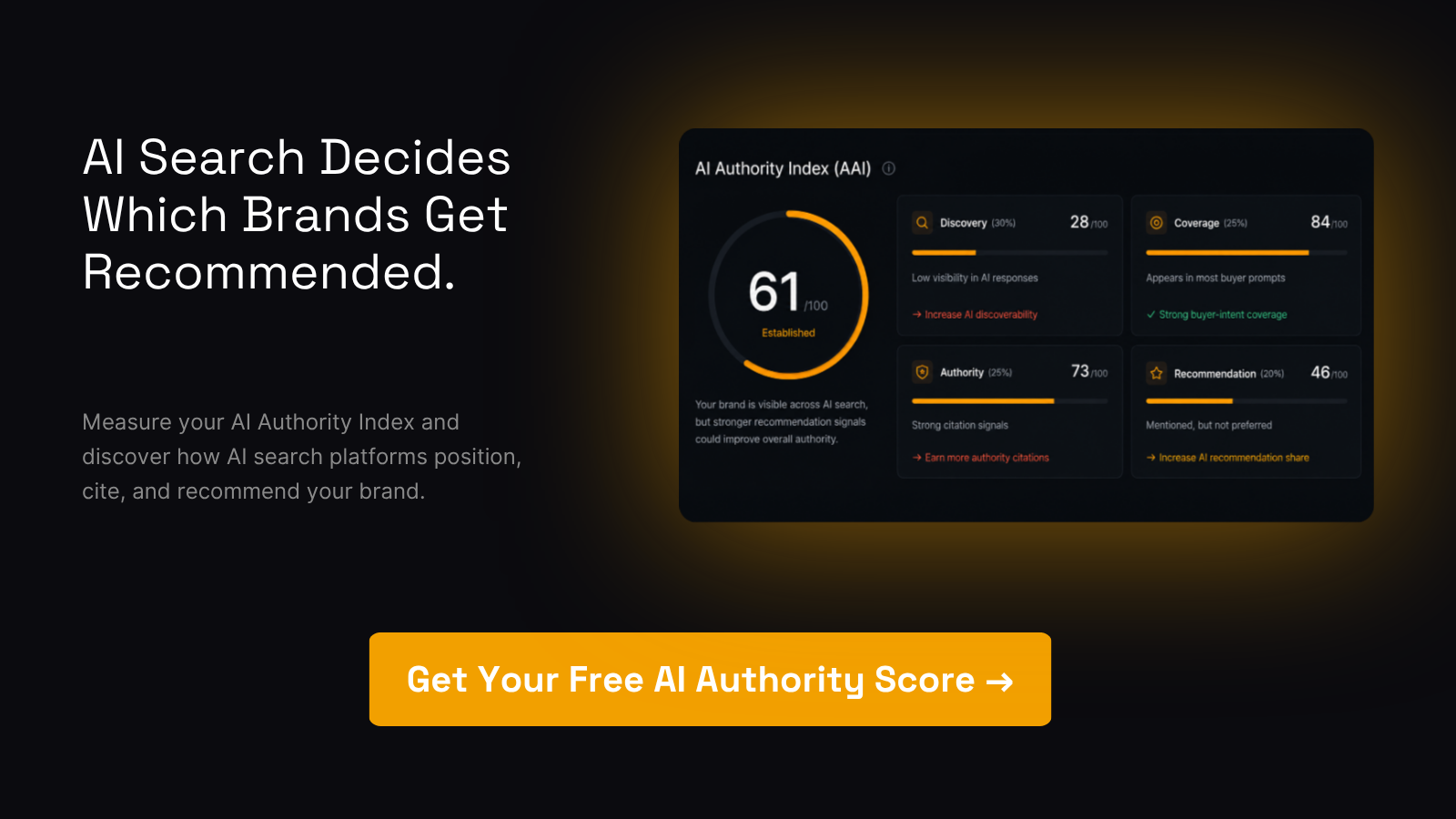
- The Free AI Visibility Scan gives a first read on where your brand stands before you commit to anything.
- The Enterprise Plan covers full evidence-level dashboards, competitive benchmarking, and prioritized recommendations across markets, at a monthly subscription price.
- Smaller teams can start with Starter or Growth plans priced monthly, depending on how many markets and prompts you need to track.
Run the free scan first and see what an evidence-level score actually looks like for your brand.
Sources
Four categories of tooling collect the data behind an AI visibility program, and most teams end up blending two or three.
Each source yields a different mix of mentions, cited domains, full answer text, evidence order, and, where the platform supports it, estimated audience reach. A comparison of AI search analytics tools is a useful starting point if your team is choosing its first platform.
The heuristic is straightforward: prioritize UI scraping when citation order and exact phrasing matter, such as a legal or medical niche, and lean on API sampling when you need breadth across dozens of markets and can tolerate slightly less fidelity. Most mature programs run a hybrid: API sampling for scale, UI spot-checks for calibration.
FAQ
What is the main metric for AI visibility across markets?
The primary metric is a Visibility Score that combines how often and how prominently a brand appears across sampled buyer-intent prompts. Supporting metrics like Mention Rate, cited pages, and competitive share explain what is driving that score in each market.
How many prompts should I test per market?
Most teams run 20 to 30 high-value prompts per market, weighted toward intents closest to a purchase decision, as a practical balance between coverage and review time. Larger programs expand this per market once the initial pattern is established.
Do I need separate tools for AI visibility versus SEO rankings?
AI visibility and traditional search rankings are related but distinct layers, since an AI assistant can cite or recommend a brand independent of where that brand ranks in organic search. A dedicated AI visibility approach, like the one described in AuthorityLayer's metrics guide, tracks presence inside generated answers rather than page position alone.
How do I handle dialects within the same language?
Build separate prompt variants for major dialects or regional registers rather than assuming one version of a language covers every market, since phrasing and formality shift how an AI engine answers. Involving native speakers from each target region when building prompts catches issues a direct translation would miss.
Is scraping AI assistant answers for measurement legal?
Rules vary by platform and jurisdiction, so the answer depends on each assistant's terms of service and the data protection laws covering where your data is stored and processed. Review the specific platform's terms and consult legal counsel for your organization's situation rather than relying on a general rule.