AI Recommendation Share: How to Measure and Grow It
Discover how to measure and enhance your AI recommendation share to ensure your brand stands out among competitors. Learn actionable strategies!
· 15 min read

AI recommendation share measures the proportion of buyer-research answers, across ChatGPT, Gemini, Claude, and Perplexity, in which an AI assistant actively recommends your brand rather than merely mentioning it. Competition-weighted, it accounts for how many other brands appeared in the same answer, so a mention buried in a list of eight competitors counts for less than a solo recommendation.
For CMOs and heads of SEO/GEO, this number predicts something raw mention counts cannot: whether AI assistants treat your brand as the answer or as an afterthought. That distinction now sits upstream of branded search, referral traffic, and pipeline.
Two things to keep in mind before you build a tracking program:
- A single ChatGPT conversation on your personal account is a snapshot, shaped by your history and location, not a measurement.
- Real tracking requires standardized prompts run repeatedly across ChatGPT, Gemini, Claude, Perplexity, and Google AI Overviews, scored against named competitors, not against nothing.
Key Takeaways
Recommendation share, not raw mention volume, is the metric that predicts whether AI assistants actively steer buyers toward your brand or merely acknowledge it exists.
| Point | Details |
|---|---|
| Track the gap, not just the rate | The distance between mention rate and recommendation share shows where content is visible but not persuasive. |
| Cover five surfaces separately | ChatGPT, Perplexity, Gemini, Claude, and Google AI Overviews diverge enough that a blended score hides real problems. |
| Standardize prompts, run repeatedly | One-off personalized checks reflect account history and phrasing, not a comparable measurement. |
| Weight by competition | A recommendation shared with four other brands is worth a fraction of a solo recommendation. |
| Start with AuthorityLayer's free scan | Authoritylayer benchmarks recommendation share and citation share against named competitors before you commit to a subscription. |
Table of Contents
- What Does AI Recommendation Share Actually Measure?
- Why Does Recommendation Share Move Revenue?
- How Do You Build a Standardized Measurement Framework?
- How Do You Write Prompts That Don't Bias Your Own Results?
- How Should You Report Recommendation Share to Executives?
- What Actually Moves Recommendation Share Up?
- What Makes Recommendation Share Hard to Measure Reliably?
- Which Brands Have Improved Their Recommendation Share, and How?
- Where Are the Ethical Lines When Influencing AI Recommendations?
- The Measurement Discipline Most Teams Skip
- How AuthorityLayer Turns Recommendation Share Into a Growth Lever
- Sources
- FAQ
What Does AI Recommendation Share Actually Measure?
Recommendation share sits at the top of a stack of related metrics, and conflating them is the most common measurement mistake marketing teams make.
Here's the taxonomy, in order of commercial weight:
- Mention rate. The percentage of relevant AI answers in which your brand name appears anywhere in the response, regardless of context.
- Citation share. The percentage of answers where your domain appears as a linked source, which SerpApi's mapping of answer-engine payloads treats as a distinct signal from mention because engines expose it in different fields entirely.
- Recommendation rate. The percentage of answers where the model explicitly suggests your brand as a solution, not just references it in passing.
- Brand Recommendation Share. The competition-weighted version: each answer's contribution equals 1 divided by the number of brands named, so a solo recommendation scores 1.0 while a brand named alongside four competitors scores 0.2, per Rhinegold's compendium.
That gap, not the mention rate alone, is what belongs on an executive dashboard.
Why Does Recommendation Share Move Revenue?
Recommendation share matters because it's the metric most directly tied to what happens after the AI answer, not just whether your name showed up in it.
Brands with rising recommendation share tend to see branded search volume climb in the following weeks, a pattern worth checking against Google Search Console's branded query trends. IsMyBrandInAI recommends validating any AI visibility signal against Search Console and GA4 before trusting it, precisely because AI referral data alone can be noisy or incomplete.
Recommendation share also outperforms mention counts as a prioritization tool:
- A mention with no recommendation tells you the model knows you exist but doesn't trust you enough to suggest you.
- A recommendation buried in a five-brand list tells you the model considers you a peer, not a leader.
- A solo recommendation, weighted at full value, tells you where your content and citations are already working, so you know where to double down rather than rebuild from scratch.
Gaps between mention rate and recommendation share are the fastest way to triage a content and PR backlog, because they point to specific prompt categories where you're visible but not persuasive.
How Do You Build a Standardized Measurement Framework?
A defensible AI recommendation share number requires the same discipline as a lab measurement: a fixed protocol run the same way every time, not a marketer typing questions into their personal ChatGPT account and screenshotting whatever comes back.
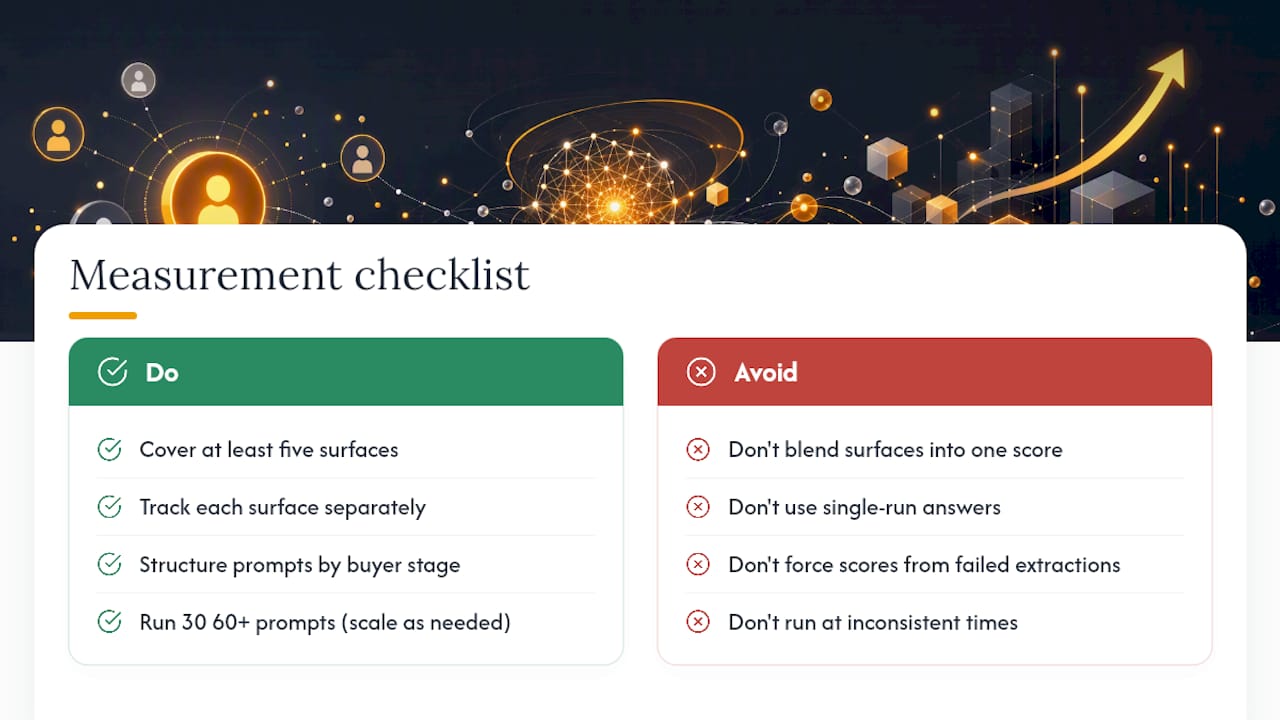
Cover at least five surfaces, because coverage varies wildly between them. Digital Bloom's research, cited by Graph Digital, found only about 11% domain overlap between ChatGPT and Perplexity citations, meaning a brand invisible on one engine can be dominant on another. Track ChatGPT, Perplexity, Gemini, Claude, and Google AI Overviews separately, and resist the urge to blend them into one score until you've published the per-surface breakdown.
Structure your prompt set across the buyer journey: awareness prompts ("what tools help with X"), comparison prompts ("X vs Y"), and decision prompts ("best X for [use case]"). Mid-market programs typically run 30 to 60 prompts across three to five personas; enterprise programs with multiple product lines often need 100 or more to cover segment variation.
Run each prompt multiple times per cycle, not once. Single-run answers can vary word for word between calls, so multi-run consistency checks separate a real signal from noise. Exclude runs where extraction fails or the model returns a malformed or off-topic answer rather than forcing a score.
Score every answer on a four-point scale: no mention, mention-only, mention-with-context, or active recommendation. Weight the top tier most heavily when you roll results into a single Brand Recommendation Share figure.
Pro Tip: Run your prompt set at the same time of day and week over week. Time-of-day model behavior drift is real, and comparing a Monday-morning run to a Friday-night run introduces variance that has nothing to do with your actual visibility.
How Do You Write Prompts That Don't Bias Your Own Results?
The failure mode nobody talks about is confirmation bias baked into prompt selection. If you write prompts you already suspect will favor your brand, you'll get a recommendation share number that flatters you and misleads your board.
Contrast the two approaches directly. A manual check ("Hey ChatGPT, is [my brand] good?") on a personalized account reflects that account's history, that day's model version, and a leading question. A standardized prompt set is written in advance, phrased the way a real buyer would phrase it, and run identically across every tracked engine and every competitor.
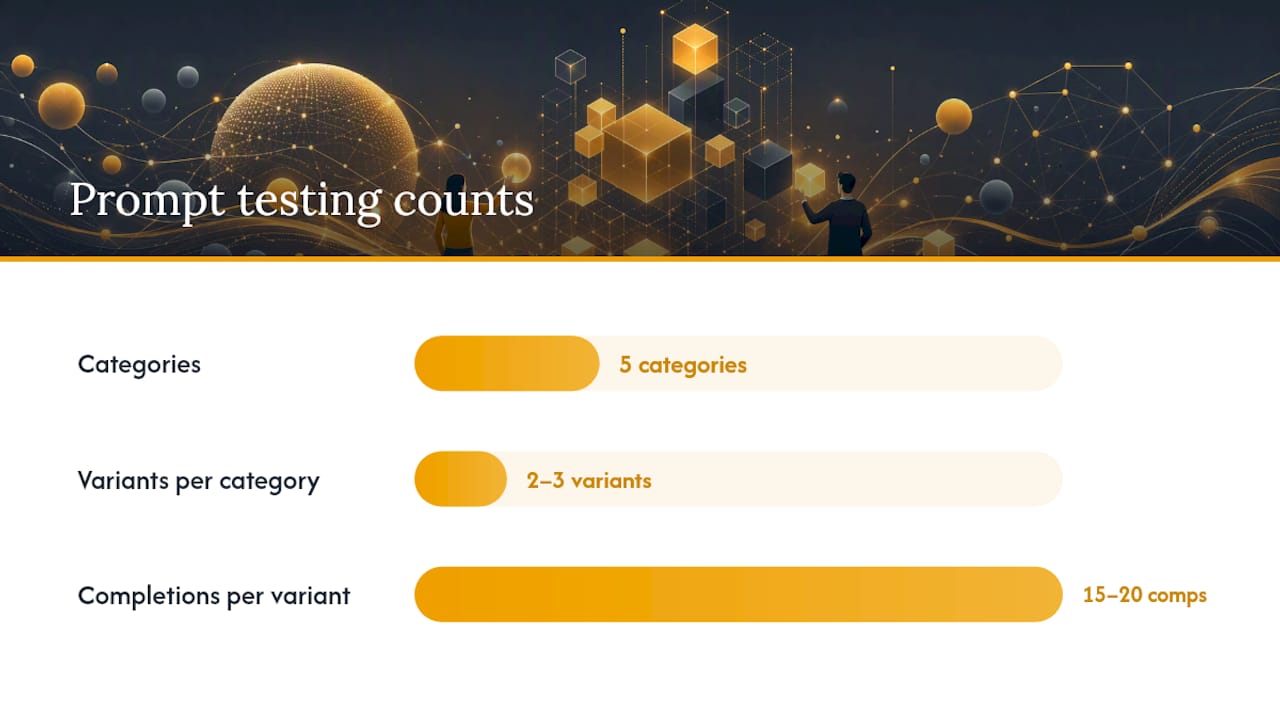
Build prompts across five categories:
- Discovery: "What are the best tools for [category]?"
- Comparison: "How does [Brand A] compare to [Brand B] for [use case]?"
- Alternatives: "What are alternatives to [known competitor]?"
- Implementation: "How do I get started with [category] for a [company size/industry]?"
- Risk: "What should I watch out for when choosing a [category] vendor?"
Write two to three phrasing variants per category, since AI answers are sensitive to how a question is worded even when the intent is identical. Run each variant against a minimum of 15 to 20 completions before treating any single category's recommendation rate as stable, and re-check with paraphrased versions periodically to confirm the pattern holds and wasn't an artifact of one exact phrasing.
Pro Tip: If a competitor's recommendation rate jumps sharply in one category but nowhere else, check whether they just published a piece of content that directly answers that prompt's phrasing. AI models reward specificity fast.
How Should You Report Recommendation Share to Executives?
The most useful format for leadership is a matrix, not a single number: surfaces down one axis, buyer-journey stage across the other, with recommendation rate, citation share, and a trend arrow in each cell.
Three diagnostics matter more than the headline figure:
- The mention-to-recommendation gap. A wide gap between how often you're mentioned and how often you're actually recommended points to a trust or evidence problem, not an awareness problem, and it tells you exactly which prompt categories to fix first.
- Surface divergence. If Perplexity recommends you consistently but Gemini never does, that's a citation-sourcing gap on one engine, not a brand-wide failure.
- List-length dilution. A rising raw mention rate paired with a flat competition-weighted score usually means you're getting added to longer lists, not winning more solo recommendations.
Validate the whole picture against Search Console's branded query trends and GA4's AI-referrer segments before presenting it as causal. Correlation between a rising recommendation share and rising branded search is a strong signal; treat it as confirmation, not proof, until you've watched it hold across two or three measurement cycles.
What Actually Moves Recommendation Share Up?
Three categories of action move the needle, and none of them require guessing.
- Fix the content gaps your prompts expose. If "best tools for [category]" prompts never recommend you, check whether you have a page that directly and specifically answers that framing. Generic homepage copy rarely gets cited; a page structured around the buyer's exact comparison question often does.
- Add evidence-rich, citable material. AI engines lean on sources that state specific numbers, named methodologies, and dated findings. Publishing original data, benchmark reports, or structured comparison pages gives models something concrete to cite instead of paraphrasing a vague claim. Reviewing what actually drives competitive recommendation share is a useful starting point before you invest in new content.
- Build third-party citation sources deliberately. AI models weight independent, authoritative mentions heavily. Structured PR placements, analyst mentions, and industry directory listings feed the citation layer that recommendation depends on. A general AI search visibility guide is a solid reference point for how discoverability and third-party citation work together.
Governance matters as much as tactics. Maintain a canonical list of claims about your product (pricing tiers, feature names, certifications) and audit it against what AI engines are actually saying, since SerpApi's per-engine extraction research shows models often paraphrase source material inconsistently. Route new claims through one approval workflow so marketing, product, and legal agree on the canonical version before it ships anywhere public.
Pro Tip: Run a quarterly audit comparing what your website says about your product to what AI engines say about it. Drift between the two is usually the first sign a competitor's content has started outranking yours as a source.
What Makes Recommendation Share Hard to Measure Reliably?
Three structural problems make this harder than tracking search rankings ever was.
Model updates break comparability. Every major model refresh can shift how an engine phrases, weights, or sources its answers, sometimes overnight. A recommendation rate measured in January and one measured in March may reflect a model change more than any real shift in your visibility, which is why a single-point measurement is nearly useless without a consistent run cadence around it.
Data access is asymmetric across engines. Some platforms expose citation data more readily than others, and none of the major assistants offer a public API purpose-built for brand visibility tracking. That forces measurement programs to rely on structured prompt sampling rather than pulling clean backend data, and it means your sample size and run frequency directly determine how much you can trust the result.
Personalization contaminates ad hoc checks. Two employees at the same company, using their own ChatGPT accounts, can get different answers to the identical question because of account history, location, or subscription tier. This is the core argument for standardized, logged-out or consistently configured prompt runs: they strip out the personalization variable that makes casual manual checks unreliable as a business metric.
None of this means measurement is futile. It means the measurement has to be built like an instrument, with a fixed prompt set, a fixed cadence, and documented exclusion rules for failed or malformed extractions, rather than treated as a one-time audit.
Which Brands Have Improved Their Recommendation Share, and How?
The pattern across companies that move their recommendation share isn't a single silver-bullet tactic. It's the compounding effect of closing the mention-to-recommendation gap category by category.
Brands that start with a wide gap, high mention rate, low recommendation rate, in comparison-style prompts typically find the fix isn't more content volume. It's rewriting existing pages to directly answer the comparison framing AI models are already being asked, with specific differentiators instead of generic value statements. Once that content ships, recommendation rate in that specific prompt category tends to move within one or two measurement cycles, well before it shows up in overall search rankings.
Companies that improve citation share fastest tend to focus on getting cited by sources AI models already trust: industry analyst reports, structured data directories, and comparison sites with clear, dated, factual claims. A single strong third-party citation, picked up consistently across engines, often moves recommendation share more than a dozen new blog posts on the brand's own domain.
The common thread across improvement stories is measurement discipline, not creative brilliance. Teams that ran the same prompt set monthly could see exactly which category improved after which content change. Teams that checked in sporadically, using whatever prompt occurred to someone that week, couldn't tell a real gain from month-to-month model noise. The tactic that works consistently is closing specific, diagnosed gaps, not a general push for "more AI visibility."
Where Are the Ethical Lines When Influencing AI Recommendations?
Improving recommendation share is fundamentally different from gaming it, and the line between the two matters more here than it did in traditional SEO.
Publishing accurate, specific, well-sourced content that answers real buyer questions is legitimate influence. Stuffing pages with keyword variations, fabricating comparison data, or seeding fake reviews to manipulate what models learn is not, and it carries real risk: once an AI model ingests and repeats a false claim about your product, correcting it across every surface is slow and inconsistent.
A few practices separate defensible influence from manipulation:
- Never publish a claim you can't defend with evidence. AI models increasingly cite sources with specific numbers and methodology; if a stat doesn't hold up, it will eventually get challenged or contradicted by a competing source, and the model may flag the inconsistency.
- Disclose sponsored or paid placements clearly. Buying a citation without disclosure risks both regulatory exposure and a credibility hit if it surfaces.
- Correct errors publicly, not just quietly. If an AI model is repeating outdated pricing or a discontinued feature, fix the source page and, where possible, flag it through the platform's feedback channel rather than assuming it will self-correct.
- Don't manufacture fake third-party consensus. Coordinated fake reviews or sockpuppet mentions are detectable, and models trained on manipulated signal patterns eventually produce answers that damage trust faster than any short-term recommendation lift can offset.
Treat AI recommendation share the way you'd treat organic search reputation: worth investing in seriously, never worth faking.
The Measurement Discipline Most Teams Skip
Most marketing teams already believe they have a sense of their AI visibility, because someone on the team asked ChatGPT about the category last month and reported back what it said. That belief is the biggest blind spot in this whole discipline.
A single prompt, run once, on one account, on one day, tells you almost nothing comparable. It's shaped by that person's account history, the exact phrasing they happened to use, and whichever model version happened to answer. Two people on the same team, asking a nearly identical question the same week, routinely get different brand lists back. Treating that as a measurement rather than an anecdote is the conventional mistake this whole category needs to unlearn.
What actually holds up is boring by comparison: the same prompt set, run the same way, across the same five surfaces, on a fixed schedule, scored against named competitors every time. It's less exciting than a screenshot of ChatGPT praising your brand, but it's the only version of this number a board should trust, because it's the only version that's comparable month over month.
If there's one place to start, it's not content production. It's building the baseline. You cannot know whether a new content push moved recommendation share if you never measured the gap it was supposed to close.
How AuthorityLayer Turns Recommendation Share Into a Growth Lever
Authoritylayer is built specifically to replace the one-off ChatGPT screenshot with the standardized measurement this article just walked through: fixed prompt sets, multi-surface tracking across ChatGPT, Gemini, Claude, and Perplexity, and multi-run consistency checks that separate real signal from model noise.
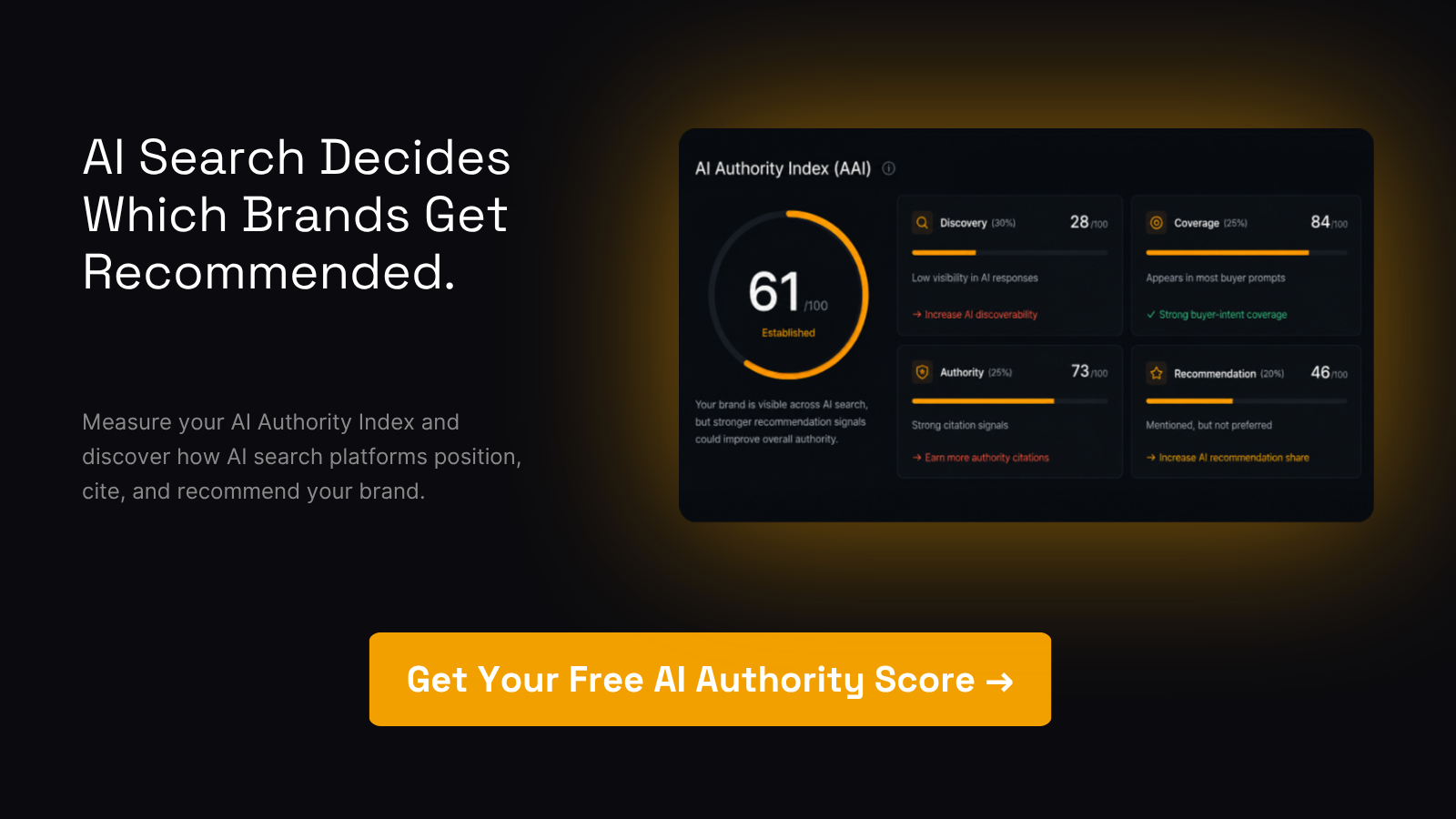
The platform tracks your recommendation share, citation share, and a composite AI Authority Index, then benchmarks all three against named competitors so you see exactly where the mention-to-recommendation gap is widest and which prompt categories to fix first. Most teams start with a free AI visibility scan to get a baseline, move into a pilot to validate the pattern across a full measurement cycle, and then subscribe to one of Authoritylayer's tiered plans for ongoing monitoring and prioritized recommendations. If you want to see how the tracking and scoring actually work before committing, the how it works page walks through the full pipeline. Start with the free scan and get your baseline number this week.
Sources
- Track brand mentions in AI search
- Measuring AI visibility: six metrics that actually answer the board's three questions | Graph Digital
- Measuring brand presence across AI answer engines
- Brand Recommendation Share — The Rhinegold Compendium
- How to Measure AI Search Visibility: The Metrics & KPIs That Actually Matter (2026) | Is My Brand in AI
FAQ
What Is AI Recommendation Share?
It's the competition-weighted percentage of relevant AI assistant answers in which your brand is actively recommended, rather than just mentioned, across engines like ChatGPT, Gemini, Claude, and Perplexity.
How Is Recommendation Share Different From Share of Voice?
Traditional share of voice counts mentions anywhere they appear; recommendation share only counts answers where the AI explicitly suggests your brand as a solution, weighted down when it's named alongside several competitors.
Why Can't I Just Check ChatGPT Myself Each Week?
A personal account reflects your own history, location, and phrasing, so results vary between people and sessions; standardized prompt sets run consistently across surfaces are the only way to get a comparable, repeatable number.
How Many Prompts Do I Need for a Reliable Baseline?
Mid-market programs typically need 30 to 60 prompts across several personas and buyer-journey stages, run multiple times per cycle; enterprise programs with multiple product lines often need 100 or more.
Can AuthorityLayer Track This Across All the Major AI Engines?
Yes. Authoritylayer monitors ChatGPT, Gemini, Claude, and Perplexity with standardized prompt sets, scoring recommendation share and citation share and benchmarking them against named competitors.