Marketers: Close AI Share of Voice Gaps with a 20–30 Prompt Playbook
A practical playbook for marketers to measure AI share of voice. Run repeatable 20–30 prompt audits across major LLMs, compare closed vs open...
· 15 min read

AI Share of Voice (AI SOV) is the percentage of AI-generated answers on a given topic where an AI assistant mentions your brand instead of, or alongside, competitors. You calculate it by running the same set of prompts across multiple large language models, counting brand mentions, and dividing your mentions by total brand mentions across the category. The catch: a single manual check in ChatGPT tells you almost nothing. Reliable AI SOV requires a fixed prompt set run repeatedly across models and time, because model answers shift and one-off snapshots produce noise, not signal.
TL;DR:
- Using both closed competitor lists and open-universe scans helps identify known rivals and emerging threats before they impact your market position.
- Tracking multiple metrics beyond mention count, such as visibility percentage, mention share, citation share, and sentiment, provides a clearer view of your AI visibility.
- Running standardized prompts across several AI platforms on a fixed schedule ensures accurate trend analysis and captures model updates or competitor movements.
- Regular audits should be conducted weekly in fast-moving categories and monthly in mature markets, with at least 20 prompts to avoid noise and ensure reliability.
- Connecting AI share of voice data to referral traffic, lead surveys, and brand awareness surveys can help prove its impact as a marketing ROI metric.
Table of Contents
- What Does AI Share of Voice Measure, and Why Does It Matter More Than Traditional SOV?
- How Do You Calculate AI SOV Across Multiple Platforms?
- Should You Benchmark Against a Closed Competitor List or an Open Universe?
- What Metrics Should You Track Beyond Basic Citation Counts?
- What Should You Look for in a Tool That Measures AI SOV?
- How Do You Build a Repeatable AI SOV Dashboard?
- How Often Should You Audit AI Share of Voice?
- How Do You Turn AI SOV Into Proof of Marketing ROI?
- How AuthorityLayer Operationalizes AI Visibility Measurement
- What's the Fastest Way to Close an AI Visibility Gap?
- What Legal and Ethical Rules Apply to Using AI Data for Competitive Analysis?
- Why Repeatable Measurement Beats a One-Time AI Check
- Start Measuring Your AI Visibility Today
- Sources
- FAQ
What Does AI Share of Voice Measure, and Why Does It Matter More Than Traditional SOV?
Traditional share of voice counted mentions across ads, press, and search results, all channels you controlled or paid into directly. AI Share of Voice measures something different: whether a generative model, acting as an intermediary between your buyer and the market, chooses to surface your brand at all. That intermediary role is the entire story. When someone asks ChatGPT or Perplexity "what's the best project management tool for a 50-person team," the model isn't showing ten blue links. It's picking, usually, three to five brands and framing an opinion about them.
Two metrics matter here, and they measure different things:
- Visibility % — the share of prompts in your set where your brand appears anywhere in the answer, regardless of how many competitors also show up.
- Mention share — your portion of total brand mentions across all answers, which reveals whether you're winning attention within a crowded field or barely registering in a niche one.
That gap is where competitive strategy actually lives. The downstream effect isn't abstract, either: buyers increasingly treat the AI answer as their shortlist, not their starting point, which means a brand invisible in that first pass may never reach a human decision maker's radar. Recommendation share, not raw mention count, is what predicts whether you make the consideration set.
How Do You Calculate AI SOV Across Multiple Platforms?
Building a defensible number takes discipline, not luck. Here's the workflow that holds up under scrutiny.
- Define scope and buyer intent. List the 3 to 6 real buying questions your prospects ask, not generic category terms. "Best CRM for a 20-person sales team" beats "best CRM."
- Build the prompt set. Vendor guides commonly recommend tracking at least 20 prompts and multiple competitors to establish a baseline that isn't skewed by phrasing quirks. Spread prompts across comparison intent ("X vs Y"), recommendation intent ("best tool for Z"), and problem intent ("how do I solve Z").
- Run the prompts across platforms. At minimum, cover ChatGPT, Gemini, Perplexity, and Claude, since each pulls from different retrieval and citation logic and will produce genuinely different answers to the same question.
- Capture full responses and citations. Record the answer text, every brand named, and every URL cited as a source, not just whether your brand appeared.
- Tag and count mentions. Log each brand mention per prompt per platform, distinguishing a passing reference from an actual recommendation.
- Compute SOV per platform and aggregated. Per-platform SOV is your mentions divided by total category mentions on that platform, times 100. Aggregate SOV averages that figure across platforms, weighted by prompt volume if platforms received different prompt counts.
Pro Tip: Run every prompt exactly as written, with no follow-up questions, and rerun the identical set on a fixed schedule. The moment you start rephrasing prompts mid-audit, you lose the ability to compare week over week, which defeats the entire purpose of the exercise.
Manual tracking works for a handful of prompts. Past 20, matched against several models and competitors, spreadsheet tracking turns into a part-time job, which is exactly why most teams eventually automate the process.
Should You Benchmark Against a Closed Competitor List or an Open Universe?
The denominator you choose changes the story your data tells, and most teams pick one without realizing there's a decision to make.
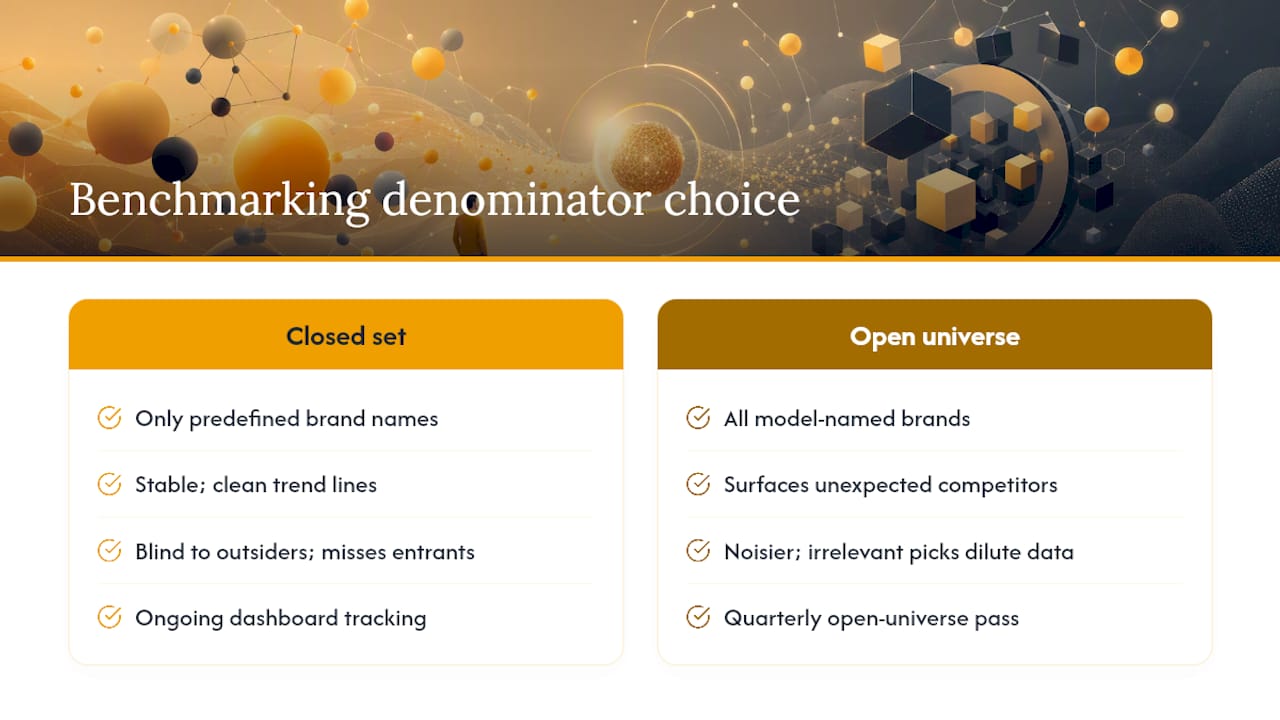
A closed competitor set means you predefine your rivals (say, five named brands) and only count mentions of those names. It's simple, it's stable across audits, and it's ideal when you already know your competitive landscape well and want clean trend lines over time. The weakness: it's blind to anyone outside the list. A fast-moving startup eating your category from the side won't show up until you manually add it.
Open-universe measurement counts every brand the model names, whether you expected it or not. This approach surfaces competitors you didn't think to track, which is often the more valuable signal, because it catches emerging threats before they show up in your quarterly competitive review. The tradeoff is noisier data. Some prompts will surface irrelevant tools, forums, or review aggregators that dilute clean percentages.
The practical answer: run both. Use a closed set for your steady-state dashboard and trend reporting, and run an open-universe pass quarterly to check who's entering the conversation. If your visibility percentage looks strong in the closed set but your mention share is falling in the open universe, that's an early warning that new entrants are eroding your position before it shows up anywhere else.
What Metrics Should You Track Beyond Basic Citation Counts?
Mention count alone tells you almost nothing about whether that mention helps or hurts you. Four additional metrics turn a raw number into a diagnosis.
- Visibility % shows how often you appear at all across your prompt set.
- Mention share shows your slice of total attention once you do appear.
- Citation share tracks how often your own domain gets cited as a source, versus a third-party site talking about you, which is a different and often more trustworthy signal.
- Sentiment and framing capture whether the model describes you as a leader, an also-ran, or a caveat ("X is solid but lacks Y").
Third-party citations often carry more weight than brand-owned content, because models tend to treat independent review sites, comparison articles, and industry publications as more credible than a company's own marketing pages. A mention buried in a negative comparison, meanwhile, can actively cost you consideration even while boosting your raw mention count, which is why tracking sentiment alongside visibility matters as much as tracking presence itself.
What Should You Look for in a Tool That Measures AI SOV?
Choosing a measurement approach comes down to a short capability checklist, whether you're evaluating a platform or scoping an internal build.
- Multi-LLM coverage. Confirm the tool actually queries ChatGPT, Gemini, Perplexity, Claude, and Google AI Overviews rather than one or two, since answer patterns vary meaningfully by platform.
- Prompt scheduling and history. You need the same prompts rerun automatically, with historical results stored for trend analysis, not just a live snapshot.
- Citation and source extraction. The tool should log every URL a model cites, not only whether your brand name appeared.
- Open-universe competitor discovery. Look for automatic detection of brands you didn't manually add to a tracking list.
- Sentiment analysis. Positive, neutral, and negative framing should be tagged per mention, not left for someone to read manually.
- Reporting and export. Dashboards, API access, and scheduled reports matter once this becomes a recurring executive metric rather than a one-time audit.
Vendors also define SOV differently, and that difference matters when you compare numbers across tools. Some count any mention equally; others weight mentions by answer position or citation prominence. Ask directly how a vendor calculates its percentage before you trust a number enough to put it in a board deck. Cost typically scales with prompt volume, platform count, and how far back historical data goes, so scope your prompt set intentionally rather than paying for coverage you won't use.
How Do You Build a Repeatable AI SOV Dashboard?
A dashboard only earns its keep if it answers three questions at a glance: are we visible, where are we losing ground, and what changed. Structure it around that.
- Display aggregate SOV first, then break it down by platform, since a strong overall number can hide a total blackout on one model.
- Add a prompt-level leaderboard showing exactly which prompts you win and lose, because prompt-level views are the most actionable data for content teams deciding what to fix next.
- Surface top cited source domains per prompt, so your team knows which third-party sites to pursue for citations.
- Track sentiment trend lines alongside raw mention counts.
- Log model version alongside every result, since retrieval and citation behavior shifts as models update, and a sudden SOV swing might reflect a model change rather than anything you did.
A solid data model stores each prompt, the model and version queried, the full response, every brand mentioned, every cited URL, and a timestamp. That structure is what lets you later answer "did this drop because of a model update or a content problem," which is usually the first question a CMO asks.
Pro Tip: Set an alert threshold for sudden swings, a 15-point SOV drop in a week is almost always a model update or a competitor's new content push, not a slow organic decline, and it deserves an immediate look rather than a shrug at month-end.
How Often Should You Audit AI Share of Voice?
Cadence depends on how fast your category moves. Fast-changing categories, like AI tools or anything with frequent product launches, deserve weekly runs. Stable, mature categories can hold at monthly.
- Run a minimum of 20 to 30 prompts per audit to avoid noise from phrasing quirks skewing the result.
- Fragmented categories with a dozen viable brands tend to produce lower individual SOV scores across the board, so a 10% share might be genuinely strong there.
- Concentrated categories with three or four dominant names should expect higher benchmarks, where anything under 20% signals real ground to make up.
There's no universal "good" percentage. Read every number against your specific competitive set, not a generic industry target.
How Do You Turn AI SOV Into Proof of Marketing ROI?
SOV becomes a business metric the moment you connect it to something a finance team recognizes. Three linkages do most of the work.
- AI-referred traffic. Track referral traffic from chat interfaces and AI-powered search results as a distinct channel, then correlate spikes with SOV gains.
- Assisted conversions. Survey new leads on how they found you; a rising share citing an AI assistant is a direct signal your visibility work is landing.
- Brand consideration lift. Pair SOV tracking with brand surveys to see if unaided awareness moves alongside your AI visibility numbers.
Attribution here needs a caution: correlation between SOV and revenue is not causation, and enterprise AI initiatives broadly show clearer qualitative gains than isolated EBIT impact for most organizations, so set expectations accordingly rather than promising a straight-line revenue lift. Where SOV earns its keep fastest is in specific use cases: monitoring visibility during a product launch, catching a new competitor entering the conversation early, and building a target list for PR outreach based on exactly which domains models already trust and cite.
How AuthorityLayer Operationalizes AI Visibility Measurement
Most teams start AI visibility tracking with a founder or analyst manually pasting prompts into ChatGPT once a month. That approach catches a moment in time, but it misses model drift, competitor movement, and the platform-to-platform variance that actually determines whether a buyer sees your brand. AuthorityLayer's AI Visibility Intelligence platform was built around the opposite premise: independent, repeatable, multi-model measurement run across a fixed prompt set, tracked against named competitors, over time.
The platform organizes that work around a few consistent moves:
- Running scheduled audits across ChatGPT, Gemini, Claude, and Perplexity against the same prompt set, so results are comparable week over week.
- Benchmarking your brand against a defined competitor set while flagging new entrants that surface in open-universe scans.
- Scoring every result against an AI Authority Index, so a raw mention count turns into a ranked, explainable score rather than a spreadsheet of names.
- Surfacing prioritized recommendations tied to specific prompt-level gaps, rather than generic advice to "create more content."
That structure exists because a single manual AI check is a snapshot, not a measurement system, and buyers are making shortlist decisions inside these answers today.
What's the Fastest Way to Close an AI Visibility Gap?
Once you know where you're losing ground, prioritize fixes by how quickly they can move the needle.
- Short-term (weeks): Rewrite key pages to answer buyer questions directly in the first paragraph, add structured comparison snippets, and build FAQ blocks that mirror your actual tracked prompts.
- Medium-term (1 to 3 months): Pursue citations on third-party sites models already trust, refresh cornerstone comparison and category pages, and fix technical issues that block crawling or indexing of key pages.
- Long-term (3+ months): Invest in original research, strategic partnerships, and PR that earns citations on authoritative domains, since those links compound in AI answers the same way they compound in traditional search.
Pro Tip: After any fix, rerun the exact same prompt set you used in your baseline audit, not a new one. Comparing apples to apples at the prompt level, not just the aggregate score, is the only way to prove a specific change moved a specific answer.
What Legal and Ethical Rules Apply to Using AI Data for Competitive Analysis?
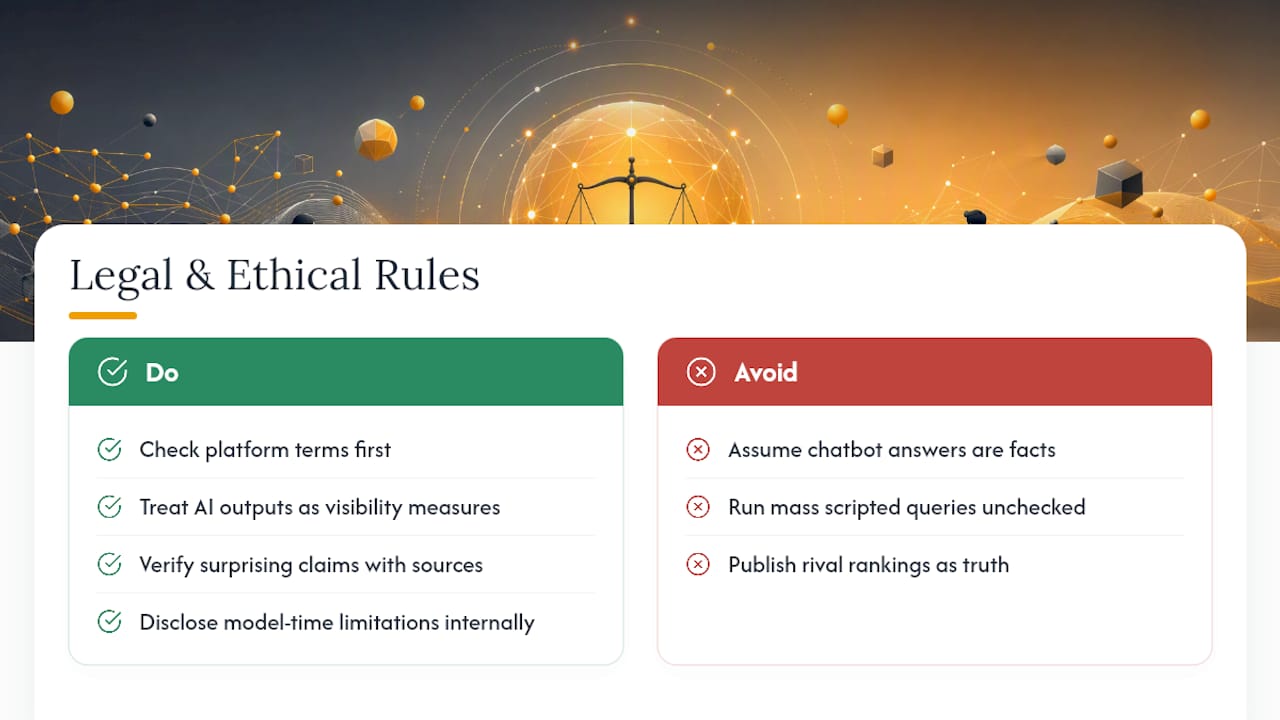
Querying AI models about competitors sits in a different gray zone than scraping a competitor's website directly, but it isn't consequence-free. The prompts and responses you generate belong to you under most platform terms of service, since you're the one submitting the query, not extracting proprietary competitor data. Still, each platform, OpenAI, Google, Anthropic, and Perplexity among them, sets its own usage terms governing automated or high-volume querying, and running thousands of scripted prompts without checking those terms can violate a platform's acceptable use policy even when the intent is legitimate research.
Ethically, the bigger issue is representation. An AI model's answer is a probabilistic output, not a verified fact, and treating a single chatbot response as settled truth about a competitor's market position, customer sentiment, or product quality is a mistake. Present AI SOV findings as a measurement of visibility and framing within AI answers, specifically, not as an objective ranking of who is actually "better." That distinction matters if you ever publish competitive comparisons externally, where implying a factual claim about a rival based on a chatbot's phrasing could raise defamation or unfair competition concerns depending on your jurisdiction.
Finally, treat AI-generated competitive data the way you'd treat any market research: verify surprising claims against primary sources before acting on them, and disclose to internal stakeholders that the data reflects model behavior at a point in time, since retrieval and citation patterns are still an active area of research and will keep shifting.
Why Repeatable Measurement Beats a One-Time AI Check
Most teams treat their first ChatGPT query about their brand as a finding. It's a data point, and a shaky one. The real signal only shows up after you run the same prompts, against the same competitors, on a schedule long enough to separate a trend from a fluke.
The most common failure isn't technical. It's ownership. SOV data sitting in one marketer's spreadsheet dies the moment that person moves teams. Get a stakeholder from SEO, brand, and product to agree on the prompt set before you run it once.
Start small: ten prompts, three platforms, one competitor set. Expand once the workflow is boring, not before.
— Geraldine
Start Measuring Your AI Visibility Today
Reading about prompt sets and citation tracking is one thing. Actually running a multi-model audit against named competitors, on a schedule, with a real score attached, is another. That's the gap AuthorityLayer's Starter Plan closes for $99 a month: repeatable prompt tracking, competitor benchmarking, and an AI Authority Index score you can defend in a leadership meeting, without hiring an analyst to paste prompts into five different chat windows every week.
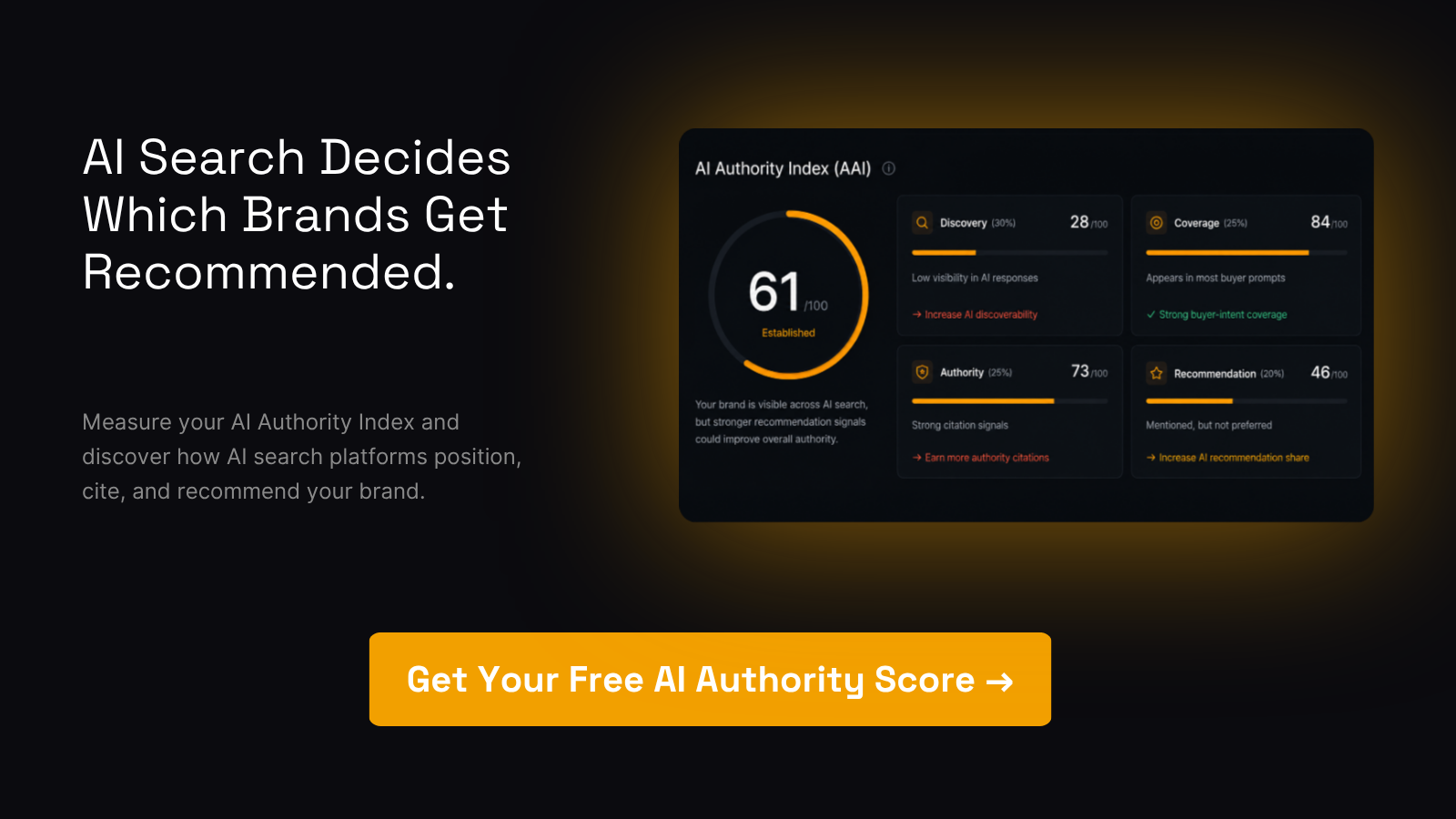
If you want a baseline before committing to anything, start with the Free AI Visibility Scan. It gives you a first read on where your brand stands against competitors across major AI platforms, no subscription required. Teams that need more prompt volume or multi-brand tracking can step up to Growth or Enterprise, and anyone who just needs a recurring executive summary without full dashboard access can subscribe to the Monthly AI Visibility Report for $59 a month. Run the scan first, review where the gaps sit, then pilot the plan that matches your prompt volume.
Sources
FAQ
How Do You Calculate Your AI Share of Voice?
Divide your brand's mentions across a fixed prompt set by total brand mentions in the same set, then multiply by 100. Run the calculation per platform and again as an aggregate across all tracked models.
What Counts as a Good AI SOV Percentage?
There's no universal target since it depends on how many real competitors occupy your category.
What Does a 50% Share of Voice Actually Mean?
It means your brand accounts for half of all brand mentions across your tracked prompts and platforms. That's a dominant position in most categories, though its significance still depends on how many competitors you're measuring against.
What's the Difference Between Market Share and Share of Voice?
Market share measures actual revenue or unit sales relative to competitors, based on real transactions. Share of voice, including AI SOV, measures how often you show up in the conversation, in ads, search, or AI-generated answers, which often moves before market share does.
How Many Prompts Do You Need for a Reliable AI SOV Audit?
Most practitioners recommend a minimum of 20 to 30 prompts spanning comparison, recommendation, and problem-solving intent to avoid results skewed by a handful of oddly phrased queries. Manual tracking gets difficult to sustain past that volume, which is why most teams eventually automate the process with a platform like AuthorityLayer.