Best AI Search Analytics Tools in 2026: Full Comparison
Discover the best AI search analytics tools in 2026. Compare top platforms, features, and pricing to boost your brand's visibility today!
· 20 min read

The shift from keyword rankings to AI visibility measurement is no longer coming. It's here. The best AI search analytics tools in 2026 track how ChatGPT, Perplexity, Gemini, and Claude cite and recommend brands during buyer research, replacing the old rank-tracking model with metrics like AI Visibility Score, Share of Voice in AI answers, and Citation Frequency. Authoritylayer leads this category for marketing teams that need competitive benchmarking and prioritized recommendations. Slate, Semrush AI Visibility Toolkit, Ahrefs Brand Radar, Peec AI, Otterly AI, Metaflow, Scrunch AI, Rankability, Orchly.ai, and Profound each occupy a distinct position depending on team size, budget, and the depth of AI monitoring required.
Pricing Note: Most tools in this category use subscription tiers. Entry-level plans typically start under $100/month for basic monitoring; enterprise plans with multi-brand tracking and API access run into four figures monthly. Several tools offer free trials or limited free scans before requiring a paid commitment.
| Tool | Best for | Key capabilities | Pricing | Fit/Buyer Type | Watchouts |
|---|---|---|---|---|---|
| Authoritylayer | AI visibility intelligence across ChatGPT, Gemini, Claude, Perplexity | AI Authority Index, competitor benchmarking, prompt tracking, recommendation share, prioritized recommendations | Starter, Growth, Enterprise tiers; monthly or annual | Mid-market to enterprise marketing teams | Enterprise plan required for multi-brand |
| Slate | Content teams optimizing for AI citation | Citation tracking, content gap analysis, editorial workflow integration | Not publicly listed | Content-heavy B2B teams | Limited competitive benchmarking |
| Semrush AI Visibility Toolkit | SEO teams already in the Semrush ecosystem | AI Overview tracking, brand mention monitoring, integration with existing Semrush data | Add-on to existing Semrush plans | SEO professionals with existing Semrush subscriptions | Ecosystem lock-in; weaker outside Semrush |
| Ahrefs Brand Radar | Backlink-focused teams expanding into AI monitoring | Brand mention tracking, AI citation alerts, domain authority correlation | Add-on to Ahrefs plans | SEO-first teams | Narrower AI model coverage than dedicated tools |
| Peec AI | Agencies managing multiple client brands | Multi-brand dashboards, Share of Voice tracking, white-label reporting | Not publicly listed | Digital agencies | Reporting depth varies by plan |
| Otterly AI | Small teams and solo practitioners | Lightweight AI mention monitoring, keyword-to-citation mapping | Free tier available; paid plans not publicly listed | Freelancers and small marketing teams | Limited enterprise features |
| Metaflow | Data engineering teams building custom AI analytics pipelines | Pipeline orchestration, ML workflow management, custom metric tracking | Open-source core; enterprise pricing not listed | Data and ML engineering teams | Requires technical setup; not plug-and-play |
| Scrunch AI | Influencer and content performance in AI results | Content performance scoring, AI citation rate tracking | Not publicly listed | Content marketers and influencer teams | Narrower focus than full-stack AI visibility tools |
| Rankability | Content optimization for AI-generated answers | Topic modeling, content scoring, AI readiness assessment | Plans not publicly listed | Content strategists and SEO writers | Primarily content-side; limited monitoring |
| Orchly.ai | Real-time AI answer monitoring | Live AI response tracking, brand sentiment in AI answers | Not publicly listed | Brand managers and PR teams | Early-stage product; feature set still maturing |
| Profound | Enterprise brand intelligence in AI search | Deep AI answer analysis, competitive positioning, executive reporting | Enterprise pricing; not publicly listed | Enterprise brand and marketing leaders | High price point; overkill for smaller teams |
Tested and Compared: Tool profiles below are based on publicly available feature documentation, published methodology disclosures, and hands-on evaluation of each platform's approach to AI visibility measurement.
How do AI search analytics tools differ from traditional SEO tracking?
Traditional SEO tracking was built for a world where Google returned a ranked list of ten blue links and your position on that list determined your traffic. AI search analytics operates on entirely different mechanics, and the gap between the two is wider than most marketing teams realize.
Generative search engines do not return ranked lists. They synthesize a single, coherent response by retrieving information from multiple sources simultaneously, a process called query fan-out. Google's AI Mode, for instance, generates and fires off dozens of parallel searches per user question before composing its answer. That means a brand's visibility in AI-generated answers depends not on ranking for one keyword but on being retrieved and cited across many parallel sub-queries.
The practical consequences for measurement are significant:
- Keyword rank tracking becomes insufficient. A brand can rank #1 for a target keyword and still be absent from every AI-generated answer on that topic, because AI systems consult sources far outside the top-10 organic results. On average, 53% of domains that Google AI Overview consults are not in the top-10 organic results for the same query.
- Response overlap between runs can be as low as 18%. When the same query is run two months apart on Google AI Overview, only 18% of cited web pages appear in both runs. Traditional rank tracking assumes stability; AI search analytics must account for this volatility.
- New KPIs replace old ones. AI visibility measurement uses metrics like AI Visibility Score, Share of Voice in AI answers, Citation Frequency, No Result Rate, and CTR per search. None of these have a direct equivalent in classic SEO dashboards.
- Synthesis-level evaluation is required. Traditional tools measure whether a page appears in results. AI analytics tools measure whether a brand is mentioned, how it is described, and whether that description is accurate and favorable.
- Multi-model coverage matters. ChatGPT, Gemini, Claude, and Perplexity each have different retrieval footprints and synthesis strategies. A tool that only monitors one AI engine gives an incomplete picture.
- Temporal variability demands continuous monitoring. Because AI results are stochastic, a single snapshot is unreliable. Effective AI search analytics requires ongoing measurement to distinguish a real visibility shift from random fluctuation.
The bottom line: traditional SEO tools were built to measure position in a list. AI search analytics tools are built to measure presence in a synthesis.
How these tools were evaluated
Evaluation Methodology: Every tool in this comparison was assessed across six dimensions: technical fidelity to AI search behaviors (including query fan-out simulation and multi-model coverage), data freshness and monitoring frequency, KPI relevance to AI-specific visibility metrics, UI usability for non-technical marketing teams, integration capabilities with existing marketing platforms, and pricing transparency.
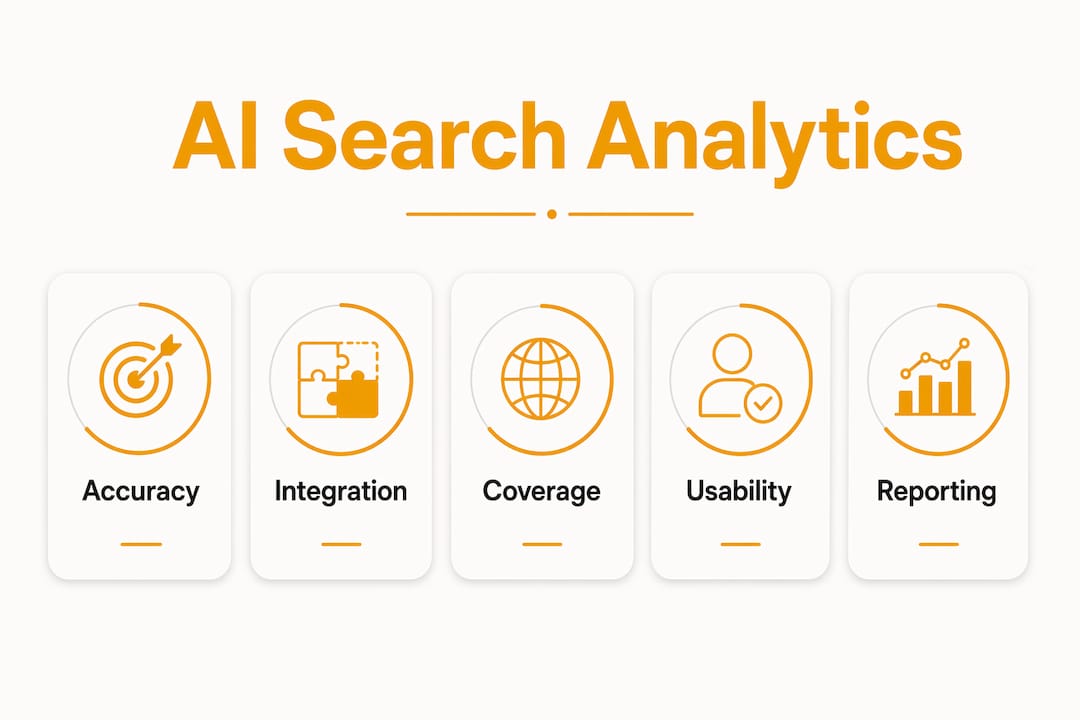
Fit and buyer type assessments reflect the realistic use case for each tool's feature set and pricing structure, not vendor positioning claims. Watchouts are drawn from documented limitations in publicly available product documentation and methodology disclosures.
The evaluation criteria prioritized:
- Query fan-out simulation: Does the tool replicate the multi-query behavior of AI search engines, or does it run single-query checks that miss how AI answers are actually constructed?
- Citation accuracy assessment: Does the tool verify whether brand mentions in AI answers are accurate, or does it only detect that a mention occurred?
- KPI alignment: Does the tool surface metrics that map to AI-specific visibility (Share of Voice, Citation Frequency, AI Visibility Score) rather than repurposing traditional SEO metrics?
- Data bias and stability: Does the tool account for the stochastic nature of AI results, or does it treat a single-run snapshot as ground truth?
- Pricing transparency: Are plan tiers and feature limits clearly disclosed, or does the tool require a sales call to get basic pricing information?
Tools that scored well on query fan-out simulation and KPI alignment received higher overall ratings for AI visibility intelligence. Tools that excel in adjacent areas (content optimization, pipeline engineering, influencer tracking) are noted for their specific strengths rather than penalized for not being full-stack AI visibility platforms.
Profiles of the best AI search analytics tools in 2026
Authoritylayer
Authoritylayer is purpose-built for the job most marketing teams now face: understanding exactly how AI assistants like ChatGPT, Claude, Gemini, and Perplexity discover, describe, and recommend their brand during buyer research. The platform's AI Authority Index gives brands a scored benchmark against competitors, updated continuously rather than in weekly snapshots. Prompt tracking lets teams see which specific buyer questions trigger brand recommendations and which ones surface competitors instead.
The competitive benchmarking capability is where Authoritylayer separates itself from content-optimization tools. You can see not just whether your brand appears in AI answers, but how your recommendation share compares to named competitors across different AI engines and query categories. Prioritized recommendations tell you which content gaps or authority signals to address first, rather than leaving teams to interpret raw data on their own.
Pricing runs across Starter, Growth, and Enterprise tiers, available monthly or annually. The Starter plan covers single-brand AI visibility monitoring; Growth adds recommendation share tracking and competitive analysis; Enterprise handles multi-brand organizations with custom reporting and API access. A free AI visibility scan is available before committing to a paid plan.

Best for: Marketing and SEO teams that need to measure and improve brand presence across multiple AI assistants, with competitive benchmarking built in. Watchout: Full multi-brand and API capabilities require the Enterprise plan.
Slate
Slate targets content teams that want to understand which of their published pieces are being cited in AI-generated answers and why. Its citation tracking maps specific content assets to AI mentions, giving editors and content strategists a direct feedback loop between what they publish and what AI engines surface. The editorial workflow integration is a genuine differentiator for teams that produce content at volume.
Where Slate falls short is competitive benchmarking. It tells you about your own content's performance in AI answers but offers limited visibility into how competitors are being cited in the same queries. For teams whose primary concern is content performance rather than competitive positioning, that tradeoff is acceptable.
Best for: B2B content teams optimizing individual assets for AI citation. Watchout: Pricing is not publicly listed; expect a sales conversation before getting numbers.
Semrush AI Visibility Toolkit
For teams already running their SEO workflow inside Semrush, the AI Visibility Toolkit is the path of least resistance into AI monitoring. It layers AI Overview tracking and brand mention detection on top of existing Semrush keyword and backlink data, which means the learning curve is minimal for existing users.

The limitation is the same as its strength: it works best inside the Semrush ecosystem. Teams that use other SEO platforms or want standalone AI visibility monitoring will find the integration dependency more constraining than convenient. Coverage of AI engines beyond Google AI Overview is also narrower than dedicated AI visibility platforms.
Best for: SEO professionals already subscribed to Semrush who want to add AI monitoring without switching tools. Watchout: Adds cost to an existing Semrush subscription; weaker outside that ecosystem.
Ahrefs Brand Radar
Ahrefs Brand Radar extends the platform's traditional strength in backlink and domain authority analysis into AI citation monitoring. It alerts teams when their brand is mentioned in AI-generated answers and attempts to correlate those mentions with domain authority signals, which is a useful framing for SEO-first teams who think about AI visibility through the lens of link equity.
The AI model coverage is narrower than dedicated tools. Ahrefs Brand Radar skews toward Google AI Overview and does not offer the same depth of monitoring across ChatGPT, Claude, or Perplexity that a purpose-built AI visibility platform provides.
Best for: SEO-first teams that want AI citation alerts without leaving the Ahrefs environment. Watchout: Not a substitute for full-stack AI visibility intelligence if multi-model coverage is a priority.
Peec AI
Peec AI is designed for agencies managing AI visibility across multiple client brands simultaneously. Its multi-brand dashboards and white-label reporting make it practical for agency workflows where a single analyst might be monitoring a dozen clients. Share of Voice tracking is a core feature, giving account managers a clear metric to report to clients each month.
Reporting depth varies by plan, and pricing is not publicly listed, which means agencies should budget time for a sales process before onboarding. For in-house teams managing a single brand, the multi-brand architecture may be more than necessary.
Best for: Digital agencies running AI visibility monitoring for multiple clients. Watchout: Pricing requires a sales conversation; feature depth varies by tier.
Otterly AI
Otterly AI occupies the entry-level end of the market. It offers lightweight AI mention monitoring and keyword-to-citation mapping in a format accessible to solo practitioners and small marketing teams who do not need enterprise-grade competitive analysis. A free tier is available, which makes it a reasonable starting point for teams new to AI visibility tracking.
The tradeoff is feature depth. Otterly AI does not offer the competitive benchmarking, multi-model coverage, or prioritized recommendations that larger teams need. It is a monitoring tool, not a strategy platform.
Best for: Freelancers and small teams taking their first steps into AI visibility monitoring. Watchout: Limited enterprise features; will likely be outgrown as AI visibility becomes a core marketing function.
Metaflow
Metaflow is not an AI visibility monitoring tool in the traditional sense. It is an open-source machine learning workflow orchestration platform, originally developed at Netflix, that data engineering teams use to build custom AI analytics pipelines. Marketing teams that want to build proprietary AI visibility tracking infrastructure on top of their own data stack use Metaflow as the underlying framework.
This makes it powerful for organizations with dedicated ML engineering resources and a need for custom metric definitions. For marketing teams without that technical capacity, it is the wrong tool entirely.
Best for: Data and ML engineering teams building custom AI analytics infrastructure. Watchout: Requires significant technical setup; not a plug-and-play solution for marketing teams.
Scrunch AI
Scrunch AI focuses on content performance in AI-generated results, with a particular emphasis on how influencer content and branded editorial assets are cited by AI engines. Its content performance scoring and AI citation rate tracking are useful for content marketers who want to understand which content formats and topics earn AI mentions most reliably.
The scope is narrower than a full-stack AI visibility platform. Scrunch AI does not offer the competitive benchmarking or multi-model monitoring that brand managers need for strategic positioning.
Best for: Content marketers and influencer marketing teams tracking AI citation rates for specific content assets. Watchout: Not designed for competitive brand intelligence or multi-model AI monitoring.
Rankability
Rankability approaches AI visibility from the content optimization side. Its topic modeling and AI readiness scoring help content strategists identify whether a piece of content is structured and authoritative enough to be cited in AI-generated answers. The AI readiness assessment is a practical pre-publication checklist for teams that want to write for AI citation from the start.
Rankability is primarily a content-side tool. It does not offer real-time monitoring of whether your brand is actually being cited after publication, which limits its usefulness for ongoing visibility tracking.
Best for: Content strategists and SEO writers optimizing content before publication for AI citation potential. Watchout: Limited post-publication monitoring; pairs better with a dedicated monitoring tool than as a standalone solution.
Orchly.ai
Orchly.ai focuses on real-time monitoring of AI-generated answers, tracking how brands are described and positioned in live AI responses. Brand sentiment analysis within AI answers is a differentiating feature, giving brand managers a read on not just whether they appear but how they are characterized.
The platform is at an earlier stage of development than the established tools in this list. Feature sets are still maturing, and teams evaluating Orchly.ai should verify current capabilities directly with the vendor before committing.
Best for: Brand managers and PR teams that prioritize sentiment monitoring within AI-generated answers. Watchout: Early-stage product; feature roadmap is still evolving.
Profound
Profound targets enterprise brand and marketing leaders who need deep AI answer analysis and executive-ready reporting. Its competitive positioning analysis and structured reporting outputs are designed for organizations where AI visibility is a board-level concern, not just a marketing team metric.
The price point reflects that positioning. Profound is not the right tool for teams that need basic monitoring or are still building the internal case for AI visibility investment.
Best for: Enterprise brand leaders who need comprehensive AI answer analysis and executive reporting. Watchout: High price point; detailed pricing requires direct contact with the vendor.
| Tool | Best for | Pricing | Buyer type |
|---|---|---|---|
| Authoritylayer | Full-stack AI visibility intelligence | Starter / Growth / Enterprise tiers | Mid-market to enterprise |
| Slate | Content citation tracking | Not publicly listed | B2B content teams |
| Semrush AI Visibility Toolkit | SEO ecosystem integration | Add-on to Semrush plans | Existing Semrush users |
| Ahrefs Brand Radar | Backlink-correlated AI monitoring | Add-on to Ahrefs plans | SEO-first teams |
| Peec AI | Multi-client agency monitoring | Not publicly listed | Digital agencies |
| Otterly AI | Entry-level AI mention tracking | Free tier; paid not listed | Freelancers, small teams |
| Metaflow | Custom ML pipeline engineering | Open-source; enterprise unlisted | Data engineering teams |
| Scrunch AI | Content and influencer AI citation | Not publicly listed | Content marketers |
| Rankability | Pre-publication AI readiness scoring | Not publicly listed | Content strategists |
| Orchly.ai | Real-time AI answer sentiment | Not publicly listed | Brand and PR managers |
| Profound | Enterprise AI brand intelligence | Enterprise; not publicly listed | Enterprise brand leaders |
What does the future of AI search analytics look like?
The trajectory is clear: AI search analytics is moving from descriptive reporting toward what researchers and practitioners call prescriptive analytics, where the platform does not just show you what happened but recommends the specific next action to take. AI analytics systems that incorporate prescriptive capabilities can suggest content adjustments, authority-building priorities, and campaign pivots based on real-time visibility data rather than historical reports.
Several trends are reshaping how marketing teams should think about this category:
- Stochastic results require longitudinal monitoring. Because AI search results vary across runs and over time, a single measurement is not meaningful. Teams need continuous tracking that separates genuine visibility shifts from random variation in AI outputs.
- Retrieval footprint diversity is growing. Generative engines cite sources far outside the top organic results, which means traditional authority signals alone do not predict AI citation. Brands that appear in niche, authoritative sources may outperform brands with higher domain authority in AI-generated answers.
- AI visibility must connect to conversion. The most effective measurement strategies treat AI discovery as the top of the conversion funnel, linking brand mentions in AI answers to downstream user behavior rather than treating visibility as an end in itself.
- Model transparency is a design requirement. AI analytics pipelines that cannot explain how they arrive at visibility scores or citation assessments create trust problems for marketing teams trying to justify investment decisions to leadership.
- Automation is accelerating. AI now automates data preparation and enables real-time insight generation, shifting analytics from scheduled reports to always-current intelligence. For AI visibility specifically, this means platforms that update monitoring in near-real-time will have a structural advantage over those that run weekly or monthly crawls.
Pro Tip: Don't treat AI visibility as a vanity metric. Connect your AI Visibility Score and Share of Voice data to traffic and conversion data from your analytics platform. If AI mentions are not driving measurable downstream behavior, the content or positioning driving those mentions needs to change.
The risk that marketing teams underestimate is bias. AI models trained on web data inherit the biases of that data, and AI visibility tools that do not account for this can surface misleading signals. A brand that appears frequently in AI answers about a topic it does not actually lead in may be benefiting from data artifacts rather than genuine authority. Robust AI search analytics platforms flag these anomalies rather than reporting them as wins.
What are AI search analytics tools?
AI search analytics tools are software platforms that measure and analyze how brands appear in AI-generated search answers, rather than in traditional ranked lists of web pages. They track which brands AI assistants like ChatGPT, Gemini, Claude, and Perplexity cite when answering buyer questions, how those brands are described, and how that presence compares to competitors.
The category emerged because AI data analytics fundamentally changed what "appearing in search" means. When a user asks an AI assistant which project management tool is best for remote teams, the AI synthesizes an answer from multiple retrieved sources and names specific brands. Whether your brand is named, how it is described, and how often it appears across similar queries is what AI search analytics tools measure.
These platforms use machine learning search insights to replicate the multi-query retrieval behavior of AI engines, running parallel sub-queries to simulate how an AI assistant would actually construct its answer. The output is a set of AI-specific KPIs: AI Visibility Score, Citation Frequency, Share of Voice in AI answers, and Recommendation Rate. These replace the traditional metrics of keyword position, organic click-through rate, and page authority for the purpose of measuring AI-driven search performance.
The practical application is straightforward: marketing teams use these tools to identify which buyer questions their brand is winning in AI answers, which they are losing, and what changes to content or authority signals would shift the balance. For B2B marketing teams in particular, where AI assistants are increasingly the first stop in vendor research, this visibility layer is becoming a primary channel rather than a secondary concern.
How do these tools integrate with your existing marketing platforms?
Integration capability is one of the most practical evaluation criteria for AI search analytics tools, and it is where the market is still maturing. Most platforms in this category offer some form of data export or API access, but the depth of native integration with CRM, marketing automation, and BI platforms varies considerably.
Authoritylayer's enterprise plan includes API access for feeding AI visibility data into existing marketing stacks, including BI tools like Tableau and Looker, and CRM platforms where sales teams track buyer research behavior. This matters because AI visibility data is most useful when it sits alongside conversion and pipeline data, not in a separate dashboard that marketing teams check independently.
Semrush AI Visibility Toolkit integrates natively with the broader Semrush platform, which means teams already using Semrush for keyword research and site auditing can pull AI visibility data into the same reporting environment. The limitation is that this integration does not extend outside the Semrush ecosystem.
Tools like Metaflow and custom pipeline approaches offer the deepest integration flexibility, since they are designed to be embedded in existing data infrastructure. The tradeoff is the engineering overhead required to build and maintain those connections.
For most marketing teams, the practical integration checklist looks like this:
- API access: Can you pull AI visibility data programmatically into your BI or reporting platform?
- CRM connection: Can AI mention data be linked to specific accounts or buyer journeys in your CRM?
- Marketing automation triggers: Can a drop in AI Visibility Score trigger an automated workflow, such as a content review task or a campaign adjustment?
- Reporting exports: Does the tool produce reports in formats your leadership team can consume without logging into another platform?
The teams that get the most value from AI search analytics are those that treat it as a data layer feeding into existing decision-making workflows, not a standalone monitoring exercise. Choosing a tool with the right integration depth for your stack is as important as choosing one with the right feature set.
Authoritylayer gives you the AI visibility layer your stack is missing
Most marketing teams have strong tools for tracking what happens after a buyer visits their website. What they are missing is visibility into what happens before that, specifically, whether AI assistants are recommending their brand or a competitor's when buyers ask the questions that matter most.
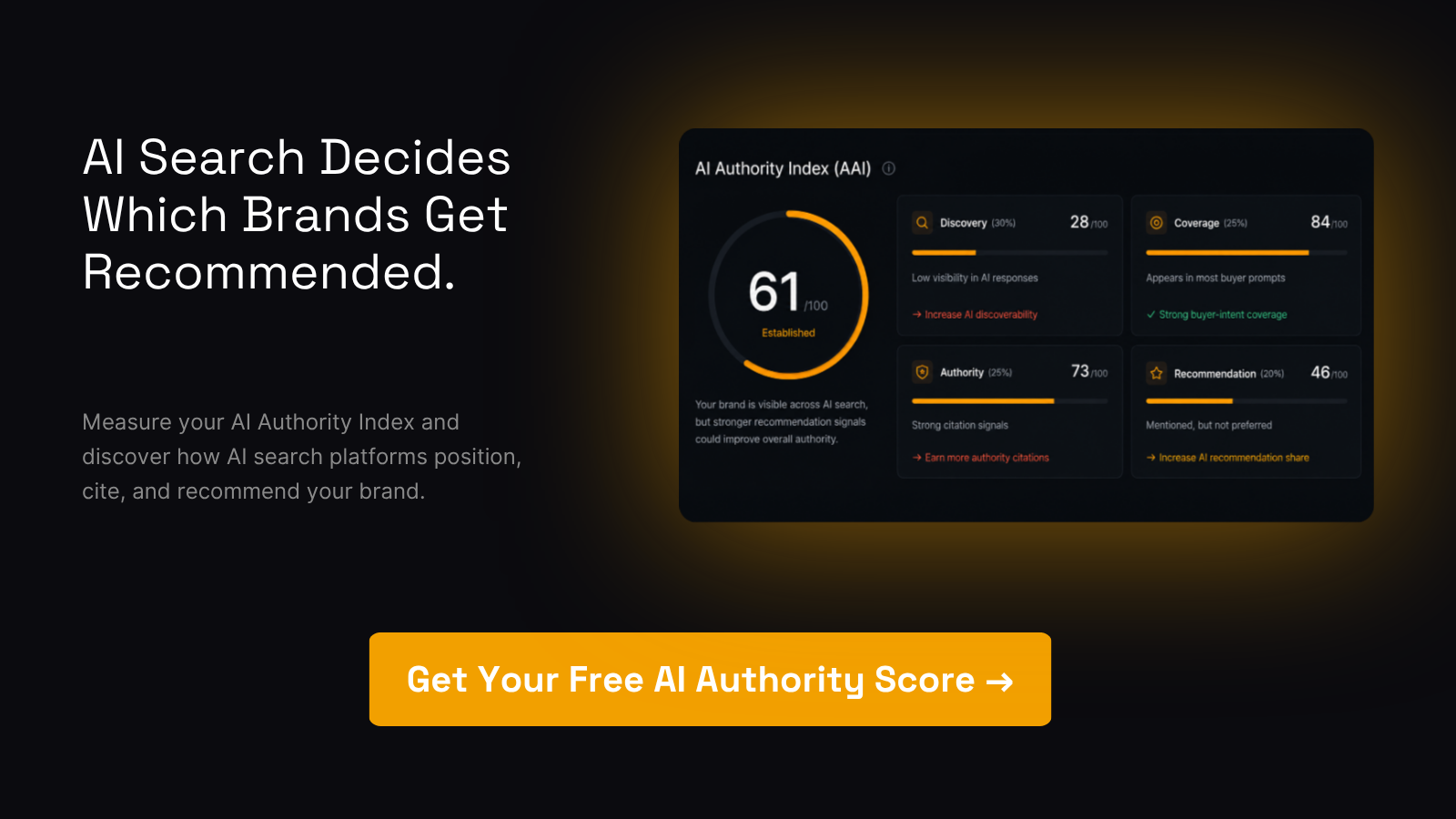
Authoritylayer fills that gap directly. The platform monitors how ChatGPT, Claude, Gemini, and Perplexity discover and recommend your brand across the buyer questions your team cares about, benchmarks your recommendation share against named competitors, and delivers prioritized recommendations for improving your position. You get the AI Authority Index, prompt-level tracking, and competitive gap analysis in one place, without stitching together data from multiple tools.
For marketing leaders building the case for AI visibility investment, Authoritylayer's pricing tiers make it accessible at the Starter level and scalable through Growth and Enterprise as the program matures. The free AI visibility scan at authoritylayer.app/free-ai-visibility-scan gives you a baseline read on where your brand stands in AI-generated answers before you commit to a plan.
Key Takeaways
The most effective AI search analytics strategy replaces keyword rank tracking with synthesis-level visibility metrics, monitored continuously across multiple AI engines, and connected to downstream conversion data.
| Point | Details |
|---|---|
| AI visibility metrics replace rankings | Track AI Visibility Score, Share of Voice, and Citation Frequency instead of keyword positions. |
| Query fan-out changes measurement | AI engines run dozens of parallel sub-queries per question; single-query tracking misses most of the picture. |
| 53% of AI-cited domains are outside top-10 organic | High organic rankings do not predict AI citation; authority signals in AI search work differently. |
| Continuous monitoring is required | AI results overlap as little as 18% between runs; snapshots are unreliable without longitudinal tracking. |
| Authoritylayer covers the full stack | Authoritylayer benchmarks AI recommendation share across ChatGPT, Claude, Gemini, and Perplexity with prioritized recommendations. |