2x Discovery Advantage: Measure AI Visibility by Stage for CMOs
CMOs: AI drives discovery about 2x more than search but completes only 8% of purchases. Use a stage by stage measurement playbook to prove AI's impact.
· 22 min read

AI leads discovery and evaluation, then loses its grip as buyers get closer to checkout. At the discovery stage, AI-driven traffic outpaces search by roughly 2:1 to 2.6:1, but by the time a purchase happens, search and AI arrive at near parity. The practical takeaway: optimize the signals that shape AI's shortlist and evaluation, then measure discovery, evaluation, and purchase as three separate performance lines, not one blended funnel.
TL;DR:
- AI-driven traffic is significantly higher at discovery, but by purchase, search and AI traffic levels become nearly equal, making stage-specific measurement essential.
- Most consumers verify AI recommendations through branded searches, reviews, and detailed visitations to brand sites, meaning brands must optimize for each verification touchpoint.
- Structured data, third-party reviews, transparent explanations, and open crawl access are critical signals that improve AI citation and recommendation from assistants.
- Different AI platforms rely on distinct signals: stand-alone models favor earned media and citation sources, while search-embedded assistants depend on structured data and SEO fundamentals.
- Consistent, stage-specific monitoring and flexible content optimization, especially for structured data and transparency, are vital to maintaining and growing AI visibility over time.
Table of Contents
- How AI Visibility Changes From Discovery to Purchase
- What Makes Brands Visible to AI Assistants
- Platform Differences and the Rise of Agentic Commerce
- The Attribution Gap and the New Metrics You Need
- A Stage-by-Stage Playbook for Discovery, Evaluation, and Purchase
- How to Measure AI Visibility Over Time
- How Privacy Rules Are Reshaping AI Visibility
- User Intent Versus AI Interpretation: Who's Really in Control
- Mobile Versus Desktop: Does AI Visibility Differ by Device?
- How AI Personalization Reshapes Each Funnel Stage
- Why Brands Struggle to Adapt Content for AI Platforms
- What Comes After Purchase: AI's Next Frontier
- What CMOs Should Actually Prioritize Right Now
- See Your Brand's AI Visibility With a Monthly Report
- Sources
- FAQ
How AI Visibility Changes From Discovery to Purchase
The shift is not uniform across the buyer journey, and treating it as one smooth curve is the biggest measurement mistake marketing teams make right now. At discovery, AI-driven traffic captures a substantially larger share of activity compared to traditional search, according to Similarweb's analysis of the AI consumer journey. That gap holds through evaluation, where consumers lean on AI to narrow ten or twelve options down to three. By purchase, the numbers close to parity between AI and search traffic.
That narrowing is not AI losing relevance. It is AI handing off the decision at the exact moment humans want to verify it themselves.
L.E.K. Consulting's research on AI and shopping behavior found that only about 8% of users complete a purchase entirely inside an AI agent. This single fact should reshape how marketing leaders think about "AI visibility." It is not a checkout channel yet. It is a pre-checkout filter that determines which brands even get a fair look during verification.
What does that verification behavior actually involve? A buyer who gets a product recommendation from ChatGPT or Perplexity typically does one or more of the following before paying:
- Runs a branded search to confirm the AI's claim ("is Brand X actually good for sensitive skin")
- Checks star ratings and review volume on the retailer or marketplace page
- Compares the AI's shortlist against a second AI query or a comparison site
- Reads at least one detailed, explanatory review rather than just a rating
- Visits the brand's own site to check price, shipping, and return policy
Every one of those actions is a visibility moment your brand either wins or loses. If your product page contradicts what the AI said, or worse, doesn't load fast enough to confirm it, you lose a buyer who was already leaning your way.
There's a second effect marketing leaders underestimate: visitors who arrive after an AI mention behave differently once they land. L.E.K.'s research on post-AI site behavior shows these visitors arrive further along in their decision, with narrower questions and less patience for generic marketing copy. They already know roughly what they want. They're checking specifics: exact dimensions, ingredient lists, warranty terms, return windows. A homepage built to "tell your brand story" fails these visitors. A product page built to answer their last three questions wins them.
This changes what "good" looks like at each funnel stage. Discovery success now means showing up in the AI's initial answer set. Evaluation success means surviving the comparison the AI just ran on your behalf, invisibly, before the shopper ever typed a word to you directly. Purchase success still depends on classic conversion mechanics, but with less room for friction, because the AI already did the persuading. Brands that measure these as one combined "traffic" number miss which stage is actually broken.
What Makes Brands Visible to AI Assistants
AI assistants don't reward the same things search engines rewarded for two decades. They reward whatever they can extract, verify, and quote with confidence. That means the signals worth prioritizing look different from a classic SEO checklist.
- Structured product and content metadata. Schema markup, normalized product feeds, and consistent attribute naming (size, material, compatibility, ingredients) give AI systems something they can parse without guessing. A product description written as flowing prose, with no structured attributes behind it, is much harder for a language model to extract cleanly and cite with confidence.
- Third-party citations and authentic explanatory reviews. NIQ's research on agentic commerce found that large language models weight detailed, explanatory reviews and outside mentions more heavily than a five-star average alone. A review that explains why a product worked for a specific use case gives the model language it can reuse in its own answer. A bare star rating gives it nothing to quote.
- Open crawl access. Brands blocking AI crawlers, whether by accident through an overzealous robots.txt file or on purpose out of caution, are opting out of citation entirely. Similarweb's findings show that brands earning consistent AI mentions share a pattern of structured, extractable content paired with open access for crawlers.
- Need-state language. Content written to answer the question a buyer is actually asking ("best running shoe for flat feet and heavy mileage") outperforms content written to rank for a keyword. AI assistants are built to match intent to answer, not to match keyword to page.
Content depth and machine readability now matter more than persuasive copywriting. A page full of brand adjectives and no specifications gives an AI model nothing to cite. A page with exact measurements, ingredient percentages, compatibility tables, and honest limitations gives it plenty. Babylovegrowth's guide to optimizing content for AI search makes a similar point: extractable structure now competes directly with narrative flair for ranking influence, and structure is winning more often.
Pro Tip: Audit your top 20 product pages for one thing only: could a language model lift three factual, specific sentences from this page without inventing anything? If the honest answer is no, that page is invisible to AI regardless of how well it ranks in classic search.
Platform Differences and the Rise of Agentic Commerce
Not every AI surface behaves the same way, and treating ChatGPT, Perplexity, Gemini, and a retailer's embedded assistant as one undifferentiated channel wastes budget on the wrong signals.
Stand-alone large language models like ChatGPT and Claude lean heavily on training data, live web citations, and third-party sources when they don't have direct commerce integrations. Getting cited there depends on your brand showing up in the sources these models trust: review sites, comparison articles, forums, and structured web content. Search-embedded assistants, like Gemini surfaced inside Google search or Perplexity's search-first interface, blend live web results with generative synthesis, which puts more weight on classic technical SEO fundamentals plus structured data working together. Retailer-native agents, such as shopping assistants built into a marketplace, rely almost entirely on the product feed itself: attributes, inventory status, price, and review data submitted directly to that platform.
That distinction drives real budget decisions:
- If your buyers research heavily on stand-alone chat assistants, invest in earned media, comparison content, and third-party review presence.
- If your category gets discovered through search-embedded AI, prioritize structured data and technical SEO fundamentals together, since these assistants pull from indexed web content.
- If your category sells primarily through marketplaces, feed quality and attribute completeness matter more than any article you could publish.
Agentic commerce, meaning AI systems that can complete purchases on a shopper's behalf, is still early but moving fast. Yale Insights' review of AI shopping behavior points to partnerships like Walmart's work with OpenAI on instant checkout experiments as a signal of where this is headed. eMarketer projects that AI-platform-driven ecommerce sales are projected to reach a significant but still modest share of total ecommerce sales by 2029. That's meaningful, not dominant. The categories most likely to see agentic commerce first are repeat, low-consideration purchases: household staples, subscription refills, and commodity electronics accessories, where trust is already established and the decision doesn't require much deliberation. High-consideration categories, like furniture or anything with fit and sizing risk, will likely stay human-verified for years.
The Attribution Gap and the New Metrics You Need
Here's the problem with last-click attribution in an AI-mediated funnel: it credits whichever channel closed the sale, and by design, that's rarely AI. A buyer who got recommended a product by ChatGPT, then searched the brand name, then clicked a paid ad, gets recorded as a paid-search conversion. The AI mention that actually created the intent disappears from the data entirely.
This is the attribution gap, and it's already large enough to distort budget decisions at most companies. Marketing teams cutting "underperforming" upper-funnel content because it shows no direct conversions may be quietly starving the exact content that's driving AI citations, and therefore driving the branded search spikes getting credited to paid media instead.
The metrics that close this gap:
- Mention or citation share: how often your brand appears in AI answers for category-relevant prompts, relative to competitors.
- AI recommendation share: a narrower cut of citation share, tracking not just mentions but active recommendations.
- AI Authority Index: a composite score blending citation frequency, reasoning transparency, and third-party corroboration into one comparable number over time.
- Prompt-level mapping: tracking which specific queries trigger a mention, so you know exactly which content or product attribute earned the citation.
Consumer appetite for this kind of transparency is well documented. Ipsos found that 67 to 71% of consumers use or would consider AI for research and comparison, but only about 9% currently trust AI enough to let it complete a purchase autonomously. More tellingly, a majority of consumers say they want to see the AI's reasoning every time it makes a recommendation, not just the recommendation itself.
That last figure matters more than it looks. It means the brands that expose why they're a good fit, structured comparisons, transparent specs, honest tradeoffs, are the ones AI models can most easily reuse to satisfy that demand for reasoning. The strongest way to close the attribution gap operationally is pairing AI mention tracking with branded search lift analysis and controlled conversion experiments, comparing cohorts exposed to an AI mention against a control group to isolate the incremental effect, an approach detailed in AuthorityLayer's research on tracking AI visibility over time.
A Stage-by-Stage Playbook for Discovery, Evaluation, and Purchase
Generic "AI optimization" advice fails because it treats the funnel as one problem. It isn't. Here's what actually changes at each stage, and what to do about it.
- Discovery: win the shortlist before the shopper types your name. Publish content written in need-state language, phrased the way a buyer would actually ask a question, not the way your SEO team wants a keyword to rank. Map the 50 to 200 prompts your buyers realistically type for your category and check which brands the AI surfaces for each one. Audit your product feed for completeness, since incomplete attributes are the single most common reason a qualified brand never makes the shortlist.
- Evaluation: give the AI facts it can trust and reuse. Structured comparison tables, explicit differentiators, and specification depth all outperform brand storytelling here. Encourage detailed, explanatory reviews over simple star ratings, since NIQ's data shows models weight the explanatory kind more heavily. If a competitor beats you on price but you beat them on durability or fit, make that tradeoff explicit and easy to extract.
- Purchase: remove every reason to hesitate after the AI already sold them. Make sure product pages confirm, rather than contradict, whatever the AI told the shopper. Show your reasoning on-site: why this size, why this material, why this price, since Ipsos's research confirms buyers actively want that transparency. Train any brand-side chat agent to answer the same questions instantly instead of routing to a form or a queue.
- Cross-stage: build the operating rhythm, not a one-time audit. Set a weekly or biweekly monitoring cadence for AI mentions across your core prompt set. Assign clear ownership: content owns the extractable copy, data/IT owns the feed quality, and marketing analytics owns the measurement. Run at least one paired experiment per quarter connecting AI visibility shifts to branded search lift, so you have evidence, not assumption, for the next budget conversation.
Pro Tip: Don't audit AI visibility once a quarter and call it done. AI models update their sources and reasoning constantly. A brand that won its category's top mention in January can lose it by March if a competitor ships a stronger comparison page or picks up a wave of detailed reviews.
How to Measure AI Visibility Over Time
Most companies discover their AI visibility problem by accident, when a sales rep mentions a prospect said "ChatGPT told me to look at your competitor." That's not a measurement system. A real one needs three components: a canonical prompt set for your category, a scoring method for mentions and reasoning transparency, and a fixed capture cadence to catch shifts before a competitor locks in an advantage, an approach outlined in AuthorityLayer's measurement methodology.
Start with the prompt set. Pull 50 to 200 realistic queries buyers in your category would actually type or speak, spanning discovery ("best CRM for a 20-person sales team"), evaluation ("compare X versus Y for enterprise reporting"), and purchase-adjacent ("is X worth the price for a mid-size company"). Score each response for whether your brand appears, whether it's recommended or merely mentioned, and whether the AI's reasoning is visible or opaque.
| Monitoring component | What it captures | Why it matters |
|---|---|---|
| Canonical prompt set | Realistic buyer queries across all three funnel stages | Prevents blind spots from testing only obvious keywords |
| Mention and recommendation scoring | Whether your brand appears, and whether it's actively recommended | Distinguishes passive mentions from real influence |
| Competitive share tracking | Your citation share versus named competitors, over time | Flags share erosion before it shows up in revenue |
| Reasoning transparency score | Whether the AI explains why it recommended your brand | Signals whether buyers get the "show your work" experience Ipsos says 57% want |
Benchmark this monthly at minimum, weekly if your category moves fast or a major competitor just launched a content push. The goal isn't a single score. It's a trend line you can hold up against branded search volume and conversion rate to prove, or disprove, that a change in AI visibility actually moved revenue. AuthorityLayer's research on tracking visibility shifts recommends pairing this with controlled experiments rather than relying on correlation alone.
How Privacy Rules Are Reshaping AI Visibility
Data privacy regulation is quietly becoming a visibility variable, not just a compliance checkbox. AI assistants that personalize recommendations often draw on browsing history, purchase history, or account data, and regulations like the EU's GDPR and various US state privacy laws increasingly restrict how that data can be collected, stored, and used for this kind of profiling.
The practical effect cuts both ways. Stricter consent requirements mean some AI systems have less first-party behavioral data to personalize recommendations with, which can push them back toward relying more heavily on public, structured brand content, the schema markup, feeds, and third-party reviews described earlier in this article. Brands with strong public-facing signals may actually gain relative visibility as personalization data gets restricted, since the AI has fewer other inputs to lean on.
At the same time, jurisdictions vary enough that a brand's AI visibility can differ by region for reasons that have nothing to do with content quality. A European buyer's AI assistant may draw on a narrower data set than a US buyer's, simply because of what regulation allows. Marketing leaders running global campaigns should expect AI visibility benchmarks to vary geographically for regulatory reasons alone, and should avoid treating a single-market AI visibility score as globally representative.
User Intent Versus AI Interpretation: Who's Really in Control
A shopper types "durable running shoes." The AI decides, on its own, whether "durable" means heavy-duty tread, reinforced stitching, or long-term cushioning retention. That gap between what a buyer meant and what the model decided to interpret is one of the least discussed forces shaping AI visibility today.
Search engines historically matched keywords with some semantic flexibility, but the interpretation stayed relatively transparent, you could usually infer why a page ranked. Generative AI assistants make an interpretive leap: they infer intent, then generate an answer built on that inference, and the reasoning behind that leap is often invisible to both the brand and the buyer. Two brands with functionally similar durability claims can get sorted very differently depending on which specific durability language the AI decided mattered most.
This is exactly why need-state language matters so much in content strategy. The more precisely your content addresses the actual range of things a buyer might mean by a given phrase, "durable" for trail use versus "durable" for daily commuting, the less room the AI has to guess wrong on your behalf. Brands that write only for the literal keyword, and never unpack what buyers actually mean by it, hand the AI's interpretation over to whichever competitor did that unpacking first.
Practically, this means testing your prompt set for the range of plausible interpretations, not just the obvious one. If "affordable" could mean sub $50 or simply "good value at a premium price," your content should speak to both, so the AI has your brand as an answer regardless of which interpretation it lands on.
Mobile Versus Desktop: Does AI Visibility Differ by Device?
AI visibility dynamics do shift by device, mostly because of how and when people invoke AI assistance during each stage of the buyer journey. Mobile usage skews toward quick, voice-adjacent, single-answer queries, often mid-errand or mid-scroll, where a shopper wants one confident recommendation fast. Desktop usage skews toward the deeper evaluation stage, when a buyer has already narrowed the field and wants to compare specifications side by side across multiple tabs.
That behavioral split has a content implication. Mobile-triggered AI queries reward concise, high-confidence answers your content should be structured to deliver in a single clear paragraph or a short comparison, since a mobile AI interaction rarely surfaces a wall of text well.
Desktop-triggered queries reward depth: detailed comparison tables, longer explanatory reviews, and multi-attribute breakdowns that a shopper can scan across several open tabs.
Brands that only optimize for one device type risk winning half the funnel and losing the other. A brand with excellent long-form comparison content but no concise, quotable summary may dominate desktop evaluation while remaining invisible on a quick mobile discovery query. The fix isn't duplicating content for each device. It's making sure every page has both a short, extractable summary near the top and the deeper structured detail further down, so whichever device triggers the AI query, there's a version of your answer ready for it.
How AI Personalization Reshapes Each Funnel Stage
Personalization used to mean a retailer remembering your last purchase. AI-driven personalization goes further: it can dynamically reshape which products get surfaced, how they're described, and which comparisons get drawn, based on inferred preferences in real time.
At discovery, this means two buyers typing a nearly identical query can get meaningfully different brand shortlists based on inferred budget, past behavior, or stated preferences earlier in the conversation. At evaluation, dynamic content means the AI might emphasize price for one buyer and durability for another, drawing from the same product page but surfacing different attributes depending on what it thinks matters to that specific person. At purchase, personalization can compress the funnel entirely, surfacing a single confident recommendation instead of a shortlist, which raises the stakes of being that one recommendation dramatically.
The strategic implication is that a static product page optimized for one "ideal buyer" persona now competes against an AI that's actively reshaping its pitch per person. Brands can't personalize a page for every possible AI interpretation, but they can make sure every major attribute a buyer might care about, price, durability, sustainability, comfort, is documented clearly enough that whichever attribute the AI decides to emphasize for a given shopper, the brand has a credible answer ready.
Why Brands Struggle to Adapt Content for AI Platforms
The single biggest obstacle isn't technical. It's organizational. Most brand content, product copy, PR, social, and SEO, was built by separate teams optimizing for separate metrics: engagement, rankings, brand sentiment. None of those teams were building for a language model that needs clean, extractable, contradiction-free facts across every channel at once.
That fragmentation shows up as inconsistency, and inconsistency is poison for AI citation. If your product page says one thing about material composition, your Amazon listing says another, and a three-year-old blog post says a third, the AI has no reliable fact to cite and often defaults to whatever a competitor stated more consistently. Fixing this requires content and product teams to agree on a single source of truth for every core attribute, then propagate it everywhere, including into what may have been an owned-only channel until now.
The second challenge is speed. AI models refresh their sources and reasoning far faster than most content calendars operate. A quarterly content plan is too slow to respond to a competitor who just published a sharper comparison page that got picked up in citations within weeks. Brands accustomed to a slow content cadence built around SEO ranking timelines will need a faster publishing and monitoring rhythm to stay competitive in AI citation share.
The third, more subtle challenge: writing for extraction feels unnatural to teams trained on persuasive marketing copy. Specificity and honest tradeoffs read as less polished than aspirational brand language, but they're exactly what earns a citation.
What Comes After Purchase: AI's Next Frontier
AI visibility research to date focuses almost entirely on the pre-purchase funnel, but the more interesting shift may be what happens after checkout. As AI assistants become embedded in post-purchase workflows, order tracking questions, product setup help, troubleshooting, return requests, they become a new visibility surface entirely, one most brands haven't started measuring yet.
A buyer who asks an AI assistant "why isn't my new blender working" is having a brand experience just as consequential as the discovery query that led to the purchase. If the AI's answer is vague, generic, or wrong because your support documentation isn't structured for extraction, that erodes trust exactly when a repeat purchase or referral was on the table. Brands that extend the same structured, extractable content discipline into warranty terms, troubleshooting guides, and FAQ documentation are positioning for a wave of post-purchase AI interactions that's still mostly unmeasured.
There's also a loyalty angle worth watching. As agentic commerce matures, particularly for the repeat, low-consideration categories most likely to adopt it first, the brands that get selected by name for a reorder, rather than re-shortlisted from scratch, will be the ones whose post-purchase experience was consistent and citation-friendly the first time. Expect AI visibility measurement to expand beyond the funnel entirely within the next few years, covering retention and advocacy the same way it covers discovery today.
What CMOs Should Actually Prioritize Right Now
Most of the AI visibility advice floating around right now is backwards. It tells marketing leaders to chase every platform equally and publish more content everywhere. That's not a priority list. That's an excuse to avoid making a hard choice.
Here's the harder truth: if your budget forces a choice between technology, content, and measurement, put measurement first, not last. Content and structured data investments made without a monitoring baseline are guesses dressed up as strategy. You can't know whether your new comparison table moved AI citation share if you never measured citation share before you published it. Get the monitoring rhythm running, even a modest version, before you pour budget into content overhauls or feed rebuilds.
Second, resist the instinct to spread thin across every AI platform simultaneously. Figure out which platform your buyers actually use for research in your category, and weight your signal investment accordingly. A B2B software buyer researching on a stand-alone chat assistant needs a different signal mix than a consumer shopping inside a marketplace's embedded agent.
Third, and this is the part most CMOs underweight: on-site confirmation is not a lesser priority than earning the AI mention itself. Winning the citation and then contradicting it on your product page wastes everything upstream. I'd rather see a marketing team spend a quarter fixing page consistency and transparency than spend that same quarter chasing one more citation with a mismatched product page waiting on the other end.
The honest read on the next 12 to 18 months: AI visibility will keep compounding in influence at discovery and evaluation, and the brands that build a real measurement discipline now, not a one-time audit, will be the ones with evidence instead of anxiety when a board member asks what AI is doing to the funnel.
— Geraldine
See Your Brand's AI Visibility With a Monthly Report
This report gives marketing teams insights on whether AI assistants mention, recommend, or ignore your brand, broken out by funnel stage instead of blended into one vague traffic number.
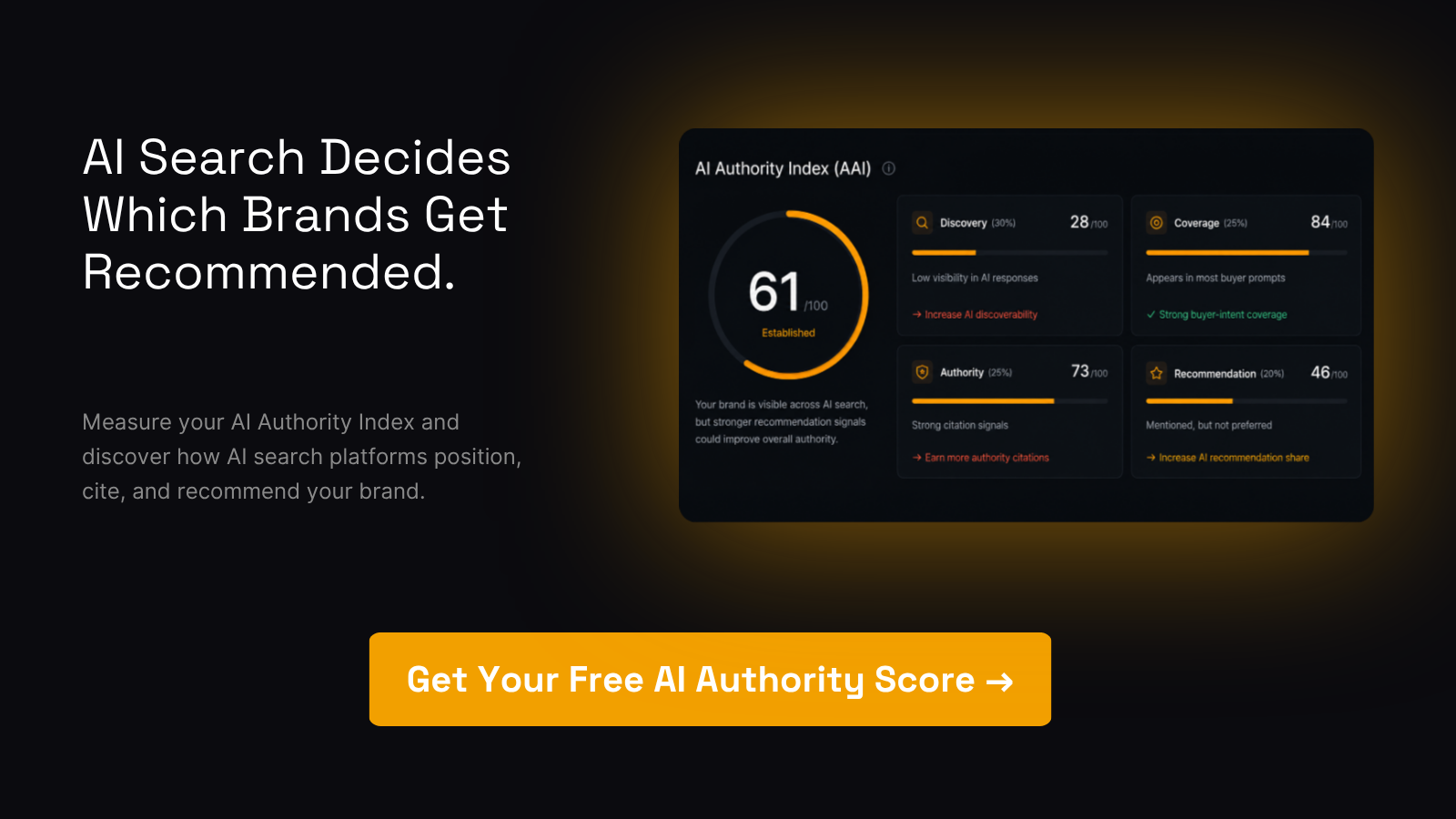
The Monthly AI Visibility Report tracks your citation share and recommendation share against named competitors across the category prompts your buyers actually type, whether that's a discovery-stage question, an evaluation comparison, or a purchase-adjacent query. Each report flags prioritized opportunities, specific pages, feeds, or review gaps costing you visibility, so your team isn't guessing which fix to make first. It's built for the exact problem this article covers: stage-level blind spots that a single blended metric hides. If you lead marketing, SEO, or demand generation and you've never measured how often AI assistants recommend your brand by name, start with a scan of your current AI recommendation share and see where the gaps actually are before your next planning cycle.
Sources
The figures and behavioral patterns in this article draw on a small set of primary research reports worth reading in full if you're building an internal business case.
- AI Is Reshaping Discovery, Influence and Visibility Without Fully Replacing Traditional Shopping Paths | L.E.K. Consulting
- AI Commerce 2026 | eMarketer
- The New Shape of Shopping: How Agentic Commerce Transforms the Path to Purchase | NIQ
FAQ
What Is AI Visibility?
AI visibility is how often and how favorably AI assistants like ChatGPT, Gemini, Claude, and Perplexity mention, describe, or recommend a brand when someone researches a category or product. It's measured through citation share, recommendation share, and reasoning transparency rather than traditional search rankings.
Does AI Actually Influence Purchases, or Just Research?
Mostly research and evaluation right now. AI-driven traffic leads search by roughly 2:1 to 2.6:1 at discovery, but only about 8% of purchases complete fully inside an AI agent; most buyers still verify through search or a retailer site.
Why Does AI Visibility Matter More at Discovery Than at Purchase?
Because AI's influence is highest early in the funnel, where it shapes shortlists, and narrows to near parity with search by purchase, when human verification takes over. Winning the discovery-stage citation determines whether a brand even gets considered during the evaluation and purchase stages that follow.
How Can I Track My Brand's AI Visibility?
Track it with a fixed prompt set covering discovery, evaluation, and purchase queries, scored for mentions, recommendations, and reasoning transparency, benchmarked monthly against named competitors. Authoritylayer's Monthly AI Visibility Report automates this scoring and flags prioritized fixes.
What Content Signals Matter Most for AI Recommendations?
Structured product data, clean attribute feeds, third-party citations, and detailed explanatory reviews matter most, according to NIQ's research on agentic commerce. Star ratings alone give AI models little to quote; explanatory detail gives them language they can reuse.