Marketers: Track AI Visibility with SPIV, Entropy, and Gini
Run a SPIV prompt set (30–50 prompts) across major AI engines. Track visibility, citations, entropy, and Gini to prioritize content and PR actions.
· 20 min read

The right approach to AI visibility monitoring is continuous, standardized measurement, not periodic manual checks in your personal ChatGPT account. Run a structured prompt set (built with the SPIV framework) across the major AI engines on a fixed cadence, capture both primary metrics and secondary diagnostics, then route what you find into prioritized content and PR work. Platforms like Authoritylayer exist specifically to operationalize that workflow at scale.
TL;DR:
- Continuous, standardized monitoring with structured prompts (SPIV framework) is essential for accurate AI visibility measurement across multiple platforms.
- Primary metrics such as visibility percentage and citation frequency should be paired with lagging indicators like share of voice and average position for comprehensive analysis.
- Regularly tracking crawl activity provides early warning of content ingestion issues before citation metrics decline, enabling proactive optimization.
- Cross-team collaboration and rapid action on identified gaps and threats are critical to maintaining and growing AI-driven brand presence.
- Automating the process through third-party tools like Authoritylayer ensures scalable, consistent, and reliable AI visibility tracking over time.
Table of Contents
- What to Measure: Primary Metrics and What They Indicate
- Which AI Platforms Should You Track and How Do They Differ?
- Building a Repeatable Prompt Set With SPIV
- Reading Stability and Risk: Secondary Diagnostic Metrics
- How Often Should You Run AI Visibility Checks?
- Turning Monitoring Data Into Wins, Gaps, and Threats
- Connecting AI Visibility to Analytics and Stakeholder Reporting
- Strategies for Automating AI Visibility Monitoring Workflows
- How Do You Verify AI-Generated Citations Are Accurate?
- Adapting Monitoring Prompts as AI Models Change
- Integrating AI Visibility Data With SEO and PR Analytics
- From Insight to Action: Planning Content and PR Campaigns
- Author perspective: implementing continuous AI visibility monitoring
- AuthorityLayer: How It Runs This Workflow for You
- Sources
- FAQ
What to Measure: Primary Metrics and What They Indicate
Most marketing teams start AI visibility tracking the wrong way: someone asks ChatGPT "best [category] tools" once, screenshots the answer, and calls it research. That's a snapshot, not measurement. Your personal chat history, location, and prior queries all shape what the model shows you, so one person's result tells you almost nothing about what a typical buyer sees. Standardized monitoring strips that personalization out and repeats the same prompts across sessions, so what you're comparing is the model's actual behavior, not your account's.
Four metrics form the foundation of any real tracking system.
- Visibility percentage measures how often your brand appears anywhere in a response across a defined prompt set. This is your broadest health check.
- Citation frequency counts how often your brand is explicitly named or linked as a source, as opposed to just being mentioned in passing.
- Share of voice compares your citation volume against named competitors within the same prompt set, so you know whether you're gaining or losing ground relative to the field.
- Average position tracks where your brand lands when a response lists multiple options, since AI Overviews and Perplexity answers frequently rank recommendations in order.
Presence and citation are not the same thing, and conflating them is one of the most common mistakes teams make. A model can reference your product category, describe a solution similar to yours, and still never name your brand. That's presence without citation, and it produces zero attributable value. Citation, by contrast, is when the model names you directly or links to your content as a source. Only citation drives the kind of downstream action, a click, a follow-up query, a save, that matters to revenue.
Some of these signals are leading indicators, others are lagging. Bot crawl activity, tracked via server logs for GPTBot, ClaudeBot, and PerplexityBot, tells you a model is actively ingesting your content before it ever shows up in an answer. That's useful for prioritizing which pages to optimize next. Citation frequency and share of voice are lagging: they tell you what already happened. A detailed breakdown of tracking crawl activity alongside citation outputs makes the case that pairing input-side and output-side monitoring gives you both a forecast and a scoreboard, instead of just one or the other.
Teams that skip the leading indicators tend to discover visibility problems only after a quarter has already gone by. Watching crawl behavior gives you a few weeks of runway to react before citation numbers move.
Which AI Platforms Should You Track and How Do They Differ?
Not all AI search surfaces behave the same way, and treating them as interchangeable is where a lot of monitoring programs go wrong. Each platform has a different citation format, a different freshness bias, and in some cases a meaningfully different answer depending on whether you're querying through the web interface or the API.
- ChatGPT (web UI) tends to favor a conversational summary with occasional inline links; ChatGPT's API responses can differ in structure and citation behavior depending on the model version and system prompt configuration, per OpenAI's own scaling guidance.
- Google AI Overviews / Gemini leans heavily on recently crawled, high-authority pages and shows a stronger freshness bias than the others, so content updated in the last few weeks often outperforms older, more comprehensive pages.
- Perplexity is the most citation-dense of the group, typically listing multiple numbered sources per answer, which makes it the easiest platform to audit for URL-level accuracy.
- Claude tends toward longer, more qualified answers with fewer explicit citations, which makes brand mentions there harder to quantify but still worth tracking for tone and framing.
The practical implication is that a win on one platform doesn't transfer to the others. Analyses of citation overlap across AI engines have found that the URLs cited across platforms show low overlap, meaning a page that ranks well in Perplexity's citations might be invisible in Gemini's. That's the argument for measuring platform by platform instead of averaging everything into one composite score.
For a B2B buyer journey, start your shortlist with ChatGPT and Perplexity, since they see the heaviest research-stage usage, then add Google AI Overviews for top-of-funnel category queries and Claude if your buyers include technical or enterprise evaluators who tend to favor it for detailed comparisons.
Building a Repeatable Prompt Set With SPIV
A random list of prompts produces random results. The SPIV framework, Segment, Persona, Intent, Variable, gives you a repeatable structure for generating prompts that actually mirror how real buyers query AI engines, instead of guessing at phrasing.
- Segment: Define the market segment the prompt targets (enterprise SaaS buyers, mid-market operations leaders, a specific vertical).
- Persona: Assign a role and seniority to the implied questioner (a VP evaluating vendors versus an individual contributor doing early research asks very differently phrased questions).
- Intent: Tag the query by funnel stage, awareness, consideration, or decision, since AI models respond to "what is X" very differently than "which X should I buy."
- Variable: Swap the specific detail (industry, company size, budget range, use case) to test how consistent your visibility is across contexts.
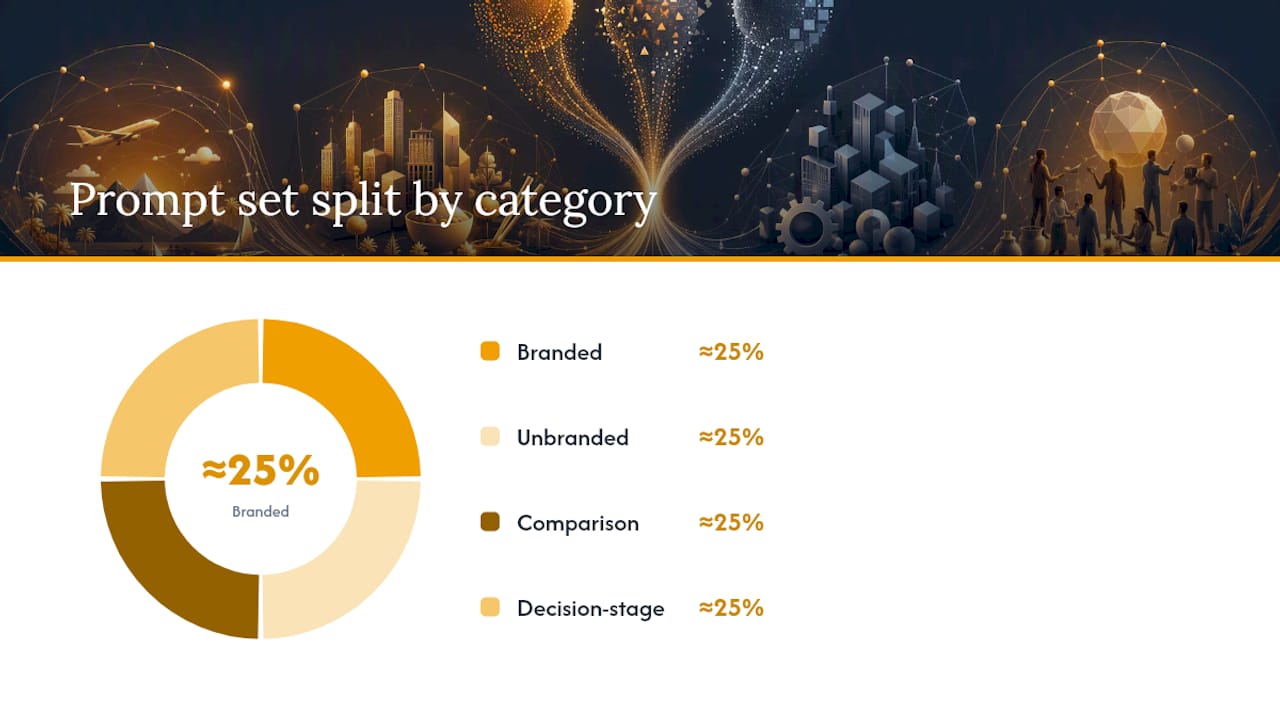
Your prompt set should include four categories: branded (does the model know your product exists?), unbranded (do you show up for category-level questions with no brand named?), comparison ("X vs Y" style queries), and decision-stage validation ("is X good for [specific use case]?"). Skipping the unbranded and comparison categories is the single biggest gap most teams have, because those are exactly the prompts a prospect uses before they've ever heard your name.
On sample size: a good starting set runs 30 to 50 prompts per platform, split roughly evenly across the four categories, with enough variable swaps to test at least three different buyer contexts. HubSpot's guidance on sourcing prompts recommends pulling actual phrasing from support tickets and sales call transcripts rather than inventing prompts from a marketing team's internal vocabulary, since real buyers rarely phrase things the way your positioning deck does.
Here's a quick example of the transformation: a sales transcript note like "customer asked if we integrate with Salesforce out of the box" becomes the SPIV prompt "As an operations manager at a 200-person company evaluating [category] tools, does [brand] integrate with Salesforce without custom development?" That's a decision-stage, comparison-adjacent prompt built entirely from real buyer language.
Changing every prompt every cycle destroys your ability to trend anything over time.*
Reading Stability and Risk: Secondary Diagnostic Metrics
Primary metrics tell you what's happening. Secondary metrics tell you whether you can trust it. You can't tell the difference without diagnostics.
- Run length is the number of consecutive monitoring periods a citation persists. A citation that shows up once and disappears is noise; one that survives five straight weekly runs is a signal worth building a campaign around.
- Shannon entropy measures how evenly your citations are distributed across different prompts and sources. Low entropy means your visibility is concentrated in one or two lucky prompts, which is fragile.
- Gini coefficient captures inequality in citation distribution, similar to how it's used in economics to measure income inequality. A high Gini score means a handful of prompts account for almost all your visibility, leaving you exposed if those specific prompts shift.
- KL divergence (Kullback-Leibler divergence) compares your citation distribution against a competitor's or against your own baseline over time, flagging meaningful shifts rather than random noise.
This two-layer approach, primary metrics for "what," secondary metrics for "why and how stable," is the core method behind rebuilding AI visibility measurement into something repeatable rather than anecdotal.
Encouraging on its own. But if entropy is low and Gini is high, that jump likely came from one or two prompts catching a lucky citation, not a broad improvement. If run length on those specific citations is only one period, treat the number as unconfirmed until it survives a second and third run.

Sample sizes matter here too. Entropy and Gini calculations are unreliable below roughly 20 prompts, since a handful of data points can swing either metric wildly. Stick to the 30 to 50 prompt range from the SPIV section and you'll have enough data for these diagnostics to mean something.
How Often Should You Run AI Visibility Checks?
Cadence is where most monitoring programs quietly fail. Running your full prompt set once a quarter feels efficient but produces almost no usable trend data, because AI model outputs shift week to week and a single quarterly snapshot can't distinguish a real change from noise.
- Run your highest-priority, decision-stage prompts daily or multiple times per day. These are the queries closest to revenue, and they're worth the compute cost.
- Run your broader prompt set (branded, unbranded, comparison combined) weekly or biweekly.
- Only trend metrics on prompts that appear in every run in the comparison window. Adding new prompts mid-cycle and folding them into your trend line introduces sampling bias that makes your charts lie to you.
Session hygiene matters as much as cadence. A logged-in ChatGPT account with months of chat history will return different results than a clean, logged-out session, because personalization shapes the answer. For monitoring purposes, always run fresh, unauthenticated sessions, and run each prompt multiple times independently per platform per cycle, since a single session on a single platform is genuinely too noisy to trust on its own.
Log at minimum: the exact prompt text, platform and model version, timestamp, full response text, every citation or brand mention with position, and session type (fresh versus authenticated). Skipping any of these fields makes it impossible to explain a metric swing later.
Pro Tip: Keep a separate log column for "prompt changed this cycle" so you never accidentally compare an old trend line against a slightly reworded prompt. It's a small thing that saves hours of confused debugging three months later.
Turning Monitoring Data Into Wins, Gaps, and Threats
Data without a triage process just becomes a spreadsheet nobody opens twice. Sort every monitoring finding into one of three buckets before you decide what to do with it.
- Wins: prompts where you're cited consistently and favorably. Protect these; they're your proof points for case studies and sales enablement.
- Gaps: prompts where you have zero or weak visibility but a competitor is cited strongly. These are your content and PR backlog.
- Threats: prompts where your visibility is dropping over time, or where a competitor's entropy and run length are improving while yours flatten. These need faster response than gaps.
Prioritize using a simple rubric: impact (how close to purchase decision is this prompt) multiplied by effort (how hard is it to close the gap) multiplied by platform priority (is this the engine your buyers actually use) multiplied by buyer-stage relevance (decision-stage gaps outrank awareness-stage gaps almost every time).
| Finding type | Example | Likely owner | How to validate impact |
|---|---|---|---|
| Win | Consistently cited in "best [category] for enterprise" prompts | Content / PR | Track referral traffic tagged from AI sources against this prompt's citation trend |
| Gap | Zero visibility on "[category] vs [competitor]" comparison prompts | SEO / Content | Build comparison content, then re-run the prompt set after two monitoring cycles |
| Threat | Visibility on a high-value decision prompt dropped three consecutive runs | Product marketing / PR | Check for a competitor product launch or press cycle that coincides with the drop |
Validation always comes back to the same discipline: don't declare a fix successful after one run. Wait for the next two to three cycles and check whether run length and entropy improved alongside the raw visibility number, not just the visibility number alone.
Connecting AI Visibility to Analytics and Stakeholder Reporting
AI visibility data means little to leadership until it's tied to traffic and revenue. Start by isolating AI referral traffic in your analytics platform using dedicated UTM parameters and a custom channel grouping, separate from organic search and paid, so AI-driven sessions don't get silently absorbed into your existing "organic" bucket. This matters more than it used to: research on zero-click search behavior found that a large share of searches now end without any click to the open web at all, which means the sessions you do capture from AI referrals represent buyers who chose to click through after already being pre-sold by the AI's answer.
Build your executive report around a small set of numbers that don't require explanation:
- Overall AI Visibility Score, trended over the last several cycles, not just the current snapshot.
- Platform breakdown showing which engines drive the most citation volume and which are lagging.
- Top five prompts by business impact, with their wins/gaps/threats status.
- The prioritized action list pulled straight from your triage process, with owners attached.
Executives generally care about key numbers such as AI share of voice broken out by funnel intent, whether you appear on your highest-priority decision-stage prompts, and whether there is any measurable lift in conversion among visitors who arrive via AI-tagged referral traffic. Growing daily AI adoption, documented by Pew Research, is the backdrop that makes these numbers worth a recurring line item in your marketing dashboard rather than a one-off audit.
Strategies for Automating AI Visibility Monitoring Workflows
Manual prompt running doesn't scale past a handful of queries. Once your prompt set crosses 30 to 50 entries across four platforms, running each one by hand, in a fresh session, multiple times per cycle, becomes a full-time job nobody signed up for.
API access is the first automation layer. Most major platforms offer programmatic access that lets you script prompt runs on a schedule, store raw responses automatically, and skip the manual copy-paste that introduces transcription errors. The catch is that API responses don't always match what a logged-out web user sees, since system prompts and model versions can differ between the two, so pure API monitoring should be treated as a proxy for, not a perfect replica of, the consumer experience.
Third-party monitoring platforms close that gap by running standardized sessions across both web UI and API access points, then normalizing the output into consistent metrics you can trend over time. This is the practical difference between a marketing team spending hours each week running prompts by hand and a system that runs the same disciplined process automatically, at the cadence your priority prompts actually need. Choosing the right monitoring tool usually comes down to whether it supports multi-session runs, stores full citation data, and calculates the secondary diagnostics, not just the primary visibility number.
How Do You Verify AI-Generated Citations Are Accurate?
An AI answer citing your brand isn't automatically good news. Models sometimes attribute outdated pricing, misstate a feature, or cite a source that no longer reflects your current positioning, and none of that shows up in a raw visibility percentage.
Verification starts with checking every citation against three questions: is the underlying fact still accurate, does the cited source page still exist and say what the model claims it says, and is the context favorable or does it position your brand as an inferior alternative. Perplexity makes this easiest since it lists explicit numbered sources you can click through directly. ChatGPT and Claude require more manual digging since their citations are often woven into prose rather than listed separately.
Build a simple accuracy log alongside your visibility log: for every citation captured, note whether the claim was accurate, outdated, or wrong, and whether the linked source (if any) is still live. Patterns matter more than one-off errors. If a model keeps citing an old pricing page months after you've updated it, that's a signal the model's training or retrieval index hasn't refreshed, and no amount of new content will fix it until that refresh happens. Tracking brand mentions systematically over time makes these drift patterns visible instead of anecdotal, since you're comparing citation content across cycles rather than checking once and assuming it stays static.
Adapting Monitoring Prompts as AI Models Change
AI models update more often and more unpredictably than search algorithms ever did, and a prompt set frozen in place for a year will drift out of sync with how buyers actually phrase things by the time you're three quarters in.
Watch for two triggers that should push you to revise your prompt set: a documented model update from a platform provider, and a noticeable shift in your own metrics that doesn't correspond to any content change you made. If your visibility percentage or entropy shifts sharply with no clear cause on your end, check release notes or community reporting for a model update before assuming it's your content's fault.
The 80/20 rotation rule from the SPIV section applies directly here: keep the majority of your prompt set stable so you preserve trend continuity, but dedicate a portion of each quarterly review to testing new phrasing, new competitor names, and new use cases that have entered the market since your last revision. When a platform ships a major model version, treat your next monitoring cycle as a mini-baseline reset. Run the full prompt set, note any structural shift in how citations are formatted or how many sources typically appear, and adjust your logging fields if the citation format itself has changed.
Don't chase every minor fluctuation. Distinguish a real model update from ordinary run-to-run noise by checking whether the shift shows up consistently across multiple sessions and multiple related prompts, not just one.
Integrating AI Visibility Data With SEO and PR Analytics
AI visibility data creates the most value when it stops living in its own silo and starts talking to the tools your SEO and PR teams already use daily.
For SEO teams, the natural integration point is content planning. Gaps identified in your AI monitoring, prompts where competitors are cited and you're not, should feed directly into the same content calendar and keyword research process you already run for traditional search, since generative engine optimization and conventional SEO increasingly share the same underlying content requirements: clear, well-structured, fact-dense pages that both crawlers and language models can parse easily.
For PR teams, threats and gaps in your monitoring data should inform which trade publications, comparison sites, and industry roundups to pursue, since third-party mentions on high-authority sites are frequently the exact source material AI models pull citations from. If your monitoring shows a competitor dominating comparison prompts, check whether they've recently landed placement on a site the models are citing, and treat that as a PR target, not just a content gap.
Practically, this means adding a monthly sync between whoever owns AI visibility tracking and whoever owns SEO and PR reporting, so gaps discovered in one system become tasks in the other within the same reporting cycle, not months later after a separate audit surfaces the same problem independently.
From Insight to Action: Planning Content and PR Campaigns
Insight that stays in a spreadsheet accomplishes nothing. The path from a monitoring finding to a published asset or a placed story should be short and repeatable.
Start with the prioritized gap and threat list from your triage process. For each item, define the specific content format that would close it: a comparison page if the gap is on a "vs" prompt, an FAQ-style page targeting the exact phrasing buyers use if the gap is on a decision-stage validation prompt, or an updated feature page if the citation issue is outdated information rather than absence.
Assign a realistic timeline based on the prompt's priority tier. Decision-stage gaps tied to daily-monitored prompts deserve a two-to-four-week turnaround; broader awareness-stage gaps can sit in a monthly or quarterly content cycle.
For PR, translate the gap into a specific target list: which publications or comparison sites does the model appear to be pulling from for the competitor's citation, and can you pitch a similar placement, contribute an expert quote, or get included in a similar roundup. Once the content publishes or the placement lands, don't stop tracking. Re-run the exact same prompt set on the same cadence and watch for the citation to appear, then confirm it survives multiple runs before crediting the campaign with success. That closing loop, publish, re-monitor, confirm persistence, is what separates a real prioritization system from a one-time content sprint that nobody ever checks the results of.
Author perspective: implementing continuous AI visibility monitoring
The teams that struggle most with AI visibility monitoring aren't the ones lacking data. They're the ones who treat it as a one-department project. SEO owns it, PR never sees the gaps, and product marketing finds out about a competitor threat three months after it started because nobody thought to loop them in.
The discovery that tends to surprise people isn't that their brand is invisible. It's that they're highly visible on easy, awareness-stage prompts and completely absent on the two or three decision-stage comparisons that actually influence a purchase. That's not a content problem you solve with more blog posts. It's a prioritization failure, and it only becomes visible once you're measuring intent-tagged prompts separately instead of lumping everything into one visibility number.
Cross-functional ownership isn't optional here. Whoever runs the monitoring needs a standing seat with content, PR, and product marketing, or the gaps just pile up unaddressed.
— Geraldine
AuthorityLayer: How It Runs This Workflow for You
Authoritylayer is the direct alternative to running this entire process by hand across four different platforms every week.
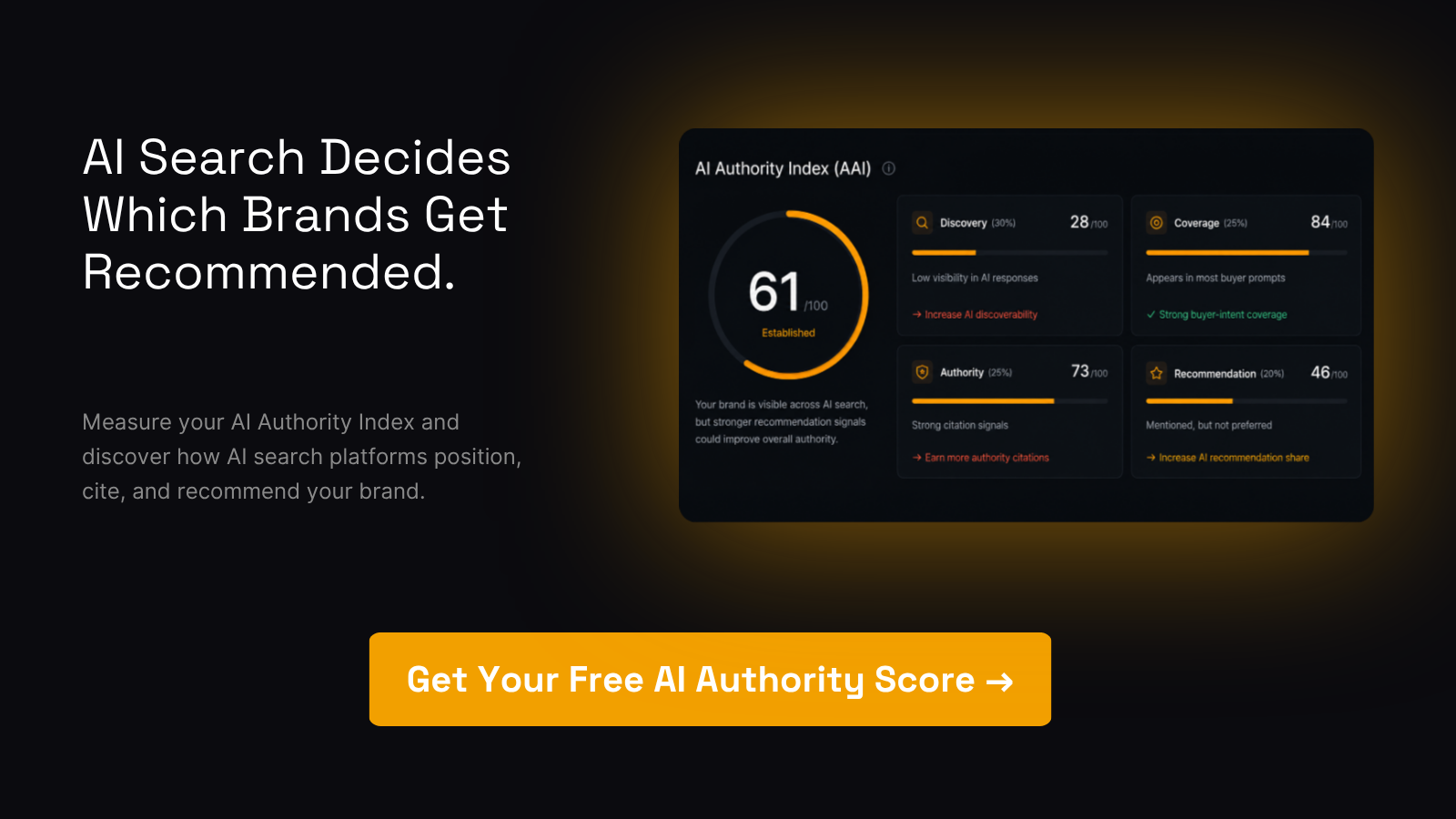
Where a manual check in your own ChatGPT account gives you one personalized, unrepeatable snapshot, Authoritylayer runs the SPIV prompt structure across fresh sessions on a fixed cadence, tracks primary metrics alongside the stability diagnostics covered above, and surfaces wins, gaps, and threats already sorted by priority. That means your team spends time acting on findings instead of assembling them.
If you want to see where your brand currently stands before committing to a full monitoring build-out, start with the Monthly AI Visibility Report for a scored breakdown across platforms, prompts, and competitors.
Sources
For methodology depth, Neil Patel's rebuild of AI visibility measurement covers SPIV and secondary metrics in detail. Entlify's platform-overlap analysis explains why cross-platform tracking matters. Gartner's search volume forecast frames the business case, and Pew Research's AI adoption data documents why this channel keeps growing.
- Pew Research: Artificial intelligence in daily life
- How to monitor AI search visibility — Neil Patel
- How to Monitor AI Search Visibility — Entlify
FAQ
How Can I Track My Brand's Visibility in AI Search Results?
Build a standardized prompt set using the SPIV framework, run it across ChatGPT, Gemini, Perplexity, and Claude on a fixed cadence, and measure visibility percentage, citation frequency, share of voice, and average position rather than checking one personal account occasionally.
How Do You Win Brand Visibility in AI Search?
Close the gaps your monitoring surfaces, usually decision-stage comparison prompts where a competitor is cited and you're not, with targeted content and PR placements, then re-run your prompt set to confirm the citation persists across multiple cycles.
What Are the Best AI Visibility Monitoring Tools?
Effective tools combine multi-session automated prompt runs across major platforms with both primary metrics and secondary diagnostics like entropy and Gini coefficient; platforms like Authoritylayer build this directly into a scored, ongoing report rather than requiring manual tracking.
Why Should I Track AI Brand Visibility?
Search volume is shifting toward AI-driven discovery, with Gartner projecting a meaningful drop in traditional search engine volume as AI agents take over more research tasks, meaning brands invisible in AI answers risk losing buyers before they ever reach a traditional search result.