AI Search Strategy: A CMO Playbook for 2026
Discover how an effective AI search strategy can boost your brand's visibility. Learn to prepare for the future of AI-driven search.
· 13 min read

An AI search strategy — more precisely, AI Visibility Intelligence — is the combination of content, technical, team, and measurement practices that make your brand eligible to be included, cited, and recommended by AI assistants like ChatGPT, Claude, Gemini, and Perplexity during buyer research. McKinsey projects that about 50 percent of Google searches already have AI summaries, and that share is projected to rise to over 75% by 2028. Your brand either gets cited in those summaries or it doesn't.
Three things to assign this week:
- Diagnostic: Run a free AI visibility scan to see how ChatGPT, Claude, and Perplexity currently describe and recommend your brand.
- Highest-impact fix: Audit your top five product or category pages for snippable, self-contained answers at the top of each section.
- Quick test: Brief your SEO lead and content director together — AI visibility requires both, and neither can own it alone.
Start with the free AI visibility scan from Authoritylayer. It takes minutes and surfaces gaps your current analytics won't show.
Table of Contents
- Why AI search visibility is different from traditional SEO
- What are the four pillars of an AI search strategy?
- A practical 6-step playbook with timeline and cost bands
- How to write content that AI assistants can extract and cite
- What technical foundations does AI search require?
- How do you measure AI visibility and recommendation share?
- How should you staff and govern AI visibility long-term?
- How Authoritylayer operationalizes AI Visibility Intelligence
- Key Takeaways
- What does AI visibility success actually look like after a year?
- Authoritylayer's Starter plan gets you from zero to measured fast
- Useful sources and further reading
- FAQ
Why AI search visibility is different from traditional SEO
Traditional SEO earns you a slot in a ranked list. A user clicks or doesn't. AI search works differently: the assistant reads dozens of sources, synthesizes a single answer, and either includes your brand in that answer or writes you out entirely. You don't get partial credit for ranking fifth.
McKinsey recommends treating this as a distinct capability — AI Visibility Intelligence — not a variation of existing SEO. The cross-functional implications are real: content, technical, brand, and analytics teams all have a role, and no single team can run it alone.
The business risk is concrete. A buyer researching your category on Perplexity gets a synthesized answer that names three competitors and omits you. That's a lost consideration, not a lost click. Traffic metrics won't catch it.
What are the four pillars of an AI search strategy?
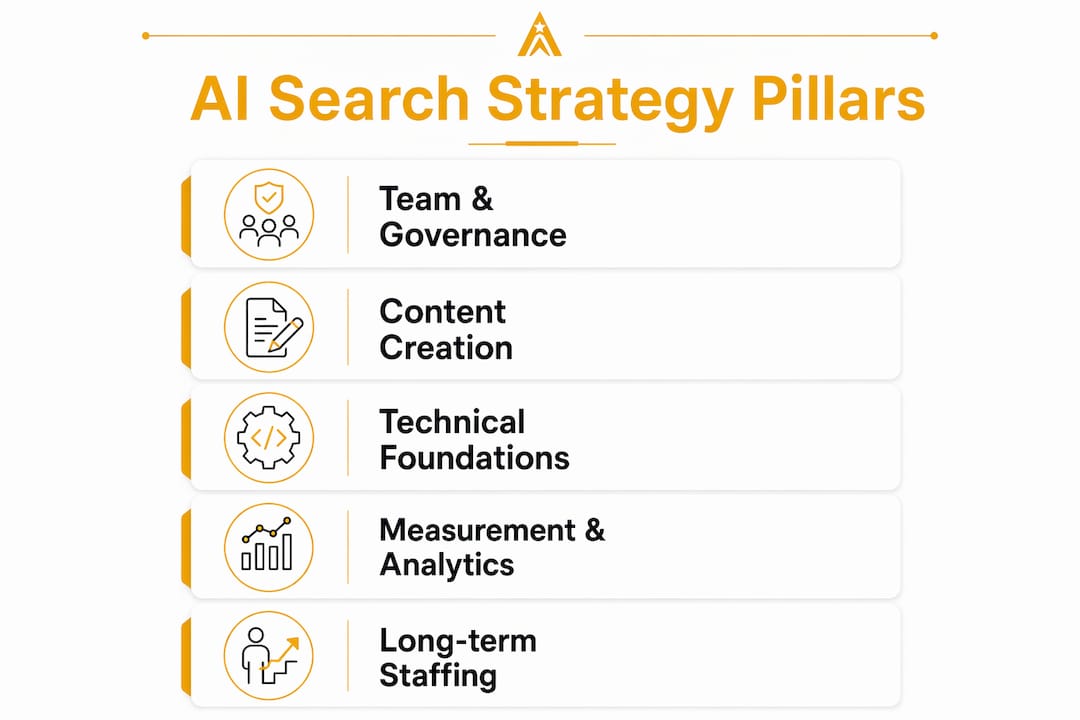
A workable framework has four pillars. Each needs an owner and a budget line.
- Team and governance: A cross-functional pod with a named GEO (Generative Engine Optimization) lead, supported by SEO, content, and engineering. Signed SLAs for measurement cadence and response to attribution issues.
- Content design: Pages structured so AI systems can extract, verify, and attribute your claims. Think modular sections, definition sentences, and inline sourcing.
- Technical foundation: Crawlability, canonical tags, structured data, and render performance. Google's documentation confirms that generative features run on the same retrieval-augmented generation (RAG) infrastructure as core search — foundational technical SEO still matters.
- Measurement: Recommendation share, citation frequency, and AI-sourced referral traffic tracked on a defined cadence.
| Pillar | Primary Owner | Supporting Roles |
|---|---|---|
| Team and governance | CMO / VP Marketing | Legal, HR, IT |
| Content design | Content Director | SEO Lead, Product Marketing |
| Technical foundation | Head of SEO / Engineering | DevOps, CMS Admin |
| Measurement | Analytics Lead | GEO Lead, Demand Gen |
Pro Tip: Don't create a new team from scratch. Assign a GEO lead from your existing SEO function and give them a dotted line to the content director. That single structural change removes the biggest coordination bottleneck.

A practical 6-step playbook with timeline and cost bands
- Diagnostic (Weeks 1–2, low cost): Run an AI visibility scan across your top 20 pages and five core buyer queries. Identify where competitors are cited and you aren't. Only about 16% of brands track AI search performance systematically, so this step alone puts you ahead.
- Quick wins (Weeks 3–4, minimal cost): Add one-line answer sentences to the top of your highest-traffic pages. Fix broken canonical tags. Submit an updated sitemap.
- Content refactor (Months 2–3, moderate investment): Rewrite your top 10 category and product pages for extractability. Add FAQ schema. Ensure every factual claim has an inline source or attribution.
- Technical fixes (Month 2, engineering sprint): Confirm all key pages render for bots, resolve duplicate content, and implement structured data for Organization, Product, and FAQPage types.
- Measurement baseline (Month 3): Set up a recommendation-share dashboard. Define your core KPIs and establish the baseline before any further content changes.
- Scale (Months 4–6+, ongoing platform or headcount): Expand to secondary query clusters, add competitor benchmarking, and run monthly content experiments. At this stage, a dedicated platform pays for itself in analyst time saved.
For in-house vs. platform decisions: if your team is running more than 50 tracked prompts per month, a dedicated AI visibility platform is almost always faster and cheaper than building the infrastructure yourself.
How to write content that AI assistants can extract and cite
Microsoft Advertising guidance is direct: AI systems act as editors. They favor precise, snippable, verifiable content over keyword-dense pages. Write for extractability first.
Content checklist:
- Open every section with a one-sentence direct answer.
- Use clear H2/H3 headings that match the question a buyer would ask.
- Keep data points compact and attributed: "X does Y, according to [Source]."
- Write self-contained paragraphs — each one should make sense pulled out of context.
- Add FAQ sections with explicit question-and-answer pairs.
Before (not snippable): "Our platform leverages advanced machine learning to deliver superior outcomes across the customer lifecycle."
After (snippable): "Authoritylayer tracks how often your brand is cited in ChatGPT, Claude, Gemini, and Perplexity responses, and shows which content changes improve that citation rate."
The Adobe analysis frames it well: the objective shifts from ranking to citation and extractability. Modular content that can be reliably pulled into an AI synthesis is the new unit of SEO value.
Pro Tip: Use FAQPage schema on any page with a Q&A section. It's one of the clearest signals to AI retrieval systems that your content is structured for direct extraction.
What technical foundations does AI search require?
The technical bar is not exotic. It's the same hygiene that good SEO has always required, applied more rigorously.
Essential checklist:
- Confirm
robots.txtallows crawling of all key pages by major AI bots (GPTBot, ClaudeBot, Googlebot). - Submit and maintain an accurate XML sitemap.
- Resolve duplicate content with canonical tags.
- Ensure server-side or hybrid rendering for JavaScript-heavy pages.
- Implement structured data: Organization, BreadcrumbList, FAQPage, and Article types.
- Add authorship markup and publication/update dates to all editorial content.
What to avoid:
- Don't create an
llms.txtfile expecting it to improve visibility. Google explicitly warns these files are not required and can be ineffective or flagged under spam policies. - Don't artificially chunk content into micro-fragments. AI parsers need context, not isolated sentences.
- Don't block AI crawlers unless you have a specific legal reason. Blocking them removes you from consideration entirely.
For teams integrating search APIs into their content pipeline, ensure your endpoints return clean, structured responses that preserve heading hierarchy and attribution.
How do you measure AI visibility and recommendation share?
The metrics are different from traditional SEO. Rank position is not the primary signal here.
Core KPIs:
| KPI | Definition | Tracking Frequency |
|---|---|---|
| Recommendation share | % of tracked prompts where your brand is cited | Weekly |
| Citation frequency | Raw count of citations across monitored AI platforms | Weekly |
| AI-sourced referral traffic | Sessions from AI assistant referral domains | Weekly |
| Share of model | Your brand mentions vs. competitors in same prompt set | Monthly |
| Assisted conversions | Conversions where AI referral appears in the path | Monthly |
Practitioner guidance emphasizes tracking recommendation share and citation frequency across LLMs as the primary performance signals, with assisted conversions as the downstream revenue proxy.
Experiment template:
- Select 10 pages with low citation rates from your diagnostic.
- Apply the content checklist from Section 5 to five of them (treatment group).
- Leave five unchanged (control group).
- Re-run the same prompt set after 30 days.
- Compare recommendation share and citation frequency between groups.
For data infrastructure, use CDN logs and bot-level monitoring to capture AI crawler activity. Model-facing telemetry from platforms like Authoritylayer fills the gap where server logs can't distinguish which AI system generated a specific recommendation.
How should you staff and govern AI visibility long-term?
AI visibility degrades without maintenance. Models update, competitors improve their content, and attribution errors accumulate. Treat it as an ongoing channel, not a one-time project.
Recommended cadence:
- Weekly: GEO lead reviews recommendation share dashboard, flags citation drops or new competitor appearances.
- Monthly: Cross-functional pod reviews content experiment results, approves next sprint, and updates the prompt tracking set.
- Quarterly: CMO review of AI Authority Index score, competitive benchmarking, and budget allocation for the next quarter.
Resourcing bands:
- Startup/lean: 0.5 FTE GEO lead + platform subscription. Covers diagnostics, monthly reporting, and content sprints.
- Mid-market: 1 FTE GEO lead + 0.5 FTE content specialist + platform. Supports weekly monitoring and quarterly experiments.
- Enterprise: Dedicated GEO team (2–3 FTE) + platform + engineering support. Enables real-time monitoring, multi-brand benchmarking, and signed SLAs. See how enterprise teams structure this as a strategic channel.
For risk mitigation: when you detect a sudden drop in recommendation share, check for three things first. A competitor may have published a high-extractability page on your core query. A model update may have shifted citation preferences. Or a technical issue (broken canonical, blocked bot) may have removed a key page from consideration. Each has a different fix.
AI integration in team workflows is increasingly a governance question as much as a technology one — who approves content changes, who owns the measurement SLA, and who escalates when a hallucination about your brand surfaces in a major AI assistant.
How Authoritylayer operationalizes AI Visibility Intelligence
Authoritylayer is built specifically for the workflow described in this playbook. The platform covers every stage from diagnostic to scale.
Key capabilities:
- AI visibility scan: Surfaces how ChatGPT, Claude, Gemini, and Perplexity currently describe and recommend your brand across your core buyer queries.
- Recommendation share tracking: Monitors your citation rate across platforms on a weekly cadence, with competitor benchmarking built in.
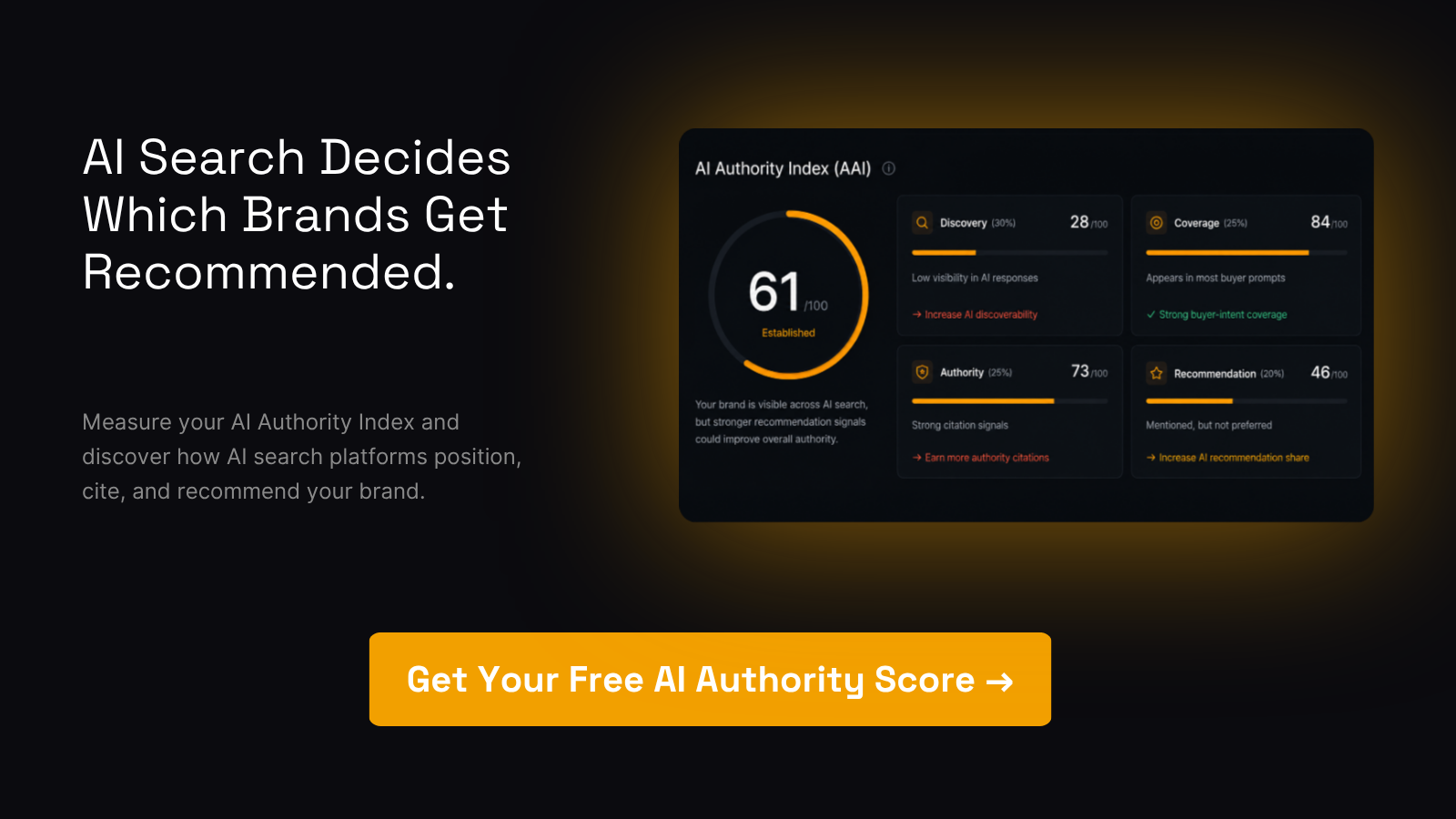
- AI Authority Index scoring: A composite score that measures your brand's overall AI visibility posture, updated as content and technical changes take effect.
- Prompt tracking: Maintains a library of buyer-intent prompts relevant to your category and tracks your appearance rate over time.
- Prioritized fix recommendations: Surfaces the specific content and technical changes most likely to improve your recommendation share, ranked by estimated impact.
The platform maps directly to the 6-step playbook: the diagnostic (Step 1) runs in minutes, the measurement baseline (Step 5) is pre-built, and the scale phase (Step 6) is supported by automated prompt monitoring and competitive alerts.
Teams using Authoritylayer's benchmark reports gain a clear view of where they stand relative to category competitors across all major AI assistants — the starting point for any credible AI visibility roadmap.
Key Takeaways
An effective AI search strategy requires treating AI Visibility Intelligence as a distinct channel with dedicated ownership, structured content, technical hygiene, and measurement infrastructure separate from traditional SEO.
| Point | Details |
|---|---|
| AI assistants are synthesizers | Your brand must be citable and extractable, not just rankable, to appear in AI-generated answers. |
| Only 16% of brands track this | Only about 16% of brands track AI search performance systematically, making early movers a significant advantage. |
| Four pillars drive the strategy | Governance, content design, technical foundation, and measurement each need a named owner and budget. |
| Measurement requires new KPIs | Track recommendation share, citation frequency, and AI-sourced referral traffic — not rank position alone. |
| Authoritylayer accelerates every step | From the initial diagnostic scan to ongoing recommendation share monitoring, Authoritylayer covers the full playbook. |
What does AI visibility success actually look like after a year?
Most marketing teams underestimate how fast the gap between AI-visible and AI-invisible brands will compound. A brand that invests in this now, even modestly, builds a citation footprint that becomes self-reinforcing: more citations lead to more model familiarity, which leads to more citations.
A realistic one-year scenario: a mid-market B2B brand starts with low recommendation share across its core buyer queries. After running the diagnostic, refactoring key pages, and implementing structured data, that share substantially improves within six months. The downstream signal is assisted conversions from AI referral domains appearing in attribution reports for the first time.
The risk worth naming is hallucination. AI assistants sometimes describe brands inaccurately, especially when the brand's own content is thin or contradictory. The mitigation is straightforward: publish clear, authoritative, frequently updated content on your own domain. Platforms like Authoritylayer surface these attribution errors when they appear, so teams can respond with a content update rather than discovering the problem months later through a sales call.
AI Visibility Intelligence is not a future-state initiative. It's the channel that determines whether your brand exists in the buyer's consideration set when an AI assistant answers their research query.
Authoritylayer's Starter plan gets you from zero to measured fast
If your team has never run an AI visibility diagnostic, the Authoritylayer Starter plan is the fastest path to a defensible baseline. You get a full visibility scan across ChatGPT, Claude, Gemini, and Perplexity, a prioritized list of content and technical fixes ranked by impact, and a starter dashboard that tracks recommendation share from day one.
For larger organizations managing multiple brands or markets, the Enterprise plan supports multi-brand benchmarking, custom prompt libraries, and dedicated onboarding. Either way, the first step is the same: run the scan, see where you stand, and assign the top three fixes this week.
Useful sources and further reading
- McKinsey: Winning in the Age of AI Search — Quantifies the urgency: about 50% of searches already carry AI summaries today, and that figure is projected to exceed 75% by 2028; recommends the cross-functional org model. Use for executive briefings and budget justification.
- Google Search Central: Optimizing for Generative AI Features — Primary source for technical implementation guidance, E-E-A-T signals, and what to avoid (including
llms.txt). - Microsoft Advertising: Optimizing Content for AI Search Answers — Practical content-design rules: headings, snippable answers, and extractable formatting.
- Adobe: SEO in 2026 — Frames the shift from ranking to citation and extractability; supports the content design and core components sections.
- HubSpot: How to Optimize Content for AI Search — Practitioner guidance on recommendation share metrics and experiment design.
- Authoritylayer Academy — Methodology documentation, AI Authority Index explanation, GEO/AEO glossary, and benchmark reports. The primary reference for measurement definitions used in this playbook.
FAQ
What is AI Visibility Intelligence?
AI Visibility Intelligence is the practice of measuring and improving how AI assistants like ChatGPT, Claude, and Perplexity discover, describe, and recommend your brand during buyer research — distinct from traditional SEO ranking.
How is recommendation share different from search rank?
Recommendation share measures the percentage of tracked buyer prompts where your brand is cited in an AI-generated answer, not your position in a list. A brand can rank on page one and still have zero recommendation share.
How long does it take to see results from an AI search strategy?
Most teams see measurable changes in recommendation share within a few months of implementing content and technical fixes, based on the playbook above. Full baseline measurement takes about 30 days to establish.
Does traditional SEO still matter for AI visibility?
Yes. Google's documentation confirms that generative AI features rely on the same core retrieval systems as standard search. Strong technical SEO, crawlability, and E-E-A-T signals remain foundational.
How does Authoritylayer help with AI visibility measurement?
Authoritylayer tracks recommendation share, citation frequency, and competitive benchmarks across major AI assistants, and surfaces prioritized content fixes through its AI Authority Index scoring methodology.