CMOs: Make ChatGPT Data Sources Find Your Brand in 30 Days
Practical 30 day playbook for CMOs and heads of SEO to fix live ChatGPT data sources. Weekly fixes, measurable KPIs, and a citation audit.
· 12 min read

Editorial coverage, structured data, and cross-domain corroboration drive most ChatGPT-style brand citations, not any single review site or forum thread. The three signals that predict citation most reliably are entity chains across independent domains, complete schema markup, and recent authoritative mentions. When you fix these, expect movement in recommendations within days to weeks, since retrieval systems re-index and resync on their own schedules rather than waiting for a quarterly crawl.
TL;DR:
- Cross-domain entity corroboration increases the likelihood of your brand being cited by retrieval systems, especially if mentions are consistent across independent sources.
- Fixing schema markup, improving passage clarity, and securing authoritative mentions can produce measurable citation increases within days to weeks due to regular re-indexing.
- For live retrieval sources, editorial coverage, product feeds, review platforms, and structured knowledge bases are the primary signals influencing brand visibility.
- Regular audits of schema completeness, feed hygiene, and entity links are critical to maintain and improve AI citation performance over time.
- Focusing efforts on extractability and verified entity building offers faster results than broad, generic content campaigns across all AI engines.
Table of Contents
- What Counts as a ChatGPT Data Source for Brand Discovery?
- How Do Retrieval Pipelines Actually Pick What to Cite?
- Do ChatGPT, Perplexity, Claude, and Gemini Weigh Sources Differently?
- What's on the Technical and Content Checklist for Citations?
- How Do You Measure and Monitor AI Citation Visibility?
- What Does a 4-Week AI Visibility Action Plan Look Like?
- Where Does ChatGPT's Original Training Data Come From?
- What Ethical and Privacy Questions Surround ChatGPT's Sources?
- Static Training Data vs. Real-Time Retrieval: What's the Difference?
- Why AI Visibility Deserves the Same Rigor as Traditional SEO
- Turn This Checklist Into a Standing Program
- Sources and Further Reading for AI Citation Research
- Sources
- FAQ
What Counts as a ChatGPT Data Source for Brand Discovery?
For this article, "chatgpt data sources" means something specific: the live retrieval and knowledge systems ChatGPT-style assistants pull from at answer time, not the historical training corpus baked into the model months or years earlier. That distinction matters for anyone running a marketing team, because you cannot influence a training run that already happened. You can influence what a retrieval layer finds today.
Those live sources break into several classes. Editorial coverage from trade publications and news outlets carries outsized weight because it's independently verified. Product feeds and technical documentation give assistants structured, current facts about pricing and specifications. Review platforms supply sentiment and volume signals. Forums and user-generated content, think Reddit threads and community Q&A, show up constantly in Perplexity sources and ChatGPT answers alike because they read as unfiltered opinion. Knowledge bases like Wikidata and Crunchbase anchor entity identity. Structured hubs, such as industry directories and comparison sites, stitch it all together.
For a CMO, this matters because buyer shortlisting increasingly happens inside a chat window before a human ever visits your site. If the live sources feeding that window don't mention your brand clearly, you're invisible at the exact moment the decision is forming.
How Do Retrieval Pipelines Actually Pick What to Cite?
Retrieval-augmented generation, RAG, works in stages, and each stage filters out brands that don't meet a bar. A user query gets expanded internally into several related sub-queries, a process sometimes called query fan-out. The system then searches a vector index of already-crawled content for passages that match those sub-queries semantically, not just by keyword.
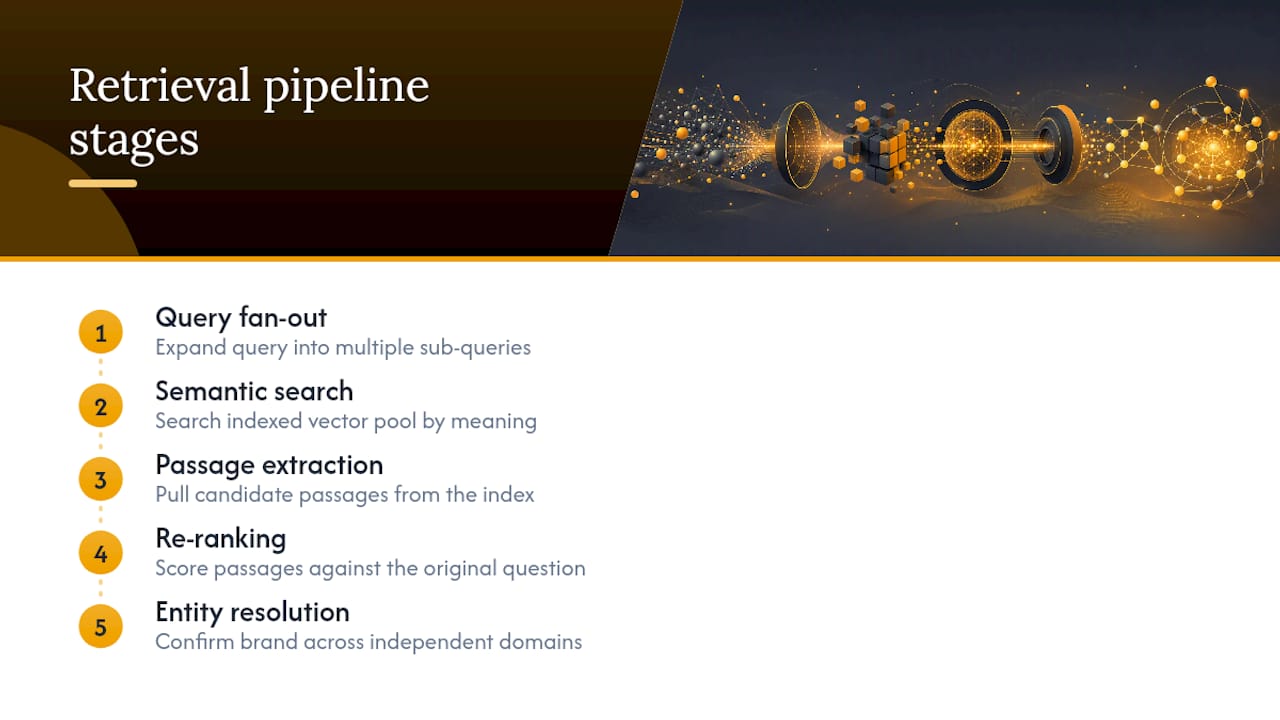
Indexed content is the entire starting pool. If a page isn't indexed, it never gets a chance to be scored, and pages with titles that closely mirror those internal fan-out queries are far more likely to get shortlisted for scraping and citation. Candidate passages then get pulled and re-ranked against the original question, and this is where entity resolution kicks in: the system tries to confirm that "Acme Corp" on your website and "Acme Corp" in a Wikidata entry and "Acme Corp" in a trade article are, in fact, the same entity.
This is what people mean by entity chains. Cross-domain corroboration, your brand mentioned consistently across independent, unaffiliated domains, measurably raises the odds a retrieval pipeline will verify and cite you instead of skipping you for lack of confirmable identity. The operational takeaway: retrieval layers favor short, self-contained paragraphs with a clear subject, consistent naming, and metadata that ties back to a verifiable entity record.
Do ChatGPT, Perplexity, Claude, and Gemini Weigh Sources Differently?
Yes, and treating them as one target wastes budget. Each engine has developed distinct habits for what it trusts and how it extracts answers.
ChatGPT tends to favor cross-domain mention density. The more independent, credible domains mentioning your brand the same way, the stronger your position. Perplexity leans retrieval-first and rewards extractability. Clean structure, clear headings, and passages that answer a question in isolation get pulled more often. Claude has shown a preference for first-party depth. Detailed documentation and long-form owned content carry weight there. Gemini and AI Overviews lean heavily on passage extraction from already top-ranking organic pages, so classic search visibility still feeds that pipeline directly.
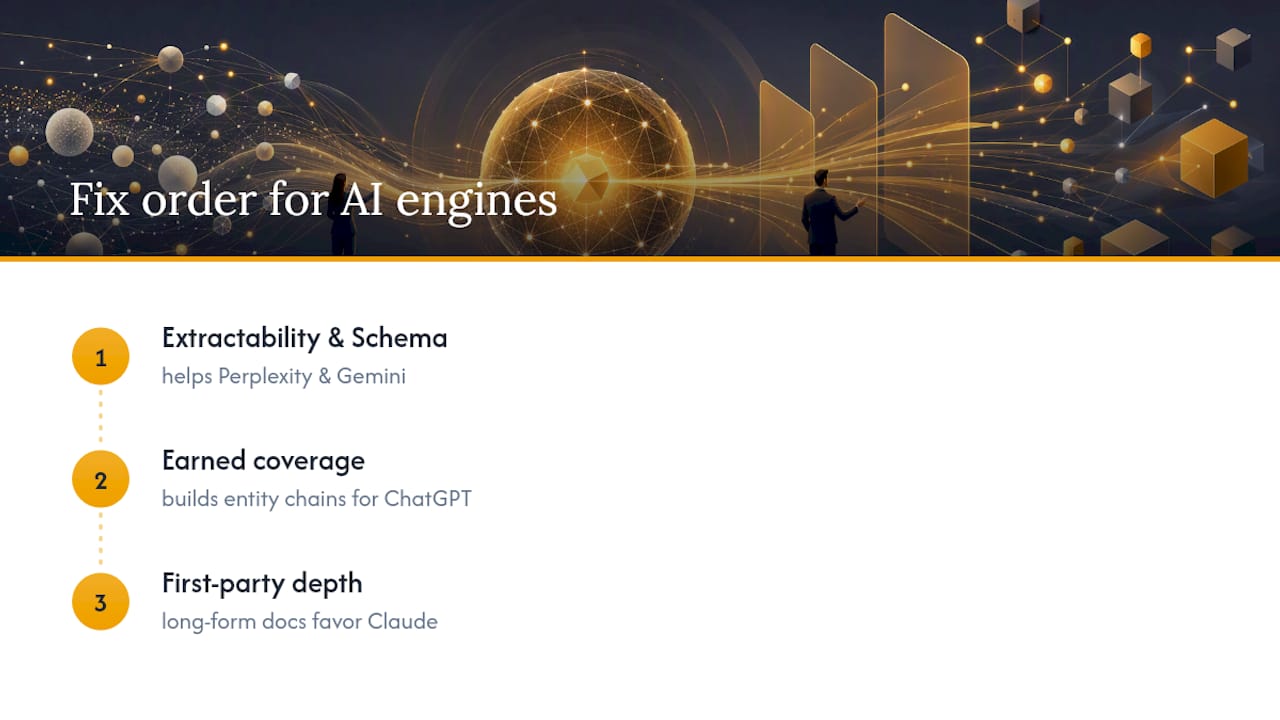
If your team has to triage, the order that tends to pay off fastest is: fix extractability and schema first, since that helps Perplexity and Gemini simultaneously, then invest in earned coverage that builds entity chains for ChatGPT, then round out first-party depth for Claude. Trying to chase all four engines with one generic content push spreads effort too thin. A single well-written paragraph on a page you'd otherwise consider secondary can outperform your top-ranked page if it's the passage that answers the question cleanly, a pattern that shows up consistently across engine citation analyses. Extractability sometimes beats raw authority.
What's on the Technical and Content Checklist for Citations?
Treat this as an audit list, not a wish list. Every item below has a direct line to a retrieval mechanic described above.
- Schema.org completeness: Organization, Product, and Review markup, plus
sameAslinks pointing to your Wikidata, Crunchbase, and LinkedIn profiles, help entity resolution succeed instead of stalling. - Passage hygiene: lead each page section with a short, self-contained answer paragraph, then back it with named data points, quotes, or figures, so a retrieval system can lift the passage cleanly.
- Feed and connector hygiene: sync product feeds using hashed per-item deltas rather than full reindexes, since self-refreshing retrievers can surface catalog changes after the next sync instead of waiting on a manual crawl.
- Cross-domain entity building: pursue mentions on Wikidata, Crunchbase, and trade directories that feed knowledge panels, since verified identity reduces the chance retrieval skips you.
- Review and UGC management: prioritize the two or three platforms your buyers actually check, and monitor sentiment, not just volume.
- Crawlability basics: keep an
llms.txtfile current and confirm AI crawlers aren't blocked in robots.txt.
Pro Tip: Audit your sameAs links quarterly. A stale Crunchbase profile or a Wikidata entry pointing to an old company name breaks entity resolution silently, and you'll never see an error message telling you why citations dropped.
How Do You Measure and Monitor AI Citation Visibility?
Run a recurring audit with four parts: sample the queries your buyers actually type, snapshot which brands get cited today, map your entity chain across domains, and validate your schema against Schema.org's own guidelines.
Track a small set of KPIs consistently: citation share against named competitors, mention frequency across authoritative domains, a composite score similar to an AI Authority Index, and passage-level "wins" where your exact content gets quoted. Monthly cadence works for most teams, with a lighter weekly check during active campaigns.
Controlled experiments matter here. Change one page's structure, schema, or sourcing, then compare citation snapshots against an untouched control page over the same window. That's the only way to prove a specific fix moved the needle rather than crediting a broader industry shift. Tooling ranges from manual query-and-log spreadsheets to dedicated AI brand mention tracking platforms built specifically for this kind of longitudinal monitoring.
What Does a 4-Week AI Visibility Action Plan Look Like?
You don't need a quarter to see movement. A tight month, assigned clearly, gets you real data.
- Week 1: Run a visibility audit against your top 20 buyer queries and map where your entity chain has gaps, missing
sameAslinks, absent Wikidata entries, thin third-party mentions. - Week 2: Ship schema fixes and rewrite your highest-traffic pages for extractability, short definitional openers, named data points, clear H2s.
- Week 3: Secure two or three mentions in authoritative outlets or directories, and publish one original-data asset. Original research and named authorship are consistently among the highest-value content types for earning citations.
- Week 4: Re-run the citation snapshot, compare against week 1, and double down on whichever page type produced the clearest win.
Assign each week to a named owner, content, SEO, or PR, and it stops being a wish list.
Where Does ChatGPT's Original Training Data Come From?
The live retrieval sources above sit on top of a separate foundation: the training data that shaped ChatGPT's baseline knowledge before any live retrieval ever happens. Worth understanding briefly, because it explains why the model has default assumptions that retrieval either confirms or overrides.
Large language models, including ChatGPT, are typically trained on a mixture of large-scale web crawls, most notably Common Crawl, a public archive of scraped web pages going back years, along with digitized books, licensed datasets from publishers and data providers, and curated reference material. This training happens in discrete cycles, not continuously, which is why a model's built-in knowledge has a cutoff date baked in.
That baseline knowledge is static between training runs. It doesn't know about a product you launched last month or a review that posted yesterday, unless a live retrieval layer supplies that context at query time. This is precisely why live sources, the ones covered throughout this article, matter so much for current brand visibility: they're the mechanism that lets an assistant say anything accurate about your business after its training data went stale. Marketing teams sometimes assume fixing "ChatGPT's data" means somehow influencing that training corpus. You can't, practically speaking. What you can influence is everything live retrieval touches.
What Ethical and Privacy Questions Surround ChatGPT's Sources?
Training on web-scraped data raises real questions about consent, copyright, and personal information that ended up in a crawl without anyone's explicit permission. Publishers and authors have pushed back, some through licensing negotiations, some through litigation, over content scraped and used without compensation or a clear opt-out path.
For marketing teams, the more immediate concern lives on the live-retrieval side, not the training side. When an assistant pulls from a review platform, a forum, or a news article to answer a buyer's question, it's surfacing whatever is publicly posted there, accurate or not. A single fabricated forum complaint about your product can get cited alongside verified customer reviews if the retrieval system doesn't weigh source credibility carefully.
That's an argument for taking your own structured data and entity signals seriously. A well-documented, verifiably linked brand presence gives retrieval systems less reason to lean on unverified third-party claims, because your own sources answer the question first and answer it with confirmable identity attached. It's also a reason to monitor sentiment across the platforms feeding these systems rather than assuming silence is safe. Silence just means someone else is currently writing your brand's story for the assistant to retrieve.
Static Training Data vs. Real-Time Retrieval: What's the Difference?
Static training data is frozen at a point in time. It's what the model "knows" without any external lookup, and it doesn't update until an entirely new training cycle runs, which happens infrequently and on the model provider's own schedule, not yours.
Dynamic retrieval is everything discussed earlier in this article: live web content, structured hubs, review platforms, forums, and knowledge bases that a retrieval layer queries fresh at the moment someone asks a question. This is the layer that lets ChatGPT-style assistants mention a product that launched last week or cite a review published yesterday.
The practical consequence for marketing leaders is straightforward. You have essentially no lever over static training data. You have real, measurable leverage over dynamic retrieval, and that leverage compounds. Timely earned coverage combined with live retrieval can shift what an assistant recommends within days or weeks rather than the months a full retraining cycle would require. Every checklist item in this article, schema, extractability, entity chains, feed hygiene, targets the dynamic layer specifically, because that's the only layer that responds to work you do this quarter.
Why AI Visibility Deserves the Same Rigor as Traditional SEO
The teams getting this right treat AI citation the same way they'd treat any measurable channel: baseline it, instrument it, and revisit it monthly, not once and never again. What surprises most marketing leaders is how fast a fix compounds once entity chains are clean. A brand mentioned consistently across four or five independent, verifiable domains stops looking like a rumor to a retrieval system and starts looking like a fact.
The mistake I see most often is treating this as a one-time audit rather than an ongoing program with named owners and a repeatable cadence, the kind an AI search strategy built for CMOs actually requires. Credentials and case studies specific to a given industry vertical will only sharpen that program further as more data accumulates across sectors.
— Geraldine
Turn This Checklist Into a Standing Program
Everything above works as a one-time sprint, but AI citation behavior shifts as engines update their retrieval logic and competitors ship their own fixes. Running the audit once tells you where you stand today. Running it monthly is what actually protects the ground you gain.
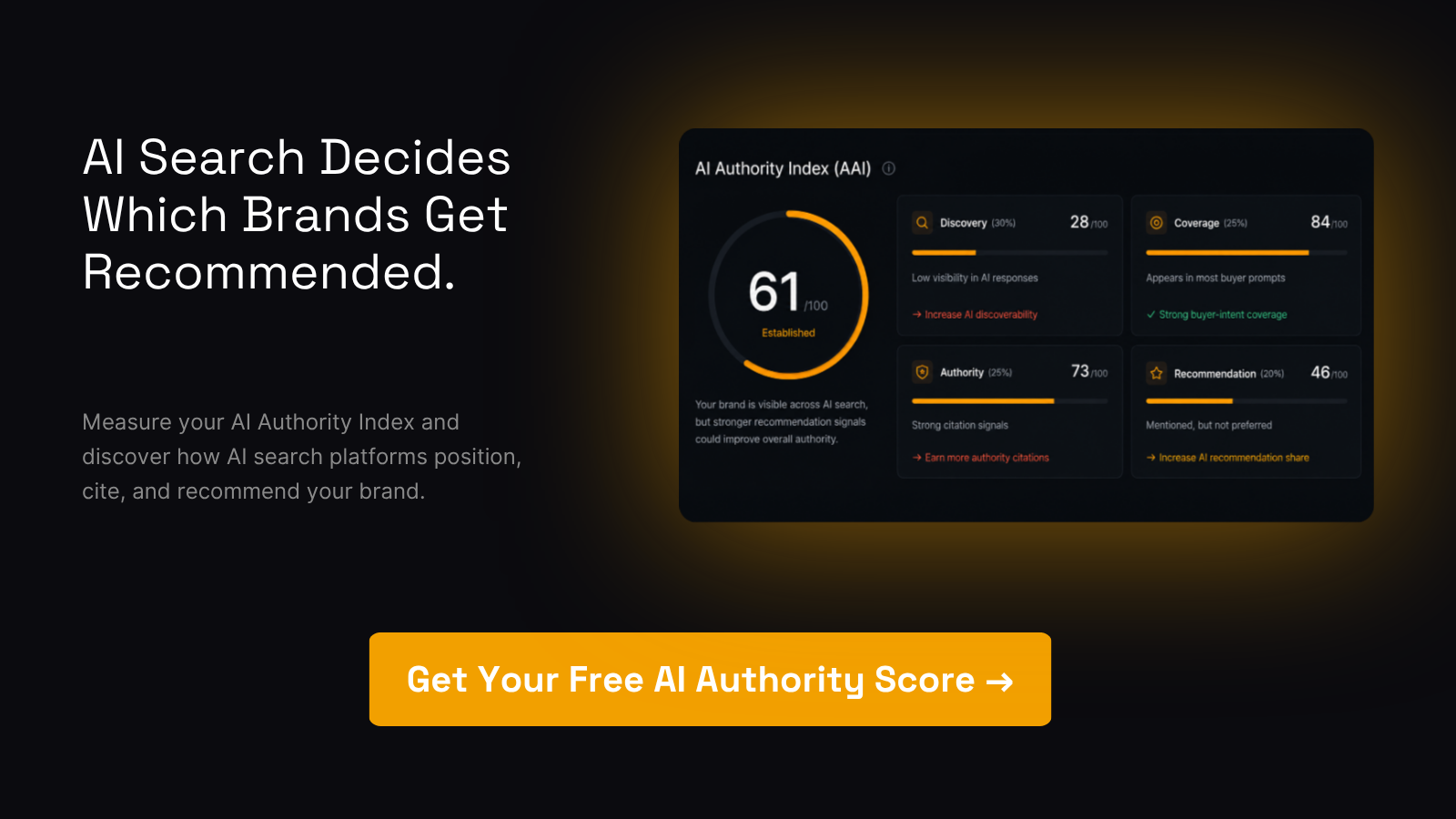
Authoritylayer's Monthly AI Visibility Report turns the 4-week plan into a recurring benchmark: citation share, entity-chain health, and competitor comparison delivered on a schedule instead of rebuilt from scratch each quarter. If your team needs a shared vocabulary before diving in, the AuthorityLayer Academy glossary covers the terms this article uses, and the methodology page explains exactly how the scoring works. Set up a workspace, add the competitors you actually compete against for AI recommendations, and get your first benchmark this week.
Sources and Further Reading for AI Citation Research
For teams building out their own audit process, a few sources stand above the rest. Ahrefs' breakdown of RAG mechanics explains query fan-out and passage extraction in technical detail. MR Research's entity chain analysis quantifies how cross-domain corroboration affects citation odds. Yoast's guide to AI citations offers a clear map of common source classes. For a faster starting point, Babylovegrowth's 90-day AI visibility program lays out a pilot structure, and 121 Group's llms.txt implementation guide covers the crawlability basics this article only summarizes.
Sources
Editorial coverage, product feeds and documentation, review platforms, forums and UGC, and structured knowledge bases like Wikidata make up the primary live retrieval sources influencing brand citations.
- A merchant-agnostic self-refreshing retriever demonstration (arXiv)
- RAG pipelines and entity chain analysis (MR Research)
FAQ
How Is This Different From ChatGPT's Training Data?
Training data is the static, historical corpus the model learned from during a fixed training cycle, while live retrieval sources are queried fresh at answer time and can reflect information published yesterday.
Which Signal Matters Most for Getting Cited?
Cross-domain entity corroboration, your brand mentioned consistently across several independent, verifiable domains, tends to be the strongest single predictor of citation across retrieval pipelines.
How Fast Can Fixes Affect AI Recommendations?
Because many retrieval systems resync regularly rather than waiting for a full retraining cycle, schema and content fixes can influence citations within days to a few weeks.
How Do I Track AI Citation Performance Over Time?
Run monthly query sampling and citation snapshots, or use a dedicated platform like AuthorityLayer's AI Visibility Report to track citation share and entity-chain health against named competitors continuously.