90 Day Playbook for Operators: Turn AI Visibility Into Citation Worthy Content
Turn AI visibility data into a prioritized content engine with a 90 day roadmap, a seven part brief template, and citation worthy production rules.
· 15 min read

Convert AI visibility data into a prioritized content pipeline by finding zero-coverage prompts, turning them into citation-focused briefs, and measuring recommendation share, not just traffic. AuthorityLayer's Monthly AI Visibility Report tracks coverage and citation paths across ChatGPT, Gemini, Claude, and Perplexity. Teams that run this loop consistently see measurable gains in AI recommendation share within a 90-day cycle.
TL;DR:
- Most teams neglect to establish a baseline and instead jump into content creation, risking stalled AI visibility improvements if they don't track key metrics monthly.
- Focusing on zero-coverage prompts with high purchase intent offers the highest leverage for filling content gaps and improving citation share.
- Structuring content with direct-answer sentences, question-based subheadings, named entities, authoritative sources, and schema markup makes pages more citation-worthy for AI models.
- Tracking recommendation share, citation conversion, and downstream engagement provides better evidence of impact than organic traffic alone.
- Using an ongoing, systematic report like AuthorityLayer's Monthly AI Visibility Report helps sustain gains by continuously identifying gaps, competitor citation paths, and trend changes over time.
Table of Contents
- Establish an AI Visibility Baseline and the Metrics You Must Track
- How Do You Analyze AI Visibility Data for Opportunities?
- Building a Prompt Set: What Questions Should You Track?
- From Gap to Brief: A Template You Can Use Today
- What Makes Content Citation-Worthy for AI Assistants?
- Measuring and Optimizing: What KPIs Actually Prove Impact
- A 90-Day Roadmap to Move Your AI Visibility Metrics
- How AuthorityLayer's Monthly Report Operationalizes This Playbook
- Why Most AI Visibility Programs Stall Out
- Turn Your Monthly AI Visibility Report Into a Content Engine
- Sources
- FAQ
Establish an AI Visibility Baseline and the Metrics You Must Track
Before you write a single brief, you need a number to move. Most marketing teams skip this step and jump straight to content production, which is why so many "AI SEO" efforts stall out after one blog sprint. A baseline gives you the before-and-after proof that content leadership actually wants to see in a quarterly review.
Four metrics matter more than the rest:
- Coverage: the percentage of your tracked prompts where your brand appears anywhere in the AI assistant's answer, even a passing mention.
- Recommendation share (AI share of voice): how often you're named as a top pick or direct recommendation versus competitors, across the same prompt set.
- Citation paths: the specific URLs, review sites, or third-party pages the AI model pulls from when it builds its answer, which tell you exactly whose content is winning the citation.
- Prompt frequency and freshness signals: how often a given question gets asked, and how recently the cited sources were updated, since AI assistants tend to favor pages with recent revision dates.
Pull this data from four places: direct AI assistant queries run on a schedule, a structured tool like AuthorityLayer's Monthly AI Visibility Report, crawled competitor and industry URLs to see what's actually getting cited, and your own sales or support call transcripts, which surface the exact phrasing buyers use before they ever type a prompt.
Cadence matters as much as the metrics themselves. Checking once a quarter is close to useless. AI model outputs shift week to week as providers update retrieval systems, so a monthly pull is the practical minimum. For a reliable trend line, track at least 25 to 50 prompts per topic cluster. Anything smaller and a single model update can look like a real shift when it's just noise. This is the same discipline a documented content audit requires before you ever touch a content calendar.
How Do You Analyze AI Visibility Data for Opportunities?
Raw visibility data is not a strategy. It's a spreadsheet full of signals until someone decides which ones are worth acting on first. The job here is triage, not analysis for its own sake.
Start by isolating zero-coverage prompts, the questions where your brand doesn't appear at all across any model. These are your highest-leverage targets because there's no existing content to compete against, only a gap to fill. Rank them by how often the prompt gets asked and how close it sits to a buying decision. A prompt like "best [category] for enterprise teams" that returns zero mentions of your brand is worth far more than a low-frequency, top-of-funnel question.
Next, run citation path analysis on the prompts where a competitor is winning. Open the actual AI answer and look at what it cites. Often it's a comparison page, a review aggregator, or a single well-structured FAQ page with clear named entities. If the cited source is thin, that's a signal you can out-produce it with a stronger, better-sourced page. If it's a deep, data-backed report, that's a harder climb.
Then segment what you find into two buckets:
- Quick wins: prompts where a competitor is cited from a shallow or outdated page, meaning a well-built FAQ or comparison page can realistically take the citation within one or two content cycles.
- Strategic bets: prompts tied to high-value buying decisions where the cited sources are authoritative and entrenched, requiring original data, video, or a multi-page evidence hub to compete.
AuthorityLayer's competitive intelligence data is built for exactly this kind of triage, showing which competitor pages are actually driving citations rather than guessing from search rankings alone.
Pro Tip: Don't just count mentions. Read the actual AI-generated sentence around your brand's mention. A citation buried in a "other options include" list carries far less weight than one in a direct recommendation sentence, even though both count as "coverage" on paper.
Building a Prompt Set: What Questions Should You Track?
You can't improve what you haven't defined. A prompt set is the specific list of questions you monitor across AI assistants, and it needs to reflect how real buyers actually phrase things, not how your marketing team assumes they do.
Pull prompt candidates from four sources:
- Sales call transcripts, where prospects describe their problem in their own words before they know your product category exists.
- Support tickets, which reveal the exact confusions and comparisons customers make after they've already bought.
- Search Console queries, especially long-tail questions with low click-through but high impressions, since those often mirror what people ask AI assistants directly.
- Direct AI answer monitoring, tracking how competitors phrase the same underlying question differently across models.
Once you have a raw list, map each prompt to a content format based on its intent. A prompt asking "what does [category] cost" maps to a pricing or buyer guide. A prompt structured as "X vs Y" maps to a comparison page. A prompt phrased as a direct question, like "does [product type] work for remote teams," maps to a targeted FAQ entry with a direct-answer sentence. Broader research prompts, the kind that ask for context or definitions, map to evidence or use-case pages.
One thing most teams miss: a single prompt rarely stays a single question. Ask an AI assistant "what's the best AI visibility tool for enterprise" and it will often fan that out into sub-questions about pricing, integrations, and accuracy before it gives a final answer. Your brief needs to answer each of those sub-questions directly, not just the parent prompt, or the model will pull its answer from whichever competitor page actually addresses the fan-out. AuthorityLayer's AI search strategy guide breaks down this fan-out pattern in more detail for teams building out a full prompt taxonomy.

From Gap to Brief: A Template You Can Use Today
A visibility gap means nothing until it becomes a brief someone can actually write from. The template below is deliberately rigid, because loose briefs produce loose content, and loose content rarely earns a citation.
Every brief should include seven fixed components:
- The source prompt, written exactly as it appears in your tracking data, not paraphrased.
- Question-based subheadings that mirror the sub-questions the prompt fans out into.
- Direct-answer sentences for each subheading, written as the first sentence under that heading, not buried in paragraph three.
- Named entities the content must include: specific tools, standards, figures, or competitor names relevant to the claim.
- Primary sources to cite for each factual claim, chosen for authority over convenience.
- Schema instructions, specifying whether the page needs FAQPage, Article, or Product markup.
- A freshness plan, stating who owns the page and when it gets revisited.
Score every candidate brief on a simple three-part rubric before it enters the queue: impact (how close the prompt sits to a buying decision, on a scale of 1 to 5), effort (how much original research or design work it needs), and risk (how entrenched the current citation leader is). A brief that scores high impact, low effort, and low risk jumps the queue every time.
Here's how that plays out on an actual gap. Say your tracking shows zero coverage for "how do AI visibility platforms measure recommendation share," a prompt asked frequently by mid-market marketing leaders. Impact scores a 4, since it sits close to a purchase decision. Effort scores low, since you already have the methodology internally. Risk scores low, since the current cited source is a thin glossary page. That combination makes it a same-week brief: a direct-answer FAQ page, named entities including the specific metric definitions, primary sources tied to your own measurement methodology, FAQPage schema, and a quarterly review cadence.
Pro Tip: Write the direct-answer sentence before you write anything else in the brief. If you can't compress the answer into one clean sentence, the prompt probably needs to be split into two separate pages.
What Makes Content Citation-Worthy for AI Assistants?
Production standards separate content that gets cited from content that just gets published. Practitioner consensus across AI search writeups points to six structural elements that consistently show up in pages AI assistants pull from, and skipping any one of them weakens your odds.
- Direct-answer sentences: the first sentence after a heading states the answer plainly, with no throat-clearing lead-in.
- Question-as-subheadings: headings phrased as the actual question a reader or AI model would ask, not a vague topic label.
- Named entities: specific tools, standards, and figures rather than generic category descriptions.
- Authoritative primary citations: links to original data, standards bodies, or documented methodology instead of secondhand summaries.
- Schema.org markup: FAQPage for Q&A content, Article for editorial pages, Product where a specific offering is described.
- Freshness and last-reviewed markers: a visible update date and an internal owner who actually revisits the page.
Pairing written content with a distinct format, an original chart, a short video walkthrough, or a downloadable dataset, makes a page harder for competitors to copy and more likely to get cited than plain text alone.
A byline with a real name and a clear area of expertise adds a trust signal AI models increasingly weigh alongside content structure itself, according to practitioner and SERP-lead consensus on what makes a page "citation-worthy." Structured guidance like AI Overviews optimization and format-specific advice on optimizing content for AI search both reinforce the same pattern: structure and sourcing beat length every time.
Measuring and Optimizing: What KPIs Actually Prove Impact
Traffic is the wrong headline metric for this work, and treating it as the primary KPI will make a genuinely successful program look like it's failing. Track these four instead:
- Coverage percentage: the share of tracked prompts where your brand shows up at all, month over month.
- Recommendation share: how often you're the named top pick versus how often you're just mentioned in passing.
- Citation conversion: the percentage of published briefs that actually get cited within 60 to 90 days of going live.
- Downstream engagement: demo requests, trial signups, or sales conversations that can be traced back to a visitor who first encountered your brand through an AI-generated answer.
Run structured experiments rather than shipping briefs on instinct alone. Test two brief structures against each other, one with a heavier direct-answer format and one with more narrative context, and see which earns citations faster. Test whether pairing an article with a short video changes citation conversion. Test schema on versus schema off across a matched set of pages to isolate its actual effect, since practitioner opinion on schema's weight varies more than on the other five citation-worthy elements.
Set a reporting cadence of once a month, tied directly to your visibility report cycle, and build one decision rule into it: if a published page shows zero citation movement after 90 days, rewrite it from the direct-answer sentence up rather than patching it. If it shows partial movement, a fresh publish date and expanded named-entity coverage is usually enough. AuthorityLayer's brand mention tracking is built to feed this exact reporting loop, tying individual page performance back to overall recommendation share.
A 90-Day Roadmap to Move Your AI Visibility Metrics
Twelve weeks is long enough to see a real trend and short enough to keep the team accountable. Here's how to sequence it.
- Weeks 0 to 2: Pull your baseline visibility report, build your first prompt set of at least 25 questions, and rank the top 10 by impact and effort using the scoring rubric.
- Weeks 3 to 6: Write and publish briefs for those top 10 prompts, applying the seven-part template and the six citation-worthy structural elements to every page.
- Weeks 7 to 12: Re-run your visibility scan, measure citation conversion on the published pages, iterate on anything showing zero movement, and expand the prompt set to the next 20 questions.
Assign four clear roles before week one: an analytics owner who pulls and interprets the monthly visibility data, a brief owner who scores and writes the content briefs, a publishing owner who manages the calendar and freshness reviews, and a schema engineer who implements structured markup correctly across every published page.
| Phase | Focus | Primary Owner | Key Output |
|---|---|---|---|
| Weeks 0–2 | Baseline and prompt set | Analytics owner | Ranked top-10 prompt list |
| Weeks 3–6 | Brief writing and publishing | Brief and publishing owners | 10 published citation-worthy pages |
| Weeks 7–12 | Measurement and expansion | Analytics owner | Citation conversion report, next 20 prompts |
A mid-market team can usually run this with two to three people part-time, though a full-time content strategist speeds up brief quality significantly. Plan for roughly 6 to 10 hours of combined research and writing time per brief when it involves original data or a comparison table, closer to 3 to 4 hours for a straightforward FAQ entry. Governance frameworks like the ones outlined in Canva's content strategy guidance and HubSpot's content planning resource both back this same audit-then-execute sequencing.
How AuthorityLayer's Monthly Report Operationalizes This Playbook
Every workflow described here depends on having reliable, recurring visibility data, and that's the specific gap AuthorityLayer's Monthly AI Visibility Report is built to close. The report surfaces your tracked prompt performance across ChatGPT, Gemini, Claude, and Perplexity, showing exactly which prompts return zero coverage, which competitors are winning citation share, and which specific URLs the AI models are pulling from.
That last piece, citation path visibility, is what turns a vague sense of "we're not showing up" into an actual prioritized list. Instead of guessing which content gaps matter most, teams get:
- A ranked view of zero-coverage prompts by frequency and buying-stage relevance.
- Competitor citation breakdowns showing which specific pages are earning recommendations.
- Month-over-month tracking of recommendation share, so gains from published briefs show up as a trend line, not a one-off snapshot.
AuthorityLayer's own AI visibility metrics guide walks through how to read these reports at the prompt level, which is the same diagnostic habit the analysis section above depends on.
Why Most AI Visibility Programs Stall Out
The programs that fail almost never fail because the content was bad. They fail because teams treat AI visibility as a one-time audit instead of a standing measurement habit, and the gains erode within a quarter as competitors catch up or model behavior shifts.
Three mistakes show up over and over. Teams write strong pages but let entity naming drift, referring to their own product three different ways across five pages, which confuses exactly the kind of pattern-matching AI models rely on. Teams skip schema markup because it feels like a technical afterthought, even though it's one of the few citation-worthy elements a developer can implement in an afternoon. And teams measure success by organic traffic alone, missing the fact that a page can drive real recommendation share with modest click volume, because the AI answer itself is doing the persuading before the reader ever clicks through.
Three things separate the programs that sustain their gains. First, assign a single owner for entity consistency across every published page, not just a style guide nobody checks. Second, build freshness reviews into the publishing calendar itself, not as a someday task. Third, report recommendation share to leadership every month, using the same visibility scan cadence, so the program stays funded past its first flashy result.
Treat this as infrastructure, not a campaign. The teams seeing durable gains are the ones still running their monthly scan a year later, quietly expanding their prompt set while competitors are still debating whether AI visibility is worth measuring at all.
— Geraldine
Turn Your Monthly AI Visibility Report Into a Content Engine
Building a prompt set and scoring rubric from scratch takes real time, the kind most marketing teams don't have a spare quarter to spend on. AuthorityLayer's Monthly AI Visibility Report gives you that infrastructure already built: tracked prompts, competitor citation breakdowns, and recommendation share trends delivered on a recurring cycle instead of a one-time audit you have to remember to repeat.
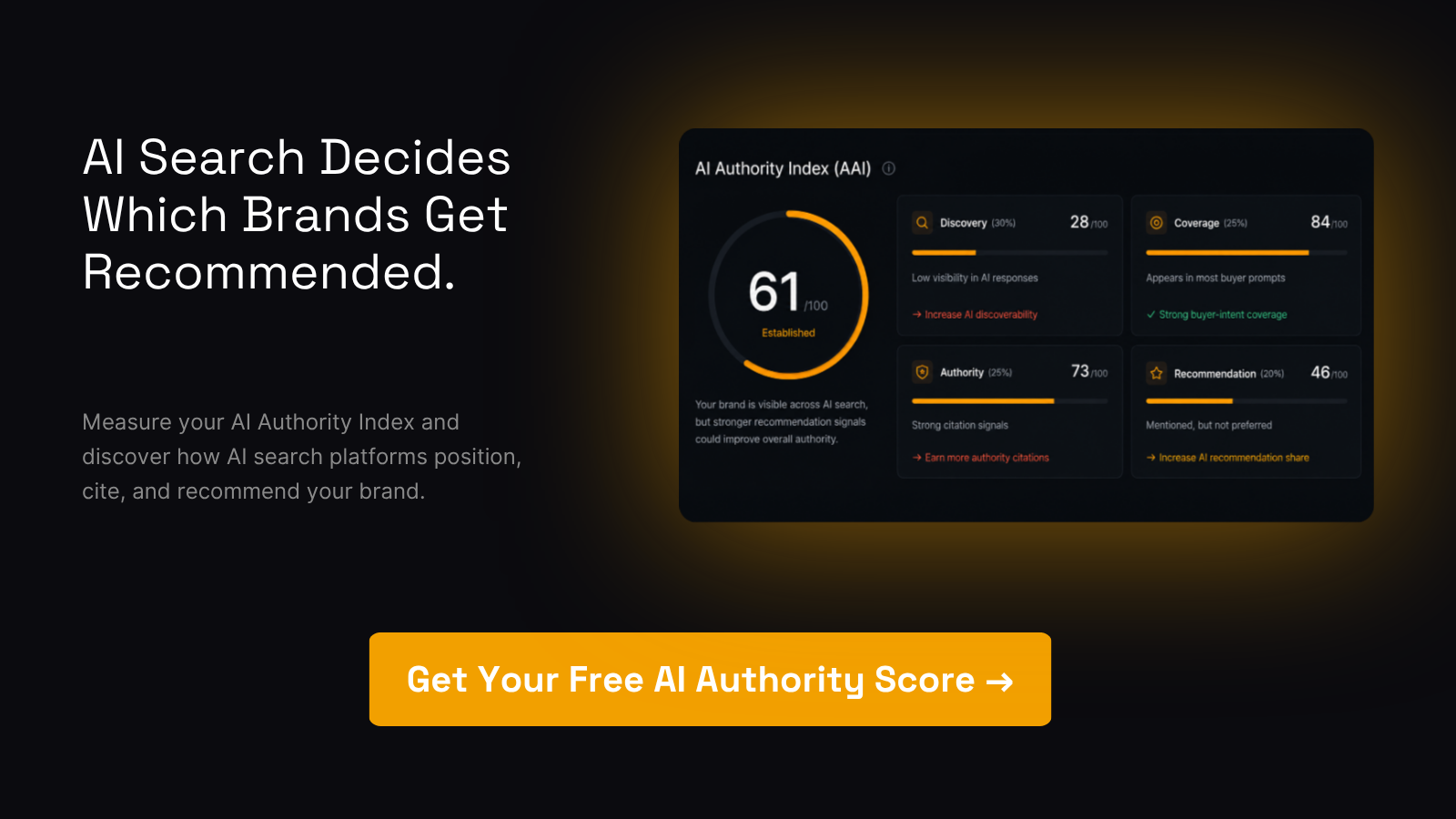
Here's what that report actually gets you. A monthly benchmark showing exactly where your brand stands against named competitors across ChatGPT, Gemini, Claude, and Perplexity. A prioritized list of zero-coverage prompts ready to feed straight into the brief template above, so your content team starts writing instead of guessing. And a tracked trend line on recommendation share, so leadership sees the program's impact in the same report every month, not in a scattered slide deck someone rebuilds each quarter.
If you're still working off manual AI assistant queries and a spreadsheet, start with a free AI visibility scan and see where your zero-coverage gaps actually are before you write another brief.
Sources
- How to Develop a Content Strategy: A Step-by-Step Guide | Coursera
- Content marketing plan | HubSpot Blog
- AI search content strategy | Ryrob
FAQ
What Is AI Visibility Data, Exactly?
AI visibility data measures how often and how favorably AI assistants like ChatGPT, Gemini, Claude, and Perplexity mention or recommend your brand in response to buyer questions, tracked through metrics like coverage and recommendation share.
How Often Should I Check My AI Visibility Baseline?
Check monthly at minimum, since AI model outputs shift as providers update retrieval systems, and track at least 25 to 50 prompts per topic cluster for a reliable trend line.
What's a Zero-Coverage Prompt?
A zero-coverage prompt is a tracked question where your brand doesn't appear anywhere in the AI assistant's answer across any monitored model, making it a high-priority content target since there's no existing content to compete against.
Do I Need Schema Markup for AI Citations?
Schema.org markup, particularly FAQPage and Article types, is one of six structural elements practitioners consistently associate with pages that earn AI citations, alongside direct-answer sentences and named entities.
How Does AuthorityLayer Fit Into This Workflow?
AuthorityLayer's Monthly AI Visibility Report supplies the recurring prompt tracking, coverage data, and competitor citation paths that this entire playbook depends on, replacing manual AI assistant queries with a structured monthly benchmark.