ChatGPT Citations: A Scalable Monitoring Playbook for CMOs
Discover how to effectively track ChatGPT citations to enhance brand visibility, gain insights, and stay ahead of the competition.
· 11 min read

ChatGPT citations are the brand mentions, source attributions, and product recommendations that ChatGPT and its sibling AI assistants surface when a buyer asks a research question. Measuring them takes three steps: run a quick manual baseline, move to standardized multi-model monitoring, and then scale with platform-level measurement and remediation. This matters because AI assistants are becoming a discovery layer that sits ahead of your website in the buyer's path, and a brand invisible there loses ground it can't easily see.
- Baseline it manually. Run a fixed set of prompts today and log what comes back.
- Standardize it. Build a repeatable prompt set with cadence and multi-model coverage.
- Scale it. Move to platform-level tracking for trend lines and prioritized fixes.
- Free and simple to start
- Reveals the biggest visibility gaps first
- Sets up the benchmarks you'll need later
Key Takeaways
ChatGPT citation tracking only becomes reliable marketing data once it moves from one-off manual prompts to a standardized, cadenced, multi-model measurement process.
| Point | Details |
|---|---|
| Separate mentions from citations | A name-drop and a sourced URL attribution need different fixes entirely. |
| Manual audits are snapshots | A single account's results reflect one moment, not a stable market pattern. |
| Standardize prompts and cadence | Fixed prompt sets with phrasing variants and set run times cut out noise. |
| Track Free and Plus separately | Training-data presence and live retrievability are different signals. |
| Authoritylayer scales the process | Its Monthly AI Visibility Report turns ongoing multi-model tracking into an executive-ready trend line. |
Table of Contents
- What Counts as a ChatGPT Citation vs. a Brand Mention?
- How Do You Run a Free Manual ChatGPT Citation Audit?
- How Do You Scale ChatGPT Citation Monitoring Across Engines?
- Which Metrics Actually Belong on an Executive AI Visibility Dashboard?
- How Do You Turn ChatGPT Citation Data Into Action?
- How Do You Correct an Inaccurate or Outdated ChatGPT Mention?
- How Do You Benchmark ChatGPT Citations Against Competitors?
- Why AI Citation Measurement Deserves Its Own Budget Line
- Ready to Move From Manual Checks to Continuous Measurement?
- Sources
- FAQ
What Counts as a ChatGPT Citation vs. a Brand Mention?
Not every appearance of your brand name in a ChatGPT response means the same thing, and treating them identically wrecks your reporting. Split every observed output into three buckets. A mention is simply your brand name showing up in the response, with no endorsement attached. A recommendation is the model actively suggesting your brand, often with "best for" or "top choice" language. A sourced citation is when the assistant attributes a URL or named publication, the strongest and most actionable signal because it tells you exactly which piece of content it trusted.
Browsing-enabled modes complicate this further. ChatGPT Free typically answers from what it learned during training, while ChatGPT Plus with browsing pulls live web results, meaning the two can give you contradictory signals for the same prompt in the same week.
- Mention: name appears, no judgment
- Recommendation: explicit endorsement or comparative framing
- Sourced citation: URL or publication named
Pro Tip: Log sentiment and accuracy alongside presence. A mention that's correct and a mention that's wrong both count as "mentioned," but they need completely different fixes.
How Do You Run a Free Manual ChatGPT Citation Audit?
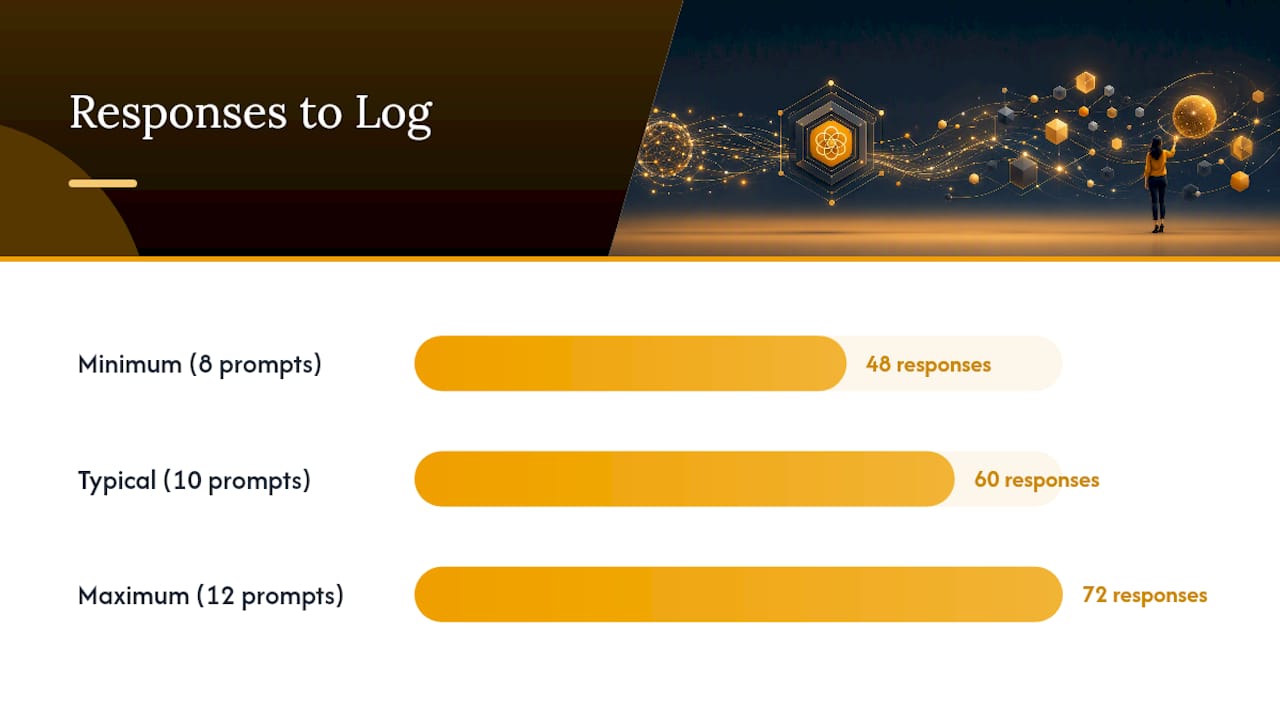
Start with prompts grouped by buyer intent: awareness ("What are the top platforms for [category]?"), comparison ("Compare [Brand A] and [Brand B] for [use case]"), problem-solving ("How do I fix [pain point]?"), and review-seeking ("Is [Brand] worth it?"). Write 8 to 12 concrete prompts across those four buckets and paste them into ChatGPT.
- Run each prompt at least three times, since model outputs vary run to run.
- Test both Free and Plus (or browsing-enabled) modes separately when you have access to both.
- Log every response before moving to the next prompt, not after a batch.
| Column | What to record |
|---|---|
| Prompt + intent | Exact wording and category |
| Engine + run number | Free/Plus, run 1/2/3 |
| Mentioned (Y/N) | Brand name present |
| Recommended (Y/N) | Explicit endorsement |
| Cited URL (Y/N + link) | Attributed source, if any |
| Sentiment + competitors named | Tone and rivals surfaced |
A practical version of this sheet, with the same core columns, is outlined by OptimizeCamp. Treat the result as a snapshot. It tells you where you stand today, on your specific account and phrasing, not what a typical buyer sees over time.
How Do You Scale ChatGPT Citation Monitoring Across Engines?
A single afternoon of manual prompts is a baseline, not a measurement system. To make it defensible, you need a standardized prompt library: 10 to 30 fixed prompts split across awareness, comparison, problem, and conversion intent, with three to five phrasing variations per intent so wording bias doesn't skew results. Running multiple phrasing variants and repeat runs is the difference between a real signal and noise from one oddly worded question.
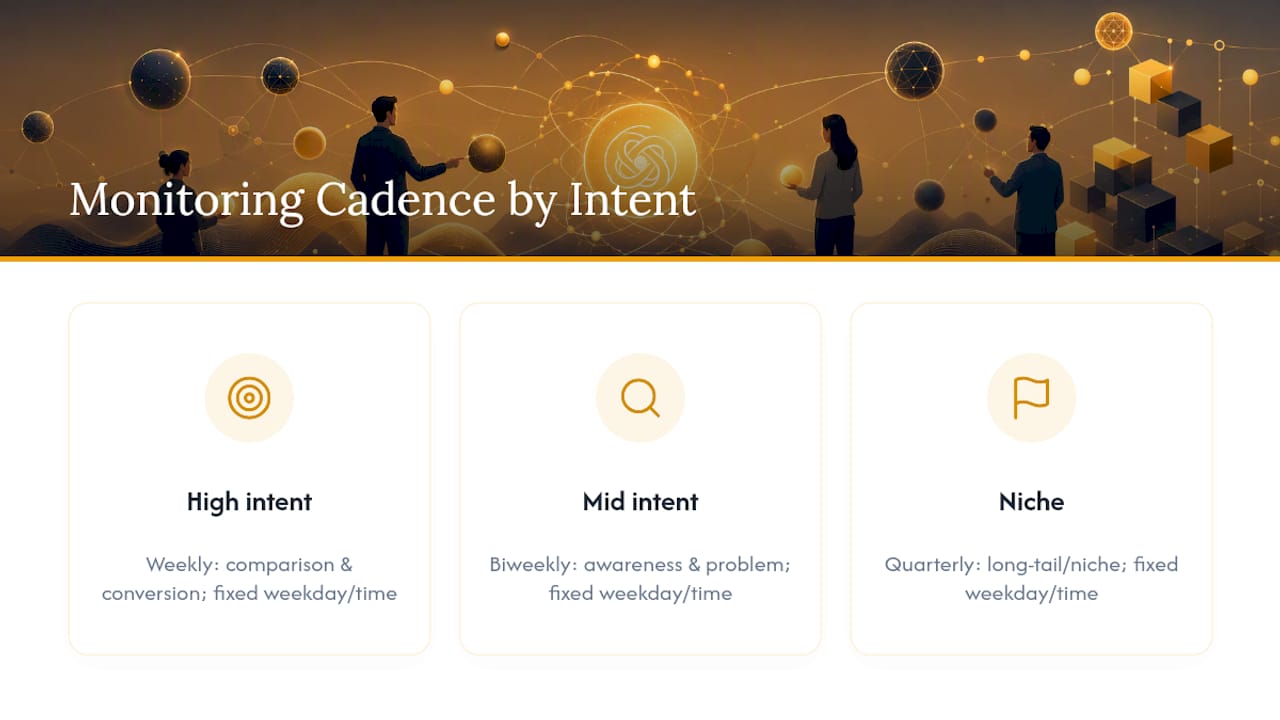
Cadence matters as much as prompt design. High-intent, high-value prompts (comparison and conversion) deserve weekly checks. Mid-intent prompts can run biweekly. Long-tail or niche prompts are fine quarterly. Pick one fixed weekday and time for each tier and stick to it, because running at a consistent cadence and time window cuts out noise caused by daily churn in what the model retrieves from the live web.
Multi-model indexing is the other half of the job. ChatGPT Free, ChatGPT Plus with browsing, Gemini, and Perplexity each draw from different training data and retrieval systems, so a brand can rank cleanly in one and disappear in another. Perplexity in particular surfaces clickable citations that are directly trackable in GA4, which makes it a useful engine for attribution work even though its citation behavior doesn't map cleanly onto ChatGPT's.
Never average Free and Plus results together. Free tells you what's baked into training data; Plus with browsing tells you what's currently retrievable on the live web. Collapsing them into one number hides exactly the gap you're trying to find.
Which Metrics Actually Belong on an Executive AI Visibility Dashboard?
Six numbers matter most. Mention rate is mentions divided by total prompts run. Recommendation share is the percent of recommendation-type responses where your brand gets picked over rivals. Citation rate is the share of responses where the assistant attributes a URL back to your domain specifically. Round that out with sentiment distribution, accuracy error rate (how often the model states something wrong about you), and AI recommendation share vs. competitors.
Layer in a few derived KPIs on top: week-over-week delta on mention rate, share-of-voice across your full prompt set, and a time-to-impact window (generally 4 to 8 weeks between a content fix and a measurable shift in outputs). Source domain concentration is worth tracking too, since a handful of publications tend to dominate what any given assistant cites.
- Mention rate, recommendation share, citation rate
- Sentiment distribution and accuracy error rate
- Week-over-week trend, share-of-voice, time-to-impact
- Source domain concentration across engines
| Point | Details |
|---|---|
| Trend over snapshots | Show mention rate over 8 to 12 weeks, not a single day's result. |
| Top movers | Flag which prompts gained or lost visibility since last cycle. |
| Domain concentration | List which third-party domains the assistant cites most for your category. |
| Prioritized actions | Rank the next three fixes by expected visibility lift. |
How Do You Turn ChatGPT Citation Data Into Action?
Fix the highest-leverage problems first. Prioritize in this order:
- Correct factual inaccuracies on your own canonical pages, since a wrong price or outdated feature list is the easiest win.
- Publish extractable answers: short, direct definitions, clear use-case statements, and explicit pricing that a model can lift cleanly into a response.
- Build supporting citations by earning coverage on third-party publications and review sites the assistants already trust.
Content clusters built around extractable snippets outperform long-form pages here. A model favors a tight, labeled paragraph answering "What is [category] for [use case]?" over a 2,000-word article that buries the answer in paragraph nine.
- Identify the domains your assistants cite most often for your category.
- Pitch content partnerships or guest contributions to those domains.
- Pursue structured review coverage where it's genuinely earned, not manufactured.
For outreach and content prioritization, understanding what actually moves recommendation share helps teams avoid wasting budget on changes that look good but don't shift model behavior.
Expect a 2 to 4 week lag before a content change gets indexed, and 4 to 8 weeks before you see it reflected in prompt outputs. Run an A/B comparison against your fixed prompt set before and after a change, and tie any traffic or conversion lift back to the specific prompts where visibility improved.
How Do You Correct an Inaccurate or Outdated ChatGPT Mention?
When ChatGPT states something wrong about your brand, work the problem in order:
- Identify the likely source. Ask the model directly, or check which domains it tends to cite for similar queries in your category.
- Update your own canonical pages with explicit, unambiguous statements that leave no room for misreading.
- Contact third-party publishers whose pages carry the error, since AI assistants often trust those pages more than your own site.
- Generate a wave of fresh, accurate mentions through reviews, press, and partner content to dilute the outdated signal.
Some errors fade on their own as models retrain and rebuild their indexes, so check whether the issue is a genuine index-lag problem before pouring resources into aggressive correction.
Pro Tip: Prioritize fixing Wikipedia, major review sites, and technical documentation first. High-signal third-party sources like these get weighted heavily when a model builds an extractable answer, so a correction there outperforms a dozen small edits elsewhere.
How Do You Benchmark ChatGPT Citations Against Competitors?
Benchmarking only works with a fixed prompt library run consistently. Calculate share-of-voice as your brand's recommendations divided by total recommendations across all brands named in a prompt set. Track domain citation concentration too, since knowing which three or four sites an assistant leans on for your category tells you exactly where to focus outreach.
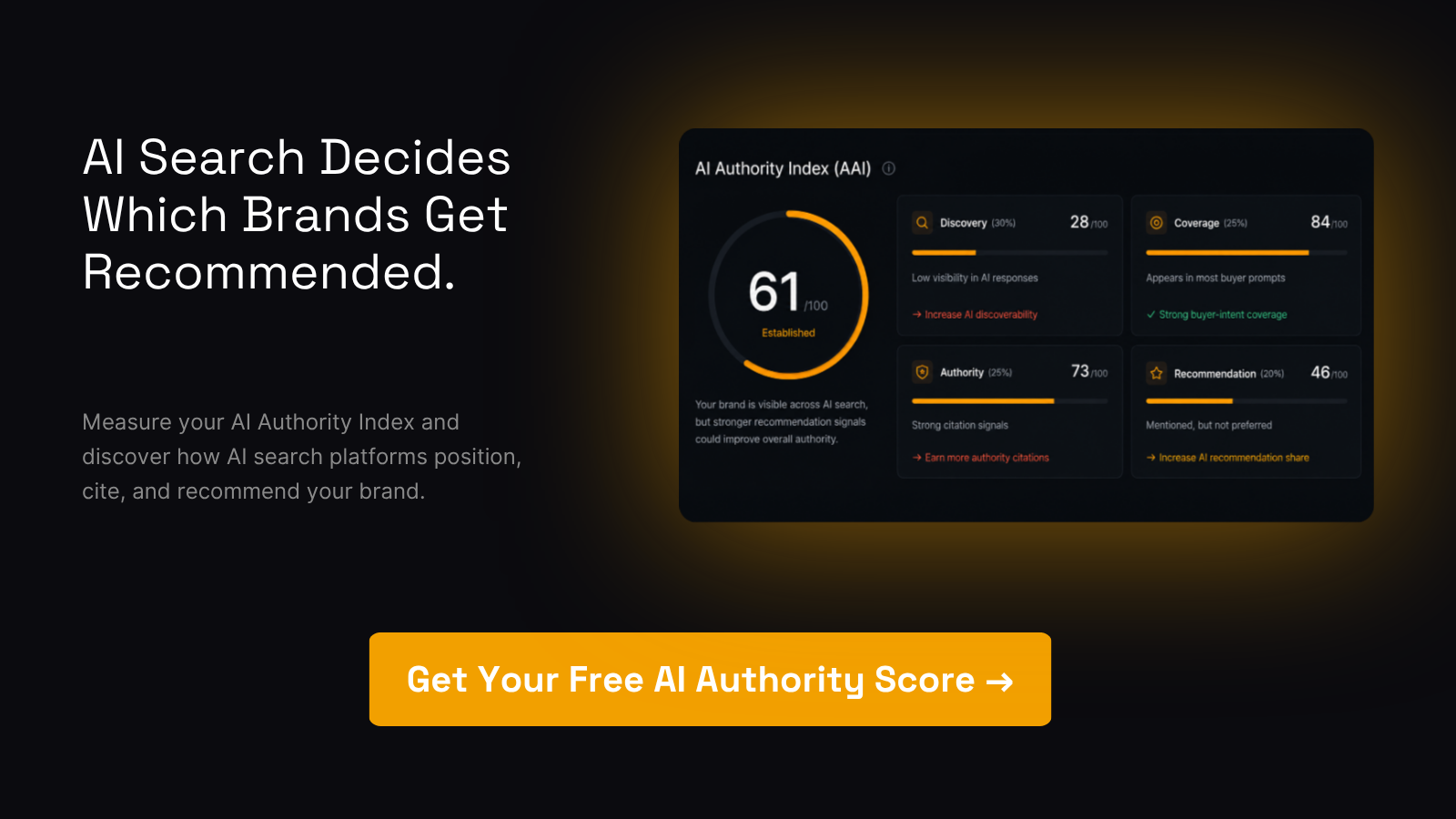
The limitation of DIY tracking shows up fast: spreadsheets get unwieldy past a few dozen prompts, and one person checking ChatGPT on their own account produces a personalized result, not a market picture. A platform approach adds continuous multi-model monitoring, normalized metrics so Free and Plus results don't get blended incorrectly, an AI Authority Index score for tracking authority over time, and trend reporting that shows movement instead of a single data point.
- Continuous monitoring across ChatGPT, Gemini, Claude, and Perplexity
- Normalized cross-engine scoring instead of averaged noise
- Prioritized recommendations ranked by expected visibility impact
- Regular reporting cadence for executive review
A recurring deliverable like a Monthly AI Visibility Report gives marketing leaders a documented trend line to bring into quarterly business reviews, something a one-off manual check can't produce.
Why AI Citation Measurement Deserves Its Own Budget Line
Every marketing channel eventually earned its own reporting line once it started influencing revenue, and AI-assisted buyer research is on that same trajectory now. A brand that shows up accurately and favorably across ChatGPT, Gemini, and Perplexity captures demand before a prospect ever hits a search results page or a competitor's ad.
Someone needs to own this inside the organization: who maintains the prompt set, who signs off on cadence changes, and who actually acts on the findings each cycle. Without an owner, monitoring turns into a one-time audit that gets stale within a quarter. Assign it the way you'd assign SEO or paid media ownership, with a name attached, not a committee.
Ready to Move From Manual Checks to Continuous Measurement?
Authoritylayer replaces the spreadsheet-and-screenshot routine with continuous, normalized tracking across ChatGPT, Gemini, Claude, and Perplexity, so your team stops guessing whether last week's prompt run means anything.
A single manual check on your own account only shows you what one personalized instance of ChatGPT returned on one day, which is exactly why the how it works page walks through standardized prompt sets, repeat runs, and multi-model indexing built to reveal patterns a solo audit can't. If you're weighing whether to build this in-house or start seeing real numbers now, run the free AI visibility scan first, then set up a Monthly AI Visibility Report to get a documented trend line for your next leadership review.
Sources
- How to Track Brand Mentions in ChatGPT (Free + Paid Methods, 2026) | Is My Brand in AI
- How to Monitor Brand Mentions in ChatGPT | Ahrefs
- How to Track Brand Mentions Across ChatGPT, Perplexity, Gemini, and Google AI Overviews - OptimizeCamp
FAQ
What Is a ChatGPT Citation, Exactly?
It's any brand mention, recommendation, or source-attributed URL that ChatGPT surfaces in response to a buyer-research prompt, distinct from a passing name-drop with no endorsement attached.
How Often Should I Check My ChatGPT Citations?
Weekly for high-intent comparison and conversion prompts, biweekly for mid-intent, and quarterly for niche or long-tail prompts, using a fixed weekday and time each cycle.
Can a Manual Audit Replace Ongoing Monitoring?
No. A manual check reflects one account's snapshot on one day; ongoing visibility requires standardized prompts run repeatedly across ChatGPT, Gemini, Claude, and Perplexity.
How Long Does It Take to See Results From a Content Fix?
Expect a 2 to 4 week index lag before changes are crawled, and 4 to 8 weeks before they show up as measurable shifts in AI assistant outputs.
Does Authoritylayer Track Engines Besides ChatGPT?
Yes. Authoritylayer indexes ChatGPT alongside Gemini, Claude, and Perplexity, normalizing results so Free and Plus behavior aren't blended into one misleading number.