AI Overviews Optimization: A Playbook for CMOs
Discover how AI overviews optimization can boost your brand's visibility in buyer conversations. Get actionable steps to enhance your strategy.
· 12 min read

AI overviews optimization means measuring and improving how AI assistants — ChatGPT, Google Gemini, Anthropic Claude, and Perplexity — discover, describe, and recommend your brand in the answers they generate for buyers. This is not about Google's web search feature. It is about your brand's presence inside the conversational layer where B2B buyers increasingly start their research.
Three things to do this week:
- Measure first. Run 30 representative buyer queries across all four assistants and log where your brand appears, how it is described, and whether it is recommended.
- Fix the foundation. Publish or update a dedicated Brand/Entity page and add Organization and FAQ schema so assistants can extract accurate information about you.
- Pick your battles. Select 5 must-win queries and launch a 90-day pilot. Use Authoritylayer to track discovery share and recommendation share from day one.
Table of Contents
- What does AI overviews optimization actually cover?
- Why AI assistant visibility affects your pipeline
- How ChatGPT, Gemini, Claude, and Perplexity generate answers
- Core metrics and a benchmarking framework
- How to run an AI visibility audit
- A practical 90-day implementation playbook
- How to measure ROI and set realistic timelines
- How Authoritylayer solves AI visibility end-to-end
- Key Takeaways
- The measurement gap most teams ignore
- What Authoritylayer gives you that manual tracking cannot
- Useful sources and methodology references
- FAQ
What does AI overviews optimization actually cover?
This guide is scoped to AI assistant discovery: the process by which ChatGPT, Gemini, Claude, and Perplexity decide whether to mention, describe, or recommend your brand when a buyer asks a question. The industry term for this discipline is Generative Engine Optimization (GEO), and AI overviews optimization is its applied, measurement-first form.
In scope:
- Entity authority and Knowledge Panel presence
- Prompt and intent coverage across buyer journey stages
- Discovery share and recommendation share by platform
- Citation and trust signals (third-party mentions, schema, review evidence)
- Cross-LLM consistency and model drift
- Remediation workflows tied to measurable outcomes
Out of scope: optimizing pages for Google's "AI Overviews" web feature, traditional organic ranking tactics, or consumer SEO.
Who owns what: CMOs set strategy and budget. Heads of SEO/GEO own measurement, technical fixes, and prompt tracking. Demand gen leaders connect AI visibility metrics to pipeline reporting and use-case documentation.
Why AI assistant visibility affects your pipeline
Buyers use AI assistants to shortlist vendors before they ever visit a website. If your brand does not appear in those answers, you are not in the consideration set. No consideration means no MQL, regardless of how well your paid media or organic search performs.

The funnel math is direct: lower discovery share produces fewer qualified discovery events, which compresses pipeline at the top. Recommendation share — how often your brand is the one an assistant names when asked to compare options — has an even sharper effect on conversion velocity, because a buyer who arrives having already been told "Brand X is the leading option for this use case" converts faster and requires less nurturing.
Three metrics connect AI visibility to revenue:
- Recommendation share: — the percentage of tracked prompts where your brand is named as a recommended option
Track all three. A brand can have high discovery share and low recommendation share, which means assistants mention you but do not endorse you. That gap is where most enterprise brands leak pipeline.
How ChatGPT, Gemini, Claude, and Perplexity generate answers
Two distinct mechanisms drive what assistants say about your brand. The first is pre-trained knowledge: patterns baked into the model during training, weighted by how consistently and authoritatively sources described your brand at training time. The second is retrieval-augmented generation (RAG), where the assistant runs a live search, retrieves documents, and synthesizes an answer from what it finds right now.
Platform differences matter significantly. Gemini grounds answers on Google Search and the Knowledge Graph; Perplexity runs its own crawler and favors recency; ChatGPT blends pre-trained knowledge with live search when browsing is enabled. Claude leans more heavily on pre-trained representations for many queries. Each platform rewards a slightly different signal mix, which is why cross-LLM measurement reveals where to focus effort rather than assuming one fix works everywhere.
Key signals all four assistants weight:
- Consistent editorial mentions across authoritative third-party sources
- Organization, FAQ, and HowTo schema markup
- Knowledge Panel presence and accurate first-party entity data
- Review evidence and case study citations
- Recent coverage from credible publications
One important limitation: the ARGEO AI Perception Index documents "cross-model drift," where the same brand is described differently across LLMs. A model may mention your brand without endorsing it, or describe your positioning inaccurately. Frequency of mention and semantic authority are not the same thing.
Core metrics and a benchmarking framework
The AI Authority Index converts raw visibility data into a single trackable score. Build it from five normalized metrics, then weight them by business priority.
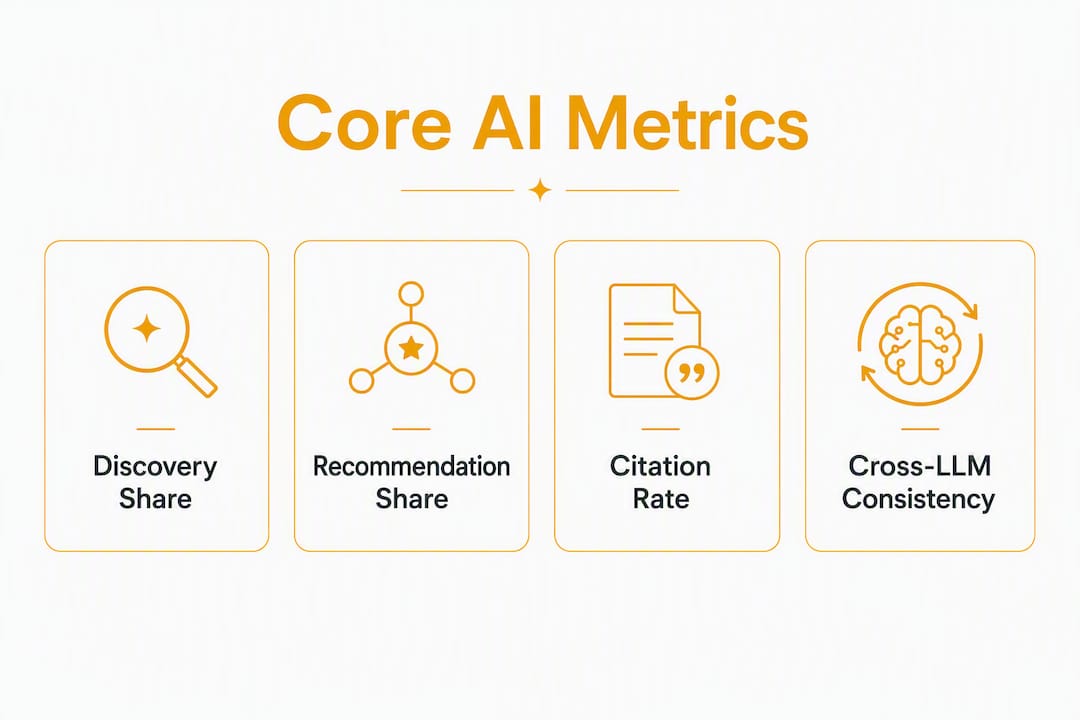
| Metric | How to measure | Sample target (competitive B2B) |
|---|---|---|
| Discovery share | % of tracked prompts where brand appears | strong scores vary by sector, with leaders reaching 15–54% in some categories |
| Recommendation share | % of tracked prompts where brand is recommended | 10% |
| Prompt/intent coverage | % of buyer-journey prompts that surface the brand | — |
| Citation rate | % of answers that link or attribute to owned/earned content | 30% |
| Cross-LLM consistency | Variance in positioning across ChatGPT, Gemini, Claude, Perplexity | Low drift |
Similarweb benchmarks show that strong discovery share scores vary widely by sector, with some leaders reaching high visibility percentages. Build your prompt set to mirror actual buyer queries, and weight decision-stage prompts more heavily when calculating recommendation share. Weekly tracking is the right cadence for competitive categories; monthly is the minimum for trend analysis.
Pro Tip: Assign higher weight to decision-stage prompts in your AI Authority Index formula. A brand that appears in "best X for enterprise" queries is worth more than one that only surfaces in broad awareness queries.
How to run an AI visibility audit
Start with a prompt coverage map: several queries spanning awareness, consideration, and decision stages. Run each prompt across all four assistants and log brand mentions, positioning language, and whether competitors appear instead.
Audit checklist:
- Cross-LLM mention logs with positioning notes
- Knowledge Panel accuracy check (name, description, category)
- Schema audit: Organization, FAQ, HowTo markup present and valid
- Third-party citation inventory: which publications mention you and how
- Review and case study trail across G2, Capterra, and industry press
- Technical crawler check: confirm GPTBot and PerplexityBot are not blocked in robots.txt
Prioritize fixes using an impact-effort matrix. High-impact, low-effort quick wins: FAQ schema on your top 10 pages, a clean Brand/Entity page, and correcting Knowledge Panel inaccuracies. High-impact, high-effort items: earned media placements in tier-one publications and original research with a named methodology. Third-party editorial mentions carry outsized weight relative to self-published content; when multiple authoritative sources repeat the same positioning language, models reproduce it with higher confidence.
A practical 90-day implementation playbook
Quick wins (Week 1–2):
- Publish or update a dedicated Brand/Entity page with structured Organization schema
- Add FAQ schema to your top 10 buyer-intent pages
- Verify GPTBot and PerplexityBot are allowed in robots.txt
- Correct any Knowledge Panel inaccuracies via Google's entity editing tools
- Audit and update directory listings (G2, Capterra, LinkedIn, Crunchbase)
Pilot phase (Weeks 3–10):
- Finalize a 30-question tracked prompt set weighted by buyer intent
- Launch weekly LLM checks across ChatGPT, Gemini, Claude, and Perplexity
- Publish a named framework or methodology with one defensible proprietary data point. Named frameworks are significantly more likely to be cited by assistants than unlabeled tactics, and a single reproducible statistic gives independent outlets something concrete to quote.
- Pitch two to three earned media placements targeting publications your buyers read
- Publish or update one case study with explicit outcome data
Scale (Weeks 11–13 and beyond):
- Automate prompt tracking and integrate AI visibility metrics into weekly marketing reporting
- Expand prompt coverage to adjacent topics and new buyer personas
- Add competitive benchmarking to identify where rivals are gaining recommendation share
How to measure ROI and set realistic timelines
Initial visibility changes often appear within a few months of technical and content fixes. Consistent, measurable lifts in recommendation share generally require several model update cycles.
| Program type | Typical cost components | Expected timeline |
|---|---|---|
| Small pilot | Internal labor + PR outreach + analytics subscription | initial signals may appear within a few months |
| Mid-market program | Analytics platform + content production + PR placements | several months for consistent lift |
| Enterprise program | Full analytics suite + dedicated PR retainer + original research | extended timeline for full category authority |
Authoritylayer fits as an operational analytics cost in all three tiers, replacing manual prompt logging with automated tracking and scoring.
Reporting template: track visibility trend (weekly discovery share by platform), recommendation share delta versus prior period, top prompt wins (queries where rank improved), and downstream pipeline impact by tagging AI-sourced discovery events in your CRM.
How Authoritylayer solves AI visibility end-to-end
Authoritylayer is built specifically for the measurement and remediation workflow described in this guide. The platform maps directly to each stage.
| Capability | What it does | Who uses it |
|---|---|---|
| Real-time prompt tracking | Monitors 30 prompts across ChatGPT, Gemini, Claude, Perplexity | SEO/GEO lead |
| AI Authority Index scoring | Weighted composite score updated on your cadence | CMO, VP Marketing |
| Competitive benchmarking | Discovery and recommendation share vs. named competitors | Demand gen, strategy |
| Prioritized recommendations | Ranked fix list by expected visibility uplift | Content, SEO, PR |
| Cross-LLM consistency reports | Flags model drift and positioning inaccuracies | Product marketing |
The Authoritylayer methodology documents how each metric is calculated, which matters when you need to defend AI visibility spend to a CFO. Teams can validate the scoring approach against the ARGEO AI Perception Index framework, which defines Surface Presence Index, Semantic Composite, and Competitive Dominance Ratio as complementary dimensions.
For teams building AI search strategy from scratch, the Academy provides onboarding resources that walk each role through the platform's modules.
Key Takeaways
AI overviews optimization requires measuring discovery share, recommendation share, and citation rate across ChatGPT, Gemini, Claude, and Perplexity before any remediation work can be prioritized.
| Point | Details |
|---|---|
| Measure before you fix | Run a 30-prompt audit across all four assistants to establish baseline discovery and recommendation share. |
| Schema and entity pages are quick wins | FAQ and Organization schema are among the most extractable signals for LLMs and take days, not months. |
| Named frameworks get cited | Publishing a named methodology with one proprietary data point increases citation probability across models. |
| Timelines are realistic | Initial visibility changes appear in 30–90 days; consistent recommendation share lifts take 2–3 model cycles. |
| Authoritylayer tracks it all | The platform automates prompt tracking, AI Authority Index scoring, and competitive benchmarking across all four assistants. |
The measurement gap most teams ignore
Most marketing teams treating AI visibility as a content problem are solving the wrong thing. The real gap is instrumentation. Teams publish FAQ pages, add schema, and pitch journalists — and then have no idea whether any of it moved their discovery share on Perplexity or their recommendation share on Claude. They are optimizing blind.
The conventional wisdom says "create helpful content and the models will find you." That is partially true, but it misses the compounding dynamic the ARGEO AI Perception Index research makes clear: being cited once increases future citation probability. Models learn from what other models and sources reproduce. If you are not tracking which prompts surface your brand and which surface a competitor instead, you cannot identify the specific queries where a single earned placement or schema fix would shift the answer. You are guessing at a channel that is already influencing your pipeline.
The teams that will own AI assistant recommendation share in their categories are the ones that instrument it now, while most competitors are still treating it as an experiment. That window is not permanent.
What Authoritylayer gives you that manual tracking cannot
Manual prompt logging across four AI assistants, scored weekly, across 50+ queries, with competitive benchmarking — that is a part-time job before you have done anything about the gaps you find. Authoritylayer replaces that with a platform built for exactly this workflow.
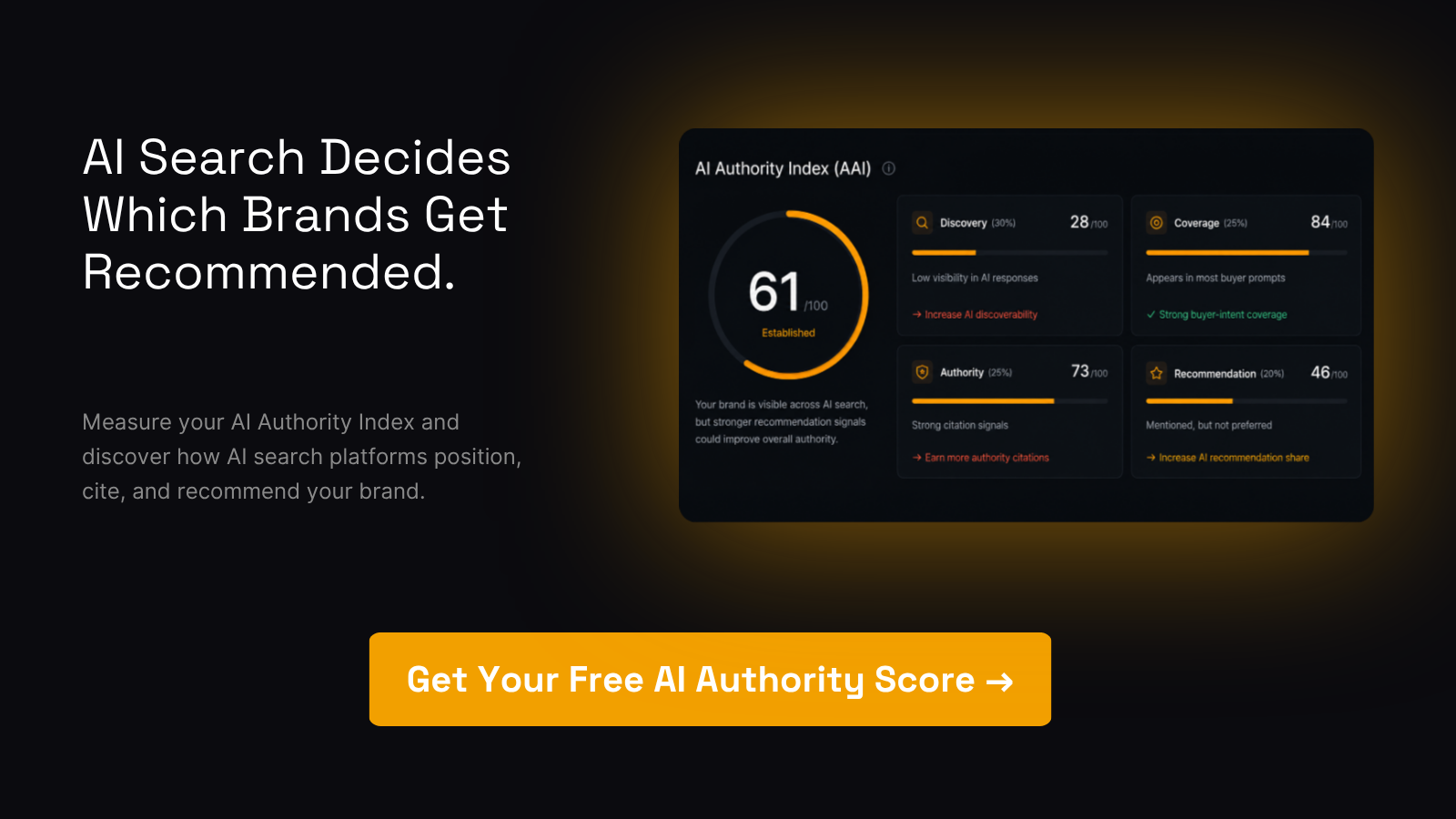
The Authoritylayer Starter plan gives you an immediate visibility scan showing where your brand appears (and does not appear) across ChatGPT, Gemini, Claude, and Perplexity. Enterprise teams get full competitive benchmarking, AI Authority Index scoring, prioritized fix lists, and dedicated support for building the 90-day pilot described in this guide. Request an enterprise demo to see how the platform maps to your existing reporting stack and team structure.
Useful sources and methodology references
- AI Perception Index 2026 — ARGEO AI: multi-dimensional scoring framework for LLM brand representation, including cross-model drift measurement
- AI Brand Visibility Score benchmarks — Similarweb: prompt-set methodology and sector benchmark ranges
- Authoritylayer methodology: scoring and data collection documentation for AI Authority Index validation
- Authoritylayer Academy: onboarding, GEO training, and role-specific learning resources
FAQ
What is AI overviews optimization for enterprise brands?
AI overviews optimization is the practice of measuring and improving how AI assistants like ChatGPT, Gemini, Claude, and Perplexity discover, describe, and recommend your brand in generated answers. It is distinct from optimizing for Google's web-based AI Overviews feature.
Which metrics should CMOs track for AI assistant visibility?
Track discovery share, recommendation share, citation rate, and cross-LLM consistency. Recommendation share has the most direct connection to conversion velocity because buyers who arrive pre-endorsed by an assistant convert faster.
How long does it take to improve AI recommendation share?
Initial visibility changes often appear within 30–90 days of technical and content fixes. Consistent recommendation share lifts generally require 2–3 model update cycles, roughly 2–3 months each depending on the platform.
How does Authoritylayer measure AI visibility?
Authoritylayer tracks a defined prompt set across ChatGPT, Gemini, Claude, and Perplexity, calculates discovery and recommendation share, and produces an AI Authority Index score. The full methodology is publicly documented.
Why do different AI assistants describe my brand differently?
Each assistant uses distinct retrieval logic and training data. Gemini weights Google's Knowledge Graph; Perplexity favors recent crawl results; ChatGPT blends pre-trained knowledge with live search. This cross-model drift means a single fix rarely works across all platforms simultaneously.
Recommended
- AI Search Strategy: A CMO Playbook for 2026 | AuthorityLayer Insights
- Insights — AI Visibility Intelligence Reports | AuthorityLayer
- Best AI Visibility Tools for Marketing Teams in 2026 | AuthorityLayer Insights
- AI Competitive Intelligence: What Actually Moves Recommendation Share | AuthorityLayer Insights