AI Brand Mentions for Marketers: Track, Measure, Act
Discover how tracking AI brand mentions can elevate your marketing strategy. Learn to measure impact and enhance visibility in search results.
· 23 min read

AI brand mentions are the instances where LLM-powered answer engines include, reference, or cite your brand in generated responses. Tracking them is not optional anymore. Bain's analysis found that roughly 80% of search users rely on AI summaries at least 40% of the time, and about 60% of searches now end without the user clicking further. If your brand isn't surfaced in those summaries, you're invisible to a growing share of buyers before they ever reach your website.
Three things you can do right now:
Run manual spot checks. Open ChatGPT, Perplexity, and Google Gemini. Type five prompts your buyers actually use ("best [category] tools for [use case]") and note whether your brand appears, how it's described, and whether a source URL is cited.
Build a minimal prompt library. Prioritize 20–30 queries across discovery, comparison, and purchase-intent stages. These become your repeatable test set.
Set up a capture spreadsheet. Log each run with at minimum: engine, prompt, mentioned (yes/no), cited (yes/no), citation URL, sentiment, and timestamp. That schema is all you need to start trending data.
The first metric to watch is your mention rate: the share of test prompts where your brand appears at all. Everything else builds from there.
Key Takeaways
AI brand mentions are the primary unit of measurement for AI-channel visibility, and tracking them requires a dedicated workflow across multiple engines, not a one-time spot check.
| Point | Details |
|---|---|
| Start with mention rate | Calculate mentions divided by total prompts run per engine; this is your baseline metric before anything else. |
| Test multiple engines separately | ChatGPT and Google AI Overviews disagree on surfaced brands about 62% of the time; single-engine checks mislead. |
| Capture three fields minimum | Log mentioned (yes/no), cited (yes/no), and sentiment for every response to build trend-ready data. |
| Improve citations with content structure | Answer-first formatting, FAQ schema, and consistent brand naming increase citation share faster than any technical fix. |
| Authoritylayer automates the framework | The platform tracks cross-engine mention rate, citation share, AI SoV, and sentiment with an AI Authority Index score. |
Table of Contents
- What are AI brand mentions, exactly?
- Why AI brand mentions matter for your marketing metrics
- How AI monitoring differs from traditional brand tracking
- Which answer engines should you check first?
- Core metrics to measure and how to calculate them
- A repeatable workflow for tracking AI brand mentions
- How to evaluate AI brand-monitoring tools
- Common challenges and how to handle them
- Tactics to increase positive AI mentions and citations
- Typical timelines and costs for AI brand monitoring
- A sample AI-visibility measurement framework
- How to integrate AI mention data with your marketing stack
- Legal and ethical considerations in AI brand monitoring
- The AI visibility shift is moving faster than most teams realize
- Authoritylayer gives you a complete picture of your AI visibility
- Sources
- FAQ
What are AI brand mentions, exactly?
The industry term for this measurement category is AI visibility, and the unit of measurement matters more than most teams realize. There are three distinct types to track.
Explicit mentions are the clearest: the AI engine names your brand in its response. "Acme Software is a strong option for mid-market teams" is an explicit mention. You can detect these with keyword matching.
Citations are a subset of explicit mentions where the engine also attributes a source URL. Perplexity does this consistently, numbering its sources. ChatGPT does it far less reliably. A citation is more valuable than a bare mention because it signals that the engine trusts a specific page on your site enough to surface it as evidence.
Implicit references are the trickiest. The engine describes your product's capabilities or positioning without naming you. "A platform that scores AI recommendation share across ChatGPT, Gemini, and Claude" could describe Authoritylayer without ever saying the name. These matter when a competitor is being described in terms that should apply to you, or when the engine has your facts wrong.
A practical example: if a buyer asks Perplexity "which AI visibility platforms benchmark competitor mentions," and the response names three tools with numbered citations but omits your brand, that is a measurable visibility gap. The fix is different depending on whether you're missing from the training data, uncited on the web, or simply outranked by a competitor's more extractable content.
Why AI brand mentions matter for your marketing metrics
The shift from page rank to answer inclusion changes which numbers actually predict revenue. When a buyer asks an AI assistant for a recommendation and gets a shortlist, the brands on that list capture the consideration. The brands off it don't get a second chance in that session.
Bain's research makes the stakes concrete: with 60% of searches ending without a click, zero-click discovery is no longer an edge case. It's the dominant mode. Your brand either wins in the answer or it doesn't win at all.
KPIs that shift as a result:
- Mention rate replaces click-through rate as the first signal of AI-channel discoverability.
- AI share of voice (your brand mentions divided by total brand mentions across a prompt set) replaces organic share of voice for AI-driven queries.
- Citation share tracks what percentage of your mentions include a source URL, which predicts referral traffic from AI surfaces.
- Sentiment in AI responses affects whether a mention converts. A mention that describes your product as "expensive" or "complex" can actively hurt conversion even while boosting raw mention count.
- Cross-engine coverage shows whether your visibility is concentrated on one platform or distributed, which matters for risk management.
Adobe's guide to tracking brand mentions in AI search frames this well: visibility is now defined by inclusion in generated answers, not by where a page ranks. That reframe has direct consequences for how marketing teams allocate content and PR resources.
How AI monitoring differs from traditional brand tracking
Classic brand monitoring tools, including Google Alerts and most social listening platforms, scan indexed web content for keyword mentions. They tell you when someone publishes a page that names your brand. That's useful, but it misses the layer where AI-generated answers live.
Semrush's brand mentions guide acknowledges the gap directly: AI visibility requires tracking mentions inside generated answers and tracking which pages are cited when citations appear, not only monitoring indexed page mentions. The metrics are different, the data sources are different, and the feedback loop is slower.
Three specific ways the old assumptions break:
Rank vs. inclusion rate. In SEO, you track position 1–10. In AI monitoring, the question is binary first: are you in the answer at all? Position within the answer matters secondarily. A brand mentioned third in a Perplexity response is still in the consideration set. A brand not mentioned is not.
Backlinks vs. citation share. Backlinks predict ranking. Citation share predicts how often AI engines surface your content as a source. The correlation exists but it's imperfect. A highly linked page with dense, jargon-heavy prose may be cited less than a shorter, answer-first FAQ that an engine can extract cleanly.
Spot-check vs. repeated sampling. This is where most teams get burned early.
ChatGPT and Google AI Overviews disagree on which brands to surface about 62% of the time for the same query. A single check on one engine tells you almost nothing reliable.
Answer variability is real. The same prompt run twice on the same engine can return different brand mentions depending on the model version, browsing mode, and randomness in the generation process. Reliable monitoring requires repeated sampling across multiple engines, tracked separately.
Google Alerts remains useful for catching web-published mentions, but it does not capture AI-generated answers or engine-specific citations. It's a complement, not a substitute.
Which answer engines should you check first?
Not all AI platforms behave the same way, and testing all of them equally from day one is a fast path to wasted effort. Prioritize based on citation transparency and audience reach.
- Perplexity is the best starting point for citation analysis. It consistently provides numbered source citations, making it straightforward to see which URLs the engine trusts for a given query. Perplexity's citation behavior makes it a practical early-warning signal for citation loss. If your brand drops out of Perplexity's cited sources, that's a high-confidence signal worth acting on.
- ChatGPT (OpenAI) has the largest user base and the most varied behavior. Free-tier ChatGPT draws from training data with a knowledge cutoff; ChatGPT Plus with browsing enabled pulls live web content. Track these separately. A mention in ChatGPT Free reflects your historical web presence; a mention in ChatGPT Plus reflects your current indexed content and citation profile.
- Google Gemini and Google AI Overviews matter most for brands whose buyers still start searches on Google. AI Overviews appear at the top of results for a growing share of queries, and inclusion there drives significant zero-click exposure. Gemini's behavior in standalone chat differs from AI Overviews, so test both surfaces.
- Claude (Anthropic) skews toward professional and technical users. Its answers tend to be more nuanced and less brand-forward than ChatGPT's, but it's increasingly used in enterprise research workflows. Worth including in your prompt library for B2B brands.
- Microsoft Copilot and vertical assistants (shopping assistants, customer service bots, industry-specific tools) are worth tracking if your buyers use them. Copilot's Bing integration means its citation behavior is more transparent than ChatGPT's.
Sampling strategy: run each prompt set at minimum weekly. Test each engine in its default mode and, where applicable, in browsing mode. Log the run mode alongside every result. Multi-engine testing is non-negotiable because engines diverge substantially on which brands they surface for the same query.
Core metrics to measure and how to calculate them
Precision here matters. Vague tracking produces vague insights.
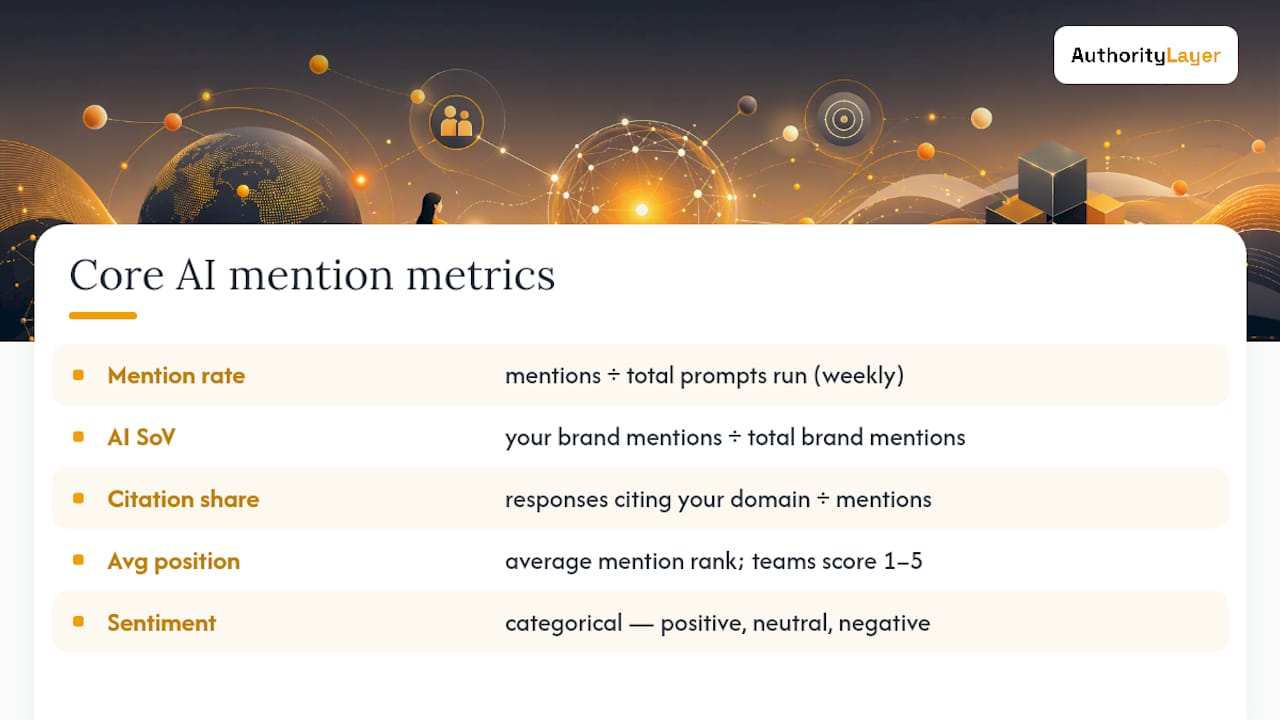
Mention rate = (number of prompts where brand is mentioned) / (total prompts run). This is your baseline. Track it weekly per engine.
AI share of voice (SoV) = (your brand mentions) / (total brand mentions across all responses in the prompt set). This is the competitive metric.
Citation share = (responses that cite a URL from your domain) / (total responses where your brand is mentioned). A high mention rate with a low citation share means the engine knows your brand but isn't trusting your content as a source. That's a content and authority problem, not a brand awareness problem.
Average position in AI recommendations tracks where in the response your brand appears. First mention in a list of five is meaningfully different from fifth. Some teams score this 1–5 and average it across the prompt set.
Sentiment is categorical: positive, neutral, or negative. Log it per mention. A brand that appears frequently but is consistently described as "expensive" or "complex" has a different problem than a brand that's simply absent.
Pro Tip: Set a threshold alert: if your mention rate drops more than 10 percentage points week-over-week on any single engine, treat it as a priority investigation. That magnitude of shift usually signals a model update, a competitor content push, or a citation loss on a key page.
The LLM Pulse category of tools is emerging specifically to automate these calculations across engines, but the formulas above are fully implementable in a spreadsheet for teams starting out.
A repeatable workflow for tracking AI brand mentions
This is the operational core. Follow it in order and you'll have defensible data within two weeks.
- Define your objectives and target prompts. What decisions will this data inform? Brand positioning, content investment, PR targeting? Objectives determine which prompt types matter most.
- Build a prioritized prompt library. Aim for 50–100 prompts across three categories: discovery queries ("best [category] tools"), comparison queries ("X vs. Y for [use case]"), and purchase-intent queries ("which [category] platform should I buy"). Include branded and unbranded variants.
- Run multi-engine tests. Execute each prompt on ChatGPT Free, ChatGPT Plus (browsing), Perplexity, Google Gemini, Claude, and any vertical engines relevant to your market. Log the run mode every time.
- Capture the required fields per response: engine name, run mode, prompt text, output text (or excerpt), mentioned (yes/no), cited (yes/no), citation URL, sentiment (positive/neutral/negative), timestamp, and competitor mentions in the same response.
- Normalize and store. Standardize brand name variants (abbreviations, misspellings) before aggregating. Store in a shared spreadsheet or database with consistent column headers.
- Calculate weekly metrics. Compute mention rate, SoV, and citation share per engine. Track trends, not snapshots.
- Set alerts. Flag any week-over-week drop above your threshold. Flag any new negative sentiment mention immediately.
- Benchmark against competitors. Run the same prompt set with competitor brand names substituted. Their mention rate is your competitive baseline.
Tracking three fields per AI response — mentioned, cited, and sentiment — is the minimum viable schema. Everything else is an enhancement.
Prompt examples by category:
- Discovery: "What are the best AI visibility platforms for marketing teams?"
- Comparison: "How does [your brand] compare to other AI monitoring tools?"
- Purchase intent: "Which AI brand monitoring tool should a B2B SaaS company use?"
Pro Tip: Run ChatGPT Free and ChatGPT Plus on the same prompt set and compare results side by side. Divergences reveal whether your visibility gap is a training-data problem (older content, low historical coverage) or a current-indexing problem (recent pages not being cited). The fix for each is different.
How to evaluate AI brand-monitoring tools
Manual checks work until they don't. Once your prompt library exceeds 100 queries or you need cross-engine coverage more than once a week, the hours add up fast. That's the threshold where automation pays.
Tool categories to consider:
- Manual plus free checks. Spreadsheet-based tracking using the schema above, supplemented by free tools like ChatGPT mention checkers that test prompt-level exposure. Best for pilots and teams with fewer than 50 prompts.
- Lightweight mention checkers. Purpose-built tools that automate prompt testing against ChatGPT-style outputs and flag where brands appear or are missing. Useful for validating your manual findings before committing to a platform. A pilot across 50–100 prompts gives a reliable signal for tool evaluation.
- Dedicated AI-visibility platforms. Full-stack solutions that cover multiple engines, automate data capture, calculate SoV and citation share, and surface alerts. Authoritylayer operates in this category, offering cross-engine monitoring, an AI Authority Index score, and prioritized recommendations.
- Enterprise integrations. Platforms that push AI mention data into existing BI tools (Tableau, Looker, Salesforce) via API. Relevant for organizations that need AI visibility data alongside CRM, paid media, and web analytics.
Evaluation checklist before you commit:
- Engine coverage: does it test ChatGPT (both modes), Perplexity, Gemini, Claude, and Copilot?
- Citation capture fidelity: does it log the actual source URL, not just a yes/no flag?
- Data export and API access: can you pull raw data into your own systems?
- Alerting: does it notify you when mention rate drops or negative sentiment spikes?
- Integration with analytics: does it connect to Google Analytics, your CRM, or your BI tool?
- Pricing model: per-prompt, per-seat, or flat subscription? Does it scale with your prompt volume?
For security-conscious enterprise teams, verify data handling practices before sharing proprietary prompt libraries with any vendor. Authoritylayer's security documentation covers its data handling approach for teams running that evaluation.
An AI visibility tools guide from ChatzyBot surveys the broader tooling market and is worth reviewing alongside your evaluation checklist.
Common challenges and how to handle them
Every team hits these. Knowing them in advance saves weeks of confusion.
- Answer variability. The same prompt returns different brand mentions on different runs. Mitigation: run each prompt at least three times per engine per week and use the average, not a single result.
- Citation inconsistency across engines. Perplexity cites reliably; ChatGPT often doesn't. Don't compare raw citation share across engines without normalizing for each engine's baseline citation rate.
- Training-data lag. ChatGPT Free reflects content from its training cutoff, which may be months old. A brand that launched a major content push recently may not see results in training-data-based engines for weeks or longer. Track browsing-enabled engines separately to get a current signal.
- False positives from forum mentions. If your brand name appears in a Reddit thread that an engine cites, that citation may not reflect your owned content. Validate citation URLs and flag third-party sources separately.
- Negative or inaccurate mentions. An engine may describe your product incorrectly or associate it with a problem you've solved. These require manual adjudication and a content response. Prioritize corrections for inaccurate mentions over low-mention-rate fixes.
- Missing citations on high-traffic pages. A page that ranks well in Google but never gets cited in AI answers has a content structure problem. Answer-first formatting and structured data usually fix it.
On ethics and privacy: monitor AI-generated content responsibly. Avoid bulk-scraping user-generated content from platforms where terms of service restrict it. When collecting outputs from AI engines for research purposes, stay within each platform's usage policies. Don't use monitoring data to identify or profile individual users.
Tactics to increase positive AI mentions and citations
Getting mentioned more often in AI answers is a content and authority problem, not a technical one. The engines surface brands whose content is clear, credible, and easy to extract.
- Publish answer-first content. Lead every page with a direct answer to the question the page targets. AI engines extract the first clear, complete answer they find. Burying your answer in paragraph three means getting skipped.
- Use structured data and parseable sections. FAQ schema, HowTo schema, and clearly labeled H2/H3 sections make your content easier for engines to extract and attribute. A page with ten dense paragraphs and no headers is harder to cite than a page with labeled sections and short answers.
- Earn third-party citations via PR and research. AI engines weight content that appears across multiple credible sources. A press release picked up by five industry publications creates five citation opportunities. Original research with a quotable statistic gets cited repeatedly.
- Create canonical short-answer snippets. Write a 2–3 sentence definition or answer for every key concept your brand owns. Place it prominently on relevant pages. These become the extractable passages engines pull verbatim.
- Maintain consistent naming. Use your brand name the same way everywhere: same capitalization, same product names, same category descriptors. Inconsistency fragments your citation profile across sources.
- Build FAQ sections on product and category pages. FAQ content maps directly to the question-and-answer format AI engines prefer. A well-structured FAQ on your pricing page can surface your brand in "how much does X cost" queries.
- Use press releases with factual bullet lists. Structured, factual press releases are among the most-cited content types in AI answers. Short sentences, named facts, and consistent brand naming make them easy to extract.
For a deeper look at how AI models form answers and what content structures they favor, ClawBase's 2026 guide on AI model responses covers the technical mechanics behind extractability.
Typical timelines and costs for AI brand monitoring
| Phase | Duration | Cost Range | Key Output |
|---|---|---|---|
| Quick audit | 1–2 weeks | Internal hours only | Baseline mention rate, prompt library, gap list |
| Pilot monitoring | 4–8 weeks | $0–$100/month (lightweight tools) | Weekly trend data, citation share by engine, first competitive benchmarks |
| Ongoing program | Monthly cadence | $100/month (platform) or custom enterprise pricing | Automated alerts, SoV trends, integration with BI and CRM |
Resourcing typically maps as follows: an SEO or growth lead owns the program and interprets findings; an analyst handles data capture and normalization; a content owner acts on content gaps; a PR or earned-media lead targets citation opportunities; and an executive sponsor receives monthly summary reports tied to business KPIs.
The manual phase costs only time. Many teams find that once their prompt library grows large and weekly tracking is time-consuming, investing in a lightweight paid tool can be cost-effective.
A sample AI-visibility measurement framework
A practical dashboard for AI brand visibility needs five widgets and a scoring formula. Here's a spec you can implement in any BI tool.
AI Authority Score formula (suggested):
AI Authority Score = (mention rate × 0.35) + (citation share × 0.30) + (sentiment score × 0.20) + (cross-engine coverage × 0.15)
Where sentiment score converts categorical labels to a 0–1 scale (positive = 1, neutral = 0.5, negative = 0), and cross-engine coverage is the share of tested engines where your brand appears at least once. Weights are adjustable based on your priorities. A brand in a reputation-sensitive category might weight sentiment at 0.30 and reduce mention rate to 0.25.
Data schema minimum fields: engine, run mode, prompt ID, prompt text, response excerpt, mentioned (boolean), cited (boolean), citation URL, sentiment, competitor mentions, timestamp, analyst ID. Normalize brand name variants before aggregating. Refresh weekly for trend reliability.
This scoring approach aligns with E-E-A-T signals because citation share directly reflects whether authoritative third-party sources are attributing claims to your content. A rising citation share is evidence of growing topical authority, which is exactly what Google's quality raters and AI engines both reward. Authoritylayer's scoring methodology follows a similar weighted-index approach and can serve as a reference for teams building their own framework.
How to integrate AI mention data with your marketing stack
AI brand mention data is most useful when it flows into the systems your team already uses for decisions. Treated as a standalone report, it gets reviewed once and forgotten.

The most practical integration point is your web analytics platform. Map citation URLs from your AI monitoring data against Google Analytics 4 sessions to identify which pages are being cited and whether those citations drive measurable referral traffic. Some AI engines, particularly Perplexity, pass referral data in ways GA4 can capture. Others don't. Track both the citation and the traffic separately and look for correlation over time rather than expecting a clean one-to-one match.
CRM integration matters for B2B teams. If your sales team logs how prospects discovered the brand, add "AI assistant" as a source option in your CRM. Over time, this creates a pipeline-level signal for AI-driven discovery that goes beyond mention rate. Connect it to deal stage and close rate and you have a business case for the monitoring investment.
For teams running paid media alongside AI monitoring, use your AI SoV data to inform keyword and audience targeting. Queries where competitors dominate AI answers but your paid ads appear are a gap worth closing with content. Queries where you lead in AI answers but have low paid coverage represent an opportunity to reinforce a position you've already earned.
Push weekly AI mention summaries into Slack or Teams channels where content, PR, and SEO leads can act on them. A mention rate drop on a specific prompt cluster is a content brief. A new negative sentiment mention is a PR response task. The data is only useful if it reaches the people who can act on it within the same week it's generated.
AI digital marketing strategies from Rooted Up covers how teams are integrating AI-driven signals into broader marketing workflows, including prioritization frameworks for acting on the data.
Legal and ethical considerations in AI brand monitoring
Monitoring AI-generated content sits in a legal gray area that's evolving fast. A few principles apply now.
Terms of service compliance. Every major AI platform (OpenAI, Anthropic, Google, Perplexity) has terms of service that govern automated querying. Bulk automated scraping of AI outputs may violate these terms. Review each platform's API terms before building automated monitoring at scale. Using official APIs (where available) is safer than scraping web interfaces.
Copyright in AI outputs. AI-generated text that includes excerpts from your content or a competitor's content raises questions about copyright ownership and fair use. The legal framework in the United States is still developing. For monitoring purposes, logging short excerpts for internal analysis is generally defensible under fair use, but republishing AI-generated content that includes third-party material is riskier.
Defamation and inaccurate AI mentions. If an AI engine makes a false factual claim about your brand, you have a legitimate interest in correcting it. The mechanism for doing so is content-based: publish clear, authoritative corrections that engines can find and cite. Pursuing legal remedies against AI platforms for generated content is largely untested in U.S. courts as of 2026.
Privacy in prompt data. If your prompt library includes customer names, deal details, or other personally identifiable information, treat that data with the same care as any customer data. Don't share proprietary prompts with third-party monitoring vendors without reviewing their data handling and privacy policies.
Competitive intelligence limits. Monitoring competitor mentions in AI answers is legal and standard practice. Using AI monitoring to harvest competitor pricing, customer lists, or trade secrets crosses into territory that may implicate trade secret law or the Computer Fraud and Abuse Act depending on the method.
This is general information, not legal advice. Confirm current platform terms and applicable law with qualified legal counsel before deploying automated monitoring at scale.
The AI visibility shift is moving faster than most teams realize
Most marketing teams are still treating AI brand monitoring as a future problem. It isn't. The buyers who use ChatGPT, Perplexity, and Google AI Overviews to research purchases are doing it right now, and the brands that show up in those answers are capturing consideration that never reaches a search results page.
What strikes me most about the current moment is how much the measurement gap resembles the early days of social media monitoring. In 2010, most brands had no systematic way to track what was being said about them on Twitter or Facebook. The teams that built that capability early had a real advantage: they could respond faster, correct misinformation sooner, and spot competitive shifts before they showed up in sales data. AI brand monitoring is at exactly that inflection point.
The teams I see moving fastest aren't waiting for perfect tooling. They're starting with a spreadsheet, a prompt library, and 30 minutes a week. They're building the muscle before the budget arrives. And when the budget does arrive, they have baseline data that makes the business case obvious.
The brands that will own AI-generated recommendation share in 2027 are the ones building their measurement infrastructure now, not the ones waiting to see how the technology settles.
Authoritylayer gives you a complete picture of your AI visibility
Most teams discover their AI visibility gap the hard way: a prospect mentions they found a competitor through ChatGPT, and no one on the team has any data on why. Authoritylayer is built specifically to close that gap, giving marketing and SEO teams a real-time view of how AI assistants like ChatGPT, Claude, Gemini, and Perplexity discover, describe, and recommend their brand during buyer research.
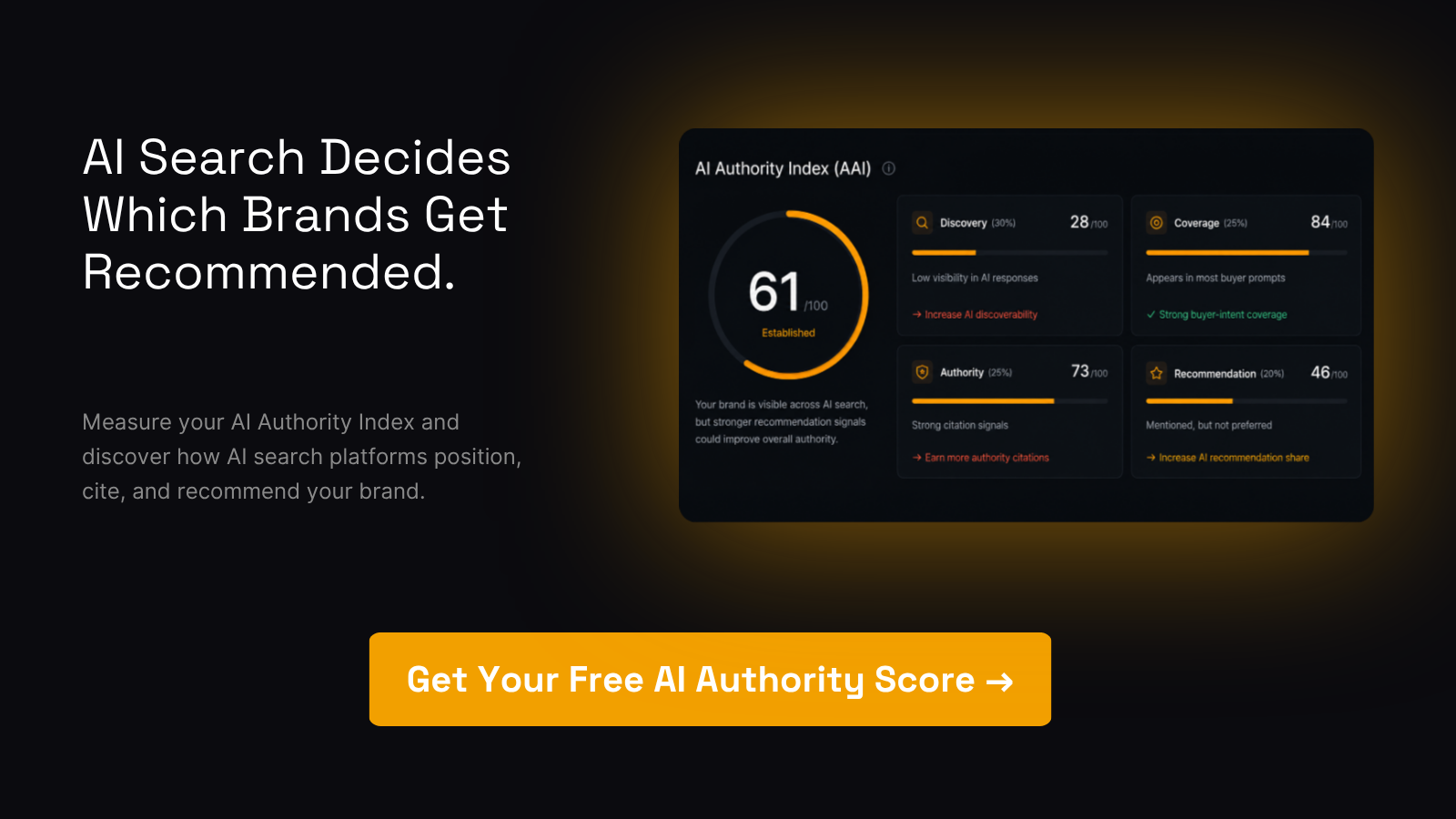
The platform covers the full measurement framework described in this guide: cross-engine mention rate, citation share by domain, AI share of voice against named competitors, sentiment tracking, and an AI Authority Index score that weights those signals into a single benchmark. It maps directly to the evaluation checklist in the tools section: multi-engine coverage, citation URL capture, data export, alerting, and integration with your existing analytics stack.
For teams ready to move beyond manual spot checks, the free AI visibility scan runs your brand against a prioritized prompt set and returns a baseline report you can act on immediately. Starter, Growth, and Enterprise plans are available at Authoritylayer for teams scaling from pilot to ongoing program.
Sources
- How to Track Brand Mentions in ChatGPT (Free + Paid Methods, 2026) | Is My Brand in AI
- Consumer reliance on AI search results signals new era of marketing — Bain & Company
FAQ
What are AI brand mentions?
AI brand mentions are instances where an LLM-powered answer engine includes, names, or cites your brand in a generated response. They differ from web mentions because they appear inside AI-generated answers rather than on indexed pages, and they directly affect whether buyers discover your brand during AI-assisted research.
How do you track brand mentions in AI search?
Build a prompt library of 50–100 queries your buyers use, run them across ChatGPT, Perplexity, Gemini, and Claude, and log whether your brand is mentioned, cited, and described positively or negatively. Track ChatGPT Free and ChatGPT Plus separately, since they reflect different signals.
Which AI platforms should you check for brand mentions?
Perplexity is the best starting point for citation analysis because it provides numbered source URLs consistently. ChatGPT has the largest user base and requires testing in both free and browsing modes. Google AI Overviews matter most for brands whose buyers search on Google.
How is AI brand monitoring different from social media monitoring?
Social media monitoring tracks mentions on indexed, user-generated content. AI brand monitoring tracks whether your brand appears in AI-generated answers, which are not indexed pages and require direct prompt testing to measure. The metrics (mention rate, citation share, AI share of voice) are also distinct from social listening KPIs.
How can you increase your brand's mentions in AI answers?
Publish answer-first content with clearly labeled sections and FAQ schema, earn third-party citations through PR and original research, and maintain consistent brand naming across all content. These tactics improve both the frequency of mentions and the likelihood that AI engines cite your pages as sources.