AI Competitive Intelligence: What Actually Moves Recommendation Share
Unlock the power of AI competitive intelligence. Discover how to boost your recommendation share with actionable insights. Run your free AI visibility scan!
· 13 min read

AI Visibility Intelligence is the discipline of measuring and improving how AI assistants like ChatGPT, Claude, Gemini, and Perplexity discover, describe, and recommend your brand during buyer research. If you're a marketing or SEO leader, the most useful thing you can do right now is establish your baseline: run a free AI visibility scan to see your current recommendation share and confidence scores before you do anything else. This guide is for CMOs, heads of SEO, and demand generation leaders who need to understand the mechanics, measure the right signals, and build an operational program around them.
Here's what you need to know at a glance:
- AI assistants are increasingly the first stop in B2B buyer research, making recommendation share a new channel KPI alongside organic traffic and paid reach.
- Generic chatbots cannot reliably track competitor moves or measure your own visibility without purpose-built retrieval and source-linking.
- The primary metric to track is recommendation share: how often AI assistants surface your brand for relevant buyer queries.
- Authoritylayer measures recommendation share, benchmarks competitors, and provides prioritized fixes so marketing teams can act on what they find.
What is AI Visibility Intelligence and how does it differ from traditional SEO?
Traditional SEO optimizes for ranking positions in search engine results pages. AI Visibility Intelligence targets a different layer entirely: whether and how AI assistants surface your brand when a buyer asks a question like "What's the best CRM for mid-market sales teams?" The output isn't a blue link. It's a named recommendation, often with a confidence level and cited sources.
The business impacts are concrete:
- Discoverability in chat assistants: Buyers who never click a search result still encounter brand recommendations through AI-generated answers.
- Recommendation share: The percentage of relevant queries where your brand appears in an AI-generated response, tracked over time.
- Deal-level insights: AI can synthesize call transcripts, win-loss data, and competitor moves into deal-specific guidance for sellers.
- Sales enablement: Reps get real-time competitive context without manually hunting for it.
- Brand risk detection: A drop in recommendation share or a shift in how an assistant describes your product can signal a positioning problem before it shows up in pipeline.
How do AI assistants actually discover and recommend brands?
The core mechanic is retrieval → grounding → ranking → recommendation. An assistant receives a query, retrieves relevant documents from connected sources, grounds its response in those documents, ranks candidate answers by relevance and confidence, and then produces a recommendation.
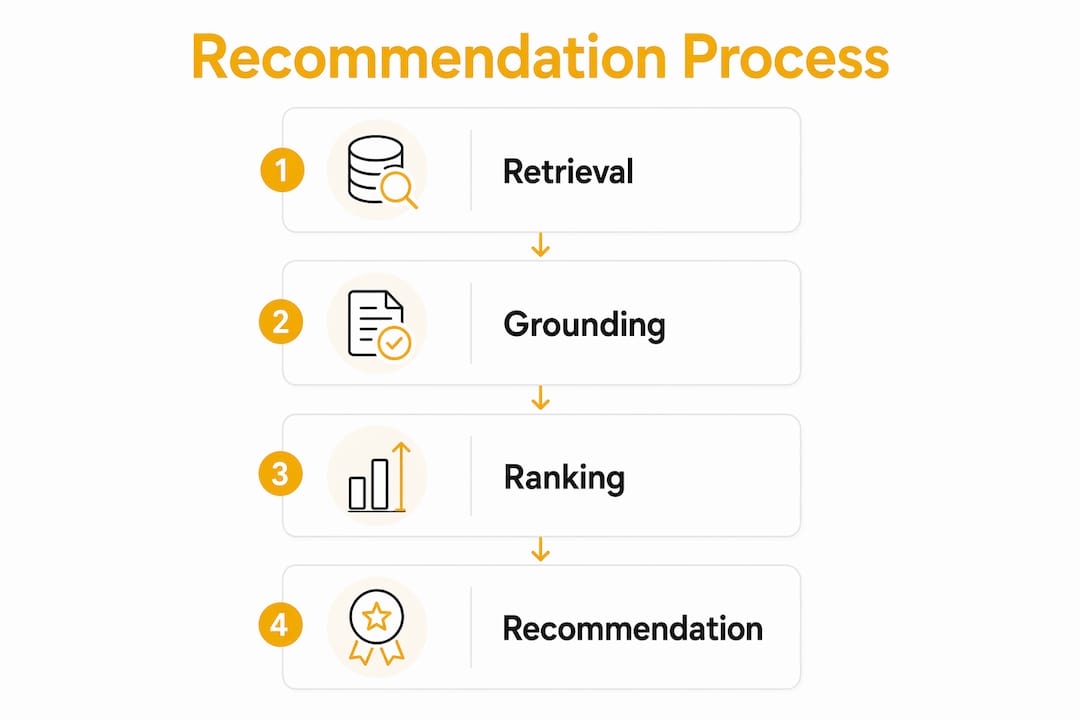
The sources that feed this process vary widely: web pages, structured schema markup, knowledge connectors, CRM data, call transcripts, press releases, and primary documents like SEC filings. "Grounding" means the model constrains its output to what it actually retrieved rather than generating from memory alone. That constraint is what makes RAG architectures essential: without retrieval-augmented generation, models frequently fabricate pricing, feature sets, or launch dates.
| Source Type | What It Contains | What Marketing Can Do |
|---|---|---|
| Web pages & blog posts | Brand narrative, product descriptions | Publish authoritative, structured content with schema markup |
| Structured data / schema | Machine-readable product and org data | Implement Organization, Product, and FAQ schema |
| Primary documents | SEC filings, press releases, whitepapers | Publish and distribute citable primary sources |
| CRM & call transcripts | Win-loss context, buyer language | Connect internal data via CRM integration |
| Knowledge connectors | Curated Q&A, playbooks | Build promptable internal knowledge bases |

Pro Tip: Source-linked records are the difference between a recommendation an AI assistant can defend and one it will quietly retract under follow-up questioning. Every asset you publish should be citable: a named author, a date, a clear claim, and a URL that resolves.
Why a generic chatbot isn't enough for competitive intelligence
The short answer: generic chatbots lack always-on retrieval, source linking, and integration with internal systems. Prompting a public LLM about a competitor's pricing is one of the fastest ways to get a confident, wrong answer.
Common misconceptions, corrected:
- Myth: Prompting a chatbot with a competitor's URL yields accurate intel. Reality: Without RAG, the model generates from training data, which may be months or years out of date, and hallucination risk is high.
- Myth: More data means better intelligence. Reality: The biggest adoption barrier isn't data scarcity. It's the noise that excess data creates. Teams need structured outputs like confidence scores and source-linked records, not more open-ended commentary.
- Myth: A one-time audit is sufficient. Reality: Competitor moves, pricing changes, and product launches happen continuously. Static snapshots go stale within weeks.
- Myth: Public AI gives you the same intelligence as everyone else. Reality: Proprietary, continuously updated intelligence built on your specific competitive set is what separates signal from noise.
The most credible AI competitive intelligence outputs force every claim to link back to a primary source, whether that's a press release, a product doc, or an SEC filing, so analysts can audit the AI's logic rather than take its word for it.
What metrics should you track for AI recommendation visibility?
Recommendation share is the primary KPI: the percentage of relevant buyer queries where your brand appears in an AI-generated answer. Supporting signals sharpen the picture.
| Metric | What It Measures | How to Calculate | Why It Matters |
|---|---|---|---|
| Recommendation share | Brand presence in AI answers | Brand mentions ÷ total relevant queries × 100 | Core channel KPI; tracks discoverability trend |
| Confidence score | AI's certainty in the recommendation | Vendor-assigned score per response | Low scores signal weak source grounding |
| Source-link ratio | How often your assets are cited | Cited responses ÷ total brand mentions | Indicates content authority and retrievability |
| Prompt exposure | Queries where your brand is eligible | Count of queries in your defined prompt set | Sets the denominator for recommendation share |
Dashboard elements worth building:
- Recommendation share trend line (weekly or monthly)
- Confidence score distribution by query cluster
- Top-cited sources and their update frequency
- Prompt exposure heatmap by persona and buying stage
- Competitor recommendation share benchmarked against yours
A multi-week audit checklist for AI visibility gaps
Start with a baseline scan. Run a free AI visibility scan and map your recommendation share by persona and query set within the first 30 days. That number is your starting point for everything that follows.
- Days 1–30 (Quick wins): Run baseline scan. Identify top 10 buyer queries per persona. Audit which sources AI assistants currently cite for those queries. Fix broken schema and update stale primary documents. Owner: SEO or content lead.
- Days 31–60 (Integrations): Connect CRM data to your AI visibility platform. Set up Slack alerts for competitor moves and confidence score drops. Publish at least three new citation-ready assets (whitepapers, case studies, structured FAQs). Owner: Marketing ops and content team.
- Days 61–90 (Optimization): Run a second scan and compare recommendation share against baseline. Prioritize the five queries with the largest gap between your brand and the top-recommended competitor. Adjust content and schema based on source-link ratio data. Owner: SEO lead and demand gen.
Investment ranges vary by scope. A pilot program using a starter-tier platform typically runs well under $1,000 per month. Enterprise rollouts with CRM integration, multi-brand monitoring, and dedicated analyst support sit in a different tier entirely. The Starter plan is the fastest way to establish a baseline without committing to a full program budget.
How to move from an audit to always-on intelligence
Operationalize by integrating AI signals into core workflows and assigning clear owners for signal triage. The audit tells you where you stand. Always-on intelligence tells you when something changes.
Priority integrations and what each enables:
- CRM (Salesforce, HubSpot): Surfaces deal-level competitive context so reps see relevant AI-sourced intel on the accounts they're working.
- Slack: Delivers real-time alerts when a competitor updates pricing, launches a feature, or drops in recommendation share for a shared query.
- Content management systems: Flags which published assets are being cited and which have gone stale.
A 90-day playbook in brief:
- Week 1: Configure alert templates for three event types (confidence score drop, competitor product launch, new competing recommendation).
- Weeks 2–4: Assign a signal triage owner who reviews alerts and routes them to the right team (content, product, sales).
- Month 2: Run a deal-level pilot: push competitive alerts to five active opportunities and track whether reps use them.
- Month 3: Review alert volume and tune thresholds to reduce noise.
Sample alert templates:
- "Confidence score for [core query] dropped below 60. Top-cited source is now [competitor asset]. Review and update [your asset URL]."
- "Competitor launched new feature: [feature name]. Update battle card and notify AEs on [account list]."
- "Recommendation share for [persona cluster] fell 8 points week-over-week. Audit prompt exposure and source-link ratio."
Integrating competitive signals into seller workflows is what moves teams from reactive reporting to proactive, deal-specific action.
How to evaluate vendor outputs and maintain trust in AI-sourced intelligence
Only trust vendor outputs that provide source-linked records and transparent confidence scoring. A vendor that can't show you where a claim came from isn't giving you intelligence. It's giving you a summary.
Vendor evaluation checklist:
- Does the platform ground every output in retrievable, dated sources?
- Does it provide confidence scores per recommendation, not just aggregate accuracy claims?
- Does it support RAG or equivalent retrieval against live data?
- Does it maintain audit logs so you can trace a claim back to its source?
- How frequently does it update its source index?
- Does it offer citation policy documentation?
Sample RFP questions to ask vendors:
- "Show me a sample output with source links for each claim."
- "What is your hallucination mitigation approach?"
- "How do you handle conflicting signals from multiple sources?"
- "What does your data refresh cadence for web and primary document sources?"
Authoritylayer's measurement methodology addresses each of these directly, including how confidence scores are calculated and how sources are linked to every recommendation.
Practical use cases with measurable outcomes
Three scenarios marketing and sales leaders will recognize immediately.
Deal win enablement. A sales rep is working a competitive deal where the buyer has already consulted ChatGPT for vendor recommendations. The AI cited a competitor's whitepaper twice and didn't mention your brand. With always-on intelligence, the rep receives an alert, accesses a battle card updated with the competitor's cited claims, and enters the next call prepared. KPIs: deal velocity and competitive win rate on AI-influenced opportunities.
Content prioritization. Your content team is planning the next quarter's editorial calendar. Instead of guessing which topics matter, they pull recommendation share data by query cluster and find that three high-volume buyer queries return zero brand mentions. Those queries become the top content priorities. KPI: recommendation share uplift for targeted query clusters within 60–90 days. AI can reduce research cycles from weeks to days when paired with curated live sources and analyst review.
Competitive risk detection. A competitor quietly updates their pricing page. Within hours, AI assistants begin citing the new pricing in comparison queries, shifting recommendation share. An alert fires to the marketing team before the sales team hears about it from a prospect. KPI: time-to-response on competitive pricing changes.
Key Takeaways
AI Visibility Intelligence requires measuring recommendation share, grounding content in citable sources, and integrating signals into seller workflows to move from reactive reporting to proactive competitive action.
| Point | Details |
|---|---|
| Recommendation share is the core KPI | Track how often AI assistants name your brand across relevant buyer queries, not just organic rankings. |
| Source-linked records build confidence | Every published asset should be citable: named author, date, clear claim, and a resolving URL. |
| RAG prevents hallucination | Purpose-built platforms using retrieval-augmented generation produce far more reliable outputs than generic chatbots. |
| Integrate signals into workflows | Connect AI intelligence to Slack and CRM so sellers receive deal-specific alerts without hunting for them. |
| Authoritylayer measures and improves visibility | Run a free scan to establish baseline recommendation share, then use Authoritylayer to benchmark competitors and prioritize fixes. |
The part most teams get wrong
Most marketing teams treat AI visibility as a content problem. Publish more, rank higher, get recommended more often. The logic feels right, but it misses the actual mechanism.
AI assistants don't recommend brands because they've seen a lot of content from them. They recommend brands because the content they've retrieved is specific, citable, and consistent across multiple independent sources. A single authoritative whitepaper cited in three places outperforms ten blog posts that say the same thing in different words.
The second mistake is treating this as a one-time project. Recommendation share shifts when competitors publish new primary sources, when assistants update their retrieval indexes, and when buyer query patterns change. Teams that run a scan, declare victory, and move on will find their numbers drifting within a quarter.
The third, and most consequential, mistake is automating without verifying. AI-sourced intelligence can be wrong, especially on fast-moving topics like competitor pricing or product features. High-stakes claims, anything that goes into a board deck, a sales call, or a public statement, need a human check against the cited source before they're acted on.
Authoritylayer measures what AI assistants actually say about your brand
Knowing your recommendation share is the starting point. Knowing why it's lower than a competitor's, and what to fix first, is where Authoritylayer earns its keep.
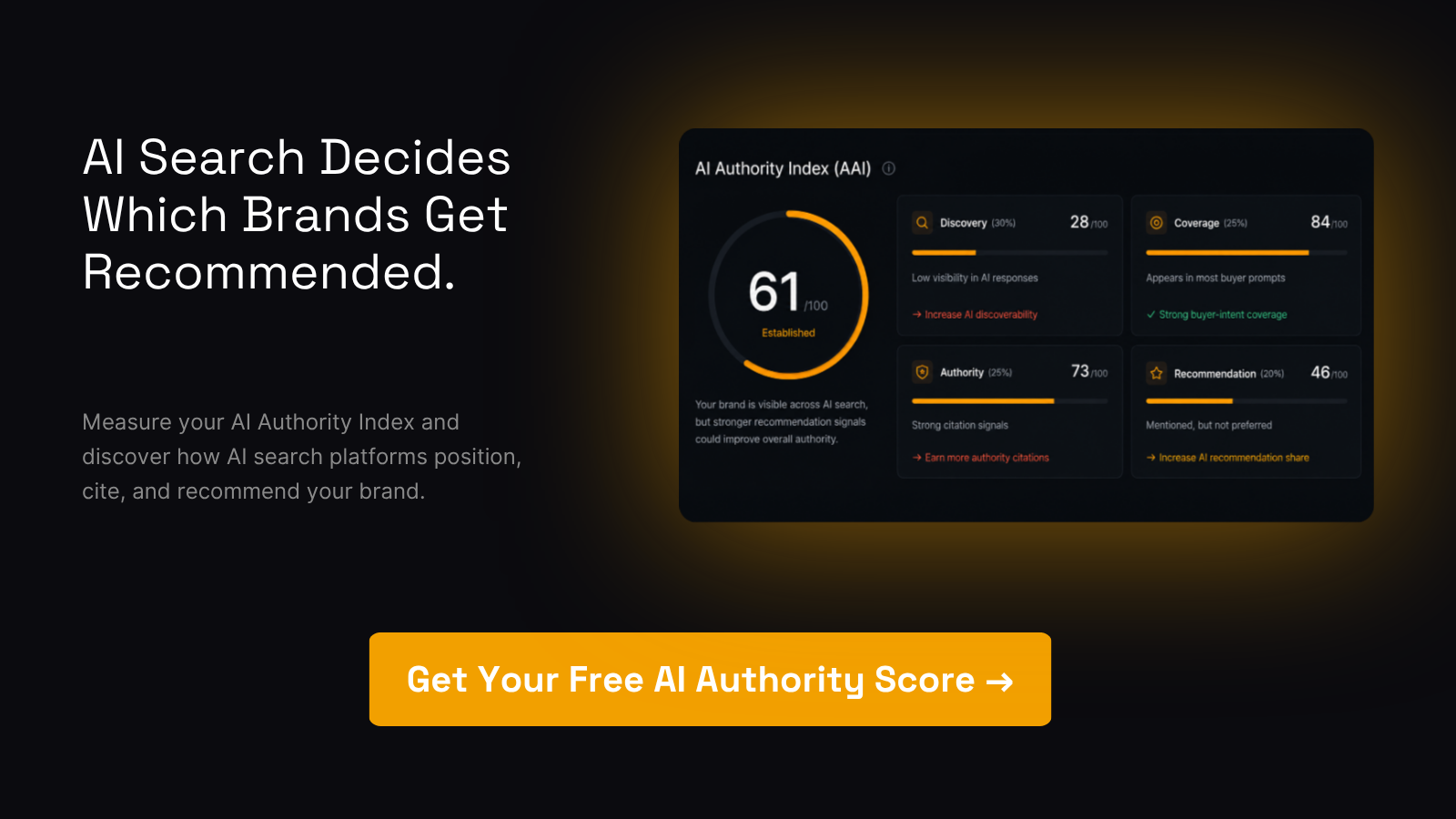
Authoritylayer combines source-linked records, confidence scoring, and continuous monitoring to give marketing teams a clear picture of how ChatGPT, Claude, Gemini, and Perplexity describe and recommend their brand. The Starter plan gets you a baseline scan and recommendation share data fast, with no lengthy onboarding. The Enterprise plan adds CRM integration, multi-brand monitoring, Salesforce connectors, and dedicated support for teams running AI visibility as a strategic channel. Every output is source-linked and scored, so you're never acting on a summary you can't audit. Start with the free scan and see exactly where you stand.
Useful sources
- Authoritylayer methodology: How recommendation share, confidence scores, and source-link ratios are measured and reported.
- AI visibility glossary: Definitions for recommendation share, RAG, confidence scores, prompt exposure, and related terms.
- Free AI visibility scan: Run a baseline audit of your brand's recommendation share across major AI assistants.
- What affects AI recommendations: The signals and content levers that influence whether AI assistants recommend your brand.
- Visibility vs. recommendation: Why being visible in AI sources and being recommended are different metrics, and which one to prioritize.
- Example reports: Sample deliverables showing what a scan or pilot produces, including recommendation share trends and source-link analysis.
FAQ
What is AI competitive intelligence?
AI competitive intelligence, more precisely called AI Visibility Intelligence, is the practice of measuring and improving how AI assistants discover, describe, and recommend your brand versus competitors during buyer research. It tracks signals like recommendation share, confidence scores, and source-link ratios rather than traditional search rankings.
How is recommendation share calculated?
Recommendation share is the percentage of relevant buyer queries where your brand appears in an AI-generated answer: brand mentions divided by total queries in your defined prompt set, multiplied by 100. Authoritylayer tracks this metric continuously across ChatGPT, Claude, Gemini, and Perplexity.
Why can't I just use ChatGPT for competitor research?
Generic chatbots generate from training data without live retrieval, which means outputs on competitor pricing, features, or positioning are frequently outdated or fabricated. Purpose-built platforms use RAG to ground every claim in a retrievable, dated source, which is what makes the output auditable and reliable.
How long does it take to improve recommendation share?
Content and schema fixes that target specific query clusters typically show measurable recommendation share movement within 60–90 days. Deeper improvements tied to CRM integration and ongoing source publishing compound over a full quarter or more.
Where do I start if I have no baseline data?
Run a free AI visibility scan first. It maps your current recommendation share by query set and identifies which sources AI assistants are currently citing for your category, giving you a concrete starting point for prioritization.