Optimize for ChatGPT: A Measurement Playbook for CMOs
Discover how to optimize your brand’s visibility with AI assistants like ChatGPT, boosting recommendations and enhancing buyer engagement.
· 12 min read

"Optimizing for ChatGPT" means measuring and improving how AI assistants — ChatGPT, Claude, Gemini, and Perplexity — discover, cite, and recommend your brand during buyer research. Not prompt engineering. Not tweaking your ChatGPT subscription. This is about AI visibility: whether your brand appears, gets named, and earns a recommendation when a buyer asks an AI assistant which vendor to consider.
The 30/60/90 picture looks like this:
- 30 days: Run a seed-prompt audit, capture your baseline recommendation share, and identify your top three gaps.
- 60 days: Fix knowledge-graph facts, publish three extractable pages, and land two authoritative earned placements.
- 90 days: Run your first citation-uplift experiment, publish a monthly scorecard, and scale what moved the needle.
One executive next step: run a seed-prompt audit this week, compute your baseline, and pick your top three levers. Everything else follows from that.
Key Takeaways
Recommendation share — not raw mentions — is the metric that predicts buyer choice from AI-generated answers, and a repeatable seed-prompt audit is the only reliable way to measure it.
| Point | Details |
|---|---|
| Recommendation share is the priority metric | A brand explicitly recommended by an AI assistant is roughly 5x more likely to be chosen than one only mentioned. |
| Single-run audits are unreliable | Run each seed prompt 5–10 times per model across ChatGPT, Claude, Gemini, and Perplexity to capture answer variance. |
| Earned media drives AI citations | Editorial placements and community signals account for the majority of AI-cited links; owned content alone is insufficient. |
| Entity consistency sharpens retrievability | Inconsistent brand descriptions across directories and knowledge sources dilute your model representation and reduce citation probability. |
| Authoritylayer accelerates the baseline | The free AI visibility scan delivers coverage rate, competitive gaps, and prioritized recommendations without manual setup. |
Table of Contents
- What KPIs actually tell you whether AI assistants recommend your brand
- How to run a repeatable AI visibility audit
- Which levers move your AI visibility the most
- How to design experiments that prove citation uplift
- A practical 30/60/90 roadmap with resourcing
- Roles, RACI, and workflows to own AI visibility continuously
- What tools your team needs for AI visibility intelligence
- Brand-safety, misinformation, and privacy guardrails
- What I'd tell every CMO who asks where to start
- Authoritylayer gives you the baseline and the benchmarks to act
- Sources
- FAQ
What KPIs actually tell you whether AI assistants recommend your brand
AI visibility breaks into four measurable components: coverage, recommendation share, prominence, and citation quality. Each one diagnoses a different problem.
Core KPIs:
- Coverage: The percentage of your seed prompts where your brand appears at all. Low coverage means the model doesn't associate you with the buyer's query.
- Recommendation share: Your share of citation slots across the prompt set. A brand explicitly recommended by an AI assistant is roughly 5x more likely to be chosen by a buyer than one that was only mentioned — this is the metric that predicts pipeline, not raw mentions.
- Prominence: Where in the answer your brand appears. First position in a list of three carries materially more weight than a buried footnote.
- Citation quality: Whether the assistant links a source, names a publication, or simply mentions your brand without attribution. Linked citations carry more retrieval weight in future answers.
Supporting signals worth tracking: referring-domain distribution across your cited sources, presence on authoritative industry lists, Wikipedia and Wikidata entries, directory and review platform accuracy, and community mentions on forums and Reddit.
Combine these into an AI Visibility Index score — a weighted composite that gives your team a single number to trend over time and benchmark against competitors.
| KPI | What it diagnoses | Benchmark target |
|---|---|---|
| Coverage rate | Query-level brand presence | Above half of seed prompts |
| Recommendation share | Citation slot ownership vs. peers | Track monthly delta |
| Prominence score | Position in answer (1 = top) | Trending toward position 1–2 |
| Citation quality | Linked vs. unlinked mentions | Maximize linked citations |
How to run a repeatable AI visibility audit
The goal is a defensible baseline you can compare against in 30 days. Single-run audits are unreliable — AI answers are probabilistic, and repeated sampling across assistants is required to understand the distribution.
- Build your seed-prompt set. Write 10–20 buyer queries per buying stage (awareness, consideration, decision). Frame them as questions, not keywords: "Which B2B data enrichment platforms do analysts recommend?" not "best B2B data enrichment."
- Sample across models. Run each prompt through ChatGPT, Claude, Gemini, and Perplexity. Repeat each query 5–10 times per model to capture answer variance.
- Capture structured snapshots. Record the full answer text, every named entity, any citations or links, brand position, and factual accuracy. Store these with timestamps and model version metadata.
- Benchmark competitors. Run the same prompt set for your top three competitors. Compute recommendation share: your citation slots divided by total citation slots across all brands in the answer set.
- Set your baseline. Aggregate results into coverage rate, recommendation share, and prominence score. This is your Month 0 scorecard.
Pro Tip: Use a prompt management tool to standardize your seed prompts and reduce variation introduced by prompt wording. Consistent prompt templates make your before/after comparisons defensible.
Which levers move your AI visibility the most
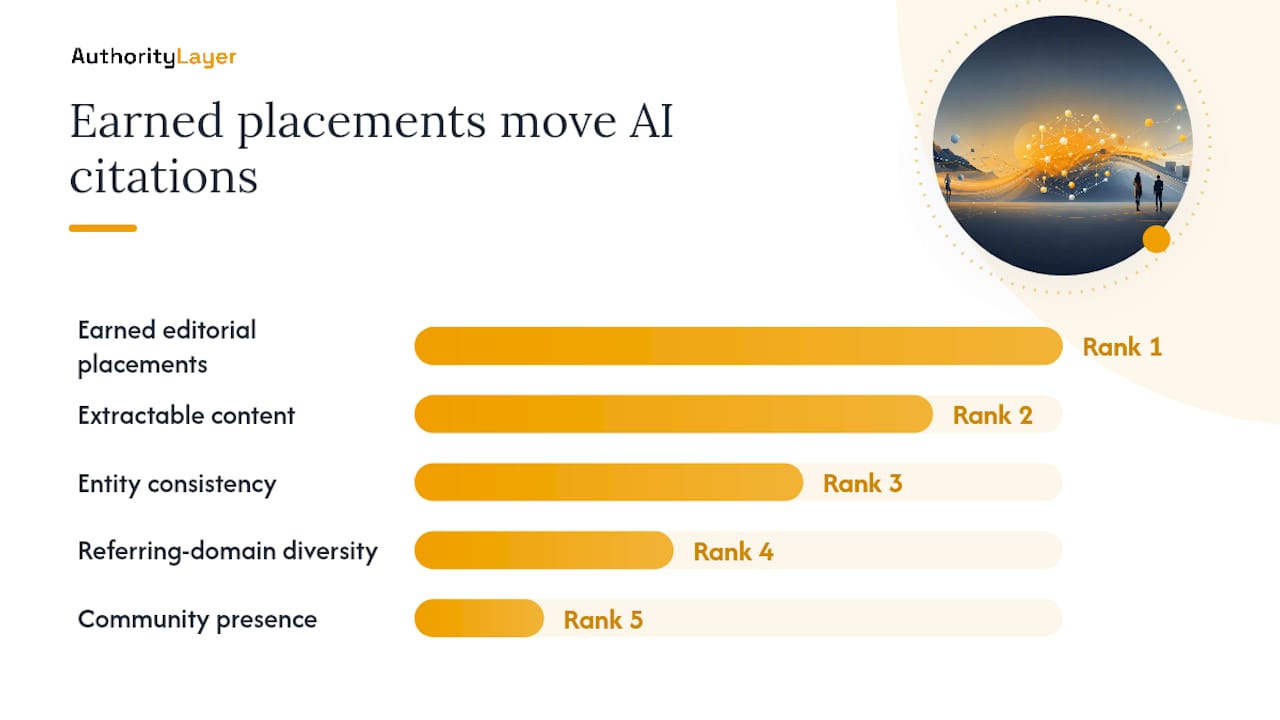
Referring-domain count is the single strongest predictor of whether ChatGPT cites a brand. Presence on authoritative lists and awards also contributes materially. That means your highest-leverage work is earned, not owned.
Ranked by impact:
- Earned editorial placements: Get your brand named in industry publications, analyst reports, and award lists. Journalists and analysts are the sources AI assistants trust most. Earned media and community signals account for the majority of AI-cited links — paid content barely registers.
- Extractable, evidence-rich content: Publish pages with one-sentence definitions, numeric claims, and methodology sections that a retrieval system can lift cleanly. ChatGPT's RAG layer favors recently published, well-structured, extractable content over dense prose.
- Entity consistency: Your brand name, category, and core claims must read identically across your website, Wikipedia, Wikidata, G2, Capterra, Crunchbase, and every directory listing. Inconsistent descriptions dilute your brand's vector representation in the model's memory — even small mismatches in product names or founding dates degrade retrievability.
- Referring-domain diversity: Pursue credible backlinks from diverse domains, not link volume from the same few sources. Breadth signals authority to both search engines and retrieval systems.
- Community presence: Credible discussions on industry forums, LinkedIn, and Reddit where your brand is mentioned in context of buyer problems. These surface in RAG retrieval and add distributional weight.
For a practical GEO playbook that maps each lever to execution steps, the AuthorityLayer Insights library covers the full workflow.
How to design experiments that prove citation uplift
Treat AI answers as probabilistic outcomes. Report results as distributions, not single data points.
- Define test and control prompt sets. Split your seed prompts into two groups matched by buying stage and query type. Apply your lever change (a new earned placement, a restructured page) to the topic area covered by the test set only.
- Set your pre/post windows. Run baseline sampling for two weeks before the change. Run post-change sampling for two weeks after. Minimum 5 runs per prompt per model in each window.
- Compute metric deltas. Recommendation uplift = (post citation share minus pre citation share) divided by pre citation share. Track prominence delta and coverage lift separately.
- Interpret the distribution. A meaningful uplift signal requires consistent directional movement across most runs, not just an average shift. High variance across runs means your sample size is too small or the lever effect is weak.
| Experiment element | Specification |
|---|---|
| Test prompt set | 5–10 prompts matched to lever topic |
| Sampling runs | 5–10 per prompt per model, pre and post |
| Models covered | ChatGPT, Claude, Gemini, Perplexity |
| Primary metric | Recommendation share delta |
| Confidence check | Directional consistency across runs |
A practical 30/60/90 roadmap with resourcing
| Phase | Actions | Owner | Effort |
|---|---|---|---|
| 30 days | Seed-prompt audit, baseline scorecard, knowledge-graph fact corrections | AI visibility lead + SEO | 20–30 hrs |
| 60 days | 3 extractable pages published, 2 earned placements pitched, directory updates | Content + PR | 10–20 hrs |
| 90 days | First citation-uplift experiment complete, monthly scorecard live, PR cadence established | Full team | Ongoing |
Budget bands: tooling runs $500–$2,000/month depending on assistant coverage and sampling frequency. Earned placement programs typically require 10–20 agency or freelance hours per placement. Brands with existing domain authority can see measurable citation improvements in 30–60 days; brands starting from low entity authority typically need 3–6 months for durable gains.
Roles, RACI, and workflows to own AI visibility continuously
Core roles:
- AI visibility lead: Owns the audit cadence, scorecard, and experiment roadmap.
- SEO/GEO lead: Manages entity consistency, structured content, and technical signals.
- PR lead: Executes earned placement programs and monitors citation sources.
- Content owner: Produces extractable pages aligned to seed-prompt topics.
- Data analyst: Runs sampling, computes metrics, and maintains the snapshot database.
- Legal/compliance reviewer: Clears claims before publication and handles misinformation escalations.
| Activity | Responsible | Accountable | Consulted | Informed |
|---|---|---|---|---|
| Monthly audit | Data analyst | AI visibility lead | SEO lead | CMO |
| Earned placements | PR lead | AI visibility lead | Content owner | Legal |
| Fact corrections | SEO lead | AI visibility lead | Legal | PR lead |
| Misinformation escalation | Legal | CMO | PR lead | All |
Monitoring cadence: daily alerting for new citations or factual errors, weekly snapshot reviews, monthly executive scorecards. Escalate to legal within 24 hours when an AI assistant propagates a materially false claim about your product.

What tools your team needs for AI visibility intelligence
Essential capabilities:
- Cross-model prompt sampling (ChatGPT, Claude, Gemini, Perplexity) with repeatable execution
- Structured snapshot storage with version and timestamp metadata
- Citation share computation and competitive benchmarking
- Source-type classification (editorial, directory, community, owned)
- Alerting for new mentions or factual errors
When evaluating tools, prioritize ingestion breadth (how many assistants are covered), sampling repeatability (can you reproduce a run?), exportable audit trails, and competitive share analytics. For teams building prompt templates manually, a prompt engineering guide helps standardize the seed-prompt format before you automate.
Authoritylayer addresses the full stack: cross-assistant sampling, competitive citation share tracking, AI Authority Index scoring, prioritized recommendations, and alerting. The best AI visibility tools comparison on AuthorityLayer Insights covers the broader category for teams doing a full procurement review.
Pro Tip: Before buying any tool, run a manual audit for one week using a spreadsheet. The discipline of capturing structured snapshots by hand clarifies exactly which fields you need automated — and prevents you from buying a tool that tracks the wrong metrics.
Brand-safety, misinformation, and privacy guardrails
Top risks:
- Hallucinated claims: An assistant invents a product feature, pricing tier, or customer outcome your brand never stated.
- Outdated facts: Stale information in parametric memory propagates incorrect product names, leadership, or capabilities.
- Private data exposure: Customer names or internal data inadvertently included in sampled prompts.
Operational mitigations:
- Maintain a single documented source of truth for every claim you expect assistants to repeat. Update it whenever a product, price, or leadership detail changes.
- Submit corrections to directories, Wikipedia, and Wikidata immediately when facts change. These are the sources models pull from most.
- Route all legal-sensitive claims through your compliance reviewer before publishing extractable content.
- Use anonymized, synthetic prompts in your audit set — never include real customer names or deal details.
Pro Tip: Fixing contradictory facts across sources — even small mismatches like an old product name on Crunchbase — can materially improve retrievability by sharpening your brand's vector in the model's memory. Audit your top 10 directory listings before you publish a single new page.
What I'd tell every CMO who asks where to start
The teams I see waste the most time are the ones who jump straight to content production without a baseline. They publish five "AI-optimized" pages, wait 90 days, and have no idea whether anything moved — because they never measured where they started.
Measurement-first isn't a philosophy. It's the only way to know which lever actually worked. And the compounding effect is real: a monthly scorecard forces the PR, SEO, and content teams to coordinate around the same prompt set, which means every earned placement and every extractable page is pulling in the same direction.
My recommendation: commit to two things before anything else. First, run the seed-prompt audit and get your baseline recommendation share on paper. Second, schedule a monthly visibility review with your full team. Those two habits, sustained for a quarter, will teach you more about your AI visibility than any single tactical play.
Authoritylayer gives you the baseline and the benchmarks to act
Most B2B marketing teams know they need to improve their AI visibility. The gap is measurement: without a repeatable audit and competitive benchmarks, you're making tactical bets without knowing the score.
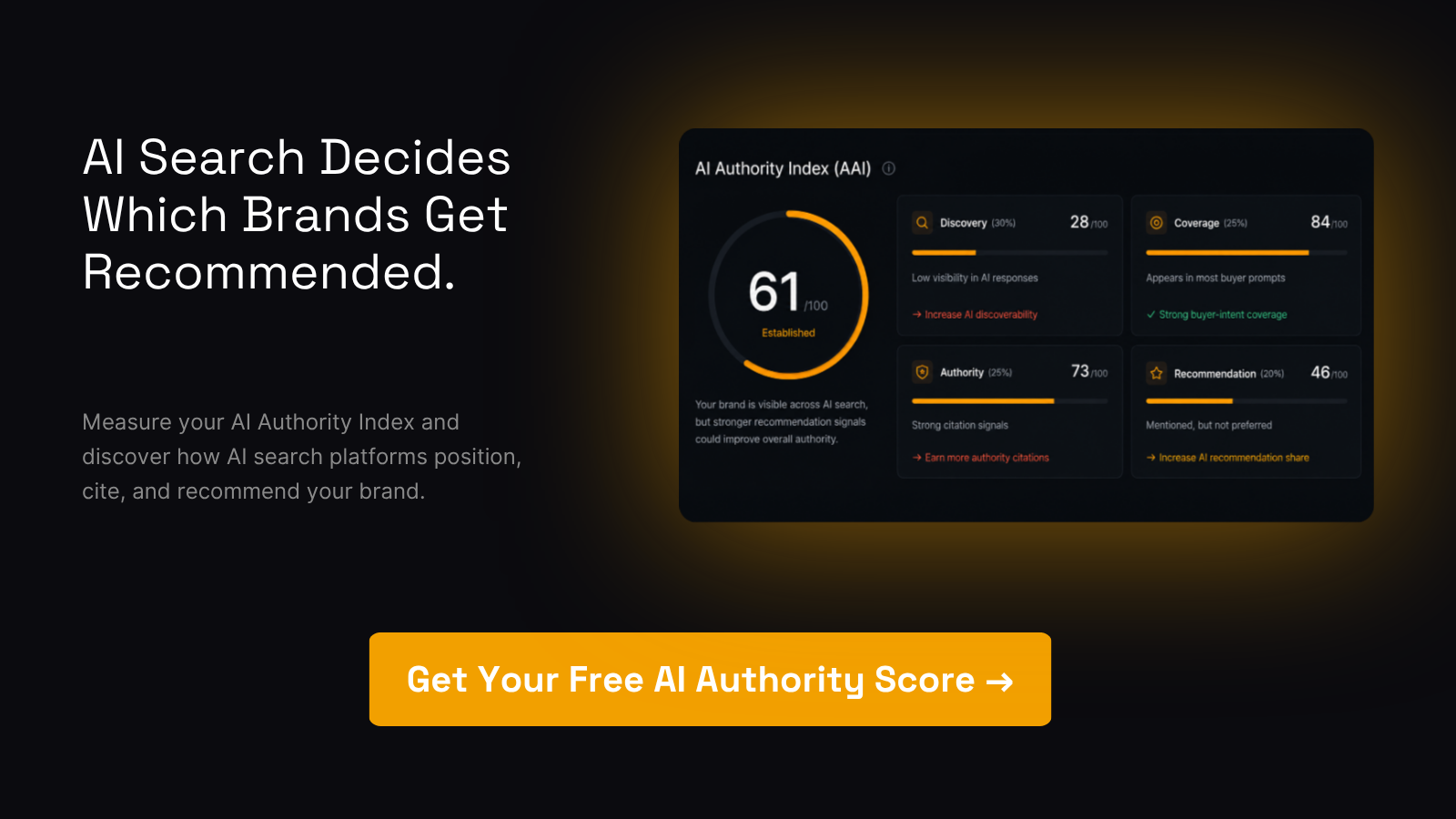
Authoritylayer tracks your recommendation share, citation slots, and AI Authority Index score across ChatGPT, Claude, Gemini, and Perplexity — and benchmarks you against your direct competitors on the same prompt set. You get prioritized recommendations tied to your actual gaps, not generic advice. The free AI visibility scan gives you a baseline report in minutes: your coverage rate, where competitors outrank you in AI answers, and the three highest-impact actions to close the gap. Run your scan at Authoritylayer and walk into your next leadership meeting with numbers.
Sources
- AI Visibility: What It Is and Why B2B Brands Need It Now
- How ChatGPT Recommends Brands: Inside the AI Recommendation Engine (2026) | First Citation
- How LLMs Decide Which Brands to Recommend (The Mechanism)
- AI Visibility for B2B Brands
FAQ
What does "optimize for ChatGPT" mean for B2B brands?
It means measuring and improving how ChatGPT, Claude, Gemini, and Perplexity discover, cite, and recommend your brand during buyer research — not adjusting prompts or ChatGPT settings.
Which metric matters most for AI visibility?
How many times should I run each audit prompt?
Run each seed prompt multiple times per model to capture the distribution of answers; a single run is unreliable because AI responses are probabilistic and vary across runs.
How long before I see measurable citation improvements?
Brands with existing domain authority typically see measurable gains in 30–60 days with targeted earned placements and structured content; brands starting from low entity authority usually need 3–6 months for durable visibility.
How does Authoritylayer help teams measure AI visibility?
Authoritylayer tracks recommendation share, citation slots, and AI Authority Index scores across ChatGPT, Claude, Gemini, and Perplexity, benchmarks results against competitors, and delivers prioritized recommendations — starting with a free AI visibility scan.