Marketers: Reproducible AI visibility workflow with MAHI 100
Practical AI visibility workflow for marketers. Run a 100 prompt MAHI 100 pilot across four models, track citations with a 12 week MAD M governance cadence.
· 16 min read

An AI visibility workflow is a repeatable process marketers use to measure, monitor, and improve how AI assistants find and cite a brand. It replaces guesswork with a cycle of identifying prompts, measuring citation share, acting on gaps, and governing the results, turning AI discovery into something a team can actually manage.
TL;DR:
- Tracking AI citation share across multiple platforms reveals variability in how brands are referenced, with each platform favoring different source types.
- Repeated testing over a 12-week cycle helps detect content drift and outdated information, ensuring citations remain accurate and current.
- Prioritizing fixes based on impact and effort ensures high-volume, high-impact citations are addressed first, accelerating visibility improvements.
- Use a structured prompt set and a fixed capture template for consistent, comparable results across testing cycles.
- Implementing a quarterly governance review and refresh of key content facts minimizes the decay of AI citations over time.
Table of Contents
- What AI visibility means and how AI search differs from traditional search
- Why tracking AI visibility matters for marketing and SEO teams
- Step-by-step AI visibility workflow to implement
- Tools, data collection methods, and integration patterns
- Key metrics and reporting: definitions and how to interpret them
- Governance, freshness, and the MAD-M decay heuristic
- Benchmarking with MAHI and MAHI-100: a reproducible measurement example
- Expected timeline for implementing and seeing results
- Criteria for selecting AI visibility platforms and tools
- Case studies or examples demonstrating successful AI visibility workflows
- Common mistakes and quick wins for an AI visibility program
- How AuthorityLayer maps to this workflow
- FAQ
- Sources
What AI visibility means and how AI search differs from traditional search
AI visibility, often grouped under generative engine optimization or GEO, describes whether an AI assistant finds a brand's content, understands what it is, and chooses to cite or recommend it when someone asks a relevant question. According to Search Engine Land's explainer on GEO, this reframes success metrics away from rankings and clicks and toward citations, mentions, and share of voice inside generated answers.
Traditional search ranks a list of links and lets the user decide. AI search extracts a passage, synthesizes it with other sources, and delivers a single answer, often without a click at all. That shift rewards different things: content that is easy to extract as a standalone fact, entities that are clearly defined and consistently described, and structural clarity that lets a model resolve who or what a brand actually is. The same source notes that brands consistently cited by AI systems tend to share clear entity markup, extractable paragraphs, and mentions across multiple platforms, features that predict citations better than raw search ranking.
Testing should span the platforms buyers actually use, since each behaves differently:
- ChatGPT leans on a mix of training data and live retrieval, and tends to favor well-structured, frequently referenced sources.
- Gemini draws heavily on Google's index and often surfaces fresher, more recently updated content.
- Claude tends to be conservative about citing sources it cannot verify, which rewards clear attribution and sourcing.
- Perplexity is explicitly citation-driven, making it one of the clearest windows into which domains an AI treats as authoritative.
A workflow that only checks one platform misses how fragmented this landscape already is. For a deeper look at platform-specific extractability patterns, our AI Overviews optimization playbook breaks down behaviors by platform in more detail.
Why tracking AI visibility matters for marketing and SEO teams
AI assistants increasingly act as a pre-filter that narrows a buyer's options before they ever visit a website. Gartner predicted that traditional search engine volume will drop 25% by 2026 as chatbots and virtual agents absorb a growing share of queries, which means the moment of discovery is moving upstream, into a conversation a marketing team cannot see or click into.
Many consumers now rely on AI summaries instead of clicking through to websites, according to Bain's analysis of consumer search behavior, with many searches ending before the user ever reaches the open web. That is the attribution gap in practice: a brand can lose a buyer's consideration set without a single session, click, or bounce showing up in web analytics.
This creates four concrete use cases for a visibility workflow:
Benchmarking against competitors reveals whether a brand is mentioned, omitted, or mischaracterized when a buyer asks an AI assistant to compare options. Content prioritization uses citation data to decide which pages need restructuring for extractability rather than guessing from traffic reports alone. Reputation monitoring catches outdated pricing, discontinued features, or incorrect claims before they spread across multiple AI platforms. PR alignment ties announcements and third-party coverage to measurable shifts in how often a brand gets cited afterward.
Step-by-step AI visibility workflow to implement
Running this well means treating it as a measurement discipline, not a one-time audit. The workflow has five stages: identify, test, aggregate, analyze, and act.
- Select categories and build a prompt set. Group prompts by buyer intent (comparison, recommendation, troubleshooting, pricing) rather than by keyword. A 100-prompt protocol like MAHI-100, described in the open-source AI citation visibility framework, gives enough volume to spot patterns without becoming unmanageable.
- Write neutral system prompts. Avoid leading language that nudges the model toward or away from a brand; the goal is to see what the model would naturally surface, not to coach it.
- Define a capture template. Record category, prompt template ID, substituted prompt text, model name, system prompt used, extracted passage, attribution text, timestamp, sentiment label, confidence score, and a run ID for every test.
- Run repeat tests with control prompts. AI outputs vary between runs, so testing the same prompt multiple times across a sampling window, alongside a few fixed control prompts, helps separate genuine drift from normal variance.
- Ingest results into structured data. Push outputs into a database or spreadsheet that connects to existing BI or reporting tools, rather than leaving results scattered across screenshots.
- Prioritize fixes by impact and effort. Rank gaps using a simple impact times effort score, assign an owner for each fix, and put it on a recurring schedule instead of a one-off task list.
Pro Tip: Keep a small set of control prompts identical across every test run so you can tell the difference between your brand losing visibility and the model simply behaving differently that day.
The prioritization step is where most programs stall. A gap that affects a high-volume comparison prompt and takes a single content edit to fix should always outrank a low-traffic prompt that requires a full page rebuild. Assigning governance ownership, usually a cross-functional owner from SEO or content plus a marketing stakeholder, keeps fixes from sitting in a backlog. For a ready-made checklist of common fixes, our guide on priority fixes to win AI picks walks through the most frequent gaps teams find in early pilots.
Manual, ad-hoc checks (one person typing a question into ChatGPT and screenshotting the answer) tend to produce inconsistent, non-comparable results over time. A fixed capture template and repeat-test cadence, as outlined in the MAHI framework documentation, make cross-model comparisons defensible rather than anecdotal.
Tools, data collection methods, and integration patterns
Choosing how to collect AI visibility data depends on scale, budget, and how reproducible the results need to be.
- Automated visibility platforms run prompt sets on a schedule across multiple models and store results in a structured format, best for teams tracking dozens of prompts across several competitors on an ongoing basis.
- Prompt-run frameworks (scripts or notebooks that call model APIs directly) suit technical teams that want full control over prompt wording and capture fields but are willing to maintain the tooling themselves.
- Manual spot checks still have a place for quick sanity checks or investigating a single surprising result, but they do not scale and are prone to inconsistent capture.
Whichever method is chosen, the capture template stays the same: prompt, platform, timestamp, extracted passage, attribution, sentiment, and a confidence or run identifier. API-based collection tends to be more reliable and auditable than scraping a chat interface, since UI layouts change and can break a scraper without warning, while APIs expose consistent response structures and let teams schedule tests programmatically.
Once collected, AI visibility data earns its keep by sitting next to existing SEO and brand metrics rather than living in its own silo. Pulling citation frequency, sentiment, and share of voice into the same dashboard used for organic traffic and brand search volume lets a team spot correlations, like whether a PR push actually shifted how often a model mentions the brand a few weeks later. Our measurement guide for comparing AI visibility across models covers how to structure that integration in more detail, and the piece on why manual ChatGPT checks fail for marketers explains the specific failure modes of relying on screenshots instead of structured capture.
Key metrics and reporting: definitions and how to interpret them
A workable metrics taxonomy stays small on purpose. Five figures cover most reporting needs.
| Metric | What it measures | How to read a shift |
|---|---|---|
| AI visibility score | Composite score blending citation rate, sentiment, and prominence | A drop signals a gap worth investigating before it compounds |
| Citation frequency | How often a brand is named across a prompt set and test runs | A sudden fall often points to a specific outdated page or claim |
| Share of voice | Brand mentions relative to competitor mentions on the same prompts | Rising competitor share with flat brand share means losing ground, not standing still |
| Provenance rate | Share of citations that trace back to a verifiable, current source | A low rate flags content that needs clearer sourcing or freshness |
| Sentiment score | Tone of how a brand is described when it is mentioned | Negative shifts often trail a pricing or product change that was not updated everywhere |
Trigger-context mapping, noting which prompt categories reliably surface a brand (comparisons, troubleshooting, pricing questions), adds a layer most dashboards skip but that makes the other four numbers actionable.
A sustainable cadence runs three loops at once: weekly alerts for sudden citation or sentiment drops, monthly share-of-voice reviews against named competitors, and a quarterly governance review that checks whether provenance rates are holding steady. For more detail on the share-of-voice calculations and distribution metrics that pair well with this cadence, see our guide on tracking AI visibility with SOV and distribution metrics.
Governance, freshness, and the MAD-M decay heuristic
AI citations are not permanent. The MAHI framework's MAD-M heuristic describes a planning window of roughly 12 weeks in which even well-cited content can drift out of favor without scheduled provenance refresh, as models retrain, re-crawl, or simply shift which sources they trust.
Keeping that drift in check takes a few standing habits:
- Assign a named owner for AI visibility governance, distinct from general SEO ownership, since the review cadence and fixes differ.
- Refresh provenance signals (dates, author bylines, cited statistics) on key pages at least once per quarter.
- Re-run the full prompt set on a fixed schedule rather than only when someone notices a problem.
- Flag any page whose core facts (pricing, features, availability) changed and prioritize it for immediate re-check rather than waiting for the next cycle.
Pro Tip: Treat a 12-week silence on a previously well-cited page as a warning sign, not a coincidence, and schedule a re-check before the next quarterly review comes around.
Common sources of decay are mundane: an outdated price, a discontinued feature still described as current, or a competitor publishing fresher content on the same topic. A quick remediation pass usually starts with checking whether the facts on the page are still accurate before touching structure or wording.
Benchmarking with MAHI and MAHI-100: a reproducible measurement example
The MAHI framework defines a composite score from 0 to 100 built from five subindices: Entity resolution (how clearly a model identifies the brand), Citation surface (how often and prominently it gets cited), Semantic coverage (how many relevant topics surface the brand), Freshness (how current the cited information is), and Trust graph (how authoritative the citing sources are).
Running a MAHI-100 pilot takes four steps:
- Choose a single product category to start, rather than testing an entire catalog at once.
- Substitute category-specific prompts into the 100-prompt template, keeping wording neutral.
- Execute the full set across the model set (at minimum ChatGPT, Gemini, Claude, and Perplexity) and log every run with the capture template.
- Score each subindex and compare against the nearest competitor tested on the same prompts.
A pilot that shows strong Entity resolution but weak Freshness points to a specific fix: update dates and figures on existing pages rather than creating new content. Low Citation surface alongside strong Semantic coverage suggests the brand is relevant to the topic but not structured in a way models choose to quote, which is a content-formatting problem, not a relevance one.
Expected timeline for implementing and seeing results
A first MAHI-100 style pilot, run on a single category across four platforms, typically takes one to two weeks to design the prompt set, execute the first test round, and compile a baseline. That baseline is the real milestone: without it, "improvement" has nothing to measure against.
Content and structural fixes identified in the first pilot usually need another two to four weeks to implement, since they often involve rewriting pages for extractability, updating stale facts, or adding clearer entity markup. Re-testing after fixes go live is where patience matters most. AI models do not re-crawl or re-train instantly, so a visibility shift from a content change often takes four to eight weeks to show up clearly in repeat tests, depending on the platform and how frequently it refreshes its sources.
A realistic first full cycle, from initial benchmark to a measurable shift in citation frequency or sentiment, runs eight to twelve weeks. That timeline also lines up with the MAD-M 12-week drift window, which is why most governance programs settle into a quarterly rhythm: one quarter to benchmark and fix, the next to confirm the fix held and catch any new drift.

Expecting next-week results from a single content edit sets a program up to look like it failed when it actually just needed another test cycle to register.
Criteria for selecting AI visibility platforms and tools
A few questions separate a tool that produces defensible, repeatable data from one that just generates reassuring screenshots.
Does it test across multiple platforms, or only one? A single-model view misses most of the fragmentation described earlier, since ChatGPT, Gemini, Claude, and Perplexity behave differently enough that a single-platform score can be misleading.
Does it use a fixed, reproducible prompt set, or ad-hoc queries? Reproducibility is what makes a month-over-month comparison meaningful instead of noise.
Does it explain how a score is calculated? A composite number with no visible subindex breakdown is hard to act on, since a team cannot tell whether a drop came from citation frequency, sentiment, or freshness.
Does it support competitive benchmarking on the same prompt set? Visibility only means something relative to competitors answering the same buyer questions.
Does it integrate with existing reporting? A tool that lives in its own silo rarely gets checked consistently; one that feeds into dashboards marketing teams already use gets checked weekly.
Pricing models vary across the category: some tools price per seat, some per brand or category tracked, and some bundle benchmarking with a human-reviewed report. The right fit depends on whether a team needs self-serve monitoring or a recurring deliverable it can hand to leadership without extra analysis.
Case studies or examples demonstrating successful AI visibility workflows
The clearest pattern across teams that get this right is narrow scope first. Rather than trying to benchmark an entire product catalog across every AI platform at once, successful pilots start with one category, one buyer intent (often comparison or recommendation prompts), and a fixed four-platform test set. That keeps the first cycle small enough to finish in a few weeks and gives a clean baseline to measure against.
A common early finding is a mismatch between where a brand ranks well in traditional search and where it gets cited by AI assistants. A product page that ranks on page one of Google but never gets quoted by an AI model usually has a structural problem: the key facts a buyer wants are buried in marketing language rather than stated as clear, extractable claims. Teams that rewrite those pages into direct, factual statements tend to see citation frequency rise within the next testing cycle, which lines up with the Freshness and Citation surface subindices in the MAHI framework.
Another recurring pattern involves PR and content timing. Teams that tie announcements, new case studies, or third-party coverage to a scheduled re-test (rather than assuming visibility updates automatically) catch whether the coverage actually changed how often a model cites the brand, turning a vague PR goal into a measurable one. For a practical audit process that supports this kind of before-and-after comparison, our AI Search Audit - Optimize Your Website for AI Search Engines walks through how to structure the comparison.
Common mistakes and quick wins for an AI visibility program
Most new programs stumble in the same three places: testing a single platform and assuming it represents AI search broadly, running one-off manual checks instead of repeat tests, and chasing content volume instead of fixing extractability on pages that already rank well.
Three fixes work inside the first 30 days. Run a four-platform baseline on one product category before touching any content. Rewrite the three highest-traffic comparison or product pages into clear, factual statements a model can quote directly. Set a recurring calendar reminder for the next test cycle so the baseline does not become a one-time exercise.
The right investment sequence is governance first, then reproducible capture, then scale tooling. Teams that buy a monitoring platform before deciding who owns the fixes tend to collect data nobody acts on.
— Geraldine
How AuthorityLayer maps to this workflow
Every stage above, benchmarking, capture, reporting, governance, is what our platform is built to run without requiring a team to assemble scripts and spreadsheets from scratch. 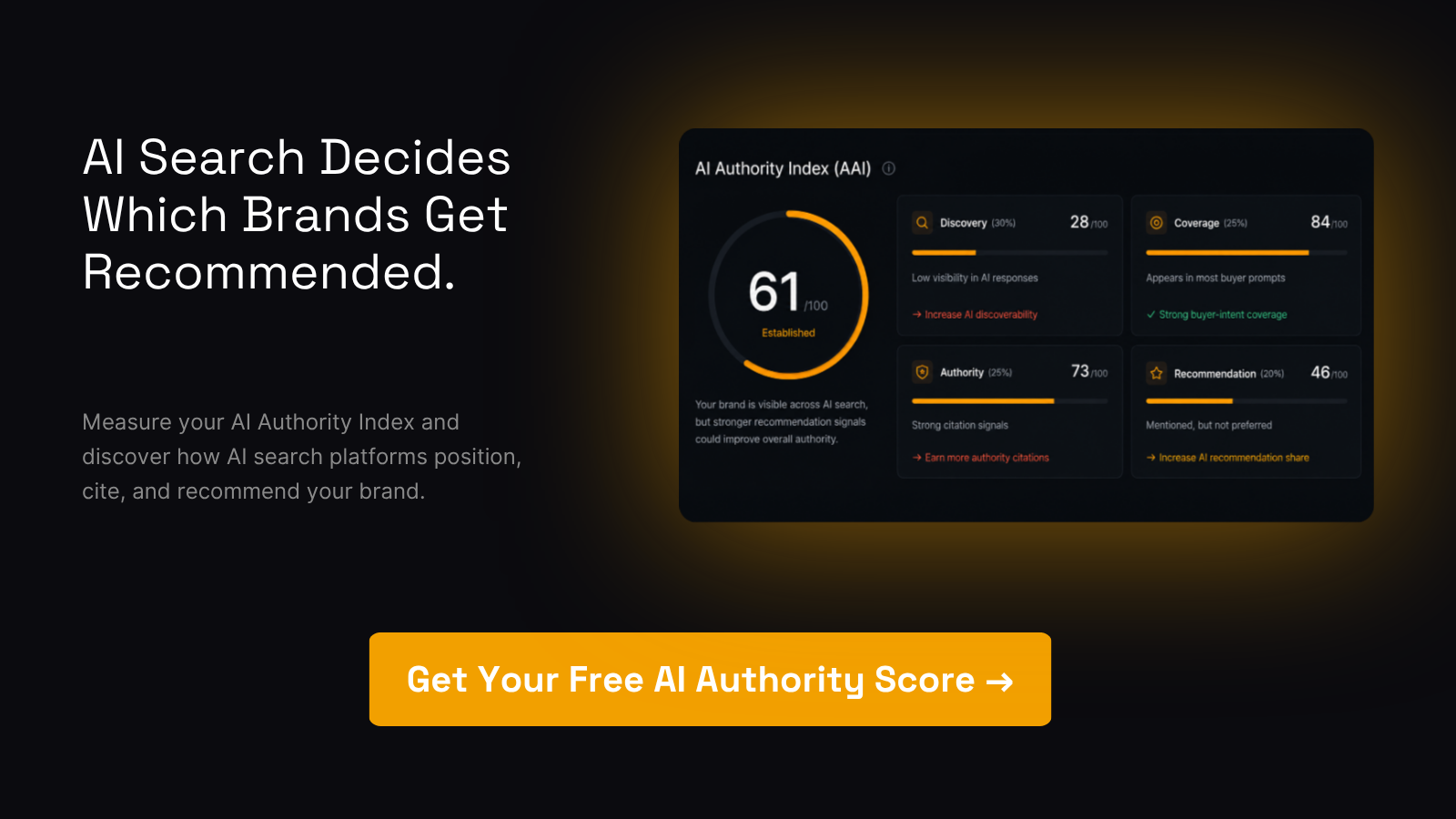
We score brands across the same subindices described in this workflow, benchmark against named competitors on a shared prompt set, and surface prioritized fixes ranked by impact, so the "analyze and act" stage becomes a report instead of a research project. A Free AI Visibility Scan gives a first snapshot of where a brand stands today, and teams ready for recurring tracking can move into our Starter plan at $99 per month, Growth at $349 per month for multi-category monitoring, or Enterprise at $795 per month for multi-brand governance. Teams that just want a recurring, human-reviewed deliverable can start with the Monthly AI Visibility Report at $59 per month.
FAQ
What is an AI visibility workflow?
An AI visibility workflow is a repeatable process for identifying test prompts, measuring how often and how accurately AI assistants cite a brand, and acting on the gaps found. It typically runs on a weekly-to-quarterly cadence rather than as a one-time audit.
How is AI visibility different from traditional SEO?
Traditional SEO optimizes for ranking position and clicks, while AI visibility optimizes for whether a model extracts and cites a brand's content inside a generated answer. According to the Search Engine Land GEO explainer, extractability and entity clarity matter more here than raw ranking position.
How often should we re-test AI visibility?
A full prompt set should run at least monthly, with lighter checks weekly for high-priority pages. The MAD-M drift heuristic suggests content can start losing citation accuracy within roughly 12 weeks without a refresh, which is why quarterly governance reviews matter even if testing happens more often.
How long before an AI visibility workflow shows results?
A first baseline typically takes one to two weeks to build, with content fixes following over the next two to four weeks. Because AI models do not re-crawl instantly, a measurable shift in citations or sentiment usually takes eight to twelve weeks from the first benchmark to a confirmed change.
Sources
- Gartner press release — search-engine volume decline prediction
- What is Generative Engine Optimization (GEO)? — Search Engine Land
- ai-citation-visibility-framework (MAHI / MAD-M / MAHI-100)
- Bain analysis on consumer reliance on AI search results