Marketers: 10 Priority Fixes to Win ChatGPT, Gemini & Claude AI Picks
Platform-aware checklist for marketers: 10 prioritized fixes to boost how often ChatGPT, Gemini, and Claude recommend your products.
· 9 min read

AI assistants recommend products by fusing what they learned in training with what they retrieve live from the web at query time, then matching both against your intent. Structured product data, merchant feeds, third-party reviews, current price and availability, and your own conversation history all feed that decision. For marketers, that means the fastest wins come from fixing crawlability, schema, review coverage, and use-case content, not from writing better ad copy.
TL;DR:
- Ensuring your product schema is complete and includes GTINs significantly improves AI assistant recognition, especially for structured data like offers and reviews.
- Regularly updating your merchant feed and synchronizing prices and stock status across your schema, feed, and webpage reduces mismatches that can prevent products from surfacing.
- Adding clear use-case descriptions and straightforward comparison pages helps AI models match buyer queries to your products more accurately.
- Growing reviews on trusted third-party platforms and securing editorial coverage enhances your brand's credibility and improves AI recommendation visibility.
- Prioritize fixing crawlability issues, including JavaScript rendering problems, to ensure raw HTML shows your current and accurate product data for retrieval.
Table of Contents
- How Do AI Assistants Decide Which Products to Recommend?
- What Signals Determine Whether a Product Gets Surfaced?
- Gemini vs. Claude vs. ChatGPT: Who Prioritizes What?
- What Should Marketers Fix First to Improve AI Visibility?
- How Authoritylayer Helps Teams Track AI Recommendation Share
- What This Means for Product Roadmaps Going Forward
- Check Where You Stand With a Free AI Visibility Scan
- Sources
- FAQ
How Do AI Assistants Decide Which Products to Recommend?
The process runs in four distinct stages, and each one rewards a different kind of marketing work.
- Pretraining builds the semantic map. Everything the model absorbed during training, forum threads, review roundups, comparison articles, press coverage, creates a rough association between your brand and certain use cases. If your product has never been discussed in that context online, it starts the race a lap behind, regardless of how good the product actually is.
- Retrieval and RAG pull in live facts. This is where crawlers, product feeds, and real-time web data override stale training knowledge. OpenAI's shopping documentation confirms that shopping research draws on structured metadata and merchant data to assemble a buyer's guide with top picks and side-by-side comparisons, not just whatever the model memorized months earlier.
- Intent processing matches your constraints to product attributes. A query like "quiet blender under $150 for a small apartment" gets decomposed into noise level, price ceiling, and size, then checked against whichever products have those attributes clearly stated somewhere machine-readable.
- Final ranking and formatting decide what actually gets shown. This is why some products appear in a comparison carousel and others get a single passing mention in a paragraph. Citations, merchant lists, and how cleanly your data renders in a UI all shape whether you make the cut.
Stage one is largely out of your hands in the short term. Stages two through four are exactly where a marketing team can move the needle within weeks, not years.
What Signals Determine Whether a Product Gets Surfaced?
Six categories of evidence do almost all the work, and most companies are only half covering two of them.
- Structured data (JSON-LD schema). Complete
Product,Offer,AggregateRating, andReviewmarkup gives the model unambiguous facts to cite instead of forcing it to guess from prose. Yotpo's research calls structured data a foundational pillar of answer engine optimization for exactly this reason. - Product feeds and merchant programs. Submitting a feed through a channel like the OpenAI Merchant Program gives assistants a direct, regularly updated line to your pricing and stock status, cutting out the guesswork that comes from crawling alone.
- Third-party reviews and editorial coverage. Platforms like G2 and Capterra carry more weight for B2B software than your own testimonials page, and unbiased editorial mentions function as third-party validation the model can point to.
- Price and availability. In live shopping experiences, an out-of-stock item or a price that doesn't match your feed can knock a product out of consideration entirely, even if every other signal is strong.
- Data consistency across schema, feed, and page copy. A price of $49 in your schema, $45 on the page, and $52 in your feed reads as unreliable data, and models tend to suppress unreliable data rather than risk citing something wrong.
- Conversation history and custom instructions. OpenAI notes that memory and prior context shift which attributes get prioritized, so a user who mentioned budget constraints earlier in a session will see price weighted more heavily later.
Pro Tip: Audit your own product pages the way a crawler would. Open each one with JavaScript disabled and check whether the price, availability, and specs are still visible in the raw HTML. If they vanish, so does your visibility.
Gemini vs. Claude vs. ChatGPT: Who Prioritizes What?
The three platforms don't weigh evidence the same way, and treating them as interchangeable wastes effort.
- ChatGPT leans on semantic synthesis combined with retrieval. HubSpot's analysis points to a shopping-specific model that rewards clean schema, strong reviews, and use-case-driven copy. Visibility changes tend to show up at a moderate pace, often within several weeks of a fix going live.
- Gemini ties more closely to Google's own infrastructure, meaning Google Merchant Center data and Knowledge Graph entries carry outsized influence. Because Gemini cross-references facts across so many Google surfaces, inconsistency between your site and your Merchant Center listing gets penalized harder here than elsewhere, and feedback loops tend to run slower.
- Claude behaves more cautiously and leans on precise specifications and vetted third-party sources rather than broad web consensus. That makes it a better test bed for detailed comparison content and claims that need to hold up under scrutiny.
- Timeline matters. Cross-platform testing from The Prompt Insider shows Perplexity surfacing new product mentions the fastest, ChatGPT landing in the middle, and Gemini frequently the slowest to reflect changes. Plan your roadmap with that lag in mind rather than expecting simultaneous results across platforms.
What Should Marketers Fix First to Improve AI Visibility?
Not every fix carries equal weight, and sequencing matters more than most teams assume.
- Validate your JSON-LD
Productschema and include GTINs wherever they apply, since missing identifiers make it harder for any system to match your listing with confidence. - Make sure
Offerschema always includes current price and availability, not placeholder values left over from launch. - Fix any crawlability issues, robots.txt blocks, JavaScript-only rendering, that hide your actual product data from automated retrieval.
- Join supported merchant programs where they exist and keep the feed synced daily against your live site.
- Reconcile schema, feed, and on-page copy so the same price and spec appear everywhere, every time.
- Build use-case-led product pages with explicit "best for" sections instead of generic feature lists.
- Publish comparison pages that state trade-offs plainly, since structured, intent-mapped copy helps models match buyer questions to your product faster than marketing prose does.
- Prioritize reviews on platforms buyers and models both trust, G2 and Capterra for B2B, verified purchase reviews for consumer goods.
- Pursue editorial mentions and earned coverage rather than relying solely on owned content.
- Track your AI recommendation share and feed error rate on a recurring cadence, checking again at 30, 90, and 180 days.
| Action Category | First Move | What It Fixes |
|---|---|---|
| Technical | Validate Product/Offer schema | Missing or ambiguous attributes |
| Feed/Merchant | Sync feed daily against live site | Price and stock mismatches |
| Content | Add "best for" use-case sections | Poor intent-to-attribute matching |
| Social Proof | Grow reviews on G2/Capterra | Weak third-party trust signals |
| Measurement | Track recommendation share monthly | No visibility into progress |
How Authoritylayer Helps Teams Track AI Recommendation Share
Authoritylayer benchmarks how often ChatGPT, Gemini, Claude, and Perplexity mention your brand against competitors, then prioritizes which fix, schema, feeds, reviews, or content, will move your recommendation share fastest. For a deeper look at how buyers actually use these assistants during research, see how buyers shortlist vendors with ChatGPT.

What This Means for Product Roadmaps Going Forward
Machine-readable product attributes now belong on the same priority list as any customer-facing feature. Treat schema and feed accuracy as shipped work, not an SEO afterthought, while your content and PR teams build the slower-moving proof that Claude and Gemini reward. Expect visibility gains to arrive unevenly across platforms, and measure before declaring victory.
— Geraldine
Check Where You Stand With a Free AI Visibility Scan
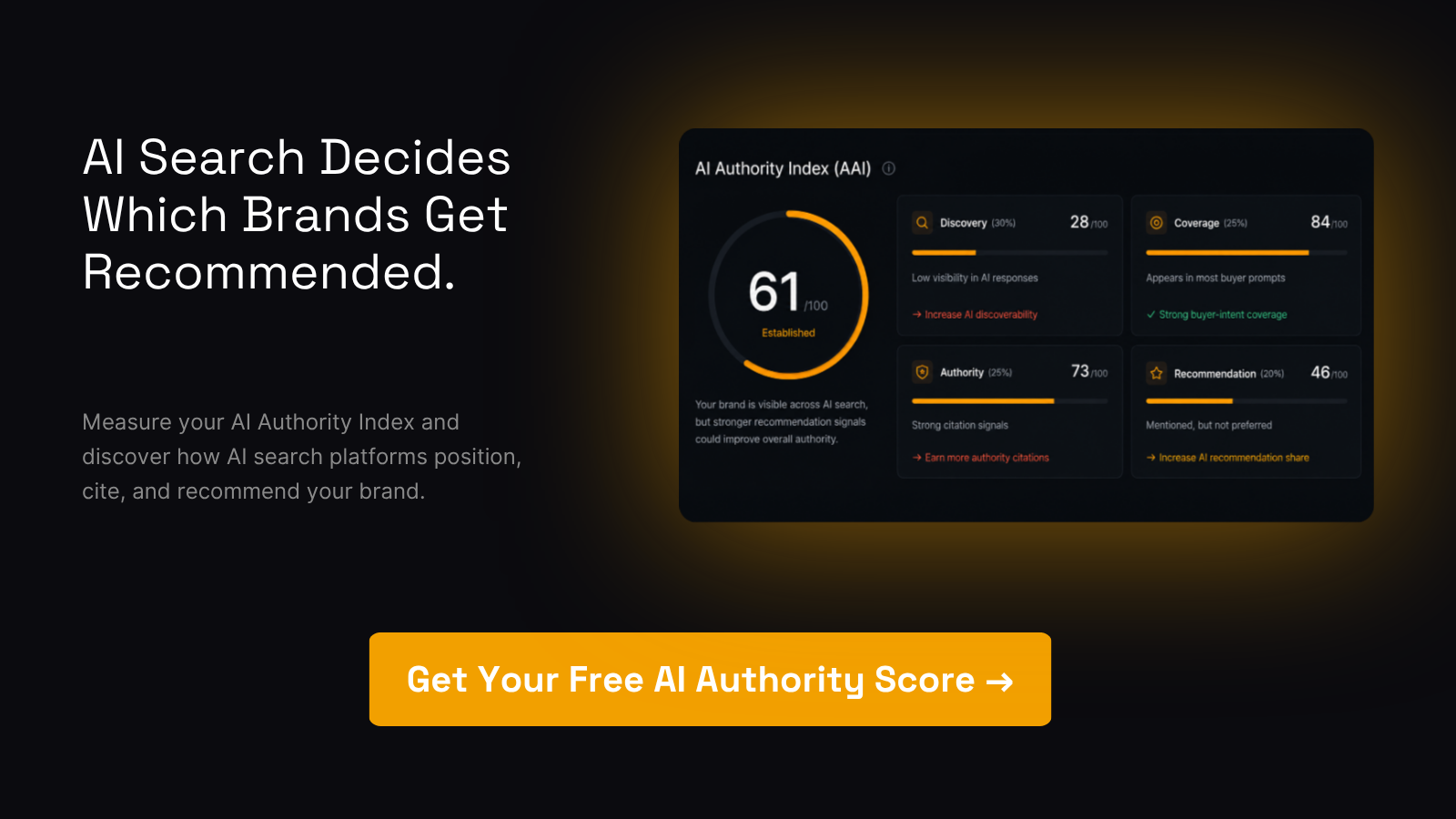
Most of the fixes above are useless if you don't know which one your product actually needs first. Authoritylayer's Free AI Visibility Scan gives you a baseline reading of how often ChatGPT, Gemini, Claude, and Perplexity currently mention your brand, and against which competitors, so you're not guessing which fix to prioritize.
From there, the path depends on scale:
- Start with Starter at $99 per month if you're tracking one brand's AI visibility for the first time.
- Move to Growth at $349 per month once you need to benchmark multiple competitors across markets.
- Choose Enterprise at $795 per month for multi-brand, multi-market programs that need dedicated tracking.
- Or subscribe to the Monthly AI Visibility Report at $59 per month if you just need a recurring check on recommendation share without a full platform commitment.
Run the free scan first. It tells you exactly which of the ten checklist items above deserves your team's attention this quarter.
Sources
- Shopping with ChatGPT Search | OpenAI Help Center
- ChatGPT Product Recommendations: How to Make Sure You Are One in 2026 | HubSpot
- How ChatGPT Recommends Products | Yotpo
- AI Product Recommendations: What ChatGPT, Gemini and Claude Use to Select Products | Lex Agentica
FAQ
How Does ChatGPT Decide Which Products to Recommend?
ChatGPT combines training knowledge with live retrieval through its shopping research flow, weighing structured metadata, merchant data, price, availability, and reviews. OpenAI's documentation confirms this produces buyer's guides with top picks and side-by-side comparisons rather than a single flat answer.
Does Gemini Use Different Signals Than ChatGPT?
Yes. Gemini leans more heavily on Google Merchant Center and Knowledge Graph data, so consistency across your Google-connected surfaces matters more there than on other platforms, and changes tend to take longer to register.
Do I Need a Product Feed to Get Recommended by AI Assistants?
A feed speeds things up and reduces ambiguity, but it isn't strictly required. Crawlable, schema-complete pages can still get discovered without one, though OpenAI's merchant guidance recommends a feed for accuracy and speed.
How Long Does It Take to See AI Visibility Changes After a Fix?
Timelines vary by platform. Cross-platform testing found Perplexity often surfaces changes within days to weeks, ChatGPT typically takes several weeks, and Gemini frequently lags behind both.