Why Manual ChatGPT Checks Fail for Marketers: 4 Repeatable Practices
Replace one off ChatGPT checks with repeatable prompt sampling. Learn four measurement practices, citation logging, and how AuthorityLayer scores AI...
· 9 min read

One employee typing a brand name into ChatGPT is not an AI visibility audit. It's a single data point captured under one account, one context, and one moment in time, and it can swing wildly from the next person's result. Personalization bias, nondeterministic outputs, and thin sampling all distort what that person sees. Real measurement requires consistent prompts run repeatedly across multiple assistants, with results tracked over time instead of eyeballed once.
TL;DR:
- Manual ChatGPT checks are unreliable because individual outputs vary due to personalization, nondeterminism, and incomplete sampling.
- Consistent, repeated prompts across multiple assistants and interfaces are necessary to accurately measure AI visibility over time.
- Recording citation sources, provenance, and run metadata is essential to distinguish true brand mentions from unsupported assertions and tracking changes.
- Building a scalable tracking program involves standardized prompts, regular sampling cadence, and logging full responses, citations, and context for proper analysis.
- Automated tools like Authoritylayer streamline continuous measurement of mention rate, citation quality, share of voice, and citation decay to replace noisy manual snapshots.
Table of Contents
- Why manual ChatGPT checks don't measure AI visibility
- Principles of repeatable AI visibility measurement
- How to build a prompt tracking program that scales
- What to measure once you stop guessing
- AuthorityLayer's approach to measuring what manual checks can't
- What marketing and analytics leaders should prioritize now
- Starter Plan: your path from guesswork to measurement
- Sources
- FAQ
Why manual ChatGPT checks don't measure AI visibility
A marketer logs into their personal ChatGPT account, types "best project management software," and sees their company mentioned third. They screenshot it, drop it in Slack, and move on. That single result tells you almost nothing reliable about actual visibility.
Personalization and context bias sit at the root of the problem. ChatGPT and similar assistants can draw on saved memory, prior conversation history, and account signals to shape a response. An employee who has spent months discussing their own industry with an AI assistant is not seeing what a cold prospect sees. This doesn't mean every output is personalized to the individual, but enough context can leak in that one person's screen is not a stand-in for the market's.
Then there's the snapshot problem. Generative outputs are probabilistic, not fixed. Run the same prompt five times in a row and you can get five different sets of recommended brands, in five different orders. A single check captures one draw from that distribution and treats it as the whole picture.
Manual checks compound this with a few other blind spots:
- Inconsistent prompts. Different employees phrase queries differently, which changes which brands surface. There's no fixed script, so results aren't comparable across checks.
- No time or competitor comparability. A screenshot from March tells you nothing about April, and one person's ChatGPT session tells you nothing about how Gemini or Perplexity handle the same question.
- Interface vs. API gaps and hidden follow-ups. Assistants often issue their own follow-up retrievals behind the scenes to build an answer, and research on ChatGPT's use in screening tasks shows a single prompt can miss citations that only surface in those secondary retrievals.
- Analytics false confidence. Teams that lean on bot crawl logs or GA4 referrer data to fill the gap run into the same trap: AI-driven discovery is routinely undercounted or misattributed by both signals.
The real cost shows up downstream. A PR team targets the wrong publications because one lucky screenshot suggested a competitor was dominating. A product team rewrites messaging based on a single unfavorable mention that never repeats. Decisions built on a snapshot are decisions built on noise.
Principles of repeatable AI visibility measurement
Treat every individual prompt result as one observation, not a verdict. A single run tells you what happened once. What you need is the rate at which your brand appears across many runs, which turns a pile of one off screenshots into an actual probability estimate. That's the same logic behind frameworks like the conceptual AI Visibility Index (AIVI), which scores entity representation using dimensions like mention frequency and positional prominence rather than a single yes or no check.
A defensible measurement approach rests on four practices:
- Sample across engines. ChatGPT, Gemini, Claude, and Perplexity retrieve and rank sources differently, so a brand can appear consistently in one and rarely in another. Testing only one assistant tells you about that assistant, not about AI visibility generally.
- Match the interface real customers use. Interface scraping or user-panel sampling reflects what a logged-out or typical customer actually sees, which tends to differ from raw API responses in length, source count, and citation overlap. Reserve API sampling for specific technical checks where you need programmatic control, not as your default source of truth.
- Track provenance, not just presence. A mention with no source link carries different weight than one with an inline citation. Recording which URLs get cited, and how often, is what turns a mention count into a measure of trust.
- Log the metadata. Run counts, locale, logged-in versus logged-out state, and timestamp all need to be recorded, or nobody can audit whether a change in visibility is real or an artifact of a different sampling setup.
Pro Tip: If you can't say how many runs, which locale, and which interface a visibility number came from, don't report it as a metric yet. Provenance is what separates measurement from anecdote.
How to build a prompt tracking program that scales
Manual checks fail partly because there's no system behind them. Building one doesn't require an engineering team, but it does require discipline.
- Build a buyer-focused prompt library. Group prompts by intent (comparison queries, "best of" lists, problem-solution phrasing) and write several phrasing variants per cluster, since wording changes results.
- Set your sampling parameters. Decide how many runs per prompt you need for a stable read, and set a cadence: daily for volatile, competitive prompts, weekly for mid-priority terms, monthly for long-tail queries.
- Run every prompt in the same interface and locale your customers use. Save the full response text, not just a mention count, and capture any follow-up retrievals the assistant triggers.
- Log mentions, citations, and link attributions as separate fields. A brand name dropped in passing is not the same signal as a cited source URL, and conflating them muddies every downstream metric.
- Cross-validate against manual spot checks and analytics. Referrer data won't catch most AI-driven traffic, but correlating a spike in prompt-based visibility with even a small referrer bump helps confirm the signal is real.
Pro Tip: Store raw outputs, not just summary scores. When a competitor suddenly outranks you, the raw response text is what tells you whether they earned it or you got unlucky with sampling.
Tools built for structured prompt tracking can carry this load automatically, but even a shared spreadsheet with disciplined logging beats another round of one-off screenshots. If you want a faster starting point, a prompt-based visibility test can show you what structured sampling looks like before you build your own.

What to measure once you stop guessing
Once you're running prompts on a schedule instead of checking once, a handful of metrics actually mean something.
- Visibility rate (mention rate): the share of runs that mention your brand at all, calculated as mentions divided by total runs across your sampled prompt set.
- Citation quality: whether a mention comes with a real source link and inline provenance, or is just an unsupported assertion buried in the response text.
- Citation Decay Rate: a moat metric tracked by frameworks like AVR, which measures how citation frequency declines over time and flags when a competitor has quietly displaced you.
- Share of voice: how often your brand appears relative to the total field of brands mentioned across your sampled prompts and platforms, without needing to name specific rivals to track the trend.
Check whether a specific prompt cluster is driving the decline, whether a competitor's citation count is climbing in the same window, and whether your own source pages are still being crawled and cited before assuming the AI brand mentions picture as a whole has changed.
AuthorityLayer's approach to measuring what manual checks can't
Individual prompts are observations. Repeatable, independent measurement turns those observations into intelligence. That's the operating principle behind how Authoritylayer benchmarks brand visibility across ChatGPT, Gemini, Claude, and Perplexity.
Authoritylayer runs consistent prompt sets on a defined cadence, extracts citation URLs, and rolls the results into an AI Authority Index score that reflects mention frequency, citation quality, and share of voice, following the same run-count and provenance discipline documented in the AVR framework's CHECKS.md approach. The workflow maps directly onto the principles above:
- Runs get aggregated into a visibility rate, not reported as isolated screenshots.
- Citation extraction distinguishes a sourced mention from a bare assertion.
- Score changes get prioritized into remediation steps ranked by impact, not treated as a single alarming data point.
Authoritylayer documents this process in its measurement methodology, so teams can see exactly how a score gets built before acting on it.
What marketing and analytics leaders should prioritize now
Most teams chasing AI visibility want a polished dashboard before they've built provable signals underneath it. That's backwards. A clean chart built on ten manual checks a month is still noise with a nice font.
Provenance matters more than pace. Get sampling and citation tracking right first, then automate. Automated coverage can watch hundreds of prompts a week, but high-impact pages, the ones tied to revenue or brand reputation, still deserve a human look. Set a tight loop: detect a shift, verify it against raw response text, fix the underlying page or messaging, then measure again before declaring victory.
— Geraldine
Starter Plan: your path from guesswork to measurement
If everything above sounds like more infrastructure than your team can build in house right now, that's exactly the gap the Authoritylayer Starter Plan closes. Instead of asking an employee to spot check ChatGPT once a week, you get scheduled prompt tracking, visibility dashboards, and AI Authority Index scoring running continuously in the background.
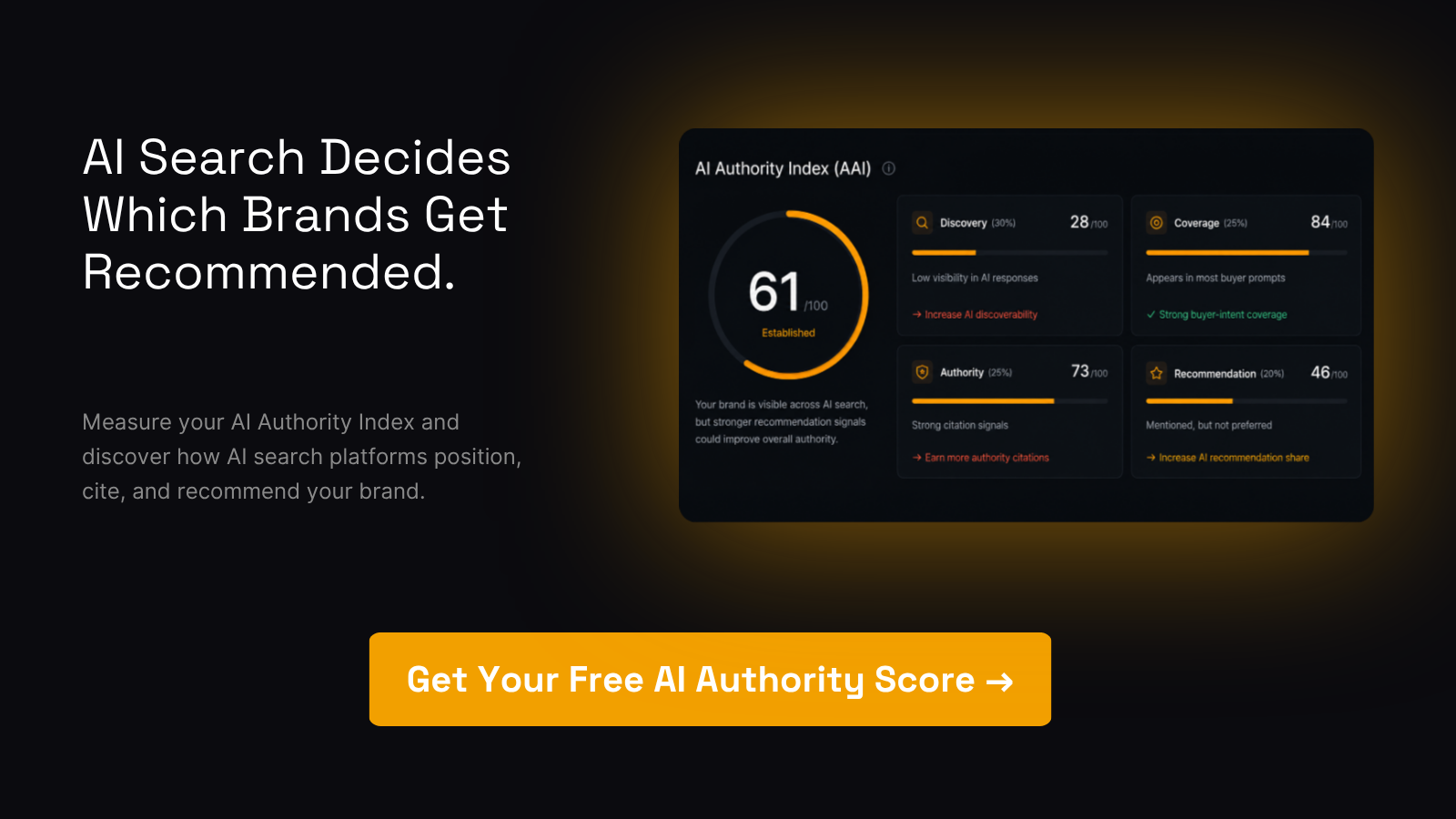
There are plans suitable for teams moving off manual checks who need reliable numbers without hiring a data engineer to build the pipeline themselves. If you're already running a mature in-house sampling operation, you may only need select features. For everyone else starting from screenshots and guesswork, it's the fastest way to get real visibility rate and share-of-voice data flowing. Check out the Starter Plan to see what a week of automated tracking looks like for your brand.
Sources
For methodology depth, see the AVR Framework's verifiable checks and the AIVI conceptual index.
- Assessing the ability of ChatGPT to screen articles for systematic reviews
- AI Visibility Reporting Isn't Any Good — Yet
FAQ
Why isn't one ChatGPT search enough to measure AI visibility?
A single search reflects one account's context and one draw from a nondeterministic output, not a stable measure of how often your brand appears across real users and repeated queries.
Does personalization mean every ChatGPT answer is customized to the user?
No. Personalization can influence outputs through account history and context signals, but not every response is uniquely tailored, which is why consistent, logged-out sampling gives a more reliable baseline.
What's a good cadence for tracking AI visibility?
High-priority prompts benefit from daily or weekly runs, while long-tail queries can be checked monthly, with all runs logged for locale, interface, and sample size.
What metric should replace "checking my rank" in ChatGPT?
Visibility rate, the percentage of runs across a sampled prompt set that mention your brand, reflects reality far better than a single rank observed once.
Can Authoritylayer help teams move off manual checks?
Yes. The Starter Plan provides scheduled prompt tracking, visibility dashboards, and AI Authority Index scoring built around repeatable sampling instead of one-off searches.