Stop Missing AI Bookings: 30/60/90 Plan for Restaurant Marketers
A prioritized 30/60/90 checklist plus monthly prompt audits to fix schema, reviews, and reservation feeds so your restaurant appears in ChatGPT and other...
· 12 min read

ChatGPT and other AI assistants no longer hand diners a ranked page of links. They synthesize a short shortlist, usually three to five restaurants, built from verifiable entity data, and they say it with confidence. That means the two fastest wins for any restaurant marketer are completing schema.org/Restaurant markup with consistent, synced listings, then pushing review ratings and descriptive review volume above the thresholds AI models treat as a gate, as explained in Why Optimize for ChatGPT: Boosting Brand Visibility.
TL;DR:
- Restaurants need to ensure their schema markup is complete and consistent across all platforms, including hours, location, and contact details.
- Maintaining ratings above 4.1 to 4.3 stars, with recent reviews and detailed descriptive content, significantly improves AI recommendation chances.
- Structured menu data and occasion-specific pages help provide AI models with specific quotes, boosting visibility in relevant queries.
- Ongoing prompt audits and monitoring are essential to identify and fix gaps before changes in AI behavior or model updates reduce visibility.
- Incomplete data or ratings below the threshold cause most restaurants to remain invisible in AI search results, regardless of quality or popularity.
Table of Contents
- How AI Assistants Decide Which Restaurants to Recommend
- The Signals That Decide Whether AI Recommends You at All
- A 30/60/90 Plan for Winning AI Recommendations
- Measuring AI Visibility and Where AuthorityLayer Fits
- Where AI Recommendations Can Get It Wrong
- What's Coming Next in AI Local Search
- Strategic Perspective: What Restaurant Marketers Should Actually Change
- Start With a Free Scan Before You Spend on Fixes
- Sources
- FAQ
How AI Assistants Decide Which Restaurants to Recommend
Traditional search engines rank pages. AI assistants do something closer to entity resolution: they pull your name, address, hours, cuisine, price range, and reviews from wherever those facts live, then assemble a single "restaurant object" they trust enough to cite. If the pieces conflict, the model either drops you or hedges its answer.
Google's own guidance on LocalBusiness structured data explains this at the technical level, but the practical effect matters more: ChatGPT isn't choosing between page one and page two anymore. It's choosing between restaurants it can confidently describe and ones it can't fully verify, so it leaves the uncertain ones out entirely.
That shift changes what "ranking" even means. Assistants typically stop at three to five named options per query, according to a 2026 industry benchmark on AI search visibility. There's no page two to fall back on. Inclusion in that shortlist matters far more than where you'd sit in a traditional search results page.
OpenAI has documented how ChatGPT pulls from structured metadata and third-party provider feeds to decide what to show and how to label it. The model favors sources it can cite with confidence over vague marketing copy, which is why a restaurant with thin, inconsistent web data can be objectively excellent and still never come up. The model isn't rewarding quality. It's rewarding evidence it can point to.
The Signals That Decide Whether AI Recommends You at All
Ratings function as a gate, not just a tiebreaker. Analysis of AI restaurant discovery patterns found ratings floors clustering around 4.1 to 4.3 across assistants, according to Bloom Intelligence's 2026 research. Fall below that range and you're often excluded from consideration before the model even weighs cuisine, price, or location.
That threshold isn't arbitrary. Assistants are trying to avoid recommending a place a diner will regret, so a 3.9-star average reads as a risk signal even if your food is genuinely good. Getting from 3.8 to 4.2 does more for your AI visibility than almost any content change you could make.
Review volume and recency matter almost as much as the score itself. A restaurant with 40 reviews from three years ago looks stale to a model trying to answer a current question. Descriptive detail matters too: reviews that mention "great for a first date," "quiet on Tuesdays," or "good gluten-free options" give the model exact phrases to match against contextual prompts. Star ratings alone don't do that work.
Roughly 79% of assistant restaurant prompts are comparative or contextual, asking about occasion, diet, or group size, per the same industry benchmark. A restaurant whose only reviews say "great food, great service" has nothing specific for the model to latch onto when a diner asks for somewhere quiet with a good wine list.
Consistency across your website schema, your Google Business Profile, and your booking provider prevents a subtler problem: entity fragmentation. When the same restaurant shows up as two slightly different records, some assistants split the reviews between them, diluting the rating that would otherwise clear the threshold.

A 30/60/90 Plan for Winning AI Recommendations
Most restaurant groups don't need a full rebuild. They need a sequence, and the order matters because early fixes make later ones more effective.
Days 1 to 30: fix the entity foundation.
- Audit and complete every required and recommended
Restaurantschema field, especiallyopeningHoursSpecificationandpriceRange. - Cross-check hours, address, and phone number across your website, Google Business Profile, Yelp, and OpenTable, and correct any mismatch.
- Confirm booking IDs in your reservation feed match the entity data on your own site, per the reservation feed spec.
Days 30 to 60: build review volume that says something. 4. Launch a review-request flow at checkout or checkout email, timed for freshness rather than one-off blasts. 5. Set a response protocol for every review, positive or negative, since assistants weigh recency and engagement. 6. Coach staff to ask satisfied diners what specifically they'd tell a friend, since that phrasing becomes the descriptive detail models cite.
Days 60 to 90: give AI something specific to quote.
7. Publish structured menu content using MenuItem schema rather than a PDF, since answer-format content converts better into AI-citable attributes than generic marketing pages.
8. Build occasion-specific pages (date night, private events, large groups) that answer the contextual questions diners actually ask assistants.
9. Run a prompt audit to find where your restaurant drops out of AI answers and fix those specific gaps.
Ongoing: monitor, don't set and forget. Schedule recurring prompt audits, track your AI recommendation share against competitors, and treat every gap as a backlog item rather than a one-time fix.
Pro Tip: Run your prompt audit using the exact phrasing diners use, not marketing language. "Best romantic restaurant downtown" surfaces very different results than "restaurant with a nice patio for anniversaries," and the gap between those two answers is where most visibility problems hide.

Measuring AI Visibility and Where AuthorityLayer Fits
You can't fix what you don't measure, and AI recommendation visibility doesn't show up in a standard rank tracker. The metrics that matter here are different: AI recommendation share (how often your restaurant appears across a defined set of relevant prompts), which sources the model cites when it does mention you, whether your rating clears the observed threshold, and how often a prompt audit turns up a gap.
A prompt audit works by simulating the actual questions diners ask: "family-friendly restaurant near the stadium," "quiet spot for a work dinner," "best patio for brunch." Running these systematically, rather than guessing, is how you find out which of your locations are invisible before a diner does.
That's the gap Authoritylayer's platform is built to close. It benchmarks your AI recommendation share against competitors, tracks which citation sources the models pull from, and turns the findings into a prioritized fix list instead of a vague audit report. Useful checks to build into a monthly cadence include:
- Tracking AI recommendation share by location and by query category
- Logging which listings, review platforms, or schema fields get cited when you do appear
- Flagging locations that fall below the observed rating threshold
- Reviewing prompt-audit results monthly rather than quarterly, since assistant behavior shifts as models update
Where AI Recommendations Can Get It Wrong
AI assistants don't evaluate restaurants; they summarize what other sources already say about them. That creates a bias problem most marketing teams haven't thought through yet.
Restaurants with more digital-native customers, the kind who leave detailed, phrase-rich reviews, get recommended more often than equally good restaurants whose regulars just don't write reviews. That skews recommendations toward younger, urban, higher-income demographics almost by default, regardless of food quality. A neighborhood spot beloved for decades can be functionally invisible to ChatGPT simply because its loyal customers never got in the habit of reviewing anywhere online.
Language and labeling introduce a second bias. OpenAI itself notes that labels like "budget-friendly" are model-generated summaries based on available metadata, not verified facts. If your menu pricing isn't structured clearly, the model may guess wrong, and that guess becomes what a diner reads as fact.
There's also a concentration effect. Because assistants typically name only three to five restaurants per query, small advantages compound: a restaurant that clears the rating threshold and has clean schema captures a disproportionate share of every relevant query in its category, while a nearly identical competitor a few tenths of a star lower gets essentially zero visibility. That's a much harsher cliff than traditional search rankings ever created, where a page-two listing still got some traffic. Marketers should treat this as a reason to close data gaps early, not evidence that the system is unfair to fight.
What's Coming Next in AI Local Search
Diner comfort with AI-driven recommendations is rising fast. Discomfort with AI in restaurant experiences dropped from 41% in 2025 to 27% by mid-2026, according to Partech's AI in Restaurants survey. That trend line points toward AI assistants becoming a default discovery channel rather than a novelty, which raises the stakes on getting entity data right now rather than later.
Expect deeper personalization next. Assistants already handle follow-up questions inside a single conversation ("actually, does it have outdoor seating?"), and that contextual memory will extend further into dietary restrictions, past order history, and group preferences pulled from connected apps. Restaurants with rich, structured menu data will answer those follow-ups accurately; restaurants without it will get skipped mid-conversation when the model can't confirm a detail.
Reservation integration will likely deepen too. The current OpenAI reservation spec already supports booking actions inside chat, and as more booking providers adopt similar feed contracts, the gap between "recommended" and "booked in the same conversation" will shrink. That collapses another step out of the discovery funnel.
Expect stricter provenance requirements too. As AI providers face more scrutiny over hallucinated details, they'll likely lean harder on verified structured data and penalize entities they can't confirm across multiple sources. Restaurants treating schema and listings sync as optional now will find that gap far more costly in twelve months.
Strategic Perspective: What Restaurant Marketers Should Actually Change
The real shift isn't technical. It's organizational. Listings and review management need one owner, not three departments quietly duplicating effort. Traditional rank-tracking KPIs should give way to AI-specific ones: recommendation share, percentage of locations above the rating threshold, prompt-audit pass rates. And AI visibility needs a standing, prioritized backlog, not an occasional audit someone runs when traffic dips. Treat entity accuracy the way you'd treat a POS outage: urgent, owned, and tracked.
— Geraldine
Start With a Free Scan Before You Spend on Fixes
One way to know where your restaurant stands in AI-driven recommendations is to move beyond guessing based on anecdotes from one diner who mentioned ChatGPT sent them your way. Instead of manually running prompt after prompt across ChatGPT, Gemini, Claude, and Perplexity, you get a benchmark against named competitors, a list of the specific citation sources feeding those answers, and a prioritized roadmap instead of a pile of disconnected observations.
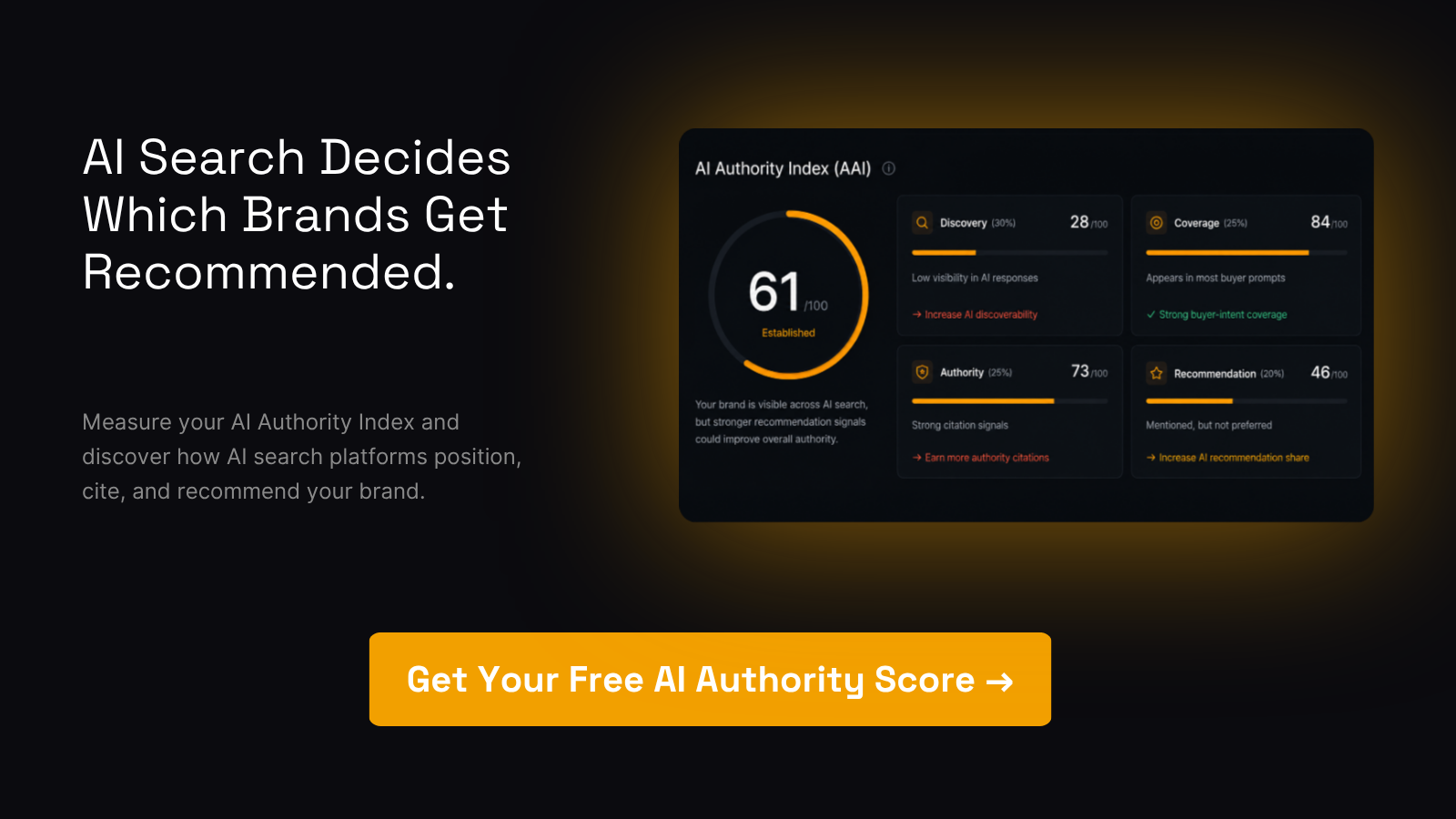
For a single location or a small group testing the waters, the Free AI Visibility Scan shows you where you currently stand with zero commitment. If the gaps are bigger than one fix can solve, the Starter Plan at $99 per month adds ongoing monitoring and a prioritized fix list built specifically for smaller restaurant operations that don't have a dedicated GEO team. Run the free scan first, then decide if Starter fits your next quarter.
Sources
Four data streams matter most, and most restaurant sites get at least one of them wrong.
Schema markup comes first. Google's structured data guidelines call out name, address, telephone, and openingHoursSpecification as required fields for LocalBusiness structured data, with priceRange, servesCuisine, and aggregateRating listed as strongly recommended. Add hasMenu or hasMenuSection where you can. A restaurant missing half these fields is handing the model an incomplete file.
Third-party listings come second. Google Business Profile, Yelp, and OpenTable each hold a version of your entity, and if your hours differ across even two of them, the model has no way to know which one is current. Citation consistency isn't a nice-to-have here; it's the difference between a confident answer and a skipped one.
Booking and reservation feeds are the third piece, and the one most marketing teams ignore. OpenAI's restaurant reservation conversion spec requires stable business IDs plus consistent name, address, and phone data in partner feeds. Assistants use these feeds as a search index, matching and deduplicating entities by ID. An unstable ID, or one that doesn't match your website's schema, fragments your restaurant into two half-visible listings instead of one strong one.
Reviews are the fourth stream, and they carry more weight than most SEO teams assume.
- Local Business (LocalBusiness) Structured Data | Google Search Central | Documentation | Google for Developers
- Shopping with ChatGPT Search | OpenAI Help Center
- Restaurant reservation conversion spec – Plugins | OpenAI Developers
- 83% of Restaurants Are Invisible in AI Search: New Uberall Report Reveals the Discovery Gap Reshaping the Quick-Service Restaurant Industry
- AI Restaurant Discovery 2026: The Data | Bloom Intelligence
FAQ
What Rating Do You Need for AI to Recommend You?
Aggregated research points to a floor around 4.1 to 4.3 stars across major assistants, based on Bloom Intelligence's analysis of AI restaurant discovery patterns. Below that range, restaurants tend to get excluded from shortlists regardless of other strengths.
Which Schema Fields Matter Most for AI Restaurant Search?
Name, address, telephone, and openingHoursSpecification are required fields under Google's LocalBusiness structured data guidelines, with priceRange, servesCuisine, and aggregateRating strongly recommended. Missing fields make it harder for AI models to build a confident restaurant profile.
How Do I Check If ChatGPT Recommends My Restaurant?
Run a prompt audit using the exact phrasing diners use, like "quiet restaurant for a business dinner near downtown," across several relevant scenarios. Track whether you appear, which sources get cited, and where competitors show up instead.
Why Do Some Great Restaurants Never Show Up in AI Answers?
Usually it comes down to incomplete schema markup, inconsistent listings across Google Business Profile and booking platforms, or a rating that falls below the observed 4.1 to 4.3 threshold. A benchmark study found that roughly 83% of restaurant locations never appear in AI-generated recommendations at all.
What Does Authoritylayer Cost for a Restaurant Group?
The Starter Plan runs $99 per month, and the Growth plan is $349 per month for larger operations needing deeper competitive benchmarking. Multi-brand organizations can review Enterprise pricing directly, and a Free AI Visibility Scan is available before committing to any plan.