15–30 Prompt Audit to Win ChatGPT Mentions for Marketers
Run a 15–30 prompt audit, fix schema and entity signals, and earn third-party citations. A measurement-first playbook for marketers to win ChatGPT mentions.
· 15 min read

Three moves change your odds most: make your brand pass a one-sentence identity test, earn mentions on the third-party pages ChatGPT already cites, and make your product facts machine-readable through schema and feeds. Run a 15 to 30 prompt baseline test this week to see where you stand. Fixing the technical layer takes hours; earning the citations that move recommendation share takes weeks to months, so start both tracks now.
TL;DR:
- Ensuring your brand passes a clear one-sentence identity test and has consistent, descriptive naming across all platforms significantly improves AI recognition and recommendation chances.
- Earning citations on third-party review sites and community sources that ChatGPT already trusts offers more influence than solely optimizing your own website content.
- Implementing structured product data, review markup, and verifying server rendering are technical steps that enhance AI's ability to crawl and cite your product facts accurately.
- Conducting targeted outreach with concrete, scenario-specific information on influential third-party pages yields better and faster results than broad or unfocused efforts.
- Using tools like AuthorityLayer's free AI visibility scan allows companies to benchmark their current AI citation status and identify quick-win improvements before investing heavily in ongoing campaigns.
Table of Contents
- How ChatGPT Finds and Decides on Product Recommendations
- The Playbook: 8 Steps to Get Recommended by ChatGPT
- Technical Checklist for Product Pages and Catalogs
- Earning Third-Party Corroboration That AI Actually Reads
- Monitor, Measure, and Scale AI Visibility
- Legal and Ethical Considerations of AI Product Recommendations
- User-Generated Content and Social Proof That Builds AI Confidence
- Naming and Branding That AI Can Actually Parse
- Influencer and Thought Leader Collaboration for Citable Mentions
- Reorienting Marketing Around Being the Name the Web Repeats
- How AuthorityLayer Helps You Get Recommended by ChatGPT
- Sources
- FAQ
How ChatGPT Finds and Decides on Product Recommendations
ChatGPT pulls from two different systems, and confusing them is the single most common mistake marketers make when chasing visibility. The first is training memory, the static knowledge baked into the model during training, which is slow to update and impossible to influence directly. The second is live web retrieval, where the model searches, reads, and cites current pages in real time. Most product recommendations today lean heavily on that second layer, which means the pages you can actually influence matter more than the model's frozen memory.
Inside live retrieval, there are distinct surfaces worth separating. There's baked-in knowledge from training. There's live web citations pulled from roundups, review sites, and comparison articles. There's shopping and product feed surfaces that power more transactional queries. And there's review and social signal aggregation, where the model reads sentiment across platforms rather than quoting a single source.

Freshness carries real weight in this system. Research on large language model retrieval behavior shows models favor pages updated recently, with a strong lean toward content refreshed within the last one to three years, over older, stagnant pages, according to research on LLM retrieval and citation behaviors. Third-party corroboration matters just as much. A page that says "we recommend X" carries more weight when three other independent sites say the same thing. And entity clarity, meaning a clean, unambiguous description of what your product is and does, determines whether the model can confidently attach your name to a query in the first place. Miss any one of these three, and the other two do less work than they should.
The Playbook: 8 Steps to Get Recommended by ChatGPT
This is the order that works, roughly. Skipping ahead to outreach before fixing your entity clarity wastes the outreach.
- Run a prompt-set audit. Build 15 to 30 realistic buyer queries ("best [category] for [use case]," "[Your Product] vs [Competitor]," "top tools for [job to be done]"). Test them across ChatGPT and Gemini, and log whether you appear, which sources get cited, and how competitors are framed. This single exercise usually reveals more than a month of guessing, since it shows you the exact pages the model already trusts in your category, a tactic AuthorityLayer's own prompt-set methodology is built around.
- Pass the one-sentence test. Can someone unfamiliar with your brand read one sentence on your homepage and know exactly what you sell, who it's for, and what makes it different? If not, fix your homepage headline, your About page, your LinkedIn company description, and your schema markup so all four say the same clear thing.
- Fix entity consistency. Your product name, category, and core claim should read identically across your site, your Crunchbase or LinkedIn profile, and any directory listings. Inconsistent descriptions confuse the model's confidence in what you actually are.
- Publish answer-first content. Every key product or comparison page needs a 40 to 60 word quotable answer near the top, before any narrative buildup. Write honest "X vs Y" comparisons; this format is heavily cited because it maps directly onto how people ask comparison-style questions, and models reuse well-structured comparison language almost verbatim.
- Pitch roundups with a specific gift. Don't email an editor asking to be "considered." Offer something they don't already have: a missing pricing detail, a screenshot of a feature, a one-line differentiator they can drop straight into their existing article without a rewrite.
- Earn reviews with concrete use-case language. Reviews that mention specific scenarios ("we used this for a 40-person sales team migrating from spreadsheets") get quoted far more often than generic five-star praise, since detailed reviews improve how confidently an assistant can quote and recommend a product.
- Fix the technical layer. Confirm your product facts render in raw HTML, not just after JavaScript loads, and confirm crawlers can reach them.
- Measure and repeat. Track share-of-voice across your prompt set, log which sources get cited, and tie AI referral traffic to conversions.
Pro Tip: Before spending a dollar on outreach, run the prompt-set audit first. It tells you exactly which three or four pages the model already trusts in your category, so your outreach list writes itself instead of being a guess.
Technical Checklist for Product Pages and Catalogs
Structured data does the heavy lifting here. Practitioner guides consistently find that structured product data, review depth, and feed participation materially affect visibility in AI shopping surfaces, and the failure modes are almost always the same handful of issues.
Get these right:
- Implement full Product schema: name, brand, price, availability, SKU, and category, matched exactly to what's visible on the page.
- Add Review and AggregateRating markup, and make sure the numbers match what a human sees when they scroll the page.
- Confirm GPTBot and OAI-SearchBot aren't blocked in your robots.txt or firewall rules.
- Run the server-render test: disable JavaScript and reload the page. If your price, availability, or specs disappear, the model likely can't see them either.
- Keep product feeds current, ideally refreshed daily for price and stock, and enroll in relevant merchant programs where your category supports it.
- Audit for CDN or bot-management rules that silently block AI crawlers while allowing Googlebot.
The most common failure isn't a missing schema field. It's a mismatch: schema saying "$49" while the visible page says "$59" after a promotion expired. That inconsistency doesn't just confuse shoppers, it teaches the model your structured data can't be trusted, which bleeds into how confidently it cites you elsewhere.
Earning Third-Party Corroboration That AI Actually Reads
Analyses of AI citations consistently find that a large share trace back to third-party roundups, review sites, and community threads rather than brand-owned pages. That's the uncomfortable truth: your own website matters less than the five external pages the model already trusts about your category.
- Pull the cited-source list from your prompt-set audit and rank pages by how often they appear.
- Prioritize outreach to the two or three pages that show up across multiple prompts rather than spreading thin across twenty low-value mentions.
- Offer editors something concrete: a comparison chart, a pricing breakdown, or a use-case they haven't covered.
- Engage on Reddit and forums with real, useful answers, not disguised pitches. Models weight community sentiment, and transparent participation reads differently than obvious astroturfing.
- Prioritize review platforms relevant to your category and encourage detailed, scenario-based reviews over generic praise.
A modest, focused program often outperforms volume: two strong earned mentions plus a handful of detailed reviews can move recommendation share more than dozens of thin content pages.
Monitor, Measure, and Scale AI Visibility
Treat this like paid search reporting, not a one-time project. Build a simple dashboard tracking four things weekly or monthly: prompt-set share-of-voice, which sources get cited when you appear, AI-referred traffic in your analytics, and conversion rate from that traffic compared to other channels.
Set targets you can actually hit in a quarter, not vague hopes. Moving prompt-share from appearing in 2 of 20 prompts to 8 of 20 is a realistic first-quarter goal for most mid-market brands. Track citation growth rate month over month, and watch whether AI-referred visitors convert at a different rate than organic search, since that number often justifies the whole effort to a skeptical CFO.
- Run the prompt-set test weekly during the first quarter, then monthly once your baseline stabilizes.
- Log every citation source, not just whether you appeared.
- Review outreach and content wins monthly against your prioritized page list.
- Revisit reputation and review strategy quarterly.
This is where AuthorityLayer's Free AI Visibility Scan fits: it gives you the prompt-set baseline and quick-win list without building the tooling yourself, and the Monthly AI Visibility Report turns that baseline into an ongoing benchmark against named competitors.
Pro Tip: Don't just track whether you appear. Track WHERE you're cited from. A brand cited from three thin blog posts is more fragile than one cited from a single, well-established comparison page that ranks for dozens of related queries.
Legal and Ethical Considerations of AI Product Recommendations
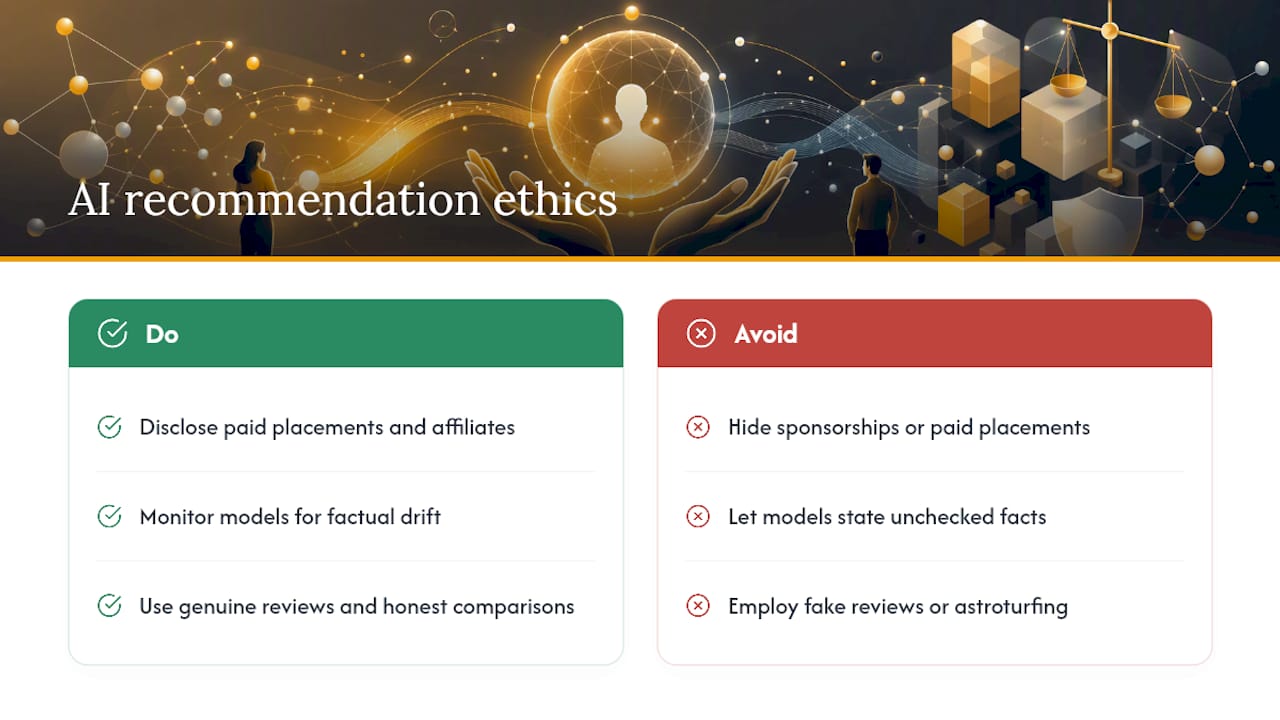
Transparency isn't optional here, and the risk cuts both ways. If you're paying for placements, sponsored content and affiliate relationships still need clear disclosure, the same standard that applies to search and social advertising. An AI model citing an undisclosed paid placement as if it were an independent review creates real liability exposure if regulators or platforms start scrutinizing AI-influenced commerce more closely, which most expect to happen as the channel matures.
There's also a factual-accuracy risk unique to this channel. Because ChatGPT synthesizes and paraphrases rather than quoting verbatim, a model can misstate your pricing, your feature set, or your availability in ways you never wrote. Monitoring isn't just about visibility, it's about catching factual drift before it becomes the version thousands of users hear. If a model tells a shopper your product costs $79 when it actually costs $99, that's a customer service problem before it ever becomes a sales opportunity.
Manipulation tactics carry outsized risk in this environment. Fake reviews, astroturfed Reddit threads, and paid roundup placements disguised as organic editorial content erode trust fast once discovered, and AI platforms are actively working to detect and discount exactly these patterns. The brands that win the long game are the ones whose corroboration is real: genuine reviews, honest comparisons, and community mentions that would exist whether or not an AI model ever read them.
User-Generated Content and Social Proof That Builds AI Confidence
Detailed, specific user content does something generic marketing copy can't: it gives the model language it can quote with confidence. A review that says "great software" tells the model nothing usable. A review that says "we switched from spreadsheets and cut onboarding time from three weeks to four days" gives it a specific, attributable claim worth surfacing in a recommendation.
Encourage customers to write reviews that include the scenario, the alternative they considered, and a concrete outcome. This isn't just a nicer review, it's structurally more citable. Prompt for this directly in your review request emails instead of asking for a star rating alone.
Case studies work the same way, especially when published with real numbers and named use cases rather than vague success language. Video testimonials with transcripts help too, since transcripts are text the model can read and quote, while the video itself is invisible to it. If you're running customer interviews, always publish the transcript alongside the video.
Community discussions carry unusual weight because they read as unfiltered. A thread where real users debate your product against a competitor, warts included, often gets cited over polished brand copy precisely because it reads as independent. That's uncomfortable for marketers used to controlling the narrative, but it's the reality of how these models weigh sources. Participate honestly in those threads rather than trying to suppress or control them.
Naming and Branding That AI Can Actually Parse
Product names that rely on invented words or heavy stylization create a real discovery problem: the model has to guess at category and function instead of reading them directly. A product literally named "InvoiceFlow" gives the model an immediate, low-ambiguity signal about what it does. A product named with an abstract, unrelated word forces every mention to carry extra descriptive context just to establish basic function, and that context doesn't always travel with the name in later references.
This doesn't mean abandon brand personality for generic descriptors. It means pairing distinctive names with consistent, plain-language category descriptions everywhere the name appears: your homepage, your schema, your directory listings, your social bios. If your product is a "project management tool for creative agencies," say that phrase identically in five places rather than five slightly different variations. Consistency here does more for AI comprehension than cleverness does.
Watch for naming collisions too. If your product shares a name with an unrelated company, a common word, or a well-known term in another field, the model may conflate the two or hedge its answer rather than commit to a recommendation. Search your exact product name alongside your category term and see what else surfaces. If the results are cluttered with unrelated entities, that ambiguity is working against you every time someone asks a question your product should win.
Influencer and Thought Leader Collaboration for Citable Mentions
Influencer content earns AI citations differently than it earns social engagement, and that distinction matters for who you choose to work with. A high-follower creator doing a flashy unboxing video generates awareness but often produces little text an AI model can retrieve and quote. A mid-tier expert writing a detailed, transcript-rich comparison or a technical breakdown produces exactly the kind of citable substance models pull from.
Prioritize collaborators who publish in formats models can actually read: long-form articles, YouTube videos with accurate transcripts, or detailed newsletter breakdowns over pure short-form video. Ask for content that names specific use cases and makes direct comparisons, not vague enthusiasm. "This is the best tool for X" with no elaboration gives the model nothing to quote; "this handles Y better than Z because of this specific feature" gives it a citable, specific claim.
Thought leaders who already rank and get cited in your category are worth more than raw follower count. Check whether a potential collaborator's existing content already appears in your prompt-set audit results. If their site or channel already shows up when you test relevant queries, a mention from them compounds an existing signal rather than starting from zero.
Reorienting Marketing Around Being the Name the Web Repeats
Most teams over-invest in publishing more and under-invest in being unambiguous about what they are. Clarity beats content volume every time a model has to decide whether to name you. Earned mentions compound slowly, so get buy-in from leadership now for a multi-quarter effort, not a campaign. And keep community participation honest. Models are getting better at spotting manufactured buzz, and so are the humans reading it.
— Geraldine
How AuthorityLayer Helps You Get Recommended by ChatGPT
Most of this playbook is diagnostic before it's tactical, and diagnosing manually across ChatGPT, Gemini, Claude, and Perplexity eats hours you probably don't have every week. That's the gap AuthorityLayer closes: instead of running your own prompt sets by hand and guessing at which competitor is winning which query, you get a benchmarked, evidence-based view of exactly where you stand and what to fix first.
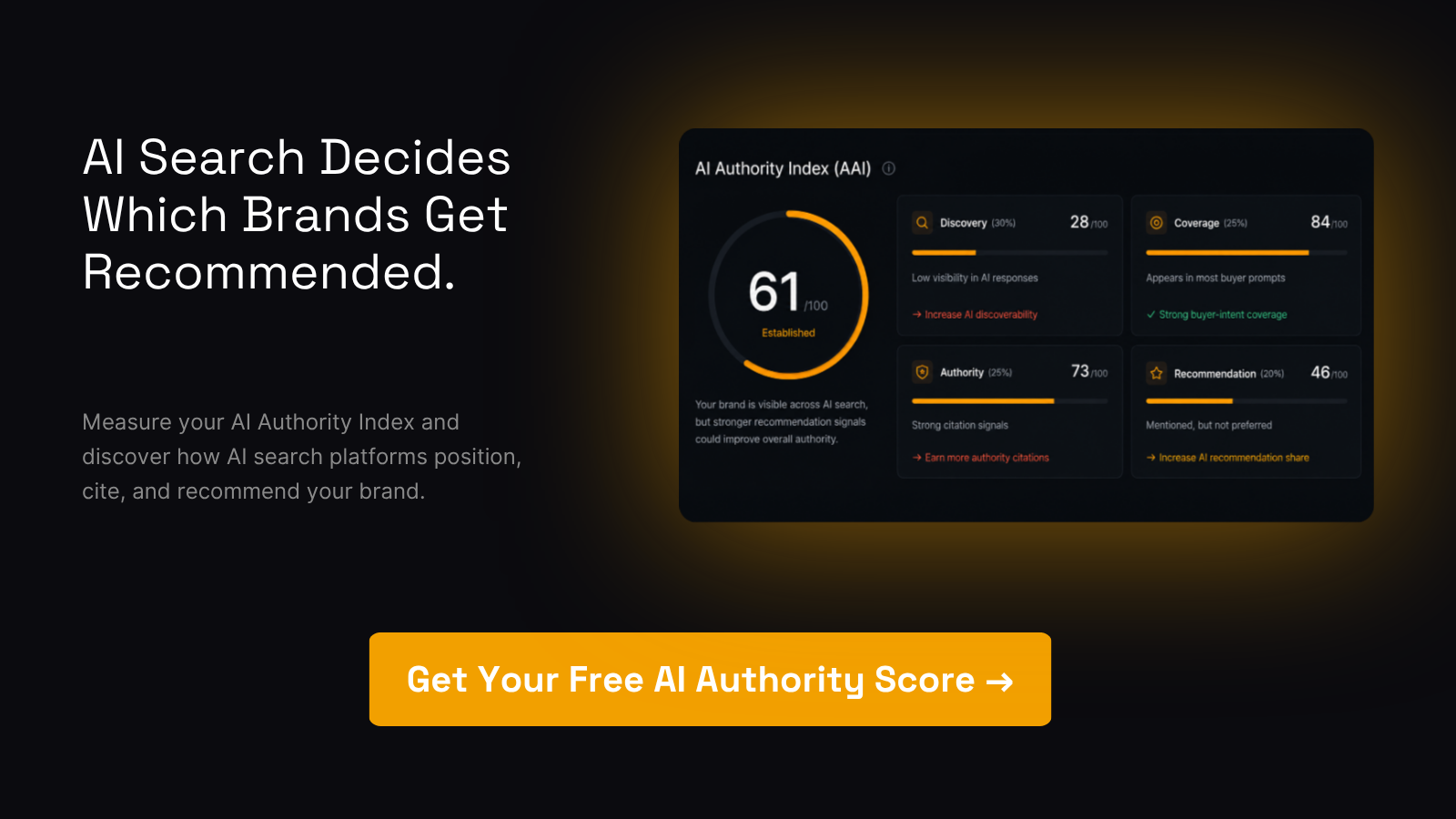
The Free AI Visibility Scan gives you a prompt-set baseline and a shortlist of quick wins without any setup work on your end. If you want ongoing tracking instead of a one-time snapshot, the Monthly AI Visibility Report delivers competitive benchmarks, prioritized recommendations, and trend tracking so you can see whether last month's fixes actually moved your citation share. Teams ready for deeper, always-on monitoring can step up to the Starter plan, the Growth plan, or the Enterprise plan for multi-brand organizations tracking recommendation share across several product lines at once.
Start with the free scan. See where you actually stand before you spend another hour guessing.
Sources
For deeper reading: OpenAI's user analytics documentation covers enterprise usage telemetry. ArXiv research on LLM retrieval behavior details freshness and citation patterns. TechCrunch's coverage of ChatGPT's 900 million weekly users frames the scale involved.
- How to Get ChatGPT to Recommend Your Products (2026 Guide)
FAQ
How Do I Get AI to Recommend My Product?
Start by making your brand pass a one-sentence identity test on your homepage, About page, and social profiles, then build a 15 to 30 prompt baseline test to see how you currently appear across ChatGPT and Gemini. From there, prioritize earning mentions on the specific third-party pages the model already cites, since analyses show most citations trace back to third-party roundups and reviews rather than brand-owned content.
How Do I Get ChatGPT to Promote My Business?
There's no way to pay ChatGPT directly for a mention. The realistic path is earning coverage on independent sites the model already trusts, keeping your product schema and feeds accurate, and publishing answer-first content with quotable comparisons. Consistent entity clarity across every platform where your brand appears speeds this up considerably.
How Long Does It Take to See Results in ChatGPT Recommendations?
Technical fixes like schema and crawlability can be resolved within hours to a few days. Earning citation share through third-party mentions and reviews typically takes weeks to months, since it depends on external sites publishing and the model refreshing its retrieval of those pages.
What Does AuthorityLayer's Monthly AI Visibility Report Include?
The Monthly AI Visibility Report costs $59 per month and delivers competitive benchmarking, prioritized recommendations, and trend tracking across your prompt set. It's built for teams that want ongoing monitoring rather than a single audit.
Do I Need Technical Access to Fix AI Visibility Issues?
Some fixes, like updating your homepage description or pursuing editorial mentions, don't require developer involvement. Others, like Product schema, crawler access, and server-side rendering checks, need someone with access to your site's codebase or CMS templates.