SEO for AI Assistants: A Measurement Playbook for CMOs
Unlock the potential of SEO for AI assistants by optimizing your brand's visibility in AI-driven searches and recommendations. Discover how!
· 11 min read

SEO for AI assistants means optimizing your brand's entity signals, structured data, and quotable content so tools like ChatGPT, Gemini, Perplexity, and Google AI Overviews name and recommend you during buyer research. It has nothing to do with using AI to help humans write meta descriptions. It's about making sure the assistant itself picks your brand when a prospect asks it for a recommendation.
The first move is diagnostic, not creative. Run a fixed set of buyer prompts across all four major engines and log, in a spreadsheet, whether your brand gets named and whether it gets cited with a source link.
- Pick 10 to 15 real buyer questions your prospects would actually type.
- Run each one in ChatGPT, Gemini, Perplexity, and Google AI Overviews.
- Record: mentioned or not, cited or not, sentiment, and which sources the engine leaned on.
Do this once manually to feel the problem. Then hand it to a measurement layer like AuthorityLayer, built by a team led by Geraldine specifically to standardize this audit across engines, competitors, and time instead of leaving it to whoever remembers to check.
Key Takeaways
AI visibility improves when brands replace one-off prompt checks with standardized, multi-model measurement tied to specific engineering, content, and PR fixes.
| Point | Details |
|---|---|
| Define the discipline correctly | SEO for AI assistants means optimizing entity signals and quotable content so models recommend your brand, not using AI to assist human SEO. |
| Audit before you optimize | Lock a 10 to 20 prompt buyer set and run it across ChatGPT, Gemini, Perplexity, and Google AI Overviews from clean sessions. |
| Fix retrieval first | Structured schema, server-rendered HTML, and current feeds are engineering-owned and typically the biggest visibility leak. |
| Publish something worth citing | Original data assets and third-party corroboration are the strongest levers for changing what a model recommends. |
| Track it like a business metric | Report AI citations, share of voice, and assisted conversions quarterly, tied to pipeline, not just mentions. |
| Use a measurement layer | Authoritylayer standardizes multi-model tracking and prioritized fixes so visibility reporting doesn't depend on manual prompt checks. |
Table of Contents
- How Do You Audit Your Brand's AI Visibility?
- Which Signals Actually Change AI Recommendations?
- What's the Fastest Way to Increase AI Citations?
- How Do You Report AI Visibility to Executives?
- Get a Monthly AI Visibility Report Built for Executives
- Sources
- FAQ
How Do You Audit Your Brand's AI Visibility?
A visibility audit only means something if it's repeatable. A one-off check tells you what happened in a single conversation, on a single account, at a single moment. It tells you almost nothing about whether that result would hold up tomorrow or against a different competitor set.
Here's the method that actually produces a usable baseline:
- Build a locked prompt set of 10 to 20 questions. Cover the full funnel: awareness ("what's the best tool for X"), comparison ("X vs Y"), and bottom-funnel ("is X worth it for a mid-market team"). Write them once and don't reword them between runs, or you lose comparability.
- Run the set across every major engine. At minimum: ChatGPT, Gemini, Perplexity, and Google AI Overviews. Each behaves differently. Perplexity tends to cite more sources per answer, while ChatGPT leans on a smaller pool of repeated trusted domains, so a brand invisible in one can be prominent in the other.
- Log five data points per response: whether your brand was mentioned, whether it was cited with a linked source, what role it played (recommended, compared, dismissed), the sentiment, and which sources the engine pulled from.
- Eliminate personalization bias. Your everyday ChatGPT or Gemini account carries months of your search history, your company's domain if you're logged in through work, and prior conversations that quietly tilt the answer. Use fresh, logged-out sessions or a standardized synthetic agent that has no history to contaminate the result.
- Repeat on a cadence, not a whim. Weekly runs catch sudden drops worth an alert. Monthly runs are what you need for a trend line you'd actually show a CFO.
Pro Tip: Before you trust any single result, run the exact same prompt three times in fresh sessions on the same day. If the answer changes meaningfully each time, you're looking at noise, not a signal worth acting on.
The IAB's guidance on AI-era visibility makes this explicit: individual prompt tests are "directional noise," and standardized, multi-model baselines are what separate real trend detection from anecdote.
Which Signals Actually Change AI Recommendations?
AI assistants make recommendations through a blend of trained memory and live retrieval. When a model can't recall your brand from training, it leans on retrieval, pulling from indexed pages, structured data feeds, and third-party mentions in real time. That means the signals worth fixing split into three distinct buckets, each with a different owner.
Retrieval signals determine whether the model's crawler can even find and parse your content cleanly. This is engineering's job:
- Structured JSON-LD markup for FAQ, HowTo, and Product schema.
- Server-side rendered or static HTML instead of content locked behind client-side JavaScript.
- An up-to-date llms.txt file and product feeds that reflect current pricing and availability.
Scoring signals determine whether the model treats your brand as worth surfacing at all once it's found. This is PR and product's job: third-party mentions on review platforms, trade press coverage, and original data assets other sites cite back to you. Skyscale's explainer on how LLMs choose which brands to recommend points to consistency across independent sources as the strongest lever here. A brand mentioned the same way on five unrelated sites scores differently than one mentioned once, inconsistently, on its own homepage.
Trust signals determine whether the model feels safe recommending you without hedging. This falls to legal and customer success: precise, current policies, recent and visible reviews, and neutral language free of unverifiable superlatives.
The practical audit here is simple: pull ten pages ranking for your category on Google, check which ones have working schema and server-rendered content, and count how many mention your brand by name in the actual copy, not just a logo in a client list. Most companies find the retrieval bucket is where they're leaking the most, because it's invisible until someone checks.
What's the Fastest Way to Increase AI Citations?
Not every fix carries equal weight. Some changes move the needle within weeks; others take a quarter to show up. Here's the order that gets results fastest, based on how these models actually extract and cite content.
- Rewrite your highest-value pages with a BLUF opening. The first 40 to 60 words should state the direct answer or claim a model could lift verbatim. HubSpot's generative engine optimization research recommends this exact structure, plus adding a specific statistic every 150 to 200 words to give the model something concrete to extract.
- Add FAQ, HowTo, and Product schema with dated metadata and a named author. An anonymous, undated page reads as less trustworthy to a model weighing which source to cite than one with a byline and a publish date.
- Publish an original data asset. Proprietary research, benchmark data, or an original survey is what other sites cite back to you, and that corroboration is one of the strongest practical levers for changing what a model recommends. Present it in HTML tables, not locked inside a PDF or an image.
- Harmonize your entity data everywhere. Your company description, founding date, and leadership names should match, word for word, across your site, LinkedIn, Crunchbase, and Wikidata, with sameAs links tying them together in your JSON-LD.
- Coordinate PR toward the exact venues models actually cite, not just wherever your team has existing relationships: trade press, G2 or Capterra style review sites, and active Reddit or community threads in your category.
Pro Tip: Check which domains show up as citations across your locked prompt set before you pitch press. If a model keeps citing three specific trade outlets, that's your PR target list, not a generic "best marketing sites" pitch deck.
How Do You Report AI Visibility to Executives?
Visibility only matters to a CMO if it maps to a number the CFO recognizes. Six KPIs do that job: AI citations per engine, AI share of voice against named competitors, first-cited rate (how often you're the first source named, not the third), sentiment score, assisted conversions, and pipeline attribution.
Instrumentation matters more than the KPI list itself. Set up a custom channel group in GA4 for AI referral traffic, tag your key landing pages so you can trace visits back to a specific AI session, and use modeled fractional attribution for the zero-click research that never generates a referral at all. Partnerize's guidance on AI search ROI argues this instrumentation step is where most teams stop short, tracking visibility without ever tying it to revenue.
A 90-day governance checklist keeps the audit from becoming a one-time PDF nobody opens again:
- Week 1 to 2: run the baseline audit, assign each finding to content, engineering, PR, or product.
- Week 3 to 6: ship the retrieval fixes (schema, rendering, feeds) since engineering work has the longest lead time.
- Week 7 to 10: publish the data asset and launch the PR push toward cited venues.
- Week 11 to 13: re-run the full prompt set and compare against baseline.
| Cadence | What it's for |
|---|---|
| Weekly | Alert-level checks for sudden drops in mentions or sentiment |
| Monthly | Trend reporting across the full prompt set and competitor set |
| Quarterly | Executive summary connecting visibility movement to pipeline |
Why standardized tracking beats checking ChatGPT yourself
Every marketing leader has typed a question into their own ChatGPT account and felt reassured, or alarmed, by what came back. That instinct is understandable and almost always misleading. Your account remembers your past searches, your company's tools if you're logged in through a work email, and dozens of prior conversations that quietly bias the answer toward what you already believe.
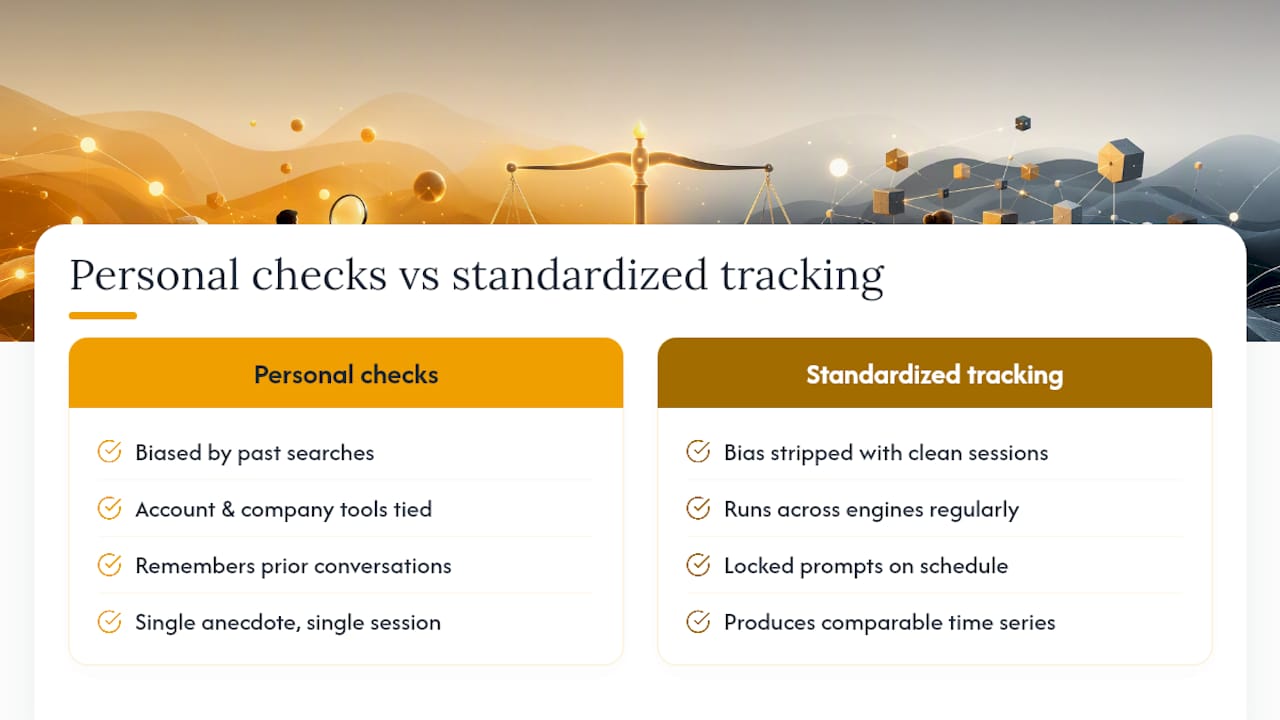
That's the personalization bias problem: the AI account you use every day is the worst possible instrument for measuring anything comparable. It's a mirror, not a measuring tape.
Standardized, synthetic prompting strips that bias out. Running the same locked prompt set from clean sessions, across engines, on a fixed schedule, turns a single anecdote into a time series you can actually trust. In practice, brands that move from occasional personal checks to structured tracking tend to discover their real gap isn't visibility overall, it's a specific competitor consistently winning the comparison prompts while going unnoticed in the awareness ones. You only see that pattern when you're comparing apples to apples across weeks, not glancing at one chat transcript.
— Geraldine
Get a Monthly AI Visibility Report Built for Executives
Running this audit by hand every month, across four engines and a dozen prompts, is the kind of task that quietly falls off the calendar the moment a launch gets busy. Authoritylayer exists to make sure it never does: it's the operational layer that runs your standardized prompt set continuously, benchmarks you against named competitors, and hands you a prioritized remediation list instead of a spreadsheet of raw transcripts.
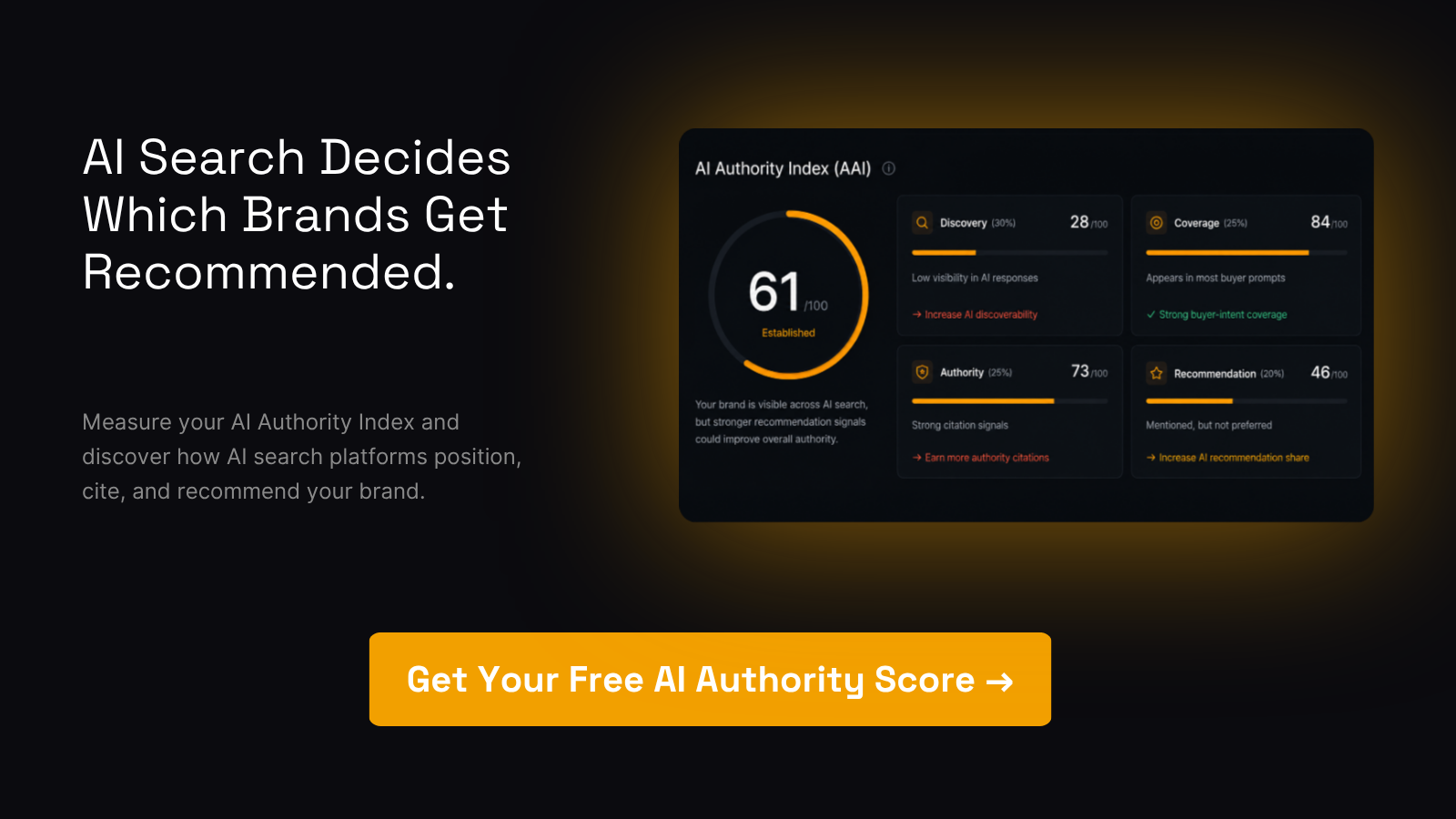
The Monthly AI Visibility Report gives you cross-engine benchmarks, your recommendation share against competitors, and a ranked list of fixes sorted by expected citation impact, the same structure this article just walked through, delivered on autopilot. If you want a lighter first step, request the free AI visibility scan to see where your brand currently stands before committing to anything. Most teams get their first workspace running within a week; setting up a workspace takes about the time of a single onboarding call, and from there you're adding the competitors and markets you actually care about.
Sources
- Measuring visibility in the AI era | IAB
- 6 generative engine optimization benefits every marketer should know | HubSpot
- AI Search Visibility: What It Is and Why It Matters in 2026 | Is My Brand in AI
FAQ
What does SEO for AI assistants actually mean?
It means optimizing your brand's entity data, structured content, and third-party corroboration so tools like ChatGPT and Perplexity name and recommend you during buyer research, a distinct discipline from using AI to help write traditional SEO copy.
How is this different from traditional SEO?
Traditional SEO targets ranking positions on a search results page; this discipline targets whether a generative model mentions or cites your brand inside a conversational answer, often with no click involved at all.
Why shouldn't I just check ChatGPT myself?
Your personal AI account carries search history and login context that biases results, making it a poor measurement environment; standardized, logged-out, repeatable testing is what reveals a real trend.
Which AI engines should I track?
At minimum, track ChatGPT, Gemini, Perplexity, and Google AI Overviews, since citation behavior differs meaningfully between engines, and a gap in one doesn't mean a gap in all.
How often should I re-run the visibility audit?
Run alerts weekly to catch sudden shifts, and treat monthly runs as the minimum sample size for a trend line reliable enough to report to executives.
Can Authoritylayer run this measurement for us?
Yes. Authoritylayer's Monthly AI Visibility Report automates the standardized, cross-engine prompt tracking this article describes and prioritizes the fixes most likely to increase citations.
Recommended
- Optimize for ChatGPT: A Measurement Playbook for CMOs | AuthorityLayer Insights
- AI Search Strategy: A CMO Playbook for 2026 | AuthorityLayer Insights
- AI Overviews Optimization: A Playbook for CMOs | AuthorityLayer Insights
- AI Answer Evaluation for Marketing Leaders: Measure and Win | AuthorityLayer Insights