AI Prompt Tracking: A Practical Playbook for 2026
Discover effective AI prompt tracking strategies for 2026. Monitor brand visibility and optimize your performance with key metrics.
· 17 min read

AI prompt tracking is the practice of monitoring a curated set of prompts to measure how often, how accurately, and how favorably a brand appears inside generative AI assistants like ChatGPT, Claude, Gemini, and Perplexity. The single best first action: pull your highest-confidence organic queries from GA4, convert them into natural-language questions, and run them against at least two AI models today. What you get back is your baseline.
Four metrics tell you whether the program is working within the first 30 days:
Recommendation share: the percentage of tracked prompts where your brand is named as a recommended option
Citation rate: how often the model links to or names your content as a source
Answer frequency: how many prompts surface your brand at all, regardless of ranking position
Citation quality: whether the model’s description of your brand is accurate, positive, and conversion-relevant
The difference from keyword tracking is structural, not cosmetic. A keyword rank tells you where a page sits in a list. A prompt-tracking result tells you whether an AI assistant recommends your brand by name when a buyer asks for help. Moz notes that prompt tracking shows mentions, sentiment, and how often a model surfaces a brand for relevant topics — none of which a rank-tracking tool captures. Tools like Authoritylayer, GA4 behavior funnels, and model provider outputs (OpenAI, Anthropic) are the measurement sources your stakeholders will recognize fastest.
Table of Contents
How do you turn prompt-tracking data into measurable improvements?
Governance and scale: how do you manage a growing prompt registry?
How does Authoritylayer’s benchmarking method prioritize AI visibility opportunities?
The gap between what prompt tracking promises and what actually matters
How to set up AI prompt tracking from scratch
The minimum viable setup is three things: a curated seed list of prompts, a daily or weekly sampling cadence, and a versioned registry that records every prompt, its owner, and its last-tested result. Everything else is iteration.
The project kickoff checklist
Before you run a single prompt, align the team on these:
- Pick your models — Start with ChatGPT (GPT-4o), Claude, Gemini, and Perplexity — the four assistants most buyers use for research.
Prompt registry schema
Treat each prompt like a design-system component — structured, versioned, and owned. Here is the minimum schema:
| Field | Description | Example value |
|---|---|---|
| Prompt ID | Unique identifier | P-0042 |
| Prompt text | Full natural-language question | “What’s the best AI visibility tool for enterprise marketing teams?” |
| Intent category | Buyer stage or topic | Decision / Brand discovery |
| Surface type | Which AI model(s) to test | ChatGPT, Perplexity |
| Owner | Responsible team member | Sarah Chen, SEO Lead |
| Version | Semantic version number | v1.2 |
| Expected citation format | What a correct answer looks like | Brand named, accurate description, no hallucination |
| Success metric | Primary KPI for this prompt | Recommendation share ≥ 50% |
| Last-test timestamp | Date of most recent run | 2026-06-10 |
| Verification command | How to confirm output accuracy | Cross-check brand description against /about page |
PromptLedger offers an open-source reference architecture for this kind of registry, including automatic versioning, execution tracing, and span capture for multi-step workflows — worth reviewing if your team wants a code-based implementation.
Timing and cadence
Run your seed prompts weekly for the first 60 days. That gives you enough data to spot trends without burning budget on noise. After 60 days, segment: high-priority prompts (top 20% by conversion proximity) move to daily sampling; the rest stay weekly. Refresh the prompt list quarterly, or whenever a major product change or competitor move warrants it.
How do you choose which prompts to track?
The answer is not “track everything.” Moz is direct on this: monitoring every prompt variation inflates costs and muddies the data. Track prompts that map to buyer intent and discoverability, focusing on the non-branded, intent-driven questions buyers ask when looking for a recommendation, rather than branded queries.
Seven sourcing methods
- Social listening — Monitor Reddit threads, LinkedIn comments, and X posts where buyers discuss your category. The exact phrasing people use in public forums is closer to what they type into an AI assistant than any keyword tool will tell you.
Prioritization framework
Not all prompts are equal. Use this filter before adding anything to the registry:
| Priority | Criteria | Example |
|---|---|---|
| High | Maps to decision stage + existing traffic + conversion proximity | “Best [category] tool for [use case]” |
| Medium | Maps to consideration stage + moderate traffic + indirect conversion | “How does [category] work?” |
| Low | Informational only + low traffic + no clear conversion path | “History of [category]” |
Drop any prompt that fails two or more of these filters: intent alignment, traffic proxy, conversion proximity, actionable ownership (someone can actually change the content it tests), and cost-to-track (complex multi-turn prompts cost more to sample reliably).
Which metrics should you capture for prompt tracking?
Three metric families cover everything a marketing or SEO team needs to report: visibility (are you showing up?), citation quality (is what the model says accurate and positive?), and recommendation share (are you being chosen?). Everything else is a diagnostic sub-metric.
| Metric | Definition | Calculation | Data source |
|---|---|---|---|
| Answer frequency | % of tracked prompts where brand appears in any form | (Prompts with brand mention ÷ total prompts tested) × 100 | Manual sampling, Authoritylayer |
| Recommendation share | % of prompts where brand is named as a recommended option | (Prompts with brand recommendation ÷ total prompts tested) × 100 | Authoritylayer, manual sampling |
| Citation rate | % of prompts where model cites brand content as a source | (Prompts with source citation ÷ total prompts tested) × 100 | Model outputs, Authoritylayer |
| Citation quality score | Composite score: accuracy + sentiment + conversion relevance | Scored 1–5 per dimension, averaged | Human review + Authoritylayer signals |
| Competitor recommendation share | % of prompts where a named competitor is recommended | Same formula as recommendation share, per competitor | Authoritylayer, manual sampling |
| Trend delta | Week-over-week or month-over-month change in recommendation share | Current period % minus prior period % | Authoritylayer, spreadsheet |
How do you turn prompt-tracking data into measurable improvements?
The workflow is four steps: hypothesize, design the change, run controlled sampling, measure lift. Every experiment needs a single variable changed, a defined run length, and a pre-agreed success threshold before you start.
A concrete example
A B2B SaaS marketing team notices their recommendation share for “best project management tool for remote teams” sits at 18% across ChatGPT and Perplexity. Their hypothesis: the existing /features page buries the remote-work use case in paragraph four. They restructure the page to lead with a remote-team use case, add a comparison table, and include a structured FAQ. After four weeks of sampling, recommendation share for that prompt cluster rises to 34%. The change ships; the registry entry is updated with v2.0 and a note on what drove the lift.
Experiment guardrails to keep in mind:
Never change the prompt text and the content simultaneously — you will not know which variable moved the needle.
Run experiments on at least two models. A win on ChatGPT that does not replicate on Perplexity is a partial result, not a conclusion.
Document negative results. A change that did not move recommendation share is still useful data about what the model does not reward.
Governance and scale: how do you manage a growing prompt registry?
The governance formula is simple: one owner per prompt, a versioned registry, and a quarterly review. Without those three constraints, prompt registries turn into sprawling folders nobody trusts.
Template: prompt registry entry
Prompt ID:        P-0042
Prompt text:      "What's the best AI visibility tool for enterprise marketing teams?"
Intent category:  Decision / Brand discovery
Surface type:     ChatGPT (GPT-4o), Perplexity
Owner:            Sarah Chen
Version:          v1.2
Change note:      Updated intent category from 'awareness' to 'decision' after Q1 review
Expected output:  Brand named as recommended option; accurate description; no hallucination
Success metric:   Recommendation share ≥ 50%
Last tested:      2026-06-10
Verification:     Cross-check brand description against authoritylayer.app/methodology
Sampling log:     /logs/P-0042/2026-06-10.json
The system-prompt and skills approach used in LLM design systems applies directly here: keep stable context (your brand’s canonical description, key claims, and differentiators) in a central reference file, and require verification runs after any content change that could affect how a model describes your brand.
Integrating with existing workflows
Prompt-tracking outputs belong in your existing analytics and content pipelines, not a separate silo. Tag each prompt with the content asset it tests, so a content update automatically triggers a re-sampling task. Use your project management tool (Jira, Asana, Linear) to create tickets from registry gaps: a prompt with recommendation share below threshold becomes a content ticket with the prompt ID in the title. Include prompt-tracking results in sprint review notes and quarterly content audits.
Pro Tip: Treat your prompt set like a design-system component library — store stable system context (brand description, canonical claims, tone rules) in a shared reference document (AGENTS.md or equivalent), and put task-specific intent in individual prompt entries. This separation makes updates faster and reduces the risk of a single edit breaking multiple prompts.
How does Authoritylayer’s benchmarking method prioritize AI visibility opportunities?
AuthorityLayer prioritizes opportunities using the AI Authority Index (AAI)—a weighted framework that measures how effectively AI assistants discover, recommend, and describe your brand across buyer-intent conversations.
Rather than relying on simple mention counts, the AAI evaluates four complementary dimensions that together provide a more accurate picture of your brand's AI visibility and identify the improvements most likely to increase recommendations.
How the AI Authority Index (AAI) is calculated
The AI Authority Index combines four weighted dimensions
| Dimension | Weight | What it measures |
|---|---|---|
| Discovery | 30% | How often AI models include your brand in relevant buyer-intent queries. Only non-branded, solution-seeking prompts are counted |
| Recommendation | 25% | How strongly AI models recommend your brand when it is evaluated alongside competing alternatives. |
| Coverage | 25% | The percentage of relevant buyer-intent prompts where your brand appears. Only non-branded visibility prompts are included. |
| Positioning | 20% | How accurately AI models describe your brand compared with your verified truth profile, including messaging, category fit, differentiators, and prohibited associations. |
The AI Authority Index is calculated by applying each dimension's weight to its individual score and combining them into a single score between 0 and 100.
A higher AAI indicates that AI assistants not only mention your brand more frequently, but also recommend it confidently and describe it accurately in the buying journeys that matter most.
How AuthorityLayer prioritizes improvements
AuthorityLayer evaluates every recommendation using two dimensions:
Expected impact on your AI Authority Index (AAI)
Estimated implementation effort
High-impact, low-effort improvements are always prioritized first because they deliver the fastest measurable gains in AI visibility.
For example, improving a high-value FAQ page or strengthening product comparison content can significantly increase discovery and recommendation performance, while larger structural changes may require more planning before producing measurable improvements.
For teams monitoring competitors, this prioritization also highlights where competing brands are outperforming yours across buyer-intent conversations, helping you focus on the opportunities most likely to improve your AI Authority Index.
Real use cases: what does prompt tracking actually solve?
Brand monitoring
A CMO wants to know whether the company’s rebrand is reflected in AI answers. The team runs 15 brand-adjacent prompts weekly across ChatGPT and Gemini. Within two weeks, they spot that Perplexity still describes the old product name. The fix: update the canonical brand description on the homepage and submit updated content to Bing (which feeds Perplexity’s index). Recommendation share for brand-adjacent prompts rises to 41% over six weeks.
Next step: Add a brand-description verification prompt to the registry and run it weekly against all four major models.
Competitive gap analysis
An SEO lead notices a competitor is named in 60% of “best [category] tool” prompts while their brand appears in 28%. They pull the competitor’s top-cited content, identify three structural patterns (comparison tables, named use cases, explicit pricing context), and replicate those patterns on their own pages. After eight weeks of sampling, the gap narrows to 12 percentage points.
Next step: Build a competitor-share view in the dashboard and set an alert when any competitor’s recommendation share exceeds yours by more than 20 points on a high-priority prompt.
Product discovery
A demand generation team wants to understand which product features drive AI recommendations. They create a prompt cluster around five specific use cases and track which features the model mentions. The data shows the model consistently omits a key integration feature. The team adds a dedicated integration page with structured data. Citation rate for that feature doubles within a month.
Next step: Map each product feature to at least one tracked prompt and include feature-level recommendation share in the monthly product-marketing review.
Customer support summarization
A content team uses AI assistants to summarize support documentation. They track how accurately models describe their troubleshooting steps. Citation quality scores reveal the model misrepresents a three-step process as two steps. The fix: restructure the support article with numbered steps and an explicit summary at the top.
Next step: Add citation quality checks for support content to the quarterly content audit.
Quick wins in the first 30 days
Convert your top 20 GA4 organic queries into tracked prompts
Run a baseline sampling pass across ChatGPT, Claude, Gemini, and Perplexity
Score each prompt on recommendation share and citation quality
Identify the three lowest-scoring prompts and assign content tickets
Set up a weekly sampling cadence with a shared results log
Common mistakes teams make with prompt tracking
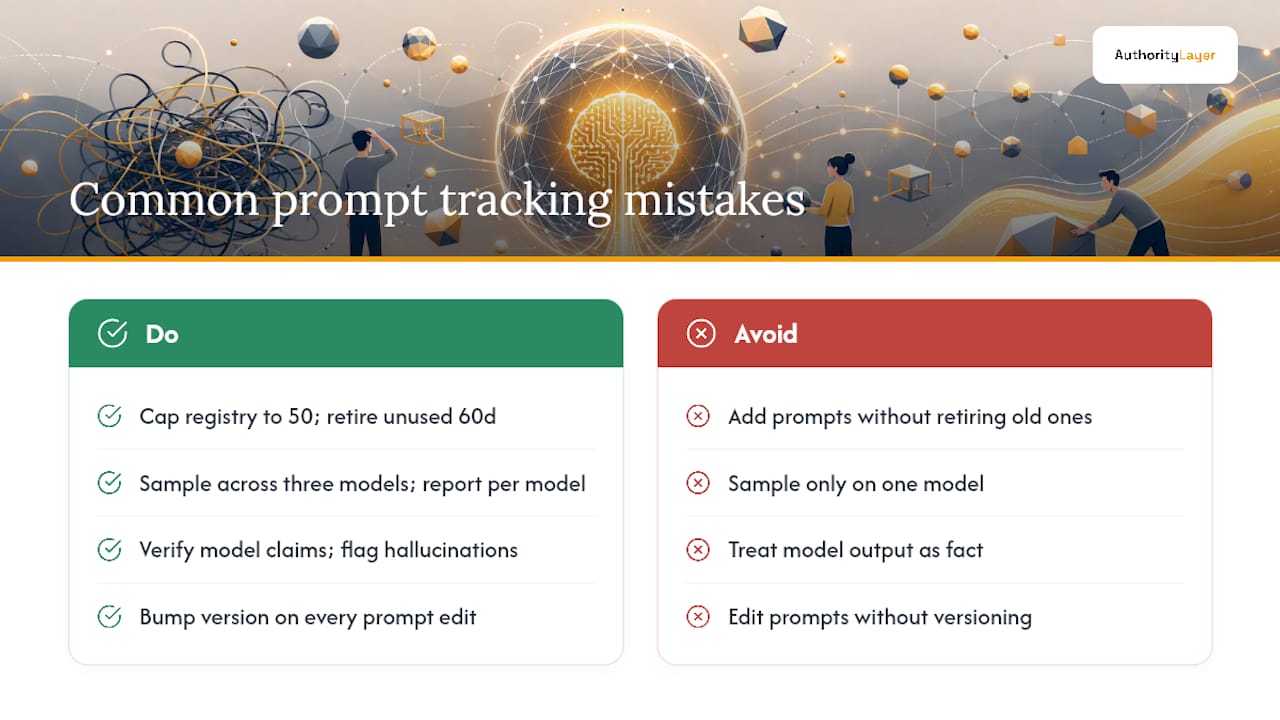
Prompt sprawl. Teams add prompts faster than they retire them. Within three months, the registry has 200 entries and nobody trusts the data. Fix: cap the active registry at 50 prompts until you have a governance process in place. Retire any prompt that has not been sampled in 60 days.
Sampling bias. Running prompts only on ChatGPT and assuming the results generalize. Different models have different training data, retrieval architectures, and citation behaviors. Fix: always sample across at least three models and report results per model, not as a blended average.
Treating model output as ground truth. A model says your brand is “the market leader in X.” That does not mean it is true, or that it will say the same thing next week. Fix: verify every model claim against your own content and flag hallucinations in the registry immediately.
No versioning. A team edits a prompt’s wording to “make it sound more natural” and loses the ability to compare results before and after. Fix: any change to prompt text is a version bump, full stop.
Ignoring negative results. A content change that did not move recommendation share gets quietly dropped. Fix: document every experiment result, positive or negative, in the registry. Negative results prevent you from running the same failed experiment six months later.
Pro Tip: Precise prompts with lightweight references outperform vague ones every time. When building your registry, attach a one-sentence expected-output description to every prompt — this forces the team to think clearly about what a correct AI answer actually looks like before they start sampling.
Pro Tip: Require a verification command in every registry entry. Per the reopt Handbook’s output contract guidance, a verification step — cross-checking the model’s brand description against your canonical /about or /methodology page — catches hallucinations before they make it into a stakeholder report.
Privacy and ethical considerations
Every registry entry should include a logging scope note: what data is stored, for how long, and whether any personally identifiable information (PII) could appear in model outputs. If your prompts include customer scenarios or support transcripts, strip PII before logging. Store raw model outputs in access-controlled logs, not in shared spreadsheets. For enterprise teams, align your prompt-tracking data retention policy with your existing data governance framework.
Key Takeaways
Effective AI prompt tracking requires a versioned registry, a disciplined sampling cadence, and a weighted scoring method to prioritize fixes — recommendation share is the single metric to watch first.
| Point | Details |
|---|---|
| Start with GA4 queries | Convert your top organic queries into natural-language prompts for the fastest, highest-confidence seed list. |
| Track recommendation share first | This metric shows whether AI assistants name your brand as a recommended option — the clearest signal of AI visibility. |
| Version every prompt | Any change to prompt text requires a version bump; without versioning, before/after comparisons are meaningless. |
| Weight your scoring | Combine recommendation share, citation quality (25%), conversion relevance (25%), and brand recall (15%) to prioritize fixes. |
| Use Authoritylayer to scale | Authoritylayer’s AI Visibility Intelligence platform automates sampling, scoring, and competitive benchmarking across ChatGPT, Claude, Gemini, and Perplexity. |
The gap between what prompt tracking promises and what actually matters
Most teams start prompt tracking with the wrong mental model. They treat it like a rank tracker with extra steps: run the prompts, see the numbers, celebrate when the numbers go up. That framing misses the point almost entirely.
The teams that get real value from this practice are the ones who treat it as a content intelligence system. The prompts are not the product — the patterns in the outputs are. When you run 25 prompts across four models and notice that three competitors are consistently cited for a use case you own in the market, that is not a tracking result. That is a strategic gap with a content fix attached to it.
The other thing most guides understate: citation quality matters more than citation frequency. A model that mentions your brand but describes it inaccurately is worse than no mention at all. Buyers trust AI answers. If Perplexity says your product “starts at $500/month” when it starts at $50, that hallucination is doing active damage. The verification step in your registry is not a nice-to-have governance detail. It is the most important quality control in the whole program.
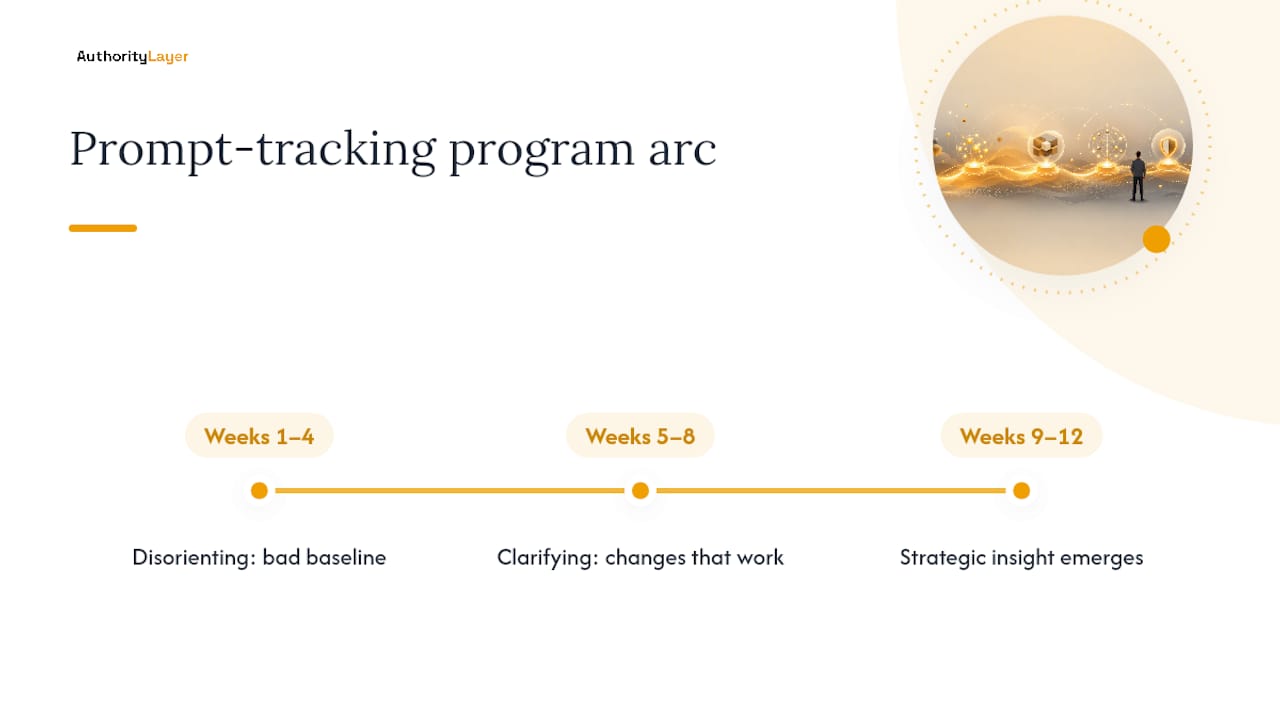
The 90-day arc for teams that do this well tends to look like this: weeks 1–4 are disorienting (the baseline data is often worse than expected), weeks 5–8 are clarifying (you start to see which content changes actually move the needle), and weeks 9–12 are when the program starts generating real strategic insight. Stick with it past the discomfort of the baseline.
Useful sources
[What Is Prompt Tracking? [Tips and Workflows To Do It on a Budget] — Moz](https://moz.com/blog/what-is-prompt-tracking)
Stop writing PRDs for AI — start using prompt sets instead - LogRocket Blog
Prompt Interface | Design Systems for the AI Era - reopt Handbook
Prompt to Design Interfaces: Why Vague Prompts Fail and How to Fix Them - NN/g
FAQ
What is AI prompt tracking?
AI prompt tracking is the practice of running a curated set of natural-language questions against AI assistants like ChatGPT, Claude, and Perplexity to measure how often and how accurately a brand appears in the generated answers. It tracks recommendation share, citation rate, and citation quality rather than keyword rankings.
How is prompt tracking different from traditional keyword tracking?
Keyword tracking measures where a URL ranks in a search results list. Prompt tracking measures whether an AI assistant recommends your brand by name when a buyer asks a question — a fundamentally different signal that reflects generative answer behavior, not link position.
Which metrics matter most in the first 30 days?
Recommendation share is the single most important metric to watch first: it shows the percentage of tracked prompts where your brand is named as a recommended option. Pair it with citation quality to catch hallucinations early.
How many prompts should a team track at the start?
Start with a seed set of prompts derived from your top GA4 organic queries. Moz recommends prioritizing prompts tied to existing traffic and conversions rather than tracking exhaustive variations, which inflates costs without improving signal quality.
How does Authoritylayer support prompt tracking?
Authoritylayer automates sampling across ChatGPT, Claude, Gemini, and Perplexity, scores recommendation share and citation quality, and delivers a prioritized list of content fixes ranked by estimated impact. Teams can run a free AI visibility scan at authoritylayer.app to get an immediate baseline.
Recommended
AI Search Strategy: A CMO Playbook for 2026 | AuthorityLayer Insights
Best Tryprofound Alternatives for AI Visibility in 2026 | AuthorityLayer Insights
AI Competitive Intelligence: What Actually Moves Recommendation Share | AuthorityLayer Insights
Best AI Visibility Tools for Marketing Teams in 2026 | AuthorityLayer Insights