Marketers: 8 Steps to Win When AI Assistants Recommend Brands
Why AI assistants favor some brands and what marketers should do: use an 8 step checklist and monthly multi model tracking to win visibility.
· 15 min read

AI assistants recommend brands when a model both knows the brand from training and can confirm it at query time. Consistent third-party mentions, entity clarity, corroboration, freshness, and platform-specific weighting all factor into who actually gets named. Marketers who understand this two-mechanism decision architecture can influence it. Those who only check a chatbot occasionally are working from snapshots, not patterns.
TL;DR:
- Combining both parametric memory and retrieval systems is essential for brands to appear in AI recommendations, as relying on only one often leads to losses against more current or well-structured content.
- The strongest signals influencing brand recommendation are entity clarity, category fit, source corroboration, freshness, and third-party trust, with corroboration acting as a tiebreaker in many cases.
- Consistent naming, category framing, and regular updates to third-party validation across multiple trusted sources significantly improve a brand’s visibility in AI outputs.
- Monitoring AI recommendation patterns requires repeated, multi-model measurements over time to distinguish true signal strength from temporary fluctuations or personalization effects.
- Training data bias favors larger, long-established brands, so smaller companies must focus on improving corroboration and entity clarity to overcome informational disadvantages.
Table of Contents
- What Determines How AI Assistants Choose Brands to Recommend
- Which Signals Push a Brand Into an AI Recommendation
- How AI Models Frame Decisions Before Naming Brands
- Do ChatGPT, Gemini, Claude, and Perplexity Recommend Differently?
- How Do You Measure AI Recommendation Visibility?
- An 8-Step Checklist to Improve Your AI Recommendation Odds
- What Repeated Multi-Model Tracking Reveals That One Prompt Cannot
- How Training Data Bias Skews Which Brands Get Recommended
- How Personalization and Context Shape What AI Recommends You
- Should AI Assistants Disclose Why They Recommend a Brand?
- How Transparent Is the AI Decision-Making Process Right Now?
- What This Means for Marketing Teams Going Forward
- Turn Measurement Into a Monthly Habit With Authoritylayer
- Sources
- FAQ
What Determines How AI Assistants Choose Brands to Recommend
Two systems run underneath every AI recommendation, and both have to line up for a brand to make the list. The first is parametric memory: whatever the model absorbed during training, baked into its weights as statistical associations between a brand name, a category, and a set of qualities. The second is retrieval, commonly called RAG, or retrieval-augmented generation, where the model pulls fresh content at the moment you ask a question and blends it with what it already "knows."
Parametric memory forms slowly. If a brand shows up consistently across the training corpus tied to the same category and the same descriptors, that association gets reinforced and becomes easier to recall. Retrieval works differently. It rewards content that is current, specific, and easy to extract, regardless of whether the model was trained on it.
The practical implication is that optimizing for only one path is a losing bet. A brand with strong training-era presence but no retrievable content published this quarter can lose ground to a newer competitor that shows up cleanly in live search results. Winning both is the actual game.
Which Signals Push a Brand Into an AI Recommendation
Five signals do most of the work: entity clarity, category fit, source corroboration, freshness, and third-party trust. Of these, corroboration tends to act as the deciding factor when two brands are otherwise evenly matched.
Here's what surprised a lot of SEO teams when the data came out: an Ahrefs analysis of 75,000 brands found branded web mentions strongly correlated with AI visibility, far ahead of backlinks. Backlinks built the last decade of SEO strategy. They are a weaker predictor of AI recommendation than simply being talked about, by name, in the right places.
Pro Tip: Run a search for your brand name plus your core product category across five review sites and two trade publications. If the phrasing describing what you do varies wildly between them, that inconsistency is likely diluting your entity clarity score.
The signals that matter most, in practice:
- Entity clarity: the same brand name, category, and short descriptor appearing everywhere, from your homepage to your Wikipedia entry to your G2 profile.
- Category fit: does the model associate you cleanly with the buying category a searcher is asking about?
- Source corroboration: independent sites, not just your own, saying the same thing about you.
- Freshness: how recently that corroboration was published or updated.
- Third-party trust: whether the sites vouching for you carry their own authority in the model's eyes.
Entity legibility research backs this up directly: consistent naming and category framing across sources materially improves how confidently a model recalls and recommends a brand.
How AI Models Frame Decisions Before Naming Brands
Models rarely jump straight to naming a brand. They typically define the criteria that matter for the question first, then evaluate candidates against that frame. This means the criteria a model settles on shape who wins before any brand name enters the conversation.
That framing step is also where elimination happens. A brand can be well known and still get filtered out entirely if it trips a high-severity signal, like contradictory information across sources or a glaring mismatch between what a company claims and what independent sources report.
- Identify the frame. Ask the model what criteria it considers important for your category and compare that to your own positioning language.
- Audit for elimination triggers. Check whether outdated pricing, contradictory claims, or unresolved negative coverage exists anywhere retrievable.
- Patch the highest-severity issue first. Corroboration tiebreakers favor the brand with fewer red flags, not just more mentions.
Do ChatGPT, Gemini, Claude, and Perplexity Recommend Differently?
They apply a shared criteria set but weight it differently. Perplexity leans harder on live retrieval and cites sources visibly, which rewards brands with fresh, well-structured pages. Claude and ChatGPT draw more heavily on parametric memory for well-established categories, which rewards brands with deep historical presence. Gemini's tighter integration with Google's index means classic search signals still bleed into its answers more than they do elsewhere.
Model updates shift these weightings without warning. A brand that ranked well in a March check can quietly drop out by June, not because anything about the brand changed, but because the model did. Optimizing for a single model is fragile precisely because that update cycle is out of your control.
The implication for prioritization: build against the shared criteria set first, entity clarity, corroboration, freshness, then treat model-specific behavior as a leading indicator you monitor, not a target you chase.
How Do You Measure AI Recommendation Visibility?
Two metrics matter more than the rest. AI Share of Voice measures how often your brand gets named relative to competitors across a fixed set of prompts. AI Topical Presence breaks that down further into depth (how thoroughly you're described), breadth (how many related topics you show up in), and concentration (whether your visibility depends on one lucky mention or many independent ones).
A single prompt typed into a personal AI assistant tells you almost nothing reliable. It reflects your account's history, your location, and the exact phrasing you happened to use that day, not a stable pattern. Repeated measurement across models and prompt variations is what surfaces the pattern underneath the noise.
A workable measurement approach:
- Run the same prompt set weekly across at least three models.
- Track raw mention frequency and whether your brand gets cited as a source.
- Calculate Share of Voice against your two or three closest competitors.
- Map topical presence gaps to specific missing corroboration.
This is where tracking AI knowledge graph associations becomes less abstract and more like a weekly diagnostic than a one-time audit.
An 8-Step Checklist to Improve Your AI Recommendation Odds
- Harmonize entity signals. Use identical name, category, and one-line descriptor across your site, LinkedIn, G2, Crunchbase, and Wikipedia.
- Earn corroboration in places that count. Analyst reports, industry standards documents, and community forums carry more weight than a press release you wrote yourself.
- Write excerptable passages. Answer specific buyer questions in two or three sentences a retrieval system can lift cleanly.
- Add structured data. Schema markup helps retrieval systems parse who you are and what you do.
- Refresh your corroboration regularly. A glowing 2023 review with no recent follow up reads as stale to a freshness-sensitive model.
- Patch elimination triggers first. Fix contradictory claims before chasing new mentions.
- Monitor across models, not one. A weighting shift on a single platform shouldn't blindside your whole strategy.
- Chase signal density over volume. One citation in a real industry standard can outweigh a dozen low-value blog mentions.
Pro Tip: Treat this as a loop, not a project. Measure, diagnose the weakest signal, execute one fix, then remeasure. Teams that try to fix all eight at once usually lose track of what actually moved the needle.
What Repeated Multi-Model Tracking Reveals That One Prompt Cannot
Checking ChatGPT once a week from your personal account feels like due diligence. It isn't. Your account's history, your default settings, and even the time of day can shift the answer you get, and none of that tells you what a prospective buyer in a different city sees.
Authoritylayer builds its measurement around a different premise: run identical prompts across models, repeatedly, and track what stays consistent versus what's noise. That's the difference between a snapshot and a pattern.
A single AI response is one sample from a distribution that shifts with context, model version, and phrasing. Only repeated measurement across prompts, competitors, and time exposes the actual recommendation pattern a brand is working with.
Authoritylayer's platform tracks AI Share of Voice, topical presence across depth, breadth, and concentration, and prompt-level tracking that flags exactly which competitor is winning which query. Those outputs map directly onto the checklist above: a topical presence gap points straight at a missing corroboration source, and a Share of Voice drop on one model points at a weighting shift worth investigating. The Monthly AI Visibility Report turns that tracking into a recurring diagnostic instead of a one-time audit.
How Training Data Bias Skews Which Brands Get Recommended
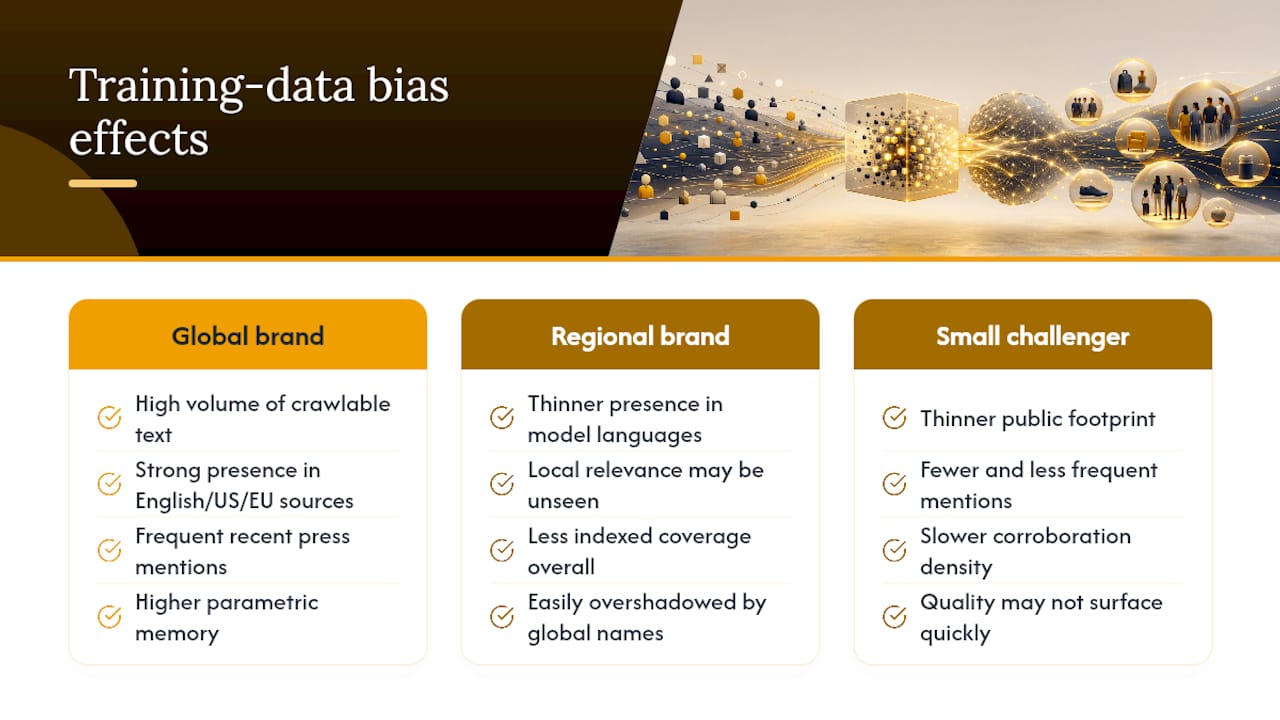
Training data isn't a neutral mirror of the market. It's a snapshot of whatever text happened to be crawlable, indexed, and abundant at training time, and that skews recommendations in predictable directions.
Larger companies with bigger PR budgets and longer digital histories simply have more text written about them. That volume advantage shows up in parametric memory regardless of whether the underlying product is actually better. A well-funded brand with five years of press coverage starts with a structural head start over a three-year-old challenger with a superior product but a thinner public footprint.
Language and geography compound the effect. Models trained predominantly on English-language, US and European sources tend to recommend brands with strong presence in those markets, even when answering a query from a searcher elsewhere. A regional brand with genuine local relevance can get overshadowed by a global name simply because more was written about the global name in the languages the model saw most.
There's also a recency skew that cuts against smaller players. Fast-moving PR cycles and frequent press mentions build the kind of corroboration density that models pick up quickly. A smaller brand doing excellent work but publishing less, less often, and in fewer places, accumulates that signal more slowly, even if its underlying quality is comparable.
None of this means the system is rigged beyond repair. It means the fixes described earlier, entity clarity, third-party corroboration, and topical breadth, matter disproportionately for brands starting from a smaller footprint. Bias in the training data is a real constraint. Consistent, corroborated presence is the lever available to work against it.
How Personalization and Context Shape What AI Recommends You
The same question asked by two different people can produce two different brand recommendations, and that's by design, not malfunction. Context, conversation history, stated preferences, and even inferred intent all shape which candidates a model surfaces.
A user who has previously mentioned a tight budget in the same conversation thread is more likely to see budget-tier brands surfaced first. Someone who mentions "enterprise" or references compliance requirements shifts the frame toward brands positioned for that segment. The model isn't randomly picking. It's adjusting its criteria weighting based on context signals you can't see from the outside.
This creates a real measurement problem for marketers who rely on personal, one-off checks. If you ask ChatGPT to recommend a tool in your category from your own logged-in account, you're seeing a response shaped by your account's history, your location, your subscription tier if applicable, and possibly prior conversations. That is not what a first-time buyer with no history sees. It's a personalized sample of one.
This is precisely why standardized, repeatable prompt sets run from neutral, controlled conditions matter more than casual spot checks. When you strip out personalization variables and run the same prompt across models and over time, what emerges is the underlying recommendation pattern the model defaults to, absent your specific context. That baseline is what competitive benchmarking actually requires. Comparing your brand's visibility against competitors only works if the comparison holds the personalization variable constant, otherwise you're comparing noise to noise and drawing false conclusions about who's actually winning the recommendation.
Should AI Assistants Disclose Why They Recommend a Brand?
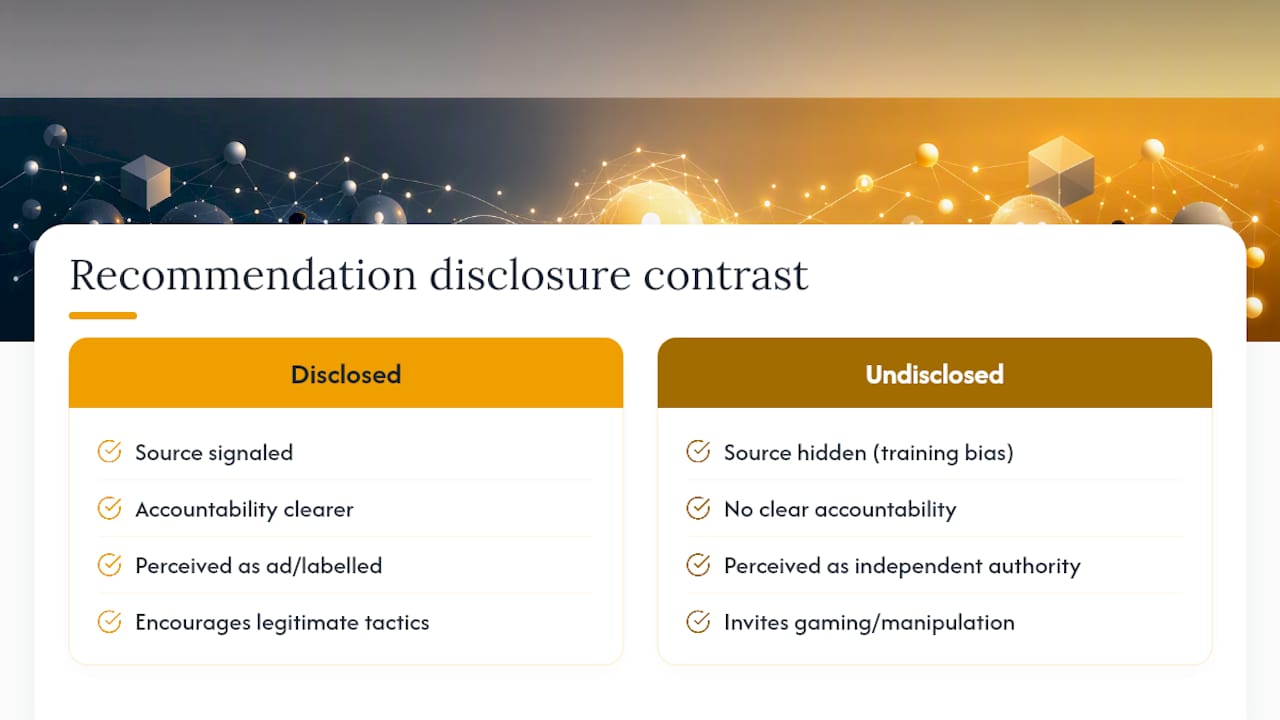
Endorsement without disclosure is the core ethical tension here. When a model names a brand, it's rarely flagging that the recommendation came from a training-data pattern shaped by whichever companies had the most written about them, not necessarily the companies best suited to the user's need.
There's also a question of accountability that traditional advertising regulation hasn't caught up with. A sponsored post carries a disclosure requirement in most markets. An AI recommendation generated from blended training data and retrieval carries no equivalent label, even though it can carry more perceived authority with the user than an obvious ad would.
Marketers face their own version of this tension. Earning a favorable AI recommendation through legitimate means, better documentation, real third-party validation, cleaner entity signals, is fundamentally different from trying to game the system through manufactured mentions, fake reviews, or coordinated content designed purely to manipulate model weighting. The tactics described earlier in this article work because they reflect genuine clarity and genuine corroboration. Attempting to fabricate that corroboration crosses into manipulation, and models are increasingly trained to discount sources that look artificially coordinated.
There's also a fairness dimension for smaller and newer brands. If AI recommendations increasingly replace traditional search as the discovery layer, and that layer structurally favors incumbents with bigger content footprints, newer entrants face a steeper climb to visibility than they did in a search-ranking world where a strong SEO strategy could compete more directly with brand size. That's not necessarily solvable at the individual marketer level, but it's worth naming honestly rather than pretending the playing field is level.
How Transparent Is the AI Decision-Making Process Right Now?
Not very, and that's arguably the most underdiscussed problem in this entire space. Most consumer-facing AI assistants give users no visibility into why a particular brand got named over another. There's no equivalent of a search engine's "why this result" explainer, no ranking factors page, no audit trail.
Perplexity is a partial exception. Because its answers cite sources directly, users can at least trace a recommendation back to the pages it pulled from. ChatGPT and Claude, by contrast, blend parametric memory and retrieval in ways that are largely opaque even to close observers, let alone the average user asking a question.
This opacity cuts two ways for marketers. On one hand, it means there's no public "checklist" a platform will hand you for guaranteed visibility, which is exactly why controlled, repeated measurement matters so much: you're inferring the rules from observed patterns, not reading them off a published spec. On the other hand, it means users making real purchasing decisions based on AI recommendations often have no way to evaluate whether that recommendation reflects genuine merit or a training-data artifact.
The pressure for more transparency is building, partly from regulators looking at AI-generated commercial content and partly from enterprise buyers who want to understand why a vendor shortlist looks the way it does. Until that pressure produces actual disclosure standards, the honest position for marketers is to treat every model as a partially observable system: you can measure its outputs rigorously, even without seeing its internal reasoning, and that measurement is the closest thing to transparency currently available.
What This Means for Marketing Teams Going Forward
The mistake I see most often is teams chasing content volume when they should be chasing relational authority, a handful of citations in places a model actually trusts, over a hundred mediocre ones, as emphasized in DBLScanner's SaaS solutions. AI visibility isn't owned by SEO alone anymore. It needs product, comms, and SEO working the same signals together, because entity clarity and corroboration touch all three functions. If you take one thing from this, make it a standing habit: measure across models monthly, not once when something breaks.
— Geraldine
Turn Measurement Into a Monthly Habit With Authoritylayer
Most teams find out their AI visibility has a gap the hard way, a prospect mentions a competitor by name in a sales call, and nobody knows why the model picked them. Authoritylayer replaces that guesswork with a standing diagnostic: multi-model tracking that shows exactly where your entity signals, corroboration, and topical presence are strong or thin, run on a repeatable cadence instead of a one-off audit.
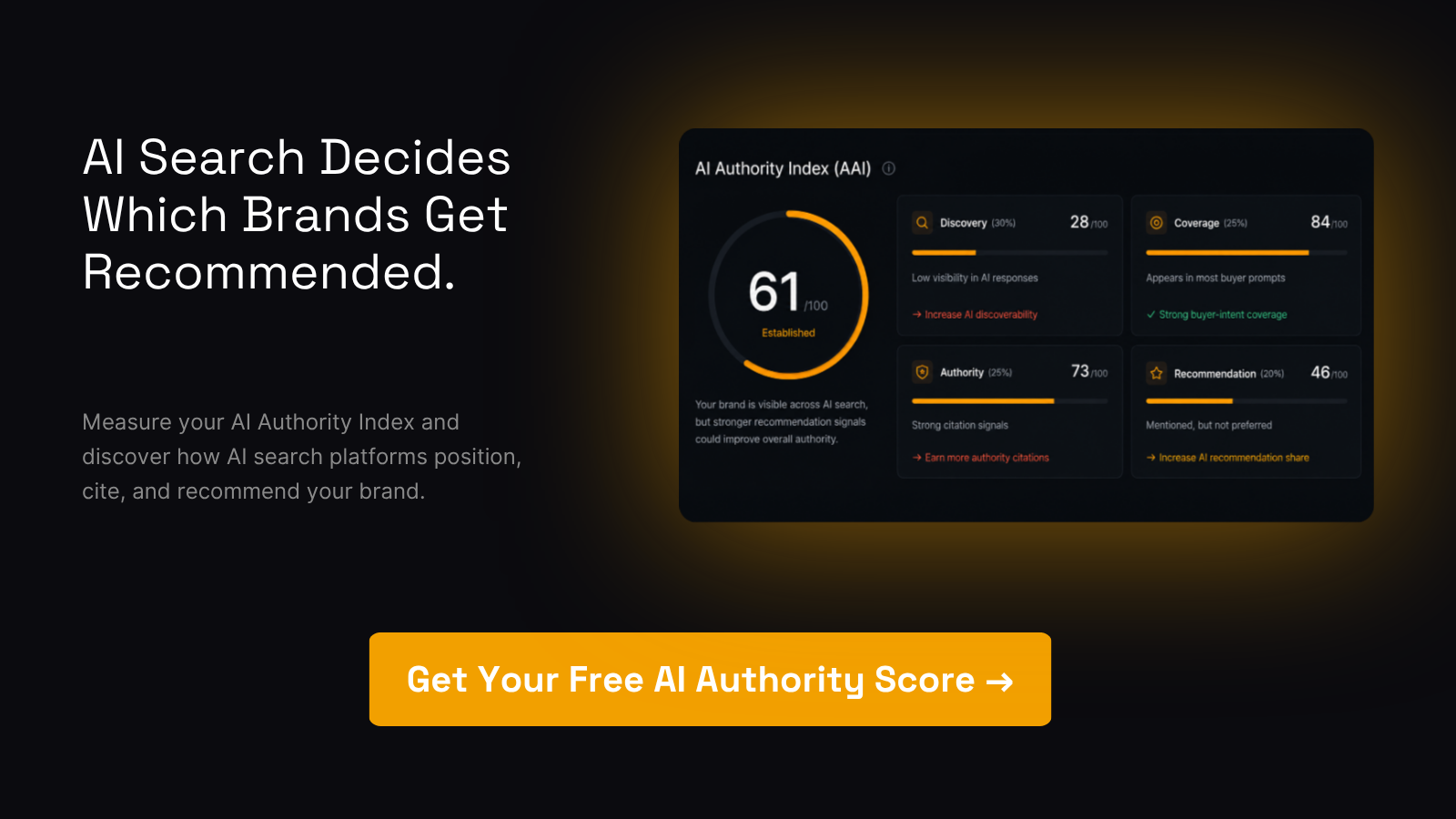
The Monthly AI Visibility Report tracks your AI Share of Voice against named competitors, breaks down topical presence by depth and breadth, and flags the specific corroboration gaps behind any drop. It's built on the same methodology described throughout this article: identical prompts, run across multiple models, on a schedule, so you're comparing patterns instead of one lucky or unlucky snapshot. Start with a scan of your current AI visibility standing, then use the monthly cadence to see whether your fixes are actually moving the needle.
Sources
- How AI decides between two competing brands in an answer (2026)
- How LLMs Decide Which Brands to Recommend
- Ahrefs data shows brand mentions boost AI search rankings
FAQ
What Is the 30% Rule in AI?
There's no single standardized "30% rule" across AI research. In practice, the phrase most often refers to studies showing that a limited share of frequently corroborated sources tends to account for a disproportionate share of what models cite in a given answer, reinforcing why concentrated, high-quality corroboration outperforms scattered mentions.
How Do I Get AI to Recommend My Company?
Harmonize your entity signals across owned and third-party pages, earn corroboration in trusted outside sources like analyst reports and review platforms, and publish concise, excerptable content that retrieval systems can pull cleanly. Then track your progress with repeated multi-model measurement rather than one-off checks.
What Is the Recommendation System in AI?
In the context of AI assistants like ChatGPT and Perplexity, the "recommendation system" isn't a single algorithm but a blend of parametric memory from training and live retrieval at query time, weighted by signals like entity clarity, corroboration, and freshness.
Which AI Assistant Is the Most Reliable for Brand Recommendations?
No single model is uniformly most reliable. Each weights the same core signals, entity clarity, corroboration, freshness, differently, which is why monitoring across ChatGPT, Gemini, Claude, and Perplexity together gives a more accurate picture than trusting any one platform's output.