Prompt Monitoring for Marketing Leaders: 2026 Playbook
Unlock the power of prompt monitoring for marketing leaders. Discover how to measure your brand's visibility and optimize AI interactions today!
· 15 min read

Prompt monitoring, in the marketing sense, means measuring how AI assistants like ChatGPT, Gemini, Claude, Perplexity, and Google AI Overviews mention, position, and cite your brand when buyers ask discovery and comparison questions. It has nothing to do with engineering observability or token costs. The first thing to do this week: run a 30–50 prompt baseline across at least three of those platforms, and log three things per prompt.
- Inclusion: Did your brand appear at all?
- Position: Where in the response did it appear (first mention, mid-list, buried)?
- Cited URLs: Which pages did the assistant link or reference?
That baseline gives you a starting Share-of-Voice (SoV) and a ranked list of prompt gaps to fix. Authoritylayer's AI Visibility Intelligence platform automates this across all five platforms.
Pro Tip: Run each prompt at least three times before recording results. AI responses vary across runs, and a single-run check can misrepresent your actual visibility by a wide margin.
Key Takeaways
Prompt monitoring is the foundation of AI visibility intelligence: without a controlled, repeatable measurement program, content fixes are guesswork and budget conversations lack evidence.
| Point | Details |
|---|---|
| Start with a 30–50 prompt baseline | Run each prompt at least three times across ChatGPT, Gemini, Claude, Perplexity, and Google AI Overviews before making any changes. |
| Track three leading KPIs | Inclusion rate, Share-of-Voice, and citation share are the metrics that drive decisions; positioning and stability are diagnostics. |
| Apply four measurement controls | Pre-trend event study, non-customer conditioning, stance classifier, and within-response category control produce credible attribution estimates. |
| Prioritize third-party citation outreach | Established publications and review sites drive LLM citation decisions; PR and outreach rank as first-tier fixes alongside content updates. |
| Use Authoritylayer for the pilot | Authoritylayer automates cross-platform prompt running, citation capture, and SoV dashboards, with a free AI visibility scan to start. |
Table of Contents
- Why prompt monitoring changes brand discovery and acquisition
- What are the core AI-visibility metrics to track?
- How do you build a reproducible measurement method?
- What does a 5-step prompt-monitoring process look like?
- How should you design test prompts that reflect real buyer intent?
- How do you scale from manual checks to a full monitoring program?
- How does Authoritylayer operationalize prompt monitoring?
- How do you turn monitoring outputs into fixes that move the metrics?
- What privacy limits and governance rules apply to prompt monitoring?
- The measurement-first case that most teams skip
- Your Authoritylayer AI visibility scan starts here
- Sources
- FAQ
Why prompt monitoring changes brand discovery and acquisition
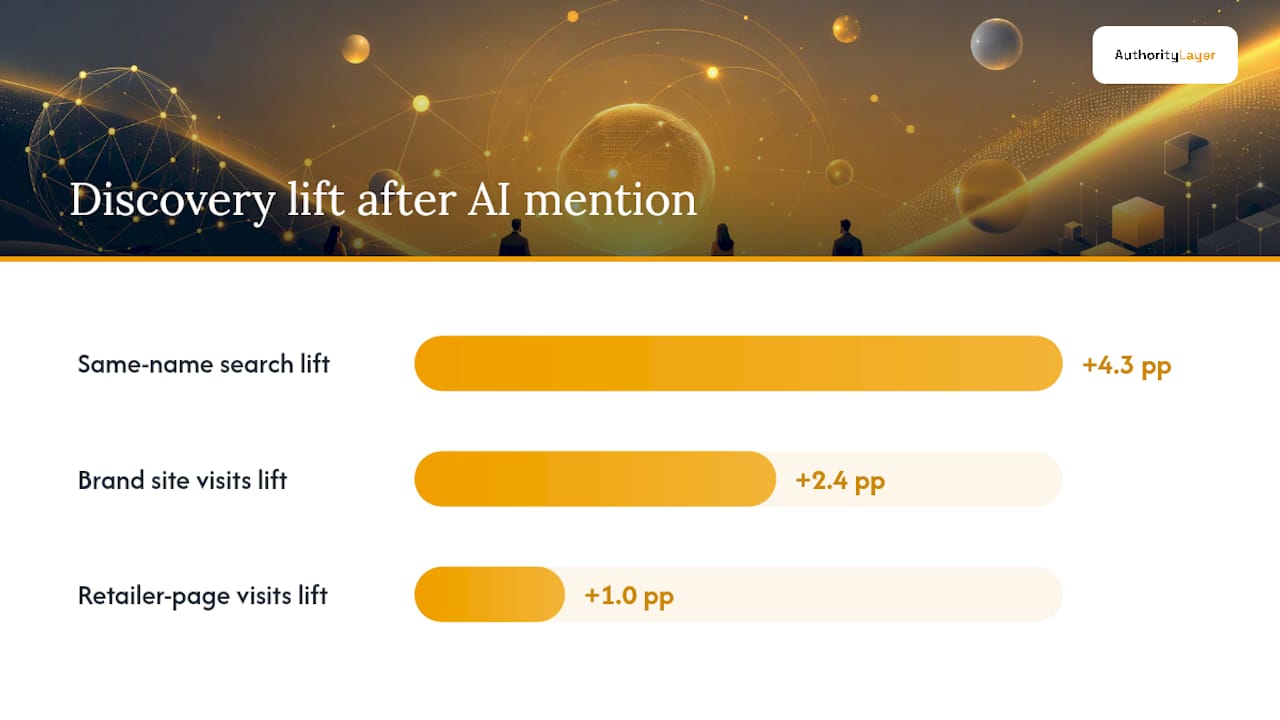
The commercial case for tracking AI mentions is no longer theoretical. A Scrunch AI panel study published on arXiv measured what happens after a conversational assistant recommends a brand to a non-customer: same-name search rose by roughly +4.3 percentage points, visits to the brand's own site rose by +2.4 percentage points, and retailer-page visits rose by +1.0 percentage point. The study applied pre-trend event-study controls, a stance classifier, and non-customer conditioning to isolate the recommendation effect from incidental name-drops. That is an acquisition-like lift from an exposure that never appears in your analytics.
Consumer behavior data reinforces the urgency. Emarketer reports that AI appears in roughly 42% of shopping experiences among people who use AI while shopping, and that about 1 in 5 shoppers now begin their research inside an AI assistant. Meanwhile, a separate survey cited by Emarketer found that 51.7% of respondents have chosen brands they otherwise wouldn't have because of a generative AI suggestion.
The channel-strategy implication is direct:
- Last-click attribution misses this entire path. A buyer who asks Claude "what's the best project management software for a 50-person team," sees your brand mentioned, then searches your name a day later, shows up in your analytics as organic branded search.
- AI referrals to websites grew roughly 527% year over year, and AI-referred visitors convert at materially higher rates than standard organic visitors in some analyses.
- Treating AI as a top-of-funnel discovery channel that feeds branded search and retail surfaces is now a defensible budget argument, not a hypothesis.
What are the core AI-visibility metrics to track?
Structured, repeated prompt testing across platforms requires a consistent metric set. Three are leading KPIs; the rest are diagnostics.
Leading KPIs
- Inclusion rate: The share of prompts where your brand appears at all, per platform. This is your floor metric.
- Share-of-Voice (SoV): Your brand's mentions as a percentage of all brand mentions across a prompt set. Tracks competitive position.
- Citation share: The percentage of citations pointing to owned content versus third-party sources. Low citation share means competitors' coverage of you is shaping the narrative.
Diagnostic metrics
- Average positioning: Where in the response your brand appears. First mention carries more weight than a footnote.
- Multi-platform coverage: Whether you appear consistently across ChatGPT, Gemini, Claude, Perplexity, and Google AI Overviews, or only on one or two.
- Consistency/stability: How often your brand appears across repeated runs of the same prompt. Volatility here signals fragile visibility.
| Metric | How to compute | Cadence | Alert threshold |
|---|---|---|---|
| Inclusion rate | Brand appearances ÷ total prompts run | Weekly | Drop >10 pp week-over-week |
| Share-of-Voice | Your mentions ÷ all brand mentions | Weekly | Drop >5 pp vs prior period |
| Citation share | Owned URL citations ÷ total citations | Bi-weekly | Below owned content majority |
| Average position | Mean rank of first brand mention in response | Monthly | Slips below position 3 |
| Multi-platform coverage | Platforms where inclusion rate >50% | Monthly | Fewer than 3 of 5 platforms |
How do you build a reproducible measurement method?
A panel or structured test framework with pre-trend controls, non-customer conditioning, a stance classifier, and a within-response same-category control is required to produce a credible estimate of AI's attributable effect on discovery. Without those controls, pooled mention funnels inflate the lift by conflating existing-customer behavior and incidental name-drops with genuine recommendation effects.
Practical implementation steps
- Set a baseline. Run your prompt library across all target platforms before any content changes. Record inclusion, position, and cited URLs per prompt.
- Apply non-customer conditioning. When using a panel, filter to users with no prior brand engagement. This isolates the recommendation's effect on genuinely new audiences.
- Run an event study. After a content change or citation outreach effort, compare post-change metrics against the pre-change trend line, not just a before/after snapshot.
- Use a within-response control. Check whether competitors in the same category appear in the same response. If they do and you don't, the gap is real. If no brand in your category appears, the prompt may not be discovery-stage.
| Control | What it corrects for | Implementation |
|---|---|---|
| Pre-trend event study | Existing upward/downward trend before the change | Establish 4-week baseline before any fix |
| Non-customer conditioning | Existing-customer familiarity inflating lift | Filter panel or test cohort to non-engagers |
| Stance classifier | Incidental name-drops vs. genuine recommendations | Tag each mention as recommended, mentioned, or neutral |
| Within-response category control | Prompt not surfacing any brand in category | Verify competitor presence in same response |
The arXiv panel study applied all four controls and still found a +4.3 pp same-name search lift. Pooled estimates without these controls run higher but are far less credible for budget conversations.
What does a 5-step prompt-monitoring process look like?
Step 1: Identify high-impact prompts. Map your buyer journey and pull the questions buyers ask at discovery and comparison stages. Prioritize prompts where competitors appear and you don't.
Step 2: Run cross-platform tests. Execute the prompt library across ChatGPT, Gemini, Claude, Perplexity, and Google AI Overviews. Run each prompt at least three times per platform per cycle.
Step 3: Record inclusion, position, and cited URLs. Log every result in a structured format. The cited URL column is often the most useful: it tells you which content the assistant trusts.
Step 4: Analyze gaps and prioritize fixes. Sort by SoV gap and downstream traffic potential. A prompt where a competitor appears in position 1 across four platforms and you don't appear at all is a higher priority than a prompt where you appear in position 3 on two platforms.
Step 5: Run fix-then-validate experiments. Publish or update the content, wait 2–4 weeks, and re-run the same prompts. Compare inclusion rate and position before and after.
| Milestone | Target outcome |
|---|---|
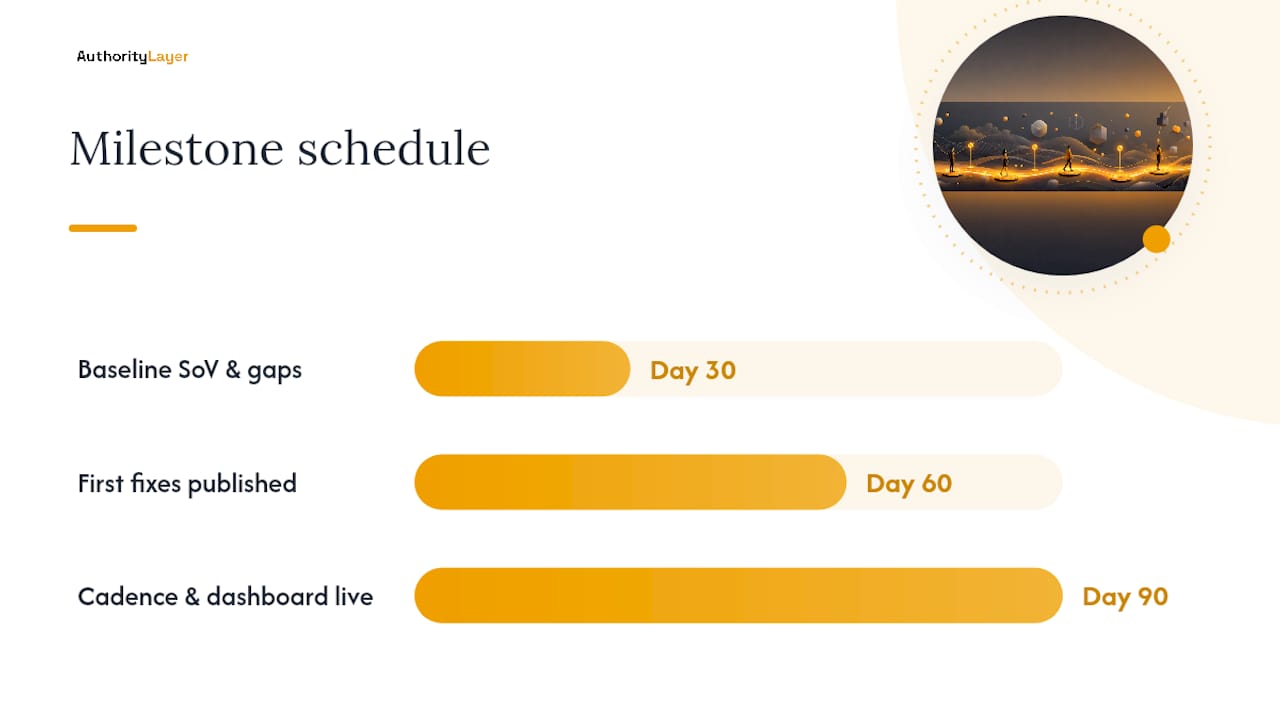
| Day 30 | Baseline SoV established across all five platforms; top 5 prompt gaps identified |
| Day 60 | First content fixes published; re-run confirms inclusion rate change |
| Day 90 | Weekly cadence operational; SoV trend line visible; stakeholder dashboard live |
Pro Tip: Build your prompt library in a shared spreadsheet with columns for intent, prompt text, category, expected owned URL, and cadence. This makes it easy to hand off to a new team member or plug into a SaaS tool later.
How should you design test prompts that reflect real buyer intent?
Strong test prompts are conversational, outcome-centered, and context-rich. "What's the best CRM for a B2B SaaS company with a 10-person sales team?" surfaces different results than "CRM software." Write prompts the way buyers actually talk to AI assistants.
- Discovery-stage: "What tools help marketing teams track brand mentions in AI search?"
- Comparison-stage: "How does [your brand] compare to alternatives for AI visibility monitoring?"
- Transaction-stage: "Which AI visibility platform should I buy if I need cross-platform citation tracking?"
Start with 30–50 prompts covering your top use cases and key comparison questions. Stratify by funnel stage and persona. Practitioner guidance recommends running this set weekly across ChatGPT, Perplexity, Gemini, and Claude as a minimum cadence, because single-run consistency is low.
| Prompt attribute | Field to record |
|---|---|
| Intent stage | Discovery / Comparison / Transaction |
| Persona | Role and company size the prompt reflects |
| Expected owned URL | The page that should be cited if you appear |
| Cadence | Weekly / Bi-weekly / Monthly |
| Volatility flag | High / Low based on cross-run variance |
How do you scale from manual checks to a full monitoring program?
Manual sampling works for a pilot. It breaks down at 50+ prompts across five platforms on a weekly cadence. The scaling path has three stages.
Stage 1 (weeks 1–4): Manual spreadsheet testing. Run 30–50 prompts, log results by hand, compute SoV manually. Useful for validating your prompt library before investing in tooling.
Stage 2 (weeks 5–12): Scheduled automation. Use a Google AI Overviews citation checker or similar platform-specific tools to automate parts of the data collection. Combine outputs in a shared dashboard.
Stage 3 (month 3+): SaaS monitoring with dashboards, API access, and alert notification systems. Platforms at this tier handle cross-platform prompt runners, citation capture, stability reporting, and integration with analytics stacks.
Tool evaluation checklist
- Coverage of all five platforms: ChatGPT, Gemini, Claude, Perplexity, Google AI Overviews
- Prompt library management with metadata fields
- Citation URL capture and change tracking
- Consistency/stability reporting across repeated runs
- Integration with Google Analytics, your CMS, or a data warehouse
- Alert notification systems for threshold breaches (e.g., SoV drops >5 pp)
Pro Tip: Ask any vendor for their methodology on repeated-run aggregation before signing. A platform that reports single-run results as your "AI visibility score" is giving you noise, not signal.
How does Authoritylayer operationalize prompt monitoring?
Authoritylayer maps directly to the playbook above. The platform runs a cross-platform prompt library across ChatGPT, Gemini, Claude, Perplexity, and Google AI Overviews, captures cited URLs per response, and computes an AI Visibility Score and SoV across your full prompt set. Gap analysis surfaces the prompts where competitors appear and you don't, with prioritized recommendations tied to content and citation fixes.
Core features:
- Cross-platform prompt runner with repeated-run aggregation
- Citation capture and URL change tracking
- AI Authority Index scoring and SoV dashboard
- Prompt library management with intent and persona metadata
- Prioritized recommendation list ranked by SoV gap and traffic potential
- Integration with Google Analytics, CMS, and data warehouse exports
Typical pilot plan:
- Import or build a 50-prompt baseline library
- Run baseline across all five platforms; receive SoV dashboard and gap list
- Implement top 3 prioritized fixes (content updates, structured data, citation outreach)
- Re-run at day 30 and day 60 to validate inclusion rate changes
- Hand off weekly cadence to operations team with live dashboard
Authoritylayer's how it works page details the integration architecture for teams that need to connect prompt results to downstream analytics.
How do you turn monitoring outputs into fixes that move the metrics?
Prioritize fixes by combining three inputs: SoV gap size, downstream traffic potential for that prompt category, and production effort. A large gap on a high-traffic comparison prompt that requires only a page update ranks above a small gap on a niche prompt that requires a full content build.
Owner matrix
| Fix type | Primary owner | Validation signal |
|---|---|---|
| Content update (owned page) | Content team | Inclusion rate on affected prompts |
| Structured data / product schema | Technical SEO | Citation URL accuracy |
| Third-party citation outreach | PR / partnerships | Citation share (owned vs. third-party) |
| Retailer page alignment | Commerce / retail media | Retailer-page visit lift |
Third-party authority often drives AI citation decisions more than raw site content. Practitioner analysis consistently finds that established publications, review sites, and forums carry more weight in LLM citation decisions than owned pages alone. That makes PR and citation outreach a first-tier fix, not a nice-to-have.
For validation, re-run the exact prompts affected by a fix 2–4 weeks after publishing. Compare inclusion rate and cited URL accuracy before and after. Where possible, cross-reference against branded search volume or retailer page visits to check for downstream signals consistent with the +2.4 pp own-site visit lift the arXiv panel study documented.
For deeper guidance on content changes that improve AI citation rates, Authoritylayer's AI visibility growth strategies page covers the highest-leverage content and authority levers.
What privacy limits and governance rules apply to prompt monitoring?
Prompt monitoring at the platform level (running prompts and recording outputs) carries minimal privacy risk. Panel-based measurement, which ties AI exposure to downstream user behavior, requires more care.
Privacy checklist:
- Opt-in consent for any panel participants whose behavior is tracked
- Aggregation rules: never report at individual-user level; minimum cohort sizes apply
- PII minimization: strip identifiers before any data leaves the panel environment
- Bot filtering: exclude non-human traffic from panel and click data
- Model-terms compliance: review each platform's terms of service before automated querying
Attribution limits to communicate to stakeholders:
Prompt monitoring shows exposure-to-navigation patterns and citation presence. It does not observe transactions, guarantee conversions, or prove causality at the individual level. Treat AI-driven lifts as directional signals that complement, not replace, your existing attribution stack.
Recommended contract clauses when purchasing monitoring data:
- Data retention limits and deletion schedules
- Explicit scope of what the vendor's panel covers (geography, device type, platform)
- Audit rights for methodology and aggregation rules
- Liability language if a platform changes its API terms mid-contract
Authoritylayer's security and data-handling practices are documented for procurement and legal review.
The measurement-first case that most teams skip
Most marketing teams treating AI visibility as a content problem are solving the wrong thing first. The real gap is measurement: without a controlled baseline, you cannot tell whether a content change moved your SoV or whether a competitor's PR push moved it for you.
The arXiv panel study is the clearest demonstration of why controls matter. Pooled mention funnels produce larger, more impressive-looking lifts. Deconfounded estimates are smaller and more honest. The smaller number is the one you can defend in a budget review.
My recommended first pilot: a 30–60 day, 50-prompt cross-platform baseline, one prioritized content or citation fix, and a 30-day validation re-run. That sequence produces a credible before/after comparison and a methodology your team can repeat without external help. Start there before scaling into a full SaaS program.
Your Authoritylayer AI visibility scan starts here
Authoritylayer gives marketing leaders a turnkey path from zero to a live SoV dashboard in days, not months. The free AI visibility scan runs your brand across ChatGPT, Gemini, Claude, Perplexity, and Google AI Overviews, captures cited URLs, and returns a prioritized gap list with specific content and citation recommendations.
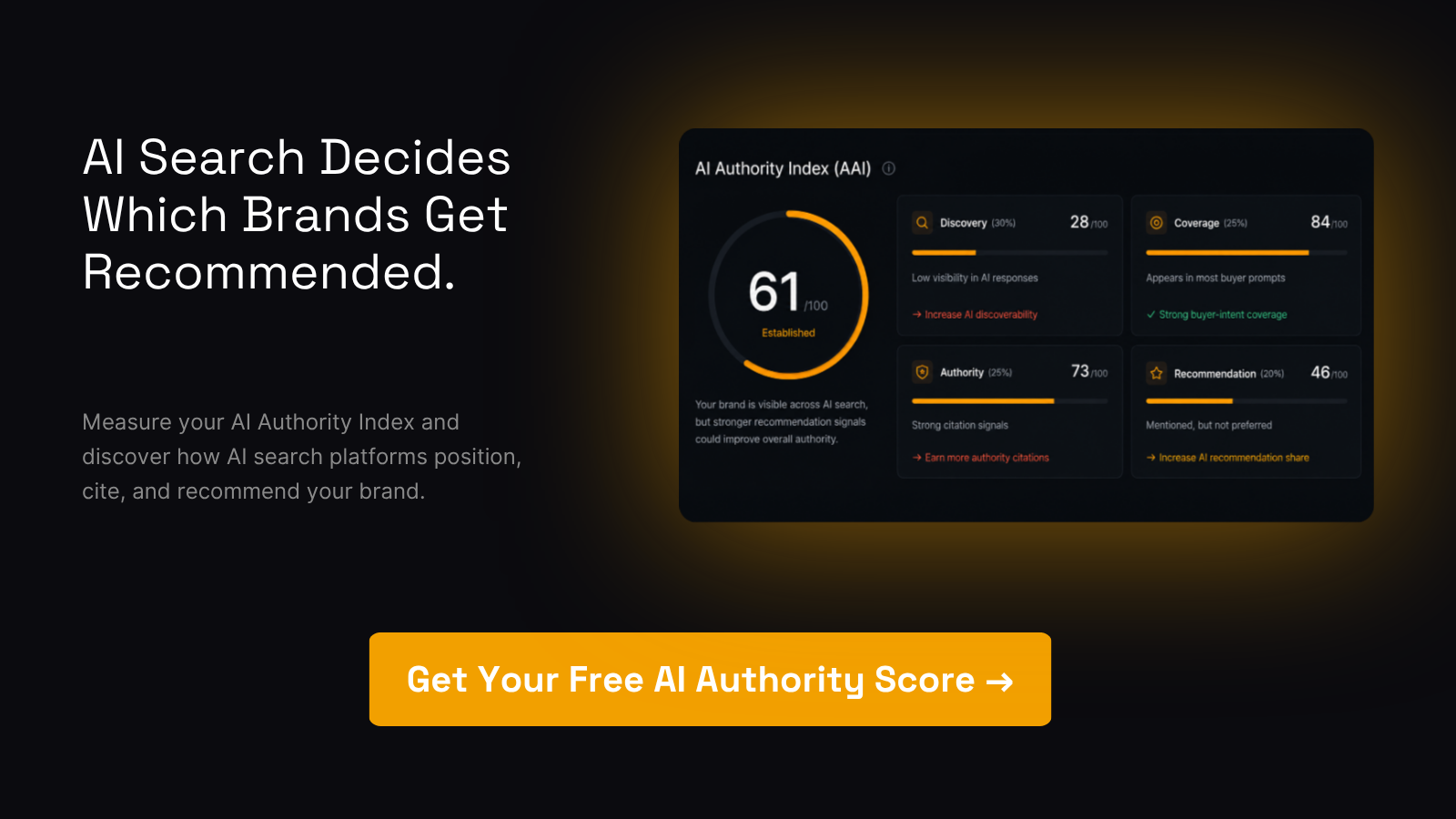
The pilot includes a baseline prompt library run, cross-platform citation capture, an AI Visibility Score dashboard, and a ranked recommendation list. For teams ready to move beyond the pilot, Authoritylayer's enterprise plan covers multi-brand organizations, API access, and custom integrations. Run your free scan at Authoritylayer to see where your brand stands today.
Sources
- Conversational assistants create unlogged brand exposures and move observably-unengaged users to web navigation — Scrunch AI panel study (arXiv)
- How to track brand mentions in AI search — Adobe Business blog
- AI search statistics 2026 — AI Index (enterprise AI / AI search statistical highlights)
- AI is rewriting the start of the shopping journey — Emarketer
- The state of AI brand mention monitoring in 2026 — Surferstack
FAQ
What is prompt monitoring for marketing teams?
Prompt monitoring is the practice of systematically running brand-related queries through AI assistants like ChatGPT, Gemini, Claude, Perplexity, and Google AI Overviews to measure inclusion rate, Share-of-Voice, and citation share. It is distinct from engineering-side LLM observability, which tracks tokens and model costs.
How often should you run prompt monitoring checks?
Practitioner guidance recommends a weekly cadence across at least three to four platforms, using a set of 20–50 prompts, because single-run AI visibility scores are unreliable due to response volatility.
What metrics matter most in AI visibility monitoring?
Inclusion rate, Share-of-Voice, and citation share are the three leading KPIs. Positioning and multi-platform consistency are useful diagnostics but should not drive prioritization decisions on their own.
Can prompt monitoring prove that AI mentions drive conversions?
No. Monitoring shows exposure-to-navigation patterns and citation presence. The arXiv panel study documented downstream search and site-visit lifts using controlled methods, but monitoring alone does not observe transactions or guarantee conversions.
How does Authoritylayer support a prompt monitoring program?
Authoritylayer runs automated cross-platform prompt libraries across all five major AI platforms, captures cited URLs, computes an AI Visibility Score and SoV dashboard, and returns a prioritized recommendation list. Teams can start with a free AI visibility scan before committing to a paid plan.