Why AI Visibility Changes Over Time (And How to Track It)
Discover how fluctuations in AI visibility impact your brand and learn effective strategies to track and improve your rankings over time.
· 10 min read

AI visibility shifts because the corroboration behind your brand, the way models retrieve information, and the inherent randomness in generation all move independently of each other. It is not a stable rank you earn once and keep like a page-one Google result might feel. A brand's appearance in ChatGPT responses can vary widely from one week to another, with changes not necessarily related to the brand itself.
The immediate implication for marketing leaders: stop treating a single prompt result as a finding. One search is a snapshot, not a signal.
- Run the same prompt across multiple models, multiple times, before drawing any conclusion
- Track visibility percentage (how often you appear) rather than position (where you rank)
- Treat any one-off check, including the one a curious executive ran on their personal ChatGPT account last night, as anecdote, not data
Standardized, repeatable measurement, the kind AuthorityLayer runs across models and prompt sets, is what turns that noise into a trend line you can actually manage.
Key Takeaways
AI visibility changes because corroboration, retrieval across three knowledge graphs, and model-level randomness shift independently, which is why only repeated, multi-model measurement reveals a real trend.
| Point | Details |
|---|---|
| Visibility is not stable rank | It reflects corroboration and retrieval variance, so single checks are unreliable by design. |
| Track presence, not position | Visibility percentage across many runs is meaningful; list order on one run is not. |
| Clear the corroboration threshold | Two to three high-confidence third-party sources can shift a model from hedging to direct recommendation. |
| Measure across models monthly | Sample multiple prompts, multiple models, and a consistent cadence, weekly during active campaigns. |
| Authoritylayer standardizes the process | Its AI Authority Index and monthly reporting replace one-off manual checks with repeatable, benchmarked tracking. |
Table of Contents
- The Three Knowledge Graphs Behind AI Visibility Fluctuations
- Why Do AI Recommendations Change Between Searches?
- What Metrics Actually Matter for AI Visibility?
- Which Levers Actually Move AI Visibility?
- How Often Should You Measure AI Visibility?
- How Long Does It Take to Improve AI Visibility?
- What Practitioners Get Wrong About AI Visibility
- Get a Baseline Before You Guess at Your AI Visibility
- Sources
- FAQ
The Three Knowledge Graphs Behind AI Visibility Fluctuations
AI assistants do not pull an answer from one place. They blend three distinct representations of the world, and your brand's presence, or absence, in each one changes independently over time.
- The entity graph holds structured facts: your company name, category, founders, products, and how these connect to competitors and partners. This is closest to a traditional knowledge graph.
- The document graph is the indexed web: articles, reviews, comparison pages, and documentation the model's retrieval layer can pull from at answer time.
- The concept graph is the fuzzier layer of associations baked into the model's training. It's why some brands get linked to a category ("best for enterprise") even without a document saying so explicitly.
A brand weak in one graph but strong in the other two can still surface. A brand thin across all three needs more evidence before a model will state a recommendation confidently, rather than hedge it. Once a topic clears a small threshold of high-confidence, independent corroborations, the three-graph model shows a shift from hedged language ("some options include") to direct recommendation. Below that line, visibility stays volatile because the system has no cascading confidence to lean on.
Pro Tip: Audit your entity home (your own site, your G2 or Crunchbase profile, your Wikipedia presence if you have one) before chasing press coverage. Weak entity-graph data undermines corroboration you're paying for elsewhere.
Why Do AI Recommendations Change Between Searches?
Run the identical prompt through the identical model twice in a row, and you will likely get two different lists. A large-scale study running thousands of prompts across ChatGPT, Claude, and Google's AI found that the odds of getting the exact same recommendation list twice sit under 1 in 100, and the odds of the same ordering drop to roughly 1 in 1,000.
That is not a bug. It is how generative retrieval works: sampling temperature, minor context differences, and constant index updates all introduce variance a static search rank never had.
Here's what that means for how you measure:
- Position in a list is close to meaningless on any single run
- Presence across many runs, visibility percentage, holds up as a real signal
- A brand can show up frequently in a significant portion of runs, even while its rank bounces around inside each answer source.
A one-off check on your personal ChatGPT account tells you nothing repeatable. It reflects that session, that account's history, that day's sampling. Automated, multi-model, multi-prompt tracking is what separates a real pattern from a single noisy data point.
What Metrics Actually Matter for AI Visibility?
Most teams start by asking "where do we rank" and that is the wrong question. Rank is unstable by design. The metrics worth reporting up the chain are the ones that hold steady across repeated sampling.
- Visibility percentage (citation frequency): the share of runs, across prompts and models, where your brand appears at all
- Query coverage: visibility broken out by buyer-intent cluster, not one blended number
- Attribution accuracy: how often the model describes you correctly versus hallucinating a feature, price, or capability you don't have
An AI visibility score that's replacing single-dimension SEO indices typically combines citation frequency, prominence, query coverage, and attribution accuracy into one composite, measured monthly at minimum.
| Metric | What it tells you |
|---|---|
| Visibility percentage | How often you show up across repeated, multi-model runs |
| Query coverage | Whether you're visible for every stage of buyer intent, not just brand-name searches |
| Attribution accuracy | Whether the model's description of you is factually correct |
| Position/rank | Almost nothing on its own; too volatile to report as a KPI |
Traditional SEO metrics still matter, they feed the document graph, but they no longer tell the whole story on their own.
Which Levers Actually Move AI Visibility?
Not every fix carries equal weight, and teams that spread effort evenly across all of them waste months. Prioritize by how directly a lever strengthens corroboration.
- Fix the entity home first. Canonical facts about your product, pricing tier names, and integrations need to be consistent everywhere, including schema.org structured data on your own site. This is the cheapest, fastest lever.
- Build third-party corroboration deliberately. Brands with dense external validation, expert roundups, comparison reviews, analyst mentions, appear in AI answers far more often than brands leaning solely on owned-domain SEO strength, even when their domain authority is lower.
- Make content actually retrievable. Gated PDFs and JavaScript-rendered pages that crawlers can't parse are invisible to the document graph, no matter how good the content is.
- Align your narrative across channels. If your website says one thing and your G2 reviews say another, the concept graph gets conflicting signals and confidence drops.
For B2B categories specifically, crossing the corroboration threshold tends to require targeted earned mentions, industry reports, integration directories, partner citations, rather than general news volume.
Pro Tip: Run the quick wins (entity home, schema, structured facts) in the first month. Digital PR and third-party corroboration compound but take longer, budget for both simultaneously rather than sequentially.
How Often Should You Measure AI Visibility?
A measurement plan that skips sample size or model coverage will produce numbers that look precise and mean nothing.
Build it in five parts:
- Cluster your prompts by intent. "Best [category] for enterprise" and "[Brand] vs [competitor]" surface completely different visibility patterns and need separate tracking.
- Run each prompt repeatedly, not once. A single run tells you what happened in that instant; ten to twenty runs tell you the actual frequency.
- Cover multiple models separately. ChatGPT, Gemini, Claude, and Perplexity draw on different indexes and training cuts. A brand can be strong in one and nearly absent in another, and blending them into one number hides that gap.
- Version your prompt set and keep a baseline, and note whether you're querying through an API or a consumer UI, since the two can return different results.
The IAB's guidelines for measuring visibility in the AI era exist partly because more than 20 companies now sell AI visibility measurement with wildly different methodologies, so what you demand from a vendor's sampling approach matters as much as the number it hands you.
Monthly is the floor for reporting cadence. Run weekly if you're mid-campaign and need to see whether a specific push is moving the needle before the next board update.
How Long Does It Take to Improve AI Visibility?
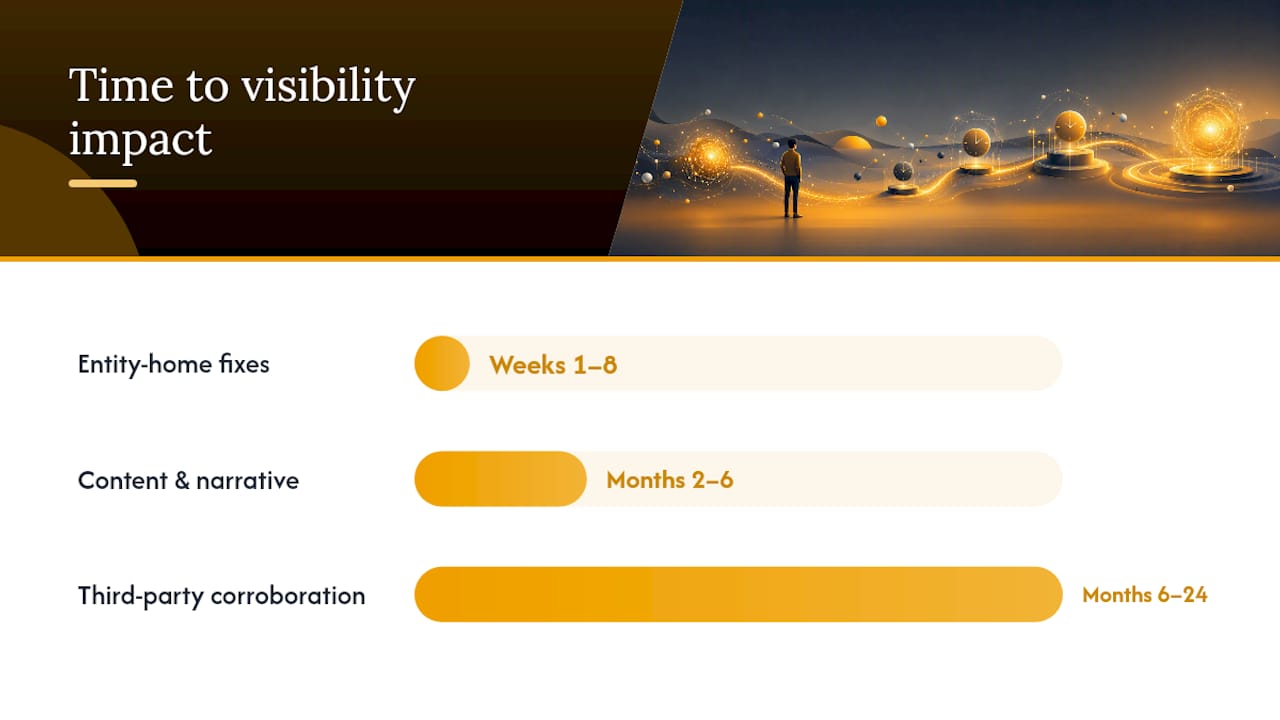
Entity-home fixes and structured data cleanup can shift attribution accuracy within weeks, since they change what the model retrieves on the next crawl or index refresh.
Third-party corroboration is slower. Digital PR, analyst placements, and review volume typically take six to twenty-four months to build into a durable pattern, but the payoff compounds: once a brand clears the corroboration threshold for a category, each additional mention reinforces an already-assertive recommendation instead of trying to establish one from zero.
- Weeks 1 to 8: entity home, schema, structured facts
- Months 2 to 6: content accessibility, narrative alignment
- Months 6 to 24: third-party corroboration density, category association
Early movers in a category get a compounding head start competitors can't easily buy back later.
What Practitioners Get Wrong About AI Visibility
The most common mistake I see marketing teams make is treating an AI visibility check the way they treat a rank tracker, running it once, screenshotting the result, and presenting it as fact in a leadership meeting. That instinct comes from a decade of stable SERP tracking, and it does not transfer.
The teams that actually move their numbers are the ones measuring monthly through AuthorityLayer's own AI Visibility Report, cross-referencing against our methodology, and reporting frequency trends rather than single snapshots. Clients doing this consistently over multiple quarters have seen substantial lifts in visibility percentage, because such patterns only become visible with repeated sampling.
— Geraldine
Get a Baseline Before You Guess at Your AI Visibility
Guessing your AI visibility from a handful of personal ChatGPT queries is like judging your SEO from one incognito search. Authoritylayer replaces that guesswork with standardized, repeatable measurement: many prompts, every major model, tracked on a schedule instead of a whim.
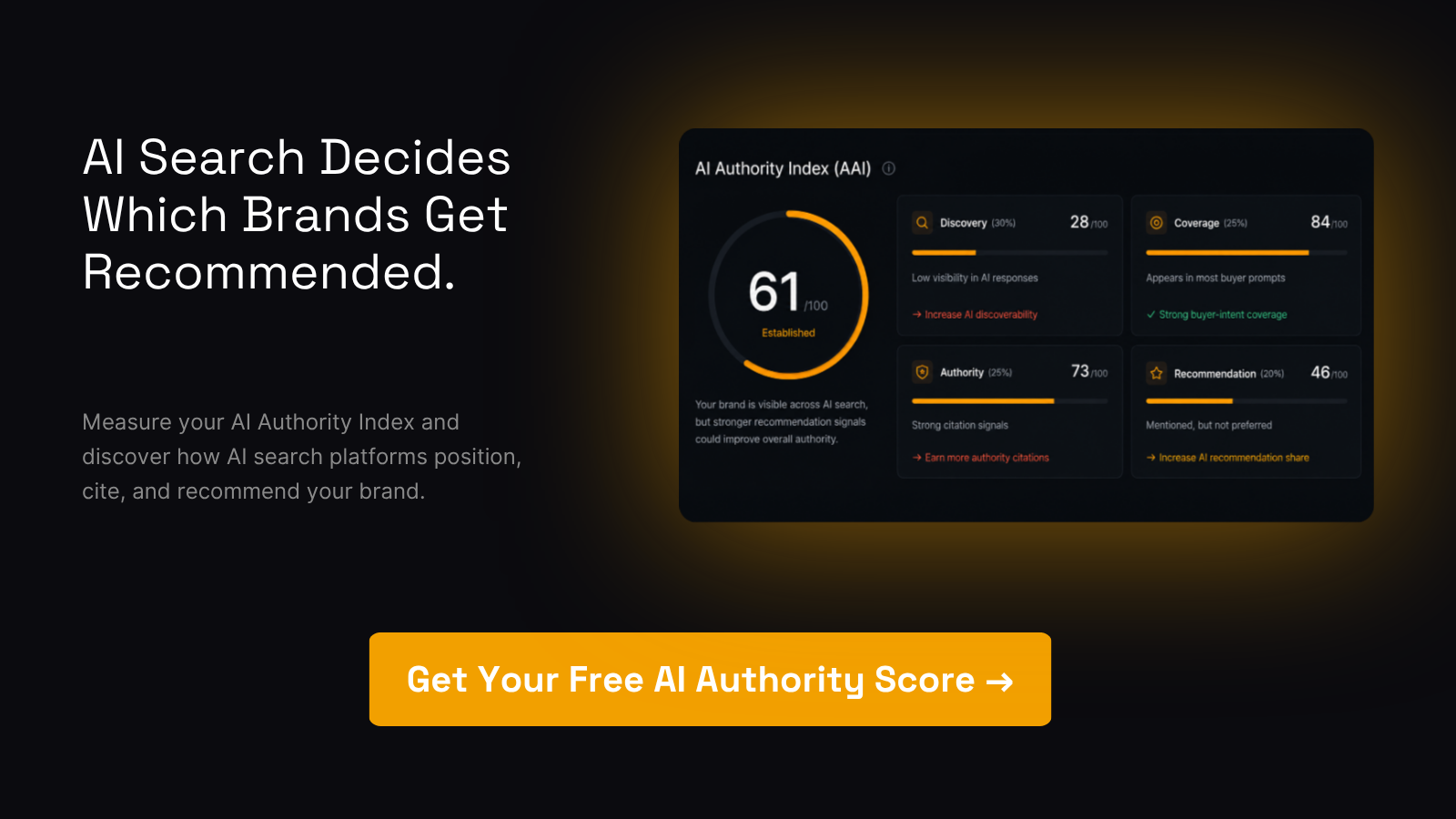
The platform benchmarks your entity, document, and concept-graph presence against named competitors, scores it through the AI Authority Index, and turns the gaps into a prioritized fix list instead of a spreadsheet of confusing screenshots. Every account gets access to monthly AI Visibility Reports built for executive reporting, not just marketing ops. If your team is still checking visibility manually one prompt at a time, run a free AI visibility scan this week and see where the real gaps sit before your next planning cycle.
Sources
- Rand Fishkin proved AI recommendations are inconsistent – here’s why and how to fix it
- AI visibility index shows which brands are disappearing
- Measuring Visibility in the AI Era
FAQ
Why does my brand show up in ChatGPT one day and not the next?
Generative models introduce sampling variance on every run, so the same prompt rarely returns the same list twice; a study found under 1% of runs return an identical recommendation list.
What is the corroboration threshold in AI visibility?
It's the point, roughly two to three high-confidence independent sources, where a model shifts from hedged mentions to direct, assertive recommendations of your brand.
Is a manual ChatGPT check a reliable way to measure visibility?
No. A single prompt on a personal account is a snapshot influenced by that session and sampling variance; reliable measurement requires repeated runs across multiple models, which is what platforms like Authoritylayer are built to do.
How often should marketing teams measure AI visibility?
Monthly is the minimum reporting cadence; run weekly checks during active campaigns so you can see whether a specific change is moving the numbers before the next report.
Which metric matters more: rank or visibility percentage?
Visibility percentage, how often your brand appears across many runs, holds up as a stable signal, while rank position shifts too much between runs to be treated as a reliable KPI.