4 Weeks to AI Visibility for CMOs: Fix Entity Signals & Passages
In 4 weeks, run a measurement first AI audit CMOs can use to fix entity signals, make passages extractable, and lift AI citations.
· 8 min read

Content gaps for AI are the missing or inconsistent entity signals and extractable answer structures that stop ChatGPT, Perplexity, Gemini, and Claude from surfacing or recommending your brand. If your brand doesn't appear when it should, the fix starts with a prioritized AI-visibility audit, because entity maturity and clear claim-to-evidence passages drive most citation outcomes, not classic keyword rankings.
TL;DR:
- Building complete and structured entity profiles, such as Wikidata properties and consistent schema links, significantly increases the likelihood of AI citations, with a strong correlation to citation rates.
- Ensuring webpage content answers questions directly in self-contained paragraphs boosts extractability and can account for nearly half of all AI citations.
- Regularly auditing crawler access and avoiding client-side-only rendering issues are essential technical steps to prevent AI crawlers from missing critical content.
- Prioritizing entity maturity improvements yields higher returns than technical fixes and should be completed before addressing passage-level rewrites.
- Tracking AI recommendation share and citation rate monthly allows for measurable progress, with targeted off-site mentions further enhancing AI visibility.
Table of Contents
- Why AI Visibility Is Different From Traditional SEO
- How to Run an AI-Visibility Audit This Quarter
- What Actually Causes AI Visibility Gaps?
- What to Fix First: A Prioritized Remediation Playbook
- How to Measure Progress: KPIs, Dashboards, and Cadence
- What Marketing Leaders Should Expect in Year One
- How AuthorityLayer Turns This Audit Into an Ongoing System
- Sources
- FAQ
Why AI Visibility Is Different From Traditional SEO
Ranking well on Google and getting cited by an AI assistant are related but not the same job. A page can hold a top-three Google position and still never appear in a ChatGPT answer, because language models weigh signals that traditional rank trackers never measured.
Entity maturity carries outsized weight in that calculation. A multi-brand regression study found that entity-maturity composites correlated with citation rate at r=0.67, and entity signals combined with passage structure explained roughly 58% of the variance in whether a brand got cited at all. That's a bigger lever than most content teams are pulling.
Two mechanics explain why:
- Entity maturity: how completely your brand exists as a structured entity, through Wikidata properties, coherent Schema
@idgraphs, and consistentsameAslinks tying your site, social profiles, and directory listings together. - Passage extractability: whether your content states a claim and backs it with concrete evidence in a self-contained paragraph a model can lift cleanly, rather than burying the answer in a narrative lead-up.
Get those two right, and citation probability climbs regardless of where you sit in organic rankings.
How to Run an AI-Visibility Audit This Quarter
You don't need a research team to start. You need a repeatable checklist and a few hours a week for four weeks.
- Sample the models. Run 20 to 30 representative buyer queries across ChatGPT, Perplexity, Gemini, and Claude. Log whether your brand appears, whether it's cited with a link, and what context surrounds the mention (praised, listed, or ignored entirely).
- Check crawler access. Audit your robots.txt for GPTBot, PerplexityBot, ClaudeBot, and similar user agents, then pull server logs to confirm those crawlers are actually visiting, not just permitted to.
- Score entity coherence. Count Wikidata properties tied to your brand, verify Schema
@idvalues match across pages, and confirmsameAslinks point to the correct external profiles with no naming drift. - Scan off-site presence. Search review platforms, trade press, and forums for brand mentions, then note how often competitors show up in the same AI answers where you're missing.
Pro Tip: Run the same query set once a month and screenshot the raw output. Model behavior shifts between updates, and a gap that closed in March can reopen by June without warning.
The AuthorityLayer AI visibility audit template mirrors this exact sequence if you want a starting framework rather than a blank spreadsheet.
What Actually Causes AI Visibility Gaps?
Most gaps trace back to a small set of repeat offenders, and they rarely show up alone. A site with weak entity signals usually has weak passage structure too, because both stem from treating content as marketing copy instead of machine-readable evidence.
- Crawler blocking. Robots.txt rules written years ago for a different purpose often block GPTBot or ClaudeBot without anyone noticing. One practitioner analysis found that A substantial portion of enterprise SaaS sites unintentionally block at least one AI crawler.
- Client-side-only rendering. If your critical product or pricing content only loads via JavaScript with no server-side rendering, crawlers that don't execute scripts never see it.
- Weak passage structure. Pages that open with a story, then a definition, then finally an answer three paragraphs later give models nothing clean to extract.
- Inconsistent naming. Your brand listed one way on your site, another on Crunchbase, and a third on a review platform fractures the entity graph a model relies on to connect the dots.
- Missing or broken schema. Sparse Organization, Product, or FAQPage markup, plus thin FAQ content generally, leaves fewer extractable answer units.
- Thin off-site footprint. Few reviews, little press, and no forum presence mean there's nothing for a model to cross-reference when it's deciding who to trust.
What to Fix First: A Prioritized Remediation Playbook
Fixing everything at once is how remediation projects stall. Sequence matters more than effort here.
- Entity maturity first. This is the highest-leverage fix, given its 0.67 correlation with citation rate. Build out Wikidata properties, resolve
sameAslinks across every platform your brand touches, and make sure Schema@idvalues are identical site-wide. This work is unglamorous and it's the biggest single move you can make. - Passage-level extractability second. Rewrite key pages to answer-first: a direct claim in the opening sentence, followed by concrete data and a named source. Front-loaded answers in the first 30% of an article account for roughly 44.2% of citations across engines.
- Technical access third. Fix robots.txt, move critical content to server-side rendering, and reconfirm crawler access monthly. A robots.txt generator built for granular crawl rules helps avoid re-blocking a crawler by accident during the next site update.
- Citation ecosystem fourth. Pursue targeted press placements, encourage reviews, and engage in relevant forums. Off-site mentions and comparison content outperform raw backlink counts for AI citation specifically.
- Freshness and governance last, but ongoing. Refresh high-value pages monthly, display visible update dates, and set a recurring monitoring cadence rather than a one-time audit.
Pro Tip: Skip straight to priority two if your entity graph is already clean. Passage rewrites take days, not months, and often produce the fastest visible lift in early testing.
How to Measure Progress: KPIs, Dashboards, and Cadence
Remediation work is invisible to executives unless you're tracking the right numbers on a fixed schedule.
- AI citation rate: the percentage of sampled queries where your brand appears with an attributed mention.
- AI recommendation share: how often you're the recommended option versus simply listed among competitors.
- AI Authority Index (AAI): a composite score benchmarking your entity strength and citation performance against competitors.
- Hallucination rate: how often models state inaccurate details about your brand, which needs its own escalation path.
- Secondary signals: Wikidata property count, Schema validation errors, crawler access events in server logs, and the velocity of new third-party mentions.
Report a monthly executive snapshot, roll it into quarterly trend reviews, and set a service-level target for correcting hallucination incidents within a fixed window. The AI Authority Index methodology breaks down how each of these scores gets calculated if your team is building a dashboard from scratch.
What Marketing Leaders Should Expect in Year One
The honest timeline: a measurable citation lift usually occurs within a few months after entity and passage fixes are implemented, and expect that lift to compound as off-site mentions accumulate. It rarely happens faster, and treating it as a quick win sets the wrong internal expectations.
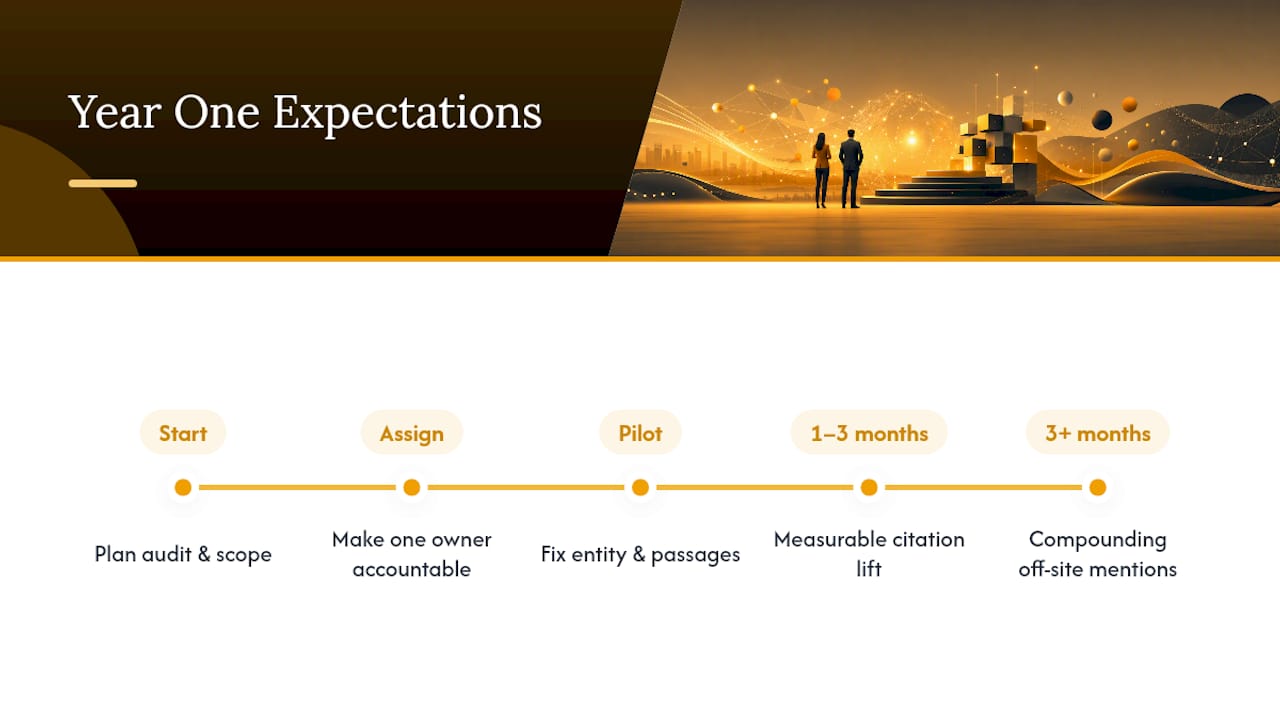
The real blocker isn't strategy. It's coordination. Engineering owns robots.txt and rendering, SEO owns schema and passage structure, and PR owns off-site mentions, and none of them report to the same VP in most organizations. Get one person accountable for the whole pipeline before you write a single audit.
Start narrow. Pick one product line, run the audit, ship the priority-one and priority-two fixes, and measure citation rate before expanding scope. A focused pilot proves the model works before you ask for headcount to scale it.
— Geraldine
How AuthorityLayer Turns This Audit Into an Ongoing System
Running this audit by hand once is manageable. Running it every month, across every competitor and every model, is what actually moves your AAI score, and that's where a manual spreadsheet breaks down fast.
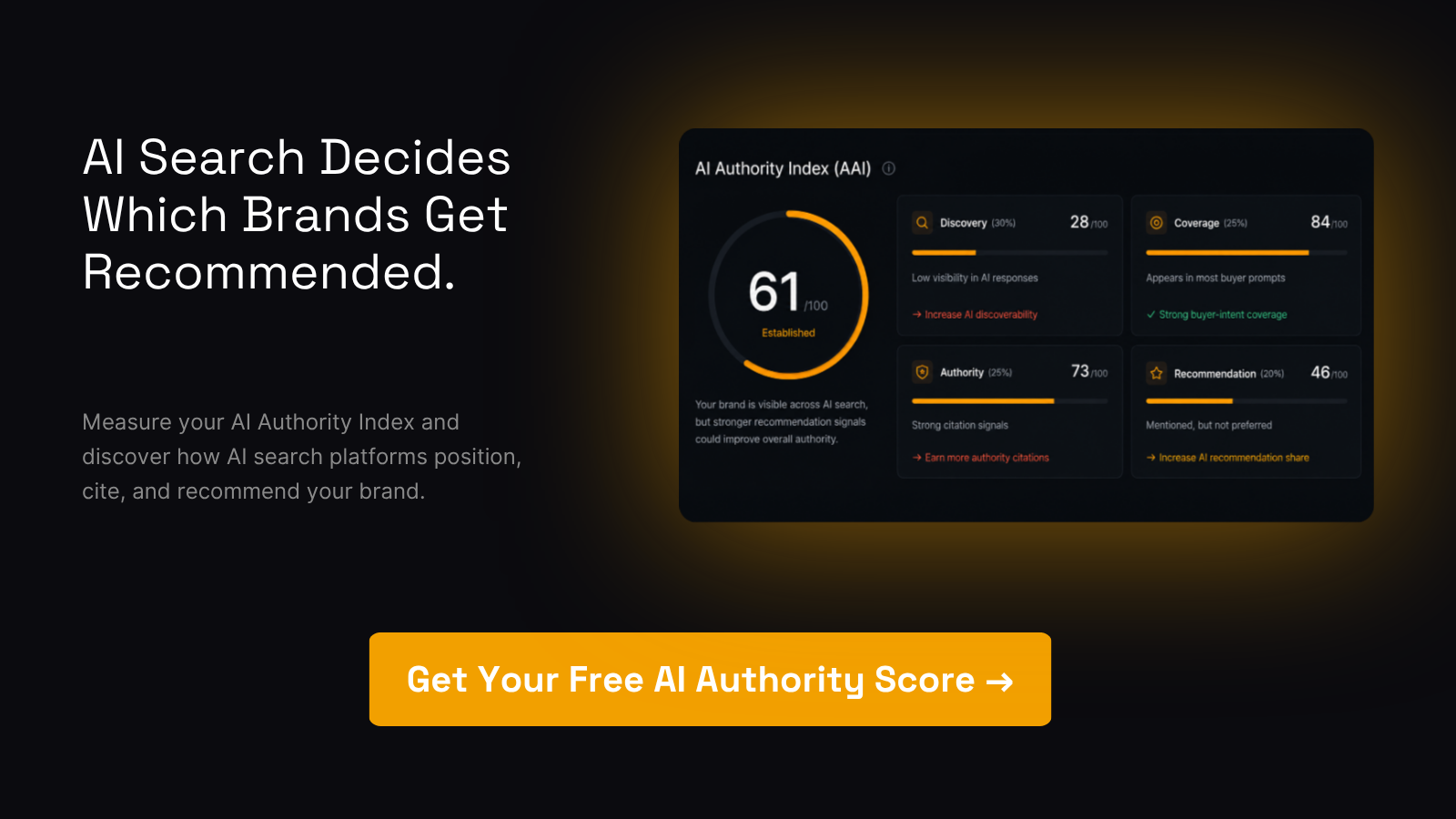
An AI visibility intelligence platform can track AI recommendation share, citation rate, and entity maturity continuously across ChatGPT, Perplexity, Gemini, and Claude, then rank remediation priorities automatically instead of relying on manual quarterly updates. The AI Authority Index scores your brand against named competitors so you know exactly which gap to close first.
If you're presenting this to leadership next quarter, start with the Monthly AI Visibility Report. It's built as an executive-ready benchmark, so you walk into the room with the citation data already prioritized instead of assembling it from four different tools the night before.
Sources
- State of AI Search 2026 - Research Report · Murat Ulusoy
- How to Rank in ChatGPT, Gemini, and Perplexity in 2026: Patterns From 50 B2B Sites Across Industries | WebThree Consulting
FAQ
What Are Content Gaps for AI Specifically?
They're missing or inconsistent entity and extractable content signals, such as incomplete Wikidata records or buried answer paragraphs, that prevent AI assistants from surfacing or recommending a brand.
How Long Does It Take to Close an AI Visibility Gap?
A measurable citation lift usually occurs within a few months after entity and passage fixes are implemented, with gains compounding as off-site mentions build.
Which Metric Matters Most for Tracking Progress?
AI recommendation share and citation rate are the primary KPIs; AuthorityLayer's AI Authority Index combines both into a single benchmark against named competitors.
Do I Need to Fix Technical Issues Before Content Issues?
No. Entity maturity and passage-level rewrites typically deliver faster, larger gains than technical fixes, though blocked crawlers or client-side-only rendering must eventually be resolved too.
Can Small Brands Compete With Larger Ones on AI Citation?
Yes. Retrieval-enabled systems pull fresh, well-structured web content at query time, so a smaller brand with strong entity signals can out-cite a larger competitor with a thinner digital footprint.