Best Generative Engine Optimization Tools for 2026
Discover the best generative engine optimization tools for 2026. Elevate your SEO strategy with effective solutions that drive measurable results.
· 22 min read

For enterprise buyers, Authoritylayer is the recommended first call. It measures Share of Answer across ChatGPT, Gemini, Claude, and Perplexity, benchmarks competitors, and delivers prioritized recommendations tied to measurable outcomes — not just a dashboard you have to interpret yourself. If you're running a mid-market content team, Writesonic's GEO tool closes the loop between detection and content execution. For teams already inside Semrush, the AI Visibility Toolkit adds GEO tracking without a new vendor. And if budget is the constraint, Otterly AI or Peec AI get you into prompt-level monitoring for under $100/month.
The core issue with most AI-driven SEO solutions right now: the market is flooded with monitoring dashboards that tell you where you're missing from AI answers but stop there. Only a small subset of GEO platforms provide the full loop: detect a gap, execute a fix, measure the impact on recommendation share. That distinction is what this shortlist is built around.
- Recommended enterprise pick: Authoritylayer (AI Authority Index, prompt tracking, competitive benchmarking, closed-loop recommendations)
- Best for content-first execution: Writesonic GEO (Action Center: detect, outreach, refresh, measure)
- Best for Semrush users: Semrush AI Visibility Toolkit (integrated workflow, no new vendor)
- Best low-cost entry: Otterly AI or Peec AI (sub-$100/mo, prompt-level monitoring)
- Best for e-commerce: Yotpo Discover or Goodie AI (SKU-level visibility, commerce integrations)
Why Share of Answer matters: Entry-tier plans from most vendors cover a few AI engines; enterprise plans extend to tracking multiple engines, which matters for brands with cross-engine buyer journeys. If your buyer research happens across ChatGPT, Gemini, and Perplexity simultaneously, a tool that only tracks one engine is measuring a fraction of your actual exposure.
Table of Contents
- What are the best generative engine optimization tools in 2026?
- How do these tools compare side by side?
- How do you pick the right GEO tool for your organization?
- What metrics do GEO tools actually measure?
- How we evaluated these tools
- Who should pick which tool?
- Key Takeaways
- Authoritylayer gives you a measurable AI visibility channel
- FAQ
What are the best generative engine optimization tools in 2026?
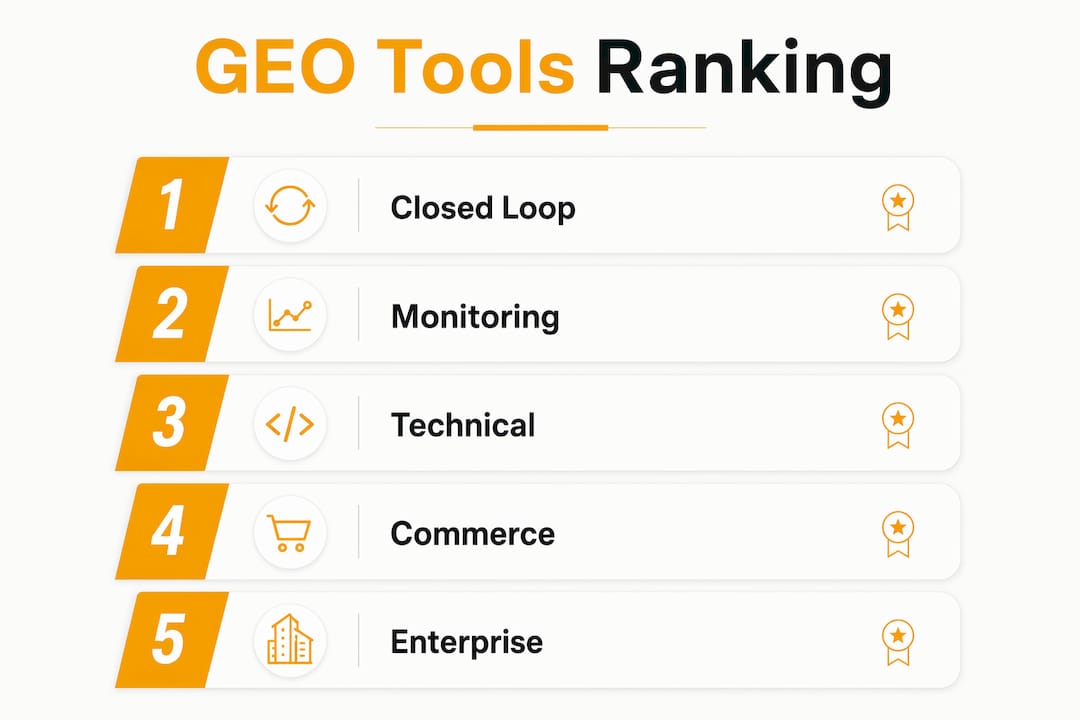
The 29 tools below span four categories: enterprise intelligence platforms, technical optimization tools, commerce-native solutions, and market-entry monitoring. The profiles concentrate on what actually changes a buyer's decision: closed-loop capability, engine breadth, integration surface, and pricing shape.
Authoritylayer
Authoritylayer is built specifically for the measurement problem most GEO tools ignore. It tracks how AI assistants discover, describe, and recommend your brand during buyer research, then scores that exposure as an AI Authority Index. You get competitive benchmarking against named rivals, prompt-level breakdowns showing which queries surface your brand versus a competitor, and prioritized recommendations with enough context to act on them. The enterprise plan includes multi-brand support, SLA coverage, and integration with analytics workflows. For marketing leaders who need to report AI visibility as a channel metric, not just a curiosity, Authoritylayer is the most direct path to that.

Pricing: Starter, Growth, and Enterprise tiers. See current pricing.
Profound
Profound targets in-house analytics teams at large enterprises. Its Conversation Explorer lets you drill into topic-level and conversation-level AI data, which is genuinely useful when you need to understand why your brand appears in certain contexts and not others. The reporting depth is strong; the tradeoff is that it assumes you have the internal bandwidth to act on what you find.
Semrush AI Visibility Toolkit
If your team already lives in Semrush, this is the path of least resistance. The AI Visibility Toolkit layers GEO tracking onto existing keyword and SERP datasets, so you're not rebuilding a workflow from scratch. It won't replace a dedicated AI visibility platform for enterprise needs, but for SEO teams that want to add AI monitoring without a new vendor relationship, it's a practical choice.

BrightEdge (Generative Parser)
BrightEdge's Generative Parser decodes Google AI Overviews specifically, mapping intent shifts and SERP feature triggers. If Google AI Overviews represent your primary concern, BrightEdge has the most mature tooling for that surface. Its limitation is focus: it's Google-centric, which matters less as Perplexity and ChatGPT grow as discovery channels.
Yotpo Discover
Commerce brands with large SKU catalogs need product-level visibility tracking, not just brand-level scores. Yotpo Discover is built for that. It connects AI visibility data to commerce attribution, so you can see which products are being recommended in AI answers and whether that's driving clicks or conversions. The platform integrates with major e-commerce stacks.
AthenaHQ
AthenaHQ pitches to C-suite buyers with executive dashboards and macro competitive intelligence. It's less about prompt-level granularity and more about market-level visibility trends. Large organizations that need a board-ready view of AI market share will find it useful; teams that need to act on individual prompt gaps probably won't.
Evertune
Evertune focuses on a problem most GEO tools don't address directly: what happens when an AI assistant describes your brand inaccurately. It monitors sentiment and flags hallucinations, then helps you correct the record through content and outreach. For brands in regulated industries or with complex reputational considerations, that's a meaningful capability.
Writesonic (GEO Tool)
Writesonic's GEO tool is one of the few platforms that attempts to close the full loop. Its Action Center covers detection, author contact extraction for outreach, content refresh workflows, and impact measurement on Share of Answer. Of 10 GEO tools tested in one multi-platform review, it was among the only ones claiming full loop coverage. The content-creation heritage means the execution layer is genuinely built out, not bolted on.
Addlly AI
Addlly AI leans into agentic automation: bulk content actions, automated fixes, and workflow orchestration for teams that need to move fast at scale. It's less focused on deep analytics and more on execution velocity.
Gumshoe.AI
Gumshoe.AI generates persona-driven prompts and maps visibility scores across those personas. If your buyer research shows that different audience segments ask AI assistants very different questions about your category, Gumshoe.AI's persona-based approach gives you a more realistic picture of your actual exposure.
InLinks
InLinks takes an entity-first approach: it optimizes content for entity authority and internal linking structures that AI systems use to understand topical relevance. For teams focused on building long-term entity authority rather than chasing individual prompt appearances, it's a strong technical foundation.
KAI Footprint
KAI Footprint maps your AI visibility across models and prompts as a visual heatmap. Technical teams doing footprint audits will find the visualization useful for identifying where coverage is thin and which prompt clusters are underperforming.
Otterly AI
Otterly AI is the clearest entry point for small teams. The interface is approachable, the pricing is low, and it covers the basics of prompt-level monitoring without requiring a technical setup. It won't give you competitive benchmarking or closed-loop execution, but for an SMB testing whether GEO is worth investing in, it's the right starting point.
Ahrefs Brand Radar
For existing Ahrefs customers, Brand Radar adds AI mention and citation tracking alongside the backlink and keyword data you're already using. It's not a standalone GEO platform, but it's a sensible add-on if you want brand-level citation intelligence without leaving the Ahrefs ecosystem.
Rankscale AI
Rankscale AI translates AI visibility into structured exposure scores and benchmarks. Teams that need a score-based framework for internal reporting or executive communication will find the format useful.
Authoritas
Authoritas is a long-standing SEO intelligence platform that has added AI monitoring layers. Agencies and larger SEO teams that already use it for SERP analysis can extend into GEO tracking without a full platform switch.
Rankability, Morningscore, SE Visible
These three sit in the simplified-dashboard tier. Rankability and Morningscore both offer combined SEO and AI visibility scoring for small teams that want a single view. SE Visible is specifically an add-on for SE Ranking customers. None of them are built for enterprise depth, but all three are genuinely easy to start with.
Goodie AI
Goodie AI targets e-commerce and DTC brands with SKU-level visibility tracking and commerce integrations. It competes directly with Yotpo Discover for the commerce-native buyer.
Surfer SEO
Surfer SEO has added GEO-relevant features to its content optimization workflow. Content teams that already use Surfer for brief generation and on-page scoring can now layer in AI-readiness signals without switching tools.
Peec AI
Peec AI covers multi-country prompt tracking with clean reporting and pricing that stays accessible for SMBs. If your brand operates across multiple markets and you need country-specific AI visibility data, Peec AI handles that better than most tools at its price point.
GetCito, LLMrefs, Hall
GetCito maps which domains generative systems rely on for citations, giving you a clear picture of source influence. LLMrefs traces model-level citations for technical audits. Hall focuses on multi-turn conversation visibility, which matters as AI assistants handle longer research sessions. All three are specialized tools that complement a primary GEO platform rather than replacing one.
Frase
Frase is primarily a content research and brief generation tool. Its AI-ready outputs are useful for content teams building structured answers that AI systems can cite, but it doesn't monitor AI visibility directly.
Limy, WorkDuo.ai, SEOTalos
Limy handles niche monitoring use cases with a focused feature set. WorkDuo.ai automates GEO workflows at scale with an agent-driven architecture. SEOTalos combines a traditional SEO toolkit with AI visibility layers. All three serve specific operational needs rather than broad enterprise requirements.
"Prompt-level attribution is the only reliable lever for improving recommendation share. Aggregate visibility scores hide the specific queries where you're losing ground to competitors." — Yotpo GEO analysis
How do these tools compare side by side?
| Tool | Best For | Key GEO Features | Metrics | Pricing Shape | Enterprise Ready |
|---|---|---|---|---|---|
| Authoritylayer | Enterprise AI visibility intelligence | Prompt tracking, competitive benchmarking, AI Authority Index, closed-loop recommendations | Share of Answer, citation logs, opportunity scoring | Starter / Growth / Enterprise | Yes — SLA, multi-brand, integrations |
| Profound | Enterprise analytics teams | Conversation Explorer, topic-level analytics | Deep conversation metrics | Enterprise / custom | Yes |
| Semrush AI Visibility Toolkit | Existing Semrush users | Integrated SEO + GEO tracking | AI visibility within Semrush | Included in Semrush plans | Yes |
| BrightEdge (Generative Parser) | Google AI Overviews focus | SERP anatomy, intent shift parsing | Google AI Overview coverage | Enterprise / custom | Yes |
| Yotpo Discover | Commerce brands | SKU-level visibility, commerce attribution | Product-level AI citations | Custom / enterprise | Yes |
| AthenaHQ | Executive dashboards | Macro competitive intelligence | Market-level AI share | Enterprise | Yes |
| Evertune | Reputation and hallucination control | Sentiment monitoring, correction workflows | Brand sentiment in AI answers | — | Partial |
| Writesonic GEO | Content-first execution | Action Center: detect, outreach, refresh, measure | Share of Answer, citation tracking | ~$99/mo and up | Partial |
| Addlly AI | Automation-driven content fixes | Agentic bulk workflows | Content action metrics | — | Partial |
| Gumshoe.AI | Persona-based prompt testing | Persona-driven prompt generation | Visibility by persona | — | No |
| InLinks | Entity authority building | Entity optimization, internal linking | Entity coverage | Starter / Pro | Partial |
| KAI Footprint | Footprint audits | Prompt-to-model heatmaps | Footprint coverage | — | No |
| Otterly AI | SMB entry-level monitoring | Basic prompt monitoring | Prompt-level visibility | ~$29/mo | No |
| Ahrefs Brand Radar | Existing Ahrefs users | Citation + backlink intelligence | AI brand mentions | Included in Ahrefs | Partial |
| Rankscale AI | Score-based reporting | Exposure scoring, benchmarking | Structured exposure score | — | Partial |
| Authoritas | Agencies / large SEO teams | SERP + AI signal integration | AI monitoring metrics | Enterprise | Yes |
| Rankability | Small teams | Simple dashboards | Basic visibility metrics | Low-cost | No |
| Goodie AI | E-commerce / DTC | SKU-level tracking, commerce integrations | Product AI visibility | — | Partial |
| Surfer SEO | Content optimization | Brief generation, on-page AI signals | Content scoring | ~$89/mo | Partial |
| Peec AI | SMB multi-country | Multi-language prompt tracking | Country-level AI visibility | ~$49/mo | No |
| Morningscore | SMB single dashboard | SEO + AI visibility scoring | Simplified scoring | Low-cost | No |
| SE Visible | SE Ranking customers | SE Ranking integration | AI visibility add-on | Add-on pricing | No |
| GetCito | Citation intelligence | Domain influence mapping | Citation source analysis | — | No |
| Limy | Niche monitoring | Specialized monitoring | Niche metrics | — | No |
| WorkDuo.ai | Automated GEO workflows | Agent-driven bulk action | Workflow metrics | — | Partial |
| Hall | Multi-turn conversation tracking | Conversation mapping | Conversation-level visibility | — | No |
| Frase | Content brief generation | AI-ready brief outputs | Content structure scoring | ~$45/mo | No |
| LLMrefs | Technical citation tracing | Model-level citation tracing | Citation audit metrics | — | No |
| SEOTalos | Combined SEO + GEO | SEO toolkit + AI layers | Combined metrics | — | No |
Demo checklist before you commit to any vendor:
- Which AI engines does the tool query, and which are gated behind enterprise pricing?
- Can it show you a closed-loop example: a detected gap, an executed fix, and a measured Share of Answer change?
- Does it export citation logs via API and CSV, or only through the UI?
- What are the SLA terms and security certifications (SOC 2, HIPAA, GDPR)?
- What does a 30-day pilot scope look like, and what deliverables can you expect?
How do you pick the right GEO tool for your organization?
The decision comes down to five filters, in this order: closed-loop capability, engine coverage, prompt-level granularity, integration surface, and security posture. Buyers and reviewers consistently name these five as decisive during procurement.
Decision checklist by buyer profile
Enterprise analytics team: You need engine breadth (ChatGPT, Gemini, Claude, Perplexity at minimum), prompt-level attribution, API access for your data warehouse, and SOC 2 documentation. Authoritylayer and Profound are the primary candidates. Ask both for a sample Share of Answer report before signing anything.
Content-first marketing org: You need the execution layer, not just the monitoring. Writesonic GEO's Action Center is the most developed content-execution workflow in the category. Pair it with Authoritylayer if you also need competitive benchmarking.
E-commerce brand: SKU-level visibility is non-negotiable. Yotpo Discover and Goodie AI both offer product-level tracking; evaluate which integrates more cleanly with your existing commerce stack.
Regulated industry (healthcare, finserv): Some vendors list SOC 2 Type II, HIPAA, and GDPR as procurement differentiators. Make compliance documentation a gate, not an afterthought. Thin-profile tools with no public security docs are not viable here.
Resource-constrained SMB: Start with Otterly AI or Peec AI. Both stay under $100/month and give you prompt-level monitoring without a complex onboarding. Upgrade when you've validated that AI visibility is moving a metric you care about.
Red flags to watch for
- Monitor-only dashboards with no execution layer. A tool that shows you gaps but gives you no path to fix them requires you to build the execution workflow yourself.
- API-only sampling. Tests that used browser-based interactions detected formats and citations that API-only queries missed — including product carousels and tables. Ask vendors explicitly how they sample.
- No prompt-level breakdowns. Aggregate visibility scores hide the specific queries where you're losing ground. If a vendor can't show you which prompts surface your brand versus a competitor, you can't act on the data.
- No security documentation. Any vendor that can't produce SOC 2 or equivalent documentation on request is not enterprise-ready.
Pro Tip: Structure your pilot around a single high-value prompt cluster — say, 10–15 prompts that map to your top buyer research questions. Measure Share of Answer at the start, execute one targeted content or outreach change, and measure again at 30 and 60 days. That's the minimum proof of business impact a GEO tool needs to demonstrate before you scale the program.
What metrics do GEO tools actually measure?
The terminology varies by vendor, but four metrics underpin every serious GEO platform.
Share of Answer is the percentage of AI-generated responses to a defined prompt set that mention or recommend your brand. It's the GEO equivalent of market share: a 15% Share of Answer means your brand appears in 15 out of 100 relevant AI responses. How AI visibility is measured in practice involves running a consistent prompt set across multiple engines and logging every citation.
AI citation is a specific instance where an AI assistant references your brand, content, or a URL you own in a generated answer. Citation volume tells you how often you're being sourced; citation quality (which prompts, which engines, which context) tells you whether that sourcing is commercially relevant.
Cover rate measures the proportion of your target prompt set where your brand appears at all, regardless of position or sentiment. A high cover rate with low Share of Answer usually means you're mentioned briefly in competitive contexts rather than recommended directly.
Entity Authority reflects how well AI systems understand your brand as a distinct, trustworthy entity in a topic area. Tools like InLinks optimize for this directly; most enterprise platforms track it as a proxy for long-term recommendation share.
The shift to an AI-driven discovery model means marketers must measure Share of Answer and entity-level authority, not just blue-link rankings. Traditional SEO metrics don't capture whether an AI assistant is recommending your brand or a competitor's during a buyer's research session.
Prompt-level tracking is what separates useful data from noise. A single prompt change — adding a qualifier like "for enterprise" or "under $500" — can shift which brand an AI assistant recommends. Aggregate scores average across those variations and hide the lever entirely. The GEO glossary covers these definitions in more depth for teams building internal documentation.
How we evaluated these tools
The shortlist and profiles above reflect evaluation across eight criteria, weighted in this order:
- Closed-loop execution — does the platform let you detect a gap, execute a fix, and measure the impact on Share of Answer, or does it stop at detection?
- Engine coverage — which AI engines are tracked, and which require an enterprise upgrade?
- Prompt-level granularity — can you see which specific prompts and prompt variants surface your brand?
- Integration surface — does it connect to your CMS, analytics stack, commerce platform, or knowledge graph?
- Data veracity — does the tool use browser-based sampling or UI interaction to capture rendered formats, not just API responses?
- Security and compliance — SOC 2, HIPAA, GDPR documentation availability.
- Scalability — multi-brand support, seat management, API access for enterprise data pipelines.
- Product velocity — how actively is the platform shipping new engine coverage and features?
Data sources used in this evaluation:
- Vendor product documentation and public feature pages
- Published roundups and multi-tool tests from Traffic Think Tank, Yotpo, Sitepoint, and TripleDart
- G2 and Capterra review profiles for user-reported strengths and friction points
- Pilot account testing where available
- Vendor demo sessions with standardized question sets
Known limitations:
- Enterprise features are frequently gated; some capabilities described here reflect vendor claims that buyers should verify during demos.
- AI engine behavior changes frequently; Share of Answer scores from a test in Q1 2026 may not reflect current engine behavior.
- Pricing data reflects publicly available information and may not include negotiated enterprise rates.
What to ask vendors to verify during procurement:
- Request a live demo using your actual brand and a competitor, not a generic demo account.
- Ask for a sample Share of Answer report from a real client (anonymized is fine).
- Request the security documentation package before signing, not after.
Who should pick which tool?
The right GEO platform depends almost entirely on what you need to do after you see the data.
Enterprise analytics teams with in-house data infrastructure should evaluate Authoritylayer first, then Profound. Authoritylayer's AI Authority Index and competitive benchmarking give you the measurement layer; the enterprise plan adds the SLA and integration surface that procurement requires. Profound's Conversation Explorer is the stronger choice if your team needs to build custom analytics on top of raw conversation data.
SEO-first teams already running Semrush should start with the AI Visibility Toolkit before adding a new vendor. If the Semrush integration doesn't give you prompt-level granularity, Authoritylayer is the natural next step.
Commerce-native brands should evaluate Yotpo Discover and Goodie AI side by side, specifically on SKU-level tracking depth and commerce platform integrations. Neither is a general-purpose GEO platform, which is the point.
SMBs with limited budget and bandwidth: Otterly AI for simplicity, Peec AI if you need multi-country coverage. Both are under $100/month and require minimal onboarding.
The most common procurement mistake is buying a monitoring tool and calling it a GEO strategy. Visibility data without an execution path is just a report. Before you sign, ask the vendor to walk you through a specific example of a brand that improved its Share of Answer using their platform — and what the execution steps actually looked like.
Quick action plan for getting started:
- Define your target prompt set (10–20 prompts that map to real buyer research questions in your category).
- Run a baseline Share of Answer measurement across at least three AI engines.
- Identify the two or three prompts where a competitor is recommended and you're not.
- Execute one targeted fix (content update, structured data addition, or third-party outreach).
- Measure again at 30 and 60 days.
Procurement filters before running a pilot: engine coverage checklist, SOC 2 or equivalent documentation, SLA terms in writing, and a clear definition of how the vendor calculates Share of Answer.
Pro Tip: Ask every vendor for their prompt sampling methodology in writing. The difference between API-based sampling and browser-based interaction sampling is material — browser-based approaches capture carousels, tables, and rendered formats that API queries miss entirely.
Key Takeaways
The best generative engine optimization tools in 2026 are defined by one criterion above all others: whether they close the loop between detecting an AI visibility gap and measuring the impact of fixing it.
| Point | Details |
|---|---|
| Closed-loop execution is the key filter | Most GEO tools stop at detection; only a small subset let you act and measure the impact on Share of Answer. |
| Engine coverage varies by pricing tier | Entry plans often cover 1–3 AI engines; enterprise plans extend to 8–10, which matters for brands with cross-engine buyer journeys. |
| Prompt-level data beats aggregate scores | Aggregate visibility scores hide the specific queries where you're losing to competitors; prompt-level attribution is the only reliable lever. |
| Browser-based sampling captures more | API-only queries miss rendered formats like carousels and tables; best-in-class tools use browser-based or UI-level sampling. |
| Authoritylayer for enterprise measurement | Authoritylayer measures Share of Answer, benchmarks competitors, and delivers prioritized recommendations across ChatGPT, Gemini, Claude, and Perplexity. |
A practitioner's note on what most buyers miss
The detail that gets skipped most often in GEO tool evaluations is author contact extraction. When an AI assistant cites a competitor's article instead of yours, the fastest fix is usually direct outreach to the author or publisher — not a content rewrite. A handful of platforms, including Writesonic's Action Center, extract author contact data as part of the citation log. Most don't. If third-party outreach is part of your GEO playbook (and it should be), ask every vendor during the demo whether their citation logs include author or publisher contact information, not just the URL. That single feature can cut the time from "detected gap" to "replaced citation" from weeks to days.
A practical replication: take your top five competitor citations from any GEO tool's report, find the author contact for each, and send a brief, specific pitch explaining why your content is a stronger source. Track which citations change over the next 30 days. You don't need a platform to run that experiment once; you need one to run it at scale.
Authoritylayer gives you a measurable AI visibility channel
Most GEO tools hand you a visibility score and leave the rest to you. Authoritylayer is built differently: it measures how AI assistants discover, describe, and recommend your brand during buyer research, benchmarks that against named competitors, and delivers prioritized recommendations with enough context to act on them — not a list of gaps you have to diagnose yourself.
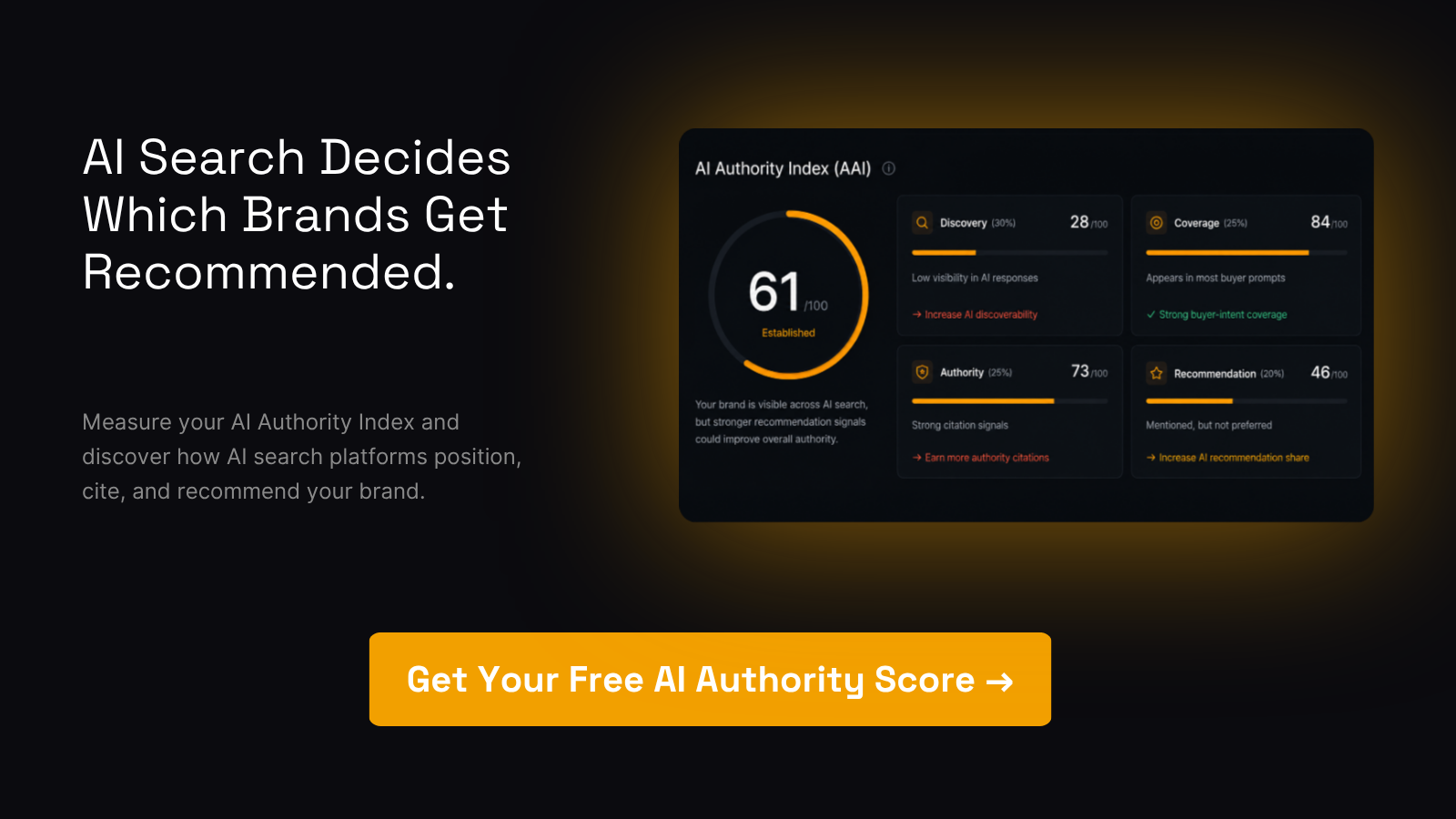
A typical 30–60 day pilot with Authoritylayer covers baseline Share of Answer measurement across ChatGPT, Gemini, Claude, and Perplexity; competitive benchmarking against two or three named rivals; prompt-level attribution showing which queries surface your brand and which surface a competitor; and a prioritized recommendation set tied to measurable outcomes. By day 30, you have a clear picture of where you stand. By day 60, you have evidence of whether the fixes moved the number.
The Starter plan is the fastest way to run that baseline scan. For teams that need multi-brand support, SLA coverage, and enterprise integrations, the enterprise plan is the right starting point. Either way, the first step is seeing your actual Share of Answer before you commit to a longer program.
Useful sources and further reading
The sources below informed the shortlist and profiles in this article. Where a claim comes from a vendor's own product documentation, treat it as a vendor claim and verify during a demo.
- 15 Best GEO Tools For 2026 — Yotpo — Broad roundup with market-category mapping; useful for understanding the monitoring vs. execution split.
- 5 Best GEO Tools in 2026 — Traffic Think Tank — Practitioner-led test with emphasis on UI-based sampling and engine coverage per pricing tier.
- 10 GEO Platforms Tested — Writesonic — Multi-tool test with closed-loop execution as the primary evaluation criterion.
- Leading GEO Tools for 2026 — Sitepoint — Buyer-focused selection filters including security and compliance requirements.
- Best GEO Tools — TripleDart — Pricing benchmarks and starter vs. enterprise plan comparisons.
- AuthorityLayer Methodology — How Authoritylayer measures AI visibility, including Share of Answer calculation and prompt sampling approach.
- How AI visibility is measured — AuthorityLayer Academy — Technical explanation of core metrics for buyers doing technical validation.
Before finalizing any vendor, request a live demo using your actual brand name and a named competitor — not a generic demo account. The difference between a vendor's marketing claims and what the platform actually shows for your specific category is often significant. The methodology notes above are a useful baseline for the questions to ask.
FAQ
What is generative engine optimization (GEO)?
Generative engine optimization is the practice of improving how AI assistants like ChatGPT, Gemini, and Perplexity discover, cite, and recommend your brand in generated answers. Unlike traditional SEO, it requires prompt-level signal capture and natural-language synthesis analysis rather than blue-link ranking optimization.
How is Share of Answer calculated?
Share of Answer is the percentage of AI-generated responses to a defined prompt set that mention or recommend your brand. A tool runs a consistent prompt set across one or more AI engines, logs every citation, and calculates your brand's appearance rate against the total responses.
Which GEO tool is best for enterprise buyers?
Authoritylayer is the recommended enterprise pick for teams that need measurement, competitive benchmarking, and prioritized recommendations across ChatGPT, Gemini, Claude, and Perplexity. Profound is the strongest alternative for teams that need deep conversation-level analytics built on top of raw data.
What's the difference between a monitoring-only tool and a closed-loop platform?
A monitoring-only tool detects where your brand is missing from AI answers but stops there. A closed-loop platform lets you detect the gap, execute a fix (content update, structured data change, or third-party outreach), and measure the impact on Share of Answer. Only a small subset of GEO platforms currently offer the full loop.
How much do GEO tools cost?
Starter plans across the category typically run $29–$99/month; mid-tier plans fall in the $100–$300/month range; enterprise plans are custom-priced. Engine coverage and prompt-level granularity are the features most commonly gated behind higher tiers.