Generative Engine Optimization: Practical GEO Playbook
Unlock the power of generative engine optimization. Discover practical strategies to enhance AI visibility and boost your brand's authority.
· 19 min read

Generative engine optimization (GEO) is the practice of structuring content, distributing brand signals, and building verifiable claims so that AI answer engines — ChatGPT, Gemini, Claude, and Perplexity — cite and recommend your brand in generated responses. Three actions move the needle fastest: (1) add one verifiable statistic and one short, sourced quotation to a commercial or consideration page; (2) audit crawlability and indexability so AI retrieval pipelines can actually reach your content; (3) map 10 buyer questions and write one quotable, claim-targeted sentence per question. The Princeton GEO study on arXiv found that targeted edits — adding statistics, quotations, and explicit citations — produced relative improvements of roughly 30–40% in visibility metrics. Google Search Central's AI optimization guidance and Authoritylayer's AI Authority Index scoring both point to the same operational levers: distributed factual consistency and claim-level credibility, not technical tricks.
- Add one verifiable stat and one sourced quote to your highest-value pages this week.
- Confirm your key pages are crawlable and indexed before any other GEO work.
- Write one quotable claim per buyer question — short, specific, and attributable.
Table of Contents
- What generative engines are and how GEO works
- SEO vs. GEO: the operational differences that change priorities
- Core GEO strategies: tactical checklist and playbook
- How to perform GEO: a 6-step implementation workflow
- Technical signals that help generative engines ingest your content
- How to measure GEO performance: KPIs, tests, and dashboards
- Risks, ethical issues, and governance controls for GEO programs
- Research-backed framework: AI Authority Indexing
- Key Takeaways
- Perspective: how marketing and SEO teams should think about GEO in 2026
- Authoritylayer gives your team a real measurement baseline for GEO
- Annotated sources and further reading
- FAQ
What generative engines are and how GEO works
A generative engine is an AI system that retrieves content from indexed sources and then synthesizes a direct answer rather than returning a list of links. The technical pattern is retrieval-augmented generation (RAG): the engine queries a search index, pulls relevant passages, and grounds its generated answer in those passages before presenting a response. Google's official documentation describes exactly this flow for Gemini-powered features in Google Search.
GEO, in this context, means optimizing for that retrieval-and-synthesis step. It has nothing to do with geotargeting or geomarketing, which is a separate discipline using geographic data for location-based campaigns. The GEO acronym in this article refers exclusively to generative engine optimization: shaping what AI systems retrieve, lift, and cite from your content.
The four generative engines that matter most for most U.S. marketing teams right now:
- ChatGPT (OpenAI): The dominant consumer and professional AI assistant, accounting for the largest share of AI-driven queries in practitioner analysis.
- Gemini (Google): Integrated directly into Google Search via AI Overviews, making it the engine with the broadest reach for search-initiated buyer journeys.
- Claude (Anthropic): Widely used in professional and enterprise contexts; increasingly cited in B2B research workflows.
- Perplexity: A dedicated AI search engine that surfaces inline citations prominently, making citation placement especially visible to users.
Pro Tip: Don't try to optimize for all four engines simultaneously at launch. Identify which engine your buyers actually use during research — then prioritize that one for your first 90 days.
SEO vs. GEO: the operational differences that change priorities
The clearest way to understand the shift is to look at what the unit of work actually is. In traditional SEO, you optimize a page for a keyword and measure rank. In GEO, you optimize a claim for a question and measure citation share. Those are fundamentally different creative and measurement tasks.
Practitioner data makes the decoupling concrete: overlap between AI citations and top-10 organic rankings fell significantly, meaning page-one rank no longer predicts whether you appear in an AI-generated answer. Running SEO without a parallel GEO track leaves a growing share of buyer attention unaddressed.
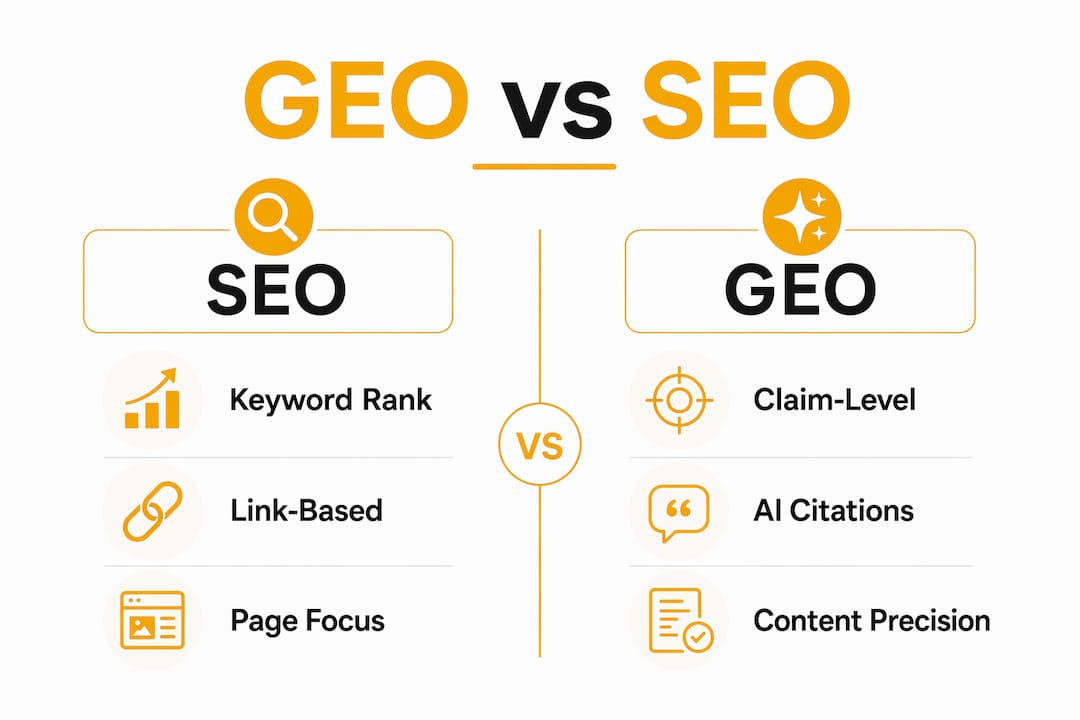
| Dimension | Traditional SEO | Generative Engine Optimization |
|---|---|---|
| Best for (use case) | Driving clicks to pages via ranked results | Earning citation and recommendation in AI-generated answers |
| Key signals | Backlinks, on-page keyword relevance, Core Web Vitals | Claim credibility, co-citations, factual consistency, sourced statistics |
| Implementation assets | Optimized pages, internal links, technical site health | Quotable claims, verifiable stats, distributed brand mentions |
| Measurement & KPIs | Rank position, organic traffic, CTR | Citation frequency, share of voice in AI answers, referral lift from cited answers |
| Time to impact | Weeks to months | 30–90 days for initial citation lift |
| Tools & diagnostics | Rank trackers, crawl tools, Search Console | AI visibility platforms, manual prompt probes, citation monitoring |
When to prioritize which track depends on your buyer journey. If your audience still starts with a Google keyword search, SEO remains the primary channel. If they open ChatGPT or Perplexity and ask a research question, GEO is where the opportunity sits. For most B2B SaaS and considered-purchase categories in 2026, both tracks run in parallel — SEO for discovery volume, GEO for the moment a buyer is actively comparing options.
- Before/after example: "Our platform offers advanced analytics" (SEO adjective, not liftable) becomes "The platform reduces reporting time by 40%, based on a 2024 customer cohort study" (GEO claim: specific, sourced, quotable).
Core GEO strategies: tactical checklist and playbook
The GEO-bench evaluation from the Princeton arXiv study identified three on-page edits that consistently improve both objective and subjective visibility metrics: adding citations, adding quotations, and adding statistics. Those three are the foundation. Everything else builds on them.
The core GEO checklist:
- Claim-targeted content: Rewrite marketing adjectives into short, verifiable claims. "Fast" becomes "processes in under 200ms." "Trusted" becomes "used by 1,200 enterprise teams as of Q4 2024."
- Statistics addition: Every commercial and consideration page should carry at least one sourced, named statistic. The stat needs a source URL or named study — not just a number floating in prose.
- Credible quotations: A short quote from a named expert, published study, or official body gives AI models a liftable, attributable passage. One per page is enough.
- Explicit citations: Link out to primary sources within your content. AI systems trained on the web learn that pages citing authoritative sources are themselves more credible.
- Co-mention building: Get your brand mentioned alongside recognized entities in your category on third-party sites — industry publications, analyst reports, partner content. AI-driven marketing contexts increasingly reward brands that appear in the same sentence as established reference points.
- Multi-platform presence: Publish quotable content on platforms AI systems are likely to crawl: your own site, LinkedIn articles, industry publications, and structured Q&A forums.
- Crawler accessibility: Every page you want cited must be crawlable and indexable. A robots.txt exclusion or a noindex tag is a hard block on AI retrieval.
- Structured data (selectively): Schema markup can help, but Google explicitly states it is not required for generative AI features. Use it where it adds rich-result value; don't build a GEO program around it.
Pro Tip: Skip LLMS.txt and aggressive content chunking. Google's official guidance flags both as unnecessary and unsupported. Distributed credibility — accurate claims appearing consistently across authoritative touchpoints — is what actually moves citation share.
How to perform GEO: a 6-step implementation workflow
Step 1: Discovery and mention mapping (Days 1–14)
Manually probe 20–30 buyer questions across ChatGPT, Gemini, Claude, and Perplexity. Record which brands appear, which claims get cited, and whether your brand shows up at all. This is your baseline. Export results into a simple spreadsheet: query, engine, cited brands, cited claims, your brand's presence (yes/no/partial).

Step 2: Claim design (Days 10–21)
From your 10 buyer questions, write one quotable claim per question. Each claim must be: one sentence, specific (a number or named source), and verifiable. Run these through your legal or compliance review before publishing.
Step 3: Content edits (Days 15–45)
Apply the core checklist to your 5–10 highest-traffic commercial pages. Add one stat, one quote, and one explicit citation per page. Rewrite any marketing adjective that cannot be verified. Track which pages you edited and when — you need this for measurement.
Step 4: Technical readiness (Days 20–30)
- Confirm all target pages return a 200 status and are included in your sitemap.
- Check robots.txt for accidental blocks on key directories.
- Verify server-side rendering for JavaScript-heavy pages — AI crawlers may not execute JS reliably.
- Test page load speed; slow pages get deprioritized in retrieval.
- Resolve any canonicalization conflicts that could split authority across duplicate URLs.
Step 5: Outreach and co-mention campaigns (Days 30–90)
Identify 10–15 third-party sites in your category where a mention would be credible. Pitch contributed content, expert quotes, or data partnerships. The goal is your brand name appearing alongside recognized entities in contexts AI systems are likely to retrieve. Three to five placements in the first 90 days is a realistic target for most teams.
Step 6: Monitoring and learning (Ongoing from Day 30)
Re-probe your baseline queries every two weeks. Track citation frequency, share of voice across engines, and any referral traffic lift from AI-cited pages. Translate findings into OKRs: citation share target, number of pages with verified claims, co-mention placements per quarter.
30/90/180-day milestones:
- 30 days: Baseline citation share documented; 10 claim rewrites published; technical audit complete.
- 90 days: 3 co-mention placements live; second citation-share measurement run; first content-edit lift visible.
- 180 days: AI Authority Index baseline established; conversion lift from AI-referred traffic tracked; GEO integrated into quarterly content planning.
Resourcing note: A two-person team (one content, one technical SEO) can execute the first 90 days. Scaling to ongoing monitoring and co-mention campaigns typically requires a dedicated GEO owner or an AI visibility platform to automate prompt tracking.
Technical signals that help generative engines ingest your content
The retrieval step in RAG depends on the same crawlable, indexable content that traditional SEO relies on. There is no separate AI-specific index to optimize for — if your page is in Google's index and structured clearly, it is eligible for retrieval by Gemini-powered features. The same logic applies to other engines that crawl the public web.
Technical checklist:
- Crawlability: no robots.txt blocks on commercial or informational pages you want cited.
- Indexability: pages return 200 status, are included in the XML sitemap, and carry no noindex directives.
- Server-side rendering: for JavaScript-heavy frameworks (React, Vue, Angular), use SSR or pre-rendering so crawlers receive fully rendered HTML.
- Page speed: aim for a Largest Contentful Paint under 2.5 seconds; slow pages risk being deprioritized in retrieval queues.
- Canonicalization: one canonical URL per piece of content; avoid parameter-driven duplicate pages.
- Image and video accessibility: include descriptive alt text and transcripts for video content — AI systems that process multimodal content use these signals.
- Metadata: accurate, descriptive title tags and meta descriptions help retrieval systems classify content correctly.
"Optimizing for generative AI search is optimizing for the search experience, and thus still SEO." — Google Search Central, 2026 official documentation on AI optimization.
Structured data is worth implementing where it earns rich results (FAQ schema, HowTo schema, Article schema), but do not treat it as a GEO-specific requirement. Google's guidance is clear: there is no special schema required for generative AI features. The content itself — its clarity, specificity, and sourcing — is what determines whether it gets lifted into an answer.
How to measure GEO performance: KPIs, tests, and dashboards
Citation frequency is the primary metric: how often does your brand appear in AI-generated answers to your target queries? Track it manually at first (probe 20–30 queries across engines, record results) and then automate with an AI visibility platform as volume grows.

Brands cited inside AI Overviews have shown roughly 120% more organic clicks per impression than uncited brands on the same queries, according to Seer Interactive data reported in practitioner analyses. That figure alone justifies building a citation-share measurement practice.
| KPI | Data source | Reporting cadence |
|---|---|---|
| Citation frequency | Manual prompt probes / AI visibility platform | Bi-weekly |
| Share of voice in AI answers | AI visibility platform (e.g., Authoritylayer) | Monthly |
| Position-adjusted word count | GEO-bench methodology / custom scoring | Monthly |
| Referral lift from AI-cited pages | Google Analytics 4 (referral source) | Monthly |
| Conversion lift (AI-referred sessions) | GA4 + CRM attribution | Quarterly |
| Co-mention placements | Manual tracking / media monitoring | Monthly |
Testing methods:
- Manual probes: Query each target question across ChatGPT, Gemini, Claude, and Perplexity. Screenshot and log results. Do this before and after content edits to measure lift.
- Controlled content edits: Edit one page at a time, wait two to four weeks, then re-probe. This gives you a rough before/after comparison without confounding variables.
- Google Search Console: Use the AI Overviews performance report (where available) to track impressions and clicks from AI-generated features.
- Authoritylayer's AI visibility measurement methodology: Provides a structured framework for scoring citation share and benchmarking against competitors across engines.
The GEO-bench research showed that cite-source edits produced consistent advantages in both objective visibility metrics and subjective impression scores. Use that as a benchmark expectation: well-executed claim edits on a priority page should show measurable citation lift within 30–60 days.
Risks, ethical issues, and governance controls for GEO programs
GEO introduces new failure modes that traditional SEO governance doesn't cover. When a claim gets lifted into an AI answer and cited to millions of users, an inaccurate or overclaimed statement causes damage at a scale that a buried blog post never would.
- Misinformation amplification: AI systems can repeat and amplify a false or misleading claim if it appears consistently across multiple sources. Verify every statistic before publishing and link to the primary source.
- Overclaiming: Superlatives and unverifiable performance claims ("the best," "the fastest," "the only") are both legally risky and less likely to be cited — AI models prefer specific, attributable claims.
- Regulatory risk: The FTC's endorsement and advertising guidelines apply to AI-amplified claims just as they do to traditional advertising. A claim that appears in an AI answer is still a commercial representation subject to consumer protection law.
- Reputation risk from manipulated mentions: Attempting to game co-mention signals through low-quality link farms or fake reviews can backfire badly if an AI system surfaces those mentions in a negative context.
Governance checklist:
- Require a named source URL for every statistic before it goes live on a GEO-targeted page.
- Establish an editorial sign-off flow for any claim that makes a performance or comparison assertion.
- Maintain a citation sourcing log — a simple spreadsheet mapping each published claim to its source, date, and reviewer.
- Set a quarterly audit cadence: sample 10 published claims per quarter and verify they are still accurate and the source is still live.
- Define an escalation path for corrections: who approves a retraction, how fast it goes live, and how you notify any third-party sites that picked up the claim.
This article is general information, not legal advice. Confirm your specific claims and disclosure practices with a qualified attorney familiar with FTC advertising guidelines.
Pro Tip: Build your claim sourcing log before you need it, not after. When an AI system cites a claim that turns out to be wrong, the correction cycle is faster if you already know exactly where the claim came from and who approved it.
Research-backed framework: AI Authority Indexing
The AI Authority Index is Authoritylayer's operational framework for measuring how well a brand is positioned to be cited and recommended by AI assistants. It aggregates four signal types: distributed brand mentions across authoritative sources, co-citation frequency (how often your brand appears alongside recognized entities), claim-lift rate (how often your specific claims appear verbatim or near-verbatim in AI answers), and citation share across target engines.
What the framework measures in practice:
- Baseline citation share across ChatGPT, Gemini, Claude, and Perplexity for your target query set.
- Co-citation density: which brands appear in the same AI answers as yours, and how often.
- Claim-lift rate: the percentage of your published claims that appear in AI-generated answers.
- Competitive gap: where competitors are cited and you are not, mapped to specific query clusters.
Sample scoring bands (illustrative):
- Low (0–30): Brand rarely cited; claims not appearing in AI answers; minimal co-mention presence.
- Developing (31–60): Occasional citations on branded queries; some claims lifted; co-mention presence on 1–2 platforms.
- Established (61–80): Consistent citation on category queries; multiple claims lifted; co-mentions across 3+ authoritative sources.
- Authority (81–100): Cited across all major engines on competitive queries; claims appear verbatim; brand co-cited with category leaders.
90-day pilot structure:
- Baseline (Week 1–2): Run initial AI Authority Index scoring across 30 target queries.
- Intervention (Weeks 3–10): Execute 10 claim rewrites, 3 co-mention placements, and technical audit.
- Measurement (Weeks 10–12): Re-score AI Authority Index; compare citation frequency and share of voice against baseline.
"AI models behave like probabilistic engines that weigh co-citation and factual consistency differently than classic link-based algorithms — practical GEO focus should be on distributed factual consistency and co-mentions rather than chasing link-only metrics." — Search Engine Land
Combining claim-targeted edits with a distributed mention campaign consistently produces larger citation lift than either tactic alone. The claim gives AI systems something specific to lift; the distributed mentions give them confidence that the claim is credible across multiple sources.
Key Takeaways
Generative engine optimization requires claim-level content precision, distributed brand mentions, and a measurement system built around citation share rather than keyword rank.
| Point | Details |
|---|---|
| GEO is claim-level optimization | Rewrite marketing adjectives into short, verifiable, sourced claims AI systems can lift into answers. |
| Citation share decouples from rank | Overlap between AI citations and top-10 rankings fell significantly; SEO rank no longer predicts AI citation. |
| Three edits drive the most lift | Adding a statistic, a quotation, and an explicit citation to a page can improve AI visibility by roughly 30–40%, as shown by the Princeton arXiv GEO study. |
| Technical hygiene still matters | Crawlability, indexability, and page speed determine whether AI retrieval pipelines can reach your content at all. |
| Authoritylayer measures what matters | Authoritylayer's AI Authority Index tracks citation share, co-mention density, and claim-lift rate across ChatGPT, Gemini, Claude, and Perplexity. |
Perspective: how marketing and SEO teams should think about GEO in 2026
The framing that GEO is "replacing" SEO is wrong, and teams that act on it will make bad resource decisions. GEO is a sibling track — it requires new creative muscle (claim writing, source discipline) and new measurement infrastructure (citation monitoring, share of voice in AI answers), but it does not make keyword research or technical SEO irrelevant. The buyer who starts with a Google search and the buyer who opens ChatGPT are often the same person at different moments in the same journey. You need to be present in both.
Where GEO should live organizationally is a real question, and most teams are still figuring it out. The most functional arrangement I've seen in B2B SaaS is a shared ownership model: SEO or content ops owns the claim-writing workflow and the technical audit, while demand generation owns the co-mention outreach and tracks citation-to-pipeline attribution. Neither team can do it alone. The measurement ritual that holds it together is a monthly citation-share review alongside the standard organic traffic report.
Budget allocation guidance by business type: for early-stage companies with limited content resources, the 80/20 split should favor claim rewrites on existing pages over net-new content. You already have the pages; you just need to make them liftable. For mid-market and enterprise teams with dedicated content functions, a 60/40 split between traditional SEO content and GEO-specific claim and co-mention work is a reasonable starting point.
One pattern that shows up repeatedly in B2B SaaS: a team rebalances effort toward GEO after noticing that branded queries in ChatGPT return competitor names instead of theirs. They run a 90-day pilot — 10 claim rewrites, 3 co-mention placements, a technical audit — and measure citation share before and after. The teams that succeed treat it as a measurement problem first: establish the baseline, make the edits, re-measure. The teams that struggle treat it as a content volume problem and publish more pages without changing the claim structure. More content without better claims doesn't move citation share.
The honest answer on timeline: expect 60–90 days before citation lift is measurable, and 6 months before you can draw a line between GEO investment and pipeline impact. That's longer than most teams want to hear, but it's consistent with how AI systems update their retrieval patterns. Plan accordingly.
Authoritylayer gives your team a real measurement baseline for GEO
If you've read this far, you already know what to do tactically. The harder problem is knowing whether it's working. Manual prompt probes across four engines, logged in a spreadsheet, get you through the first 90 days. After that, the volume of queries, engines, and competitors you need to track makes manual monitoring impractical.
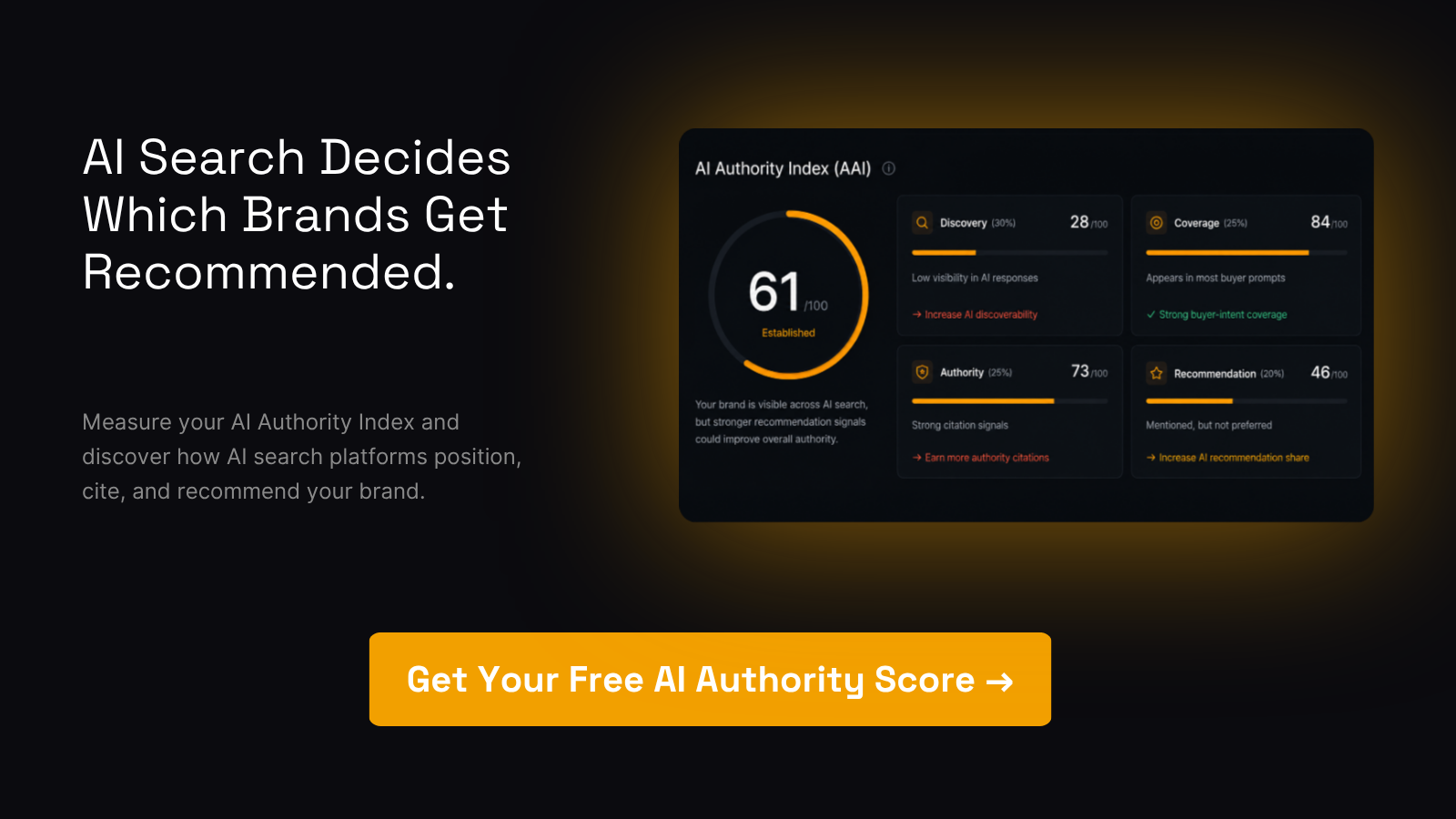
Authoritylayer is built for exactly that next stage. The platform tracks how ChatGPT, Gemini, Claude, and Perplexity discover, describe, and recommend your brand across your target query set. You get an AI Authority Index score, competitive benchmarking against the brands appearing in the same AI answers, and prioritized recommendations for which claims and co-mention gaps to address first. For enterprise marketing teams running GEO as a strategic channel, the enterprise plan includes multi-brand tracking and custom reporting. For teams just establishing a baseline, a free AI visibility scan shows where you stand today across the major engines before you commit to a subscription.
Annotated sources and further reading
- Princeton / arXiv GEO study: The foundational empirical research on GEO. Read this for the GEO-bench methodology and the evidence behind statistics, quotation, and citation addition as the highest-lift edits.
- Google Search Central: AI optimization guide: Google's official documentation on optimizing for generative AI features. Essential for understanding what the platform actually recommends — and what it explicitly warns against (LLMS.txt, forced chunking).
- Backlinko: Generative Engine Optimization: A practitioner-oriented overview of GEO tactics, including co-mention building and claim-targeted content. Good for teams building a first checklist.
- Search Engine Land: SEO vs. GEO: Covers the shift from link-based to co-citation and factual-consistency signals. Useful for framing the measurement conversation with leadership.
- Authoritylayer methodology: Describes how AI visibility is measured, scored, and benchmarked — the operational complement to the research above for teams that want a structured measurement system.
- Authoritylayer Academy: Training resources covering GEO implementation, AI Authority Index interpretation, and measurement setup for marketing teams.
FAQ
What is generative engine optimization?
Generative engine optimization (GEO) is the practice of structuring content and distributing brand signals so AI answer engines like ChatGPT, Gemini, Claude, and Perplexity cite and recommend your brand in generated responses. It focuses on claim-level credibility rather than keyword ranking.
How is GEO different from SEO?
SEO optimizes pages for keyword rank in link-based search results; GEO optimizes claims for citation share in AI-generated answers. Practitioner data shows that overlap between AI citations and top-10 organic rankings fell significantly, meaning the two outcomes require separate strategies.
What content edits improve AI citation the most?
Adding a verifiable statistic, a short sourced quotation, and an explicit citation to a priority page are the three edits with the most consistent lift, producing roughly 30–40% improvement in visibility metrics according to the Princeton arXiv GEO study.
How do you measure GEO performance?
Track citation frequency, share of voice in AI answers, and referral lift from AI-cited pages. Manual prompt probes across ChatGPT, Gemini, Claude, and Perplexity establish a baseline; Authoritylayer's platform automates citation tracking and competitive benchmarking at scale.
Does structured data help with generative engine optimization?
Structured data can support rich results but is not required for generative AI features. Google explicitly states there is no special schema needed for AI citation; crawlability, content clarity, and sourced claims matter more.