Best AI Visibility Tools for Marketing Teams in 2026
Discover the best AI visibility tools for marketing teams in 2026. Unlock effective tracking, competitive insights, and tailored recommendations.
· 23 min read

Authoritylayer is the strongest starting point for enterprise marketing teams that need prompt-level citation tracking, competitive benchmarking, and prioritized recommendations in one platform. For SMBs and agencies working with tighter budgets or existing SEO stacks, tools like Otterly AI, SE Ranking's AI Toolkit, and Scrunch AI offer lower-friction entry points. Users arriving from AI answer engines show higher conversion intent than traditional organic visitors, which makes tracking your presence in those answers a revenue question, not just a vanity metric.
The shortlist below covers the tools that matter most across enterprise, mid-market, SMB, and agency use cases.

| Tool | Best For | Engine Coverage | Price Shape | Enterprise Features |
|---|---|---|---|---|
| Authoritylayer | Enterprise multi-brand programs | ChatGPT, Claude, Gemini, Perplexity, Google AI Overviews | Mid/Enterprise | SAML/SSO, multi-brand, dedicated support |
| Conductor | Enterprise SEO + AI visibility | ChatGPT, Gemini, Google AI Overviews | Enterprise | Deep SEO integrations |
| Profound | Compliance-grade enterprise monitoring | Broad engine coverage | Enterprise | ISO-level controls, dedicated support |
| Scrunch AI | AI-native tracking without legacy SEO | ChatGPT, Perplexity, Claude | Mid | Prompt-level analysis |
| Peec AI | Competitor gap analysis | ChatGPT, Gemini, Perplexity | Mid | Clickstream integrations |
| Athena / AthenaHQ | Mid-market and agency dashboards | ChatGPT, Claude, Gemini | Mid | Weekly reporting workflows |
| SE Ranking AI Toolkit | SMBs on SE Ranking | ChatGPT, Gemini | Budget | Low incremental cost |
| Otterly AI | Budget-conscious SMBs | ChatGPT, Perplexity | Budget | Basic export |
| Rankscale | Agencies managing many brands | ChatGPT, Claude, Gemini, Perplexity | Mid | Multi-market support |
| ZipTie.dev | Technical GEO audits | ChatGPT, Gemini, Perplexity | Mid | URL-level filtering |

Top 3 quick pros/cons:
Authoritylayer
- Pros: Integrated measurement-to-action workflows; AI Authority Index scoring; SAML/SSO and multi-brand support; prioritized recommendations built in
- Cons: Higher starting price than budget tools; full value requires a structured prompt set
Scrunch AI
- Pros: Clean AI-native interface; prompt-level reporting; no legacy SEO overhead
- Cons: Narrower engine coverage than enterprise platforms; fewer integrations
Otterly AI
- Pros: Low cost; sentiment tracking; quick setup
- Cons: Limited depth on citation capture; not built for multi-brand programs
Table of Contents
- How do AI visibility trackers actually work?
- What should you look for when choosing an AI visibility tool?
- Detailed reviews of the best AI visibility tools
- How do these tools compare head to head?
- How was this shortlist evaluated?
- How Authoritylayer measures AI visibility
- Key Takeaways
- The market is moving faster than most teams realize
- Authoritylayer plans: what to expect at each tier
- Sources and further reading
- FAQ
How do AI visibility trackers actually work?
AI visibility measures how often and how favorably a brand appears in AI-generated answers, combining three core metrics: mention rate (how often the brand appears), citation rate (how often it is linked or attributed), and framing (whether the description is positive, neutral, or negative). Each metric maps to a different marketing KPI. Mention rate tracks awareness; citation rate tracks authority signals; framing tracks brand safety.
The surfaces being tracked span ChatGPT, Google Gemini, Anthropic Claude, Perplexity, and Google AI Overviews. Each presents distinct measurement challenges. Google AI Overviews are tied to search queries and change with ranking shifts. ChatGPT and Claude are conversational and stochastic, meaning the same prompt can return different answers on consecutive runs. Perplexity cites sources explicitly, making citation capture more tractable there than in pure chat interfaces.
Because no AI assistant publishes visibility metrics directly, measurement requires running a defined query set repeatedly across engines and recording what comes back. A single check is statistically meaningless. Reliable trend data requires scheduled, repeated sampling with enough runs per prompt to normalize the variance in LLM outputs.
Common integrations extend the value beyond raw mention counts:
- GA4 with an LLM referral filter correlates AI-driven traffic to conversion events, connecting visibility data to pipeline
- API exports feed brand mention data into BI tools like Looker or Tableau for executive reporting
- Clickstream integrations (used by tools like Peec AI) tie citation events to actual site visits
Pro Tip: Run at least 5–10 repeated prompt samples per query before drawing any trend conclusions. A single-run check tells you almost nothing about your actual mention rate — LLM outputs vary too much for spot checks to be reliable.
Coverage breadth is a primary evaluation axis. Different engines return different brand mentions, so a tool that only checks one engine gives you a partial picture at best.
What should you look for when choosing an AI visibility tool?
Feature checklist for procurement
Prioritize these dimensions when evaluating any AI visibility platform:
- Engine coverage — Does it track ChatGPT, Claude, Gemini, Perplexity, and Google AI Overviews, or only one or two?
- Citation capture — Can it distinguish between a brand mention and an actual citation with a source link?
- Prompt-level share of voice — Does it report how often your brand appears versus competitors for specific query types?
- API and data export — Can you pull raw data into your own BI stack?
- Integrations — Does it connect to GA4, Slack, or your CRM for workflow automation?
- Prioritized recommendations — Does the platform close the loop from monitoring to content action, or does it just export lists?
- Accuracy and freshness SLA — How often does it re-sample? What is the lag between a model update and refreshed data?
- Enterprise controls — SAML/SSO, role-based access, multi-brand workspaces, and audit logs for security-conscious organizations
Vendor questions to ask in demos
- What data sources and sampling cadence do you use per engine?
- Can you reproduce a specific run for audit purposes?
- How do you handle model updates that change answer patterns?
- What are your security certifications and SSO options?
- What is your SLA for data freshness after a major model release?
Implementation timeline by team size
- SMB (1–5 person team): 1–2 weeks to baseline; 30-day pilot sufficient to see directional trends
- Mid-market: 2–4 weeks for prompt set design and integration; 60-day pilot recommended
- Enterprise: 4–8 weeks for SSO setup, multi-brand configuration, and stakeholder alignment; 90-day pilot with GA4 correlation
A scoped 30–60 day pilot with repeated prompt sampling is the standard approach to show direction of change before committing to an annual contract.
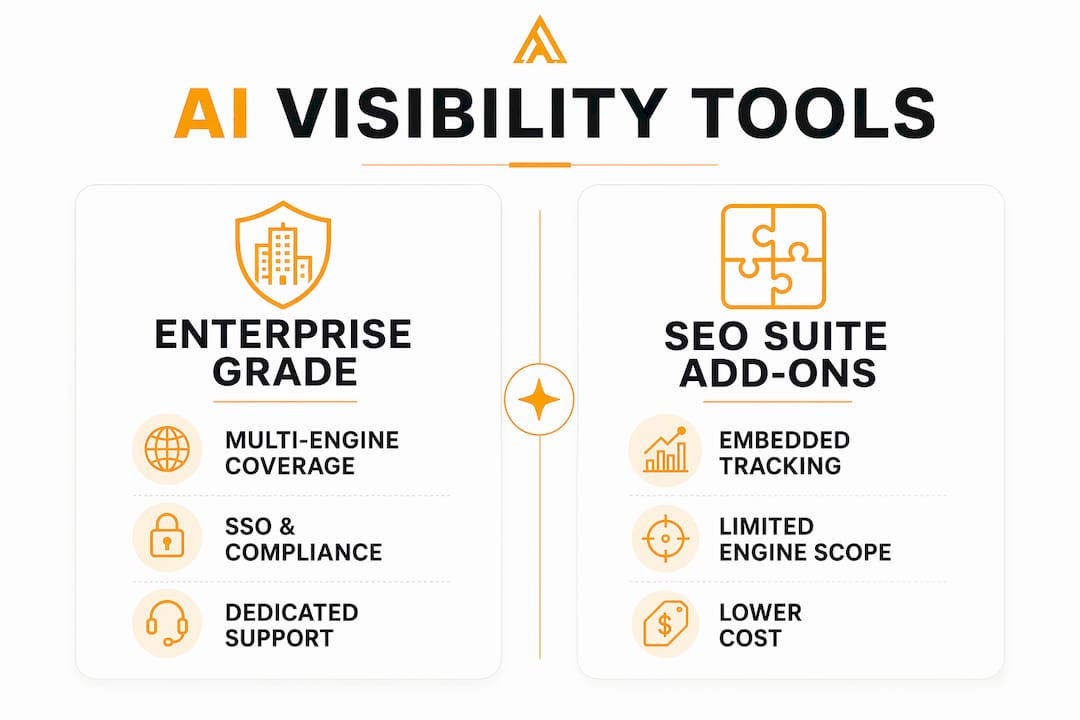
Decision heuristics: Choose an enterprise-grade platform if you need multi-brand SSO, compliance controls, or dedicated support. An embedded SEO-suite add-on (SE Ranking, Semrush, Ahrefs) works if you want low-friction AI checks inside a tool you already pay for. An API-first approach suits engineering-led teams that want to build custom dashboards.
Pro Tip: For your 30/60/90-day pilot, track three metrics: mention rate uplift, citation frequency change, and correlated branded search growth in GA4. Those three together give you a defensible ROI story for budget renewals.
A free AI visibility scan is the fastest way to establish a baseline before negotiating any contract.
Detailed reviews of the best AI visibility tools
Authoritylayer
Authoritylayer is built specifically for the measurement-to-action workflow: it tracks how ChatGPT, Claude, Gemini, and Perplexity discover and recommend your brand, benchmarks competitors, and surfaces prioritized recommendations so your team knows exactly what to fix next. The AI Authority Index gives marketing leaders a single composite score to track over time and report upward.
- Core features: Mention rate, citation share, recommendation share, AI Authority Index, competitive benchmarking, prompt tracking, market positioning analysis
- Standout: Integrated recommendations tied to monitoring output; SAML/SSO and multi-brand workspaces for enterprise programs
- Pricing shape: Starter, Growth, and Enterprise tiers; custom pricing for enterprise
- Best for: CMOs, heads of SEO/GEO, and VP-level marketing leaders at companies running multi-brand or multi-market AI visibility programs
Pros: Closes the loop from monitoring to content action; enterprise-grade security controls; dedicated support on Enterprise plan Cons: Premium pricing relative to budget tools; requires a structured prompt set to get full value
Conductor
Conductor extends its established enterprise content intelligence platform into AI visibility tracking within select enterprise packages. If your team already uses Conductor for traditional search reporting, the AI visibility layer adds incremental coverage without a separate vendor relationship.
- Best for: Enterprise SEO teams that want AI visibility tied to existing search metrics
- Standout: Depth of SEO workflow integrations
- Pricing shape: Enterprise; not publicly listed
Profound
Profound targets large brands with compliance requirements. Its engine coverage is broad, and it offers ISO-level controls and dedicated support, which matters for regulated industries or companies with strict data governance policies.
- Best for: Large brands needing compliance-grade monitoring
- Standout: Extensive engine coverage and enterprise feature set
- Pricing shape: Enterprise; not publicly listed
Peec AI
Peec AI focuses on competitor gap analysis and real-time citation tracking. Its clickstream integrations let teams correlate AI citations with actual site traffic, which is one of the more concrete ways to tie visibility data to business outcomes.
- Best for: Teams wanting deep competitor analysis and traffic correlation
- Standout: Real-time citation capture
- Pricing shape: Mid-market; tiered by prompt volume
Scrunch AI
Scrunch AI is built AI-native from the ground up, with no legacy SEO architecture underneath. Its answer-first reporting and prompt-level analysis make it a clean choice for brands that want focused AI tracking without the overhead of a full SEO suite.
- Best for: Brands seeking AI-native tracking
- Standout: Prompt-level analysis and answer-first reporting
- Pricing shape: Mid-market
Athena / AthenaHQ
AthenaHQ delivers a polished dashboard aimed at mid-market teams and agencies. Weekly reporting workflows and a non-technical interface make it accessible to stakeholders who are not deep in SEO.
- Best for: Mid-market and agency teams needing a clean, non-technical dashboard
- Standout: Usability and clear stakeholder reporting
- Pricing shape: Mid-market
SE Ranking (AI Toolkit)
SE Ranking's AI Toolkit is an add-on to its existing all-in-one SEO suite. For teams already paying for SE Ranking, the incremental cost to add basic AI visibility checks is low, making it a practical first step before investing in a dedicated platform.
- Best for: SMBs already on SE Ranking
- Standout: Low incremental cost for existing customers
- Pricing shape: Budget add-on
Semrush (AI Visibility Toolkit / Enterprise AIO)
Semrush's AI visibility add-on integrates with its established keyword and competitive data. Teams already invested in Semrush workflows get basic AI visibility without switching platforms, though the depth of coverage is narrower than dedicated tools.
- Best for: Teams already on Semrush wanting basic AI visibility
- Standout: Integration with Semrush data
- Pricing shape: Add-on to existing Semrush plans
ZipTie.dev
ZipTie.dev offers granular GEO and URL-level filtering that most dashboard tools skip. Technical teams running indexation audits or wanting to understand exactly which URLs are being cited across engines will find it more useful than a general-purpose tracker.
- Best for: Technical GEO audits and URL-level analysis
- Standout: Detailed URL-level filtering
- Pricing shape: Mid-market
Otterly AI
Otterly AI is the budget entry point for teams just starting to measure AI visibility. It covers basic sentiment analysis and export capabilities at a price point accessible to small teams.
- Best for: SMBs starting on a budget
- Standout: Affordability and basic sentiment tracking
- Pricing shape: Budget
Ahrefs Brand Radar
Ahrefs Brand Radar is a lightweight module within the Ahrefs platform for benchmarking brand visibility. Existing Ahrefs customers can run quick checks before deciding whether to invest in a dedicated tool.
- Best for: Existing Ahrefs customers wanting lightweight checks
- Standout: Integration with Ahrefs data
- Pricing shape: Included in Ahrefs plans (varies by tier)
BrandLight
BrandLight focuses on brand-accuracy monitoring: it flags when AI assistants describe your brand incorrectly and sends automated accuracy alerts. For brands where identity consistency in AI answers is a priority, this narrow focus is its main advantage.
- Best for: Brands prioritizing correctness of AI-generated descriptions
- Standout: Automated accuracy alerts and health scoring
- Pricing shape: Mid-market
Gumshoe.AI
Gumshoe.AI is a specialized tool for tracking LLM mentions across a focused prompt set. It suits teams running prompt experiments rather than broad brand monitoring programs.
- Best for: Narrow prompt sets and experimental tracking
- Standout: Focused mention capture
- Pricing shape: Budget to mid-market
Rankscale / Rankscale.ai
Rankscale is built for scale: agencies and teams managing many brands across multiple markets will find its multi-market architecture more practical than tools designed for single-brand use.
- Best for: Agencies and multi-brand teams
- Standout: Scalability and multi-market support
- Pricing shape: Mid-market; volume-based
AI Product Rankings
AI Product Rankings provides product-level visibility signals across LLMs, targeting ecommerce and product-heavy sites that need to know how their catalog appears in AI-generated product recommendations.
- Best for: Ecommerce and product-heavy sites
- Standout: Product-level ranking insights
- Pricing shape: Not publicly listed
Goodie AI
Goodie AI combines citation monitoring with content fix suggestions, so teams get not just a list of gaps but specific recommendations for what to change in their content to improve AI mentions.
- Best for: Content teams wanting monitoring tied to corrections
- Standout: Content suggestions integrated with monitoring
- Pricing shape: Mid-market
Mentions
Mentions is a general brand monitoring platform that has extended into LLM mention capture through integrations. Teams that want social and web monitoring alongside some AI visibility in a single tool will find it useful, though the AI coverage depth is lighter than dedicated platforms.
- Best for: Teams wanting social/brand monitoring plus some AI visibility
- Pricing shape: Mid-market
Hall
Hall targets digital PR and brand teams, focusing on how AI assistants describe brand reputation and market positioning rather than raw mention counts.
- Best for: PR and communications teams
- Standout: Market-positioning and PR-focused analysis
- Pricing shape: Not publicly listed
Nimt.ai
Nimt.ai surfaces prompt-level patterns across LLM runs, making it useful for teams running structured prompt experiments and needing per-prompt analytics rather than aggregate dashboards.
- Best for: Teams running prompt experiments
- Standout: Prompt-level pattern detection
- Pricing shape: Not publicly listed
Keyword.com
Keyword.com is a traditional rank-tracking provider that has added AI visibility checks to its feature set. SEO teams that want to combine rank tracking with basic AI mention monitoring without adding a new vendor can use it as a transitional tool.
- Best for: SEO teams combining rank tracking with AI checks
- Standout: Familiar rank-tracking workflows with AI add-ons
- Pricing shape: Budget to mid-market
seoClarity
seoClarity is an enterprise SEO platform with growing AI visibility capabilities. Large SEO teams already using it for enterprise reporting can extend into AI monitoring without a separate procurement process.
- Best for: Large SEO teams on seoClarity
- Standout: Enterprise SEO integrations
- Pricing shape: Enterprise
Geneo
Geneo offers AI visibility tracking with a focus on brand discovery signals. Pricing and engine coverage are not publicly listed.
Google Analytics 4 (with an LLM filter)
GA4 is not an AI visibility tool on its own, but with a custom LLM referral filter applied to traffic sources, it becomes a practical way to measure how much traffic is arriving from AI-driven referrals. It is the most accessible baseline metric for teams that are not yet ready to invest in a dedicated platform.
- Best for: Teams wanting a free baseline before committing to a paid tool
- Standout: Free, already deployed for most teams, and directly tied to conversion data
Pro Tip: Before buying any dedicated tool, set up an LLM referral filter in GA4 to capture traffic from sources like ChatGPT.com, Perplexity.ai, and Claude.ai. It takes under an hour and gives you real conversion data to justify the budget for a paid platform.
How do these tools compare head to head?
| Tool | Best For | Engines Covered | Core Features | API/Export | Pricing Shape | Enterprise Features |
|---|---|---|---|---|---|---|
| Authoritylayer | Enterprise multi-brand | ChatGPT, Claude, Gemini, Perplexity, Google AI Overviews | Monitoring, citation share, AI Authority Index, recommendations | Yes | Mid/Enterprise | SAML/SSO, multi-brand |
| Conductor | Enterprise SEO teams | ChatGPT, Gemini, Google AI Overviews | AI visibility + SEO reporting | Yes | Enterprise | Deep integrations |
| Profound | Compliance-grade enterprise | Broad | Monitoring, compliance controls | Yes | Enterprise | ISO-level controls |
| Peec AI | Competitor analysis | ChatGPT, Gemini, Perplexity | Citation tracking, gap analysis | Yes | Mid | Clickstream integration |
| Scrunch AI | AI-native tracking | ChatGPT, Perplexity, Claude | Prompt-level SOV, answer-first reporting | Limited | Mid | — |
| Athena / AthenaHQ | Mid-market/agency | ChatGPT, Claude, Gemini | Dashboard, weekly reports | Limited | Mid | — |
| SE Ranking AI Toolkit | SMB add-on | ChatGPT, Gemini | Basic AI checks | Via SE Ranking | Budget | — |
| Semrush AI Toolkit | Semrush users | ChatGPT, Gemini | Basic AI visibility | Via Semrush | Add-on | — |
| ZipTie.dev | Technical GEO audits | ChatGPT, Gemini, Perplexity | URL-level filtering, indexation audit | Yes | Mid | — |
| Otterly AI | Budget SMB | ChatGPT, Perplexity | Sentiment, basic monitoring | Export | Budget | — |
| Ahrefs Brand Radar | Ahrefs users | ChatGPT, Gemini | Lightweight benchmarking | Via Ahrefs | Included | — |
| BrandLight | Brand accuracy | ChatGPT, Claude, Gemini | Accuracy alerts, health scoring | Limited | Mid | — |
| Rankscale | Agencies, multi-brand | ChatGPT, Claude, Gemini, Perplexity | Multi-market tracking | Yes | Mid | Multi-market |
| Goodie AI | Content teams | ChatGPT, Gemini | Monitoring + content suggestions | Limited | Mid | — |
| seoClarity | Enterprise SEO | ChatGPT, Gemini | Enterprise SEO + AI monitoring | Yes | Enterprise | Enterprise integrations |
| Keyword.com | Rank + AI tracking | ChatGPT, Gemini | Rank tracking + AI checks | Yes | Budget/Mid | — |
| GA4 (LLM filter) | Free baseline | Referral traffic only | Traffic correlation | Native | Free | — |
Trade-off analysis
The clearest split in this market is between enterprise-grade platforms and embedded SEO-suite add-ons. Enterprise platforms like Authoritylayer, Profound, and Conductor offer broader engine coverage, compliance controls, and prioritized recommendations, but they cost more and require a structured onboarding process. Embedded add-ons like SE Ranking's AI Toolkit and Semrush's AI Visibility Toolkit are faster to activate and cheaper, but their coverage is narrower and their reporting shallower.
The second trade-off is API-first versus dashboard-first. ZipTie.dev and Peec AI lean toward technical teams that want to pull raw data into their own systems. Athena/AthenaHQ and Otterly AI prioritize a clean dashboard experience for non-technical stakeholders. Neither approach is wrong; the right choice depends on where your team's analytical capacity sits.
Buyer persona quick-match:
- Enterprise CMO or VP Marketing: Authoritylayer, Profound, or Conductor
- Agency managing multiple brands: Rankscale or Authoritylayer
- SMB with limited budget: Otterly AI, SE Ranking AI Toolkit, or GA4 with an LLM filter
- Engineering/BI team building custom dashboards: ZipTie.dev or Peec AI
How was this shortlist evaluated?
The evaluation process covered hands-on demos and trial access across the shortlisted tools, with a structured prompt set run across ChatGPT, Claude, Gemini, and Perplexity. Each tool was assessed against five weighted factors:
- Coverage breadth — how many engines and query types the tool tracks
- Accuracy and reproducibility — consistency of results across repeated runs of the same prompt
- Integrations and API access — ability to connect to GA4, BI tools, and export raw data
- Reporting and actionability — whether the platform surfaces prioritized recommendations or only raw data
- Price-to-time-to-value ratio — how quickly a team can reach a defensible baseline and what it costs
Independent testing is necessary to verify vendor coverage claims across the specific prompt set you care about. Vendor demos are insufficient for verification — the only way to know if a tool covers your queries is to run them yourself.
Limitations are worth stating plainly. Enterprise-only features (SAML/SSO, dedicated support tiers, compliance controls) were evaluated based on vendor documentation and demo walkthroughs rather than full production deployments. Pricing for enterprise tiers is not publicly listed for most vendors, so price-shape labels (budget, mid, enterprise) reflect publicly available information and independent roundup data. LLM outputs are stochastic, so coverage assessments reflect a snapshot across a defined prompt set and will shift as models update.
Independent roundups confirm a wide spread in starting prices and coverage across this category, with costs escalating significantly with prompt volume and engine breadth.
How Authoritylayer measures AI visibility
Authoritylayer's measurement framework defines four core metrics:
- Mention rate: the percentage of sampled prompts in which the brand appears in the AI-generated answer
- Citation share: the brand's share of all citations returned across a defined prompt set, relative to competitors
- Recommendation share: how often the brand is the primary or top recommendation, not just a mention
- AI Authority Index: a composite score that weights all three metrics and normalizes for prompt set size, giving a single trackable number for executive reporting
Tracking recommendation share separately from mention rate matters because being mentioned and being recommended are fundamentally different outcomes for revenue. A brand that appears in 60% of answers but is recommended in only 10% has a framing problem, not a visibility problem.
The distinction between visibility and recommendation is one of the more practically useful things Authoritylayer surfaces. Most tools report mention rate and stop there. The recommendation share metric is what connects AI visibility data to pipeline impact.
For US-based enterprise teams, Authoritylayer supports SAML/SSO, role-based access controls, and multi-brand workspaces. Data governance expectations for enterprise accounts include data residency options and audit logging, which matter for companies in regulated sectors.
The platform correlates AI visibility trends with GA4 branded search data to show whether improvements in mention rate and recommendation share translate to measurable branded search growth. That correlation is the closest thing to a closed-loop ROI proof point available in this category today.
Pro Tip: Use Authoritylayer's Academy resources to design your initial prompt set before starting a pilot. A well-scoped prompt set of 50–100 queries covering your core buyer journeys will produce more actionable data than a broad, unfocused set of 500 queries.
Key Takeaways
The best AI visibility tools combine multi-engine coverage, citation capture, and prioritized recommendations — with Authoritylayer leading for enterprise teams that need all three in one platform.
| Point | Details |
|---|---|
| Start with a baseline scan | Run a free AI visibility scan or set up a GA4 LLM filter before committing to any paid tool. |
| Prioritize engine coverage | Single-engine checks give an incomplete picture; choose a tool that covers ChatGPT, Claude, Gemini, and Perplexity. |
| Pilot for 30–60 days | A scoped pilot with repeated prompt sampling is the standard way to show direction of change before signing an annual contract. |
| Match tool to team size | Enterprise teams need SAML/SSO and multi-brand support; SMBs can start with budget tools like Otterly AI or SE Ranking's add-on. |
| Authoritylayer for enterprise | Authoritylayer's AI Authority Index, prioritized recommendations, and enterprise controls make it the recommended pick for multi-brand programs. |
The market is moving faster than most teams realize
The conventional wisdom in this space is that AI visibility is a "nice to monitor" metric sitting somewhere below traditional SEO in the priority stack. That framing is already outdated. When a buyer asks ChatGPT which vendor to shortlist and your brand does not appear, you have lost that opportunity before your sales team ever knew it existed. The measurement problem is not that the data is hard to get. It is that most teams are still treating AI visibility as a reporting exercise rather than a channel with its own optimization logic.
The tools that will matter most over the next 18 months are the ones that close the loop from monitoring to action. Raw mention counts are table stakes. What separates a useful platform from a dashboard you check once a quarter is whether it tells you why your recommendation share dropped and what to change to recover it. That is the gap Authoritylayer is built to close, and it is the standard worth holding every other tool in this category to.
One more thing worth saying plainly: do not rely on a single-engine check. LLMs are not interchangeable. A brand that dominates ChatGPT answers may be nearly invisible in Perplexity, and the buyer populations using each platform differ. Multi-engine coverage is not a premium feature. It is the minimum viable measurement.
Authoritylayer plans: what to expect at each tier
Most teams evaluating AI visibility tools want to know what they are actually getting before they sign anything. Authoritylayer's three tiers map directly to the buyer personas in this article.
The Starter plan is designed for teams that want a fast baseline: a defined prompt set, mention rate and citation data across the major engines, and enough output to know whether the problem is worth solving at scale. It is the right entry point for marketing managers who need to make the case internally before requesting a larger budget.
The Growth plan expands prompt coverage, adds prioritized recommendations, and includes the competitive benchmarking features that let you track recommendation share against named competitors. This is where the platform starts generating the kind of output that feeds a content and PR roadmap.
The Enterprise plan adds SAML/SSO, multi-brand workspaces, dedicated support, and custom data governance options for US-based companies with compliance requirements. A suggested pilot scope at this tier is 50–100 prompts run over 30–60 days, with GA4 correlation built in from day one.
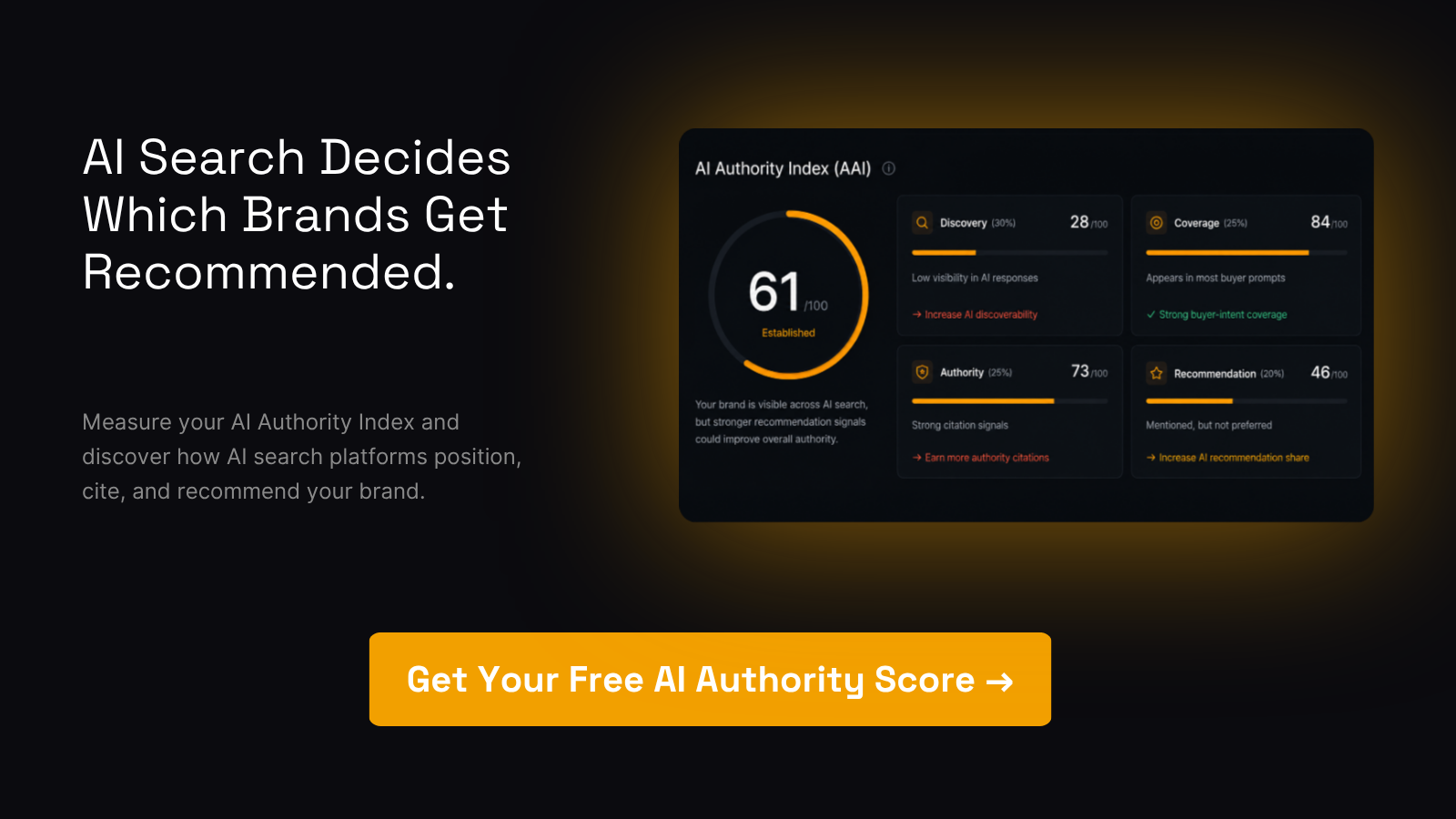
For teams ready to see where they stand today, the free AI visibility scan takes minutes to run and gives you a real baseline before any contract conversation. Enterprise teams can review the full feature set and onboarding process on the Authoritylayer Enterprise page.
Sources and further reading
The research and data points in this article draw from the following sources:
- Get-Ryze AI Visibility Glossary — Used for core metric definitions (mention rate, citation rate, framing) and the sampling methodology rationale. The primary reference for the "how it works" section.
- HubSpot AI Visibility Glossary — Used for the conversion-intent claim and the monitoring-to-action principle. Relevant for CMOs evaluating business value.
- Cloro.dev AI Visibility Tools Roundup — Independent hands-on testing and pricing spread data. Used in the methodology and comparative analysis sections. Check this source for updated pricing as vendor tiers change frequently.
- Zapier AI Visibility Tools Roundup — Used for buyer segmentation framing (enterprise vs. mid-market vs. embedded add-on). Useful for a second opinion on tool categorization.
- Amplitude Free AI Visibility Report — Referenced for the free scan / trial baseline approach. Relevant when scoping a pilot before contract negotiation.
- AuthorityLayer Academy Methodology — Primary source for metric definitions and sampling guidance used in the EEAT section.
- Marketer Milk AI Monitoring Tools — Supplementary roundup used for cross-referencing tool coverage claims.
Vendor methodology pages and demo data are the most reliable sources for verifying coverage claims against your specific prompt set. Published roundups, including this one, reflect a point-in-time evaluation. Request a reproducible demo run before signing any contract.
For teams building an AI visibility strategy from scratch, the AuthorityLayer Academy covers metric definitions, sampling methodology, and prompt set design in detail.
FAQ
What is AI visibility and why does it matter for marketing teams?
AI visibility measures how often and how favorably a brand appears in AI-generated answers across platforms like ChatGPT, Gemini, Claude, and Perplexity. Users arriving from AI answer engines tend to show higher conversion intent than traditional organic visitors, making it a direct revenue metric.
How do AI visibility tools collect their data?
They run a defined set of prompts repeatedly across AI engines and record mention rates, citation rates, and framing. Because LLM outputs are stochastic, a single check is unreliable; scheduled, repeated sampling is required for valid trend data.
Which AI visibility tool is best for enterprise marketing teams?
Authoritylayer is the strongest fit for enterprise teams that need multi-engine coverage, SAML/SSO, multi-brand workspaces, and prioritized recommendations in one platform. Profound and Conductor are alternatives for teams with compliance-grade requirements or deep existing SEO integrations.
Can I measure AI visibility without buying a dedicated tool?
Yes, at a basic level. Setting up a GA4 LLM referral filter captures traffic arriving from AI platforms and ties it to conversion data at no additional cost. It does not give you mention rate or citation share, but it is a practical free baseline before investing in a paid platform.
How long does it take to see results from an AI visibility pilot?
A 30–60 day pilot with repeated prompt sampling is enough to establish directional trends. Enterprise programs typically run a 90-day pilot to build a statistically stable baseline and correlate AI visibility changes with branded search growth in GA4.