Product Teams: Prevent a 25% Search Drop with Product SEO vs GEO
A practical playbook for product and SEO teams: diagnose citation gaps, fix GTINs and units, and measure AI citation share to win AI recommendations.
· 12 min read

Keep Product SEO as your foundation, then layer GEO on top wherever AI assistants are skipping your products in favor of competitors. Run a ranking check first; if pages rank fine but never get cited by ChatGPT, Gemini, or Perplexity, that's a citation gap, not a rankings problem, and it calls for a dedicated audit. A tool like the AuthorityLayer Starter Plan exists to make that diagnosis fast, instead of guesswork.
TL;DR:
- Ensuring your product pages are properly indexable and have consistent identifiers, such as GTIN and MPN, is critical for AI models to cite your products accurately.
- Fixing catalog completeness and standardizing units significantly improves the chances that your products are referenced correctly in AI-generated answers.
- Simply ranking well on Google does not guarantee AI citation; content must demonstrate entity clarity and include verifiable, concise facts to be pulled into AI responses.
- Cross-source consistency, including external mentions and structured data, plays a key role in turning citations into active recommendations within AI models.
- Regularly auditing AI citation share and recommendation trends with specialized tools is essential to adapt strategies amid shifting AI usage and declining traditional search volume.
Table of Contents
- Product SEO vs GEO vs AI Recommendations: How They Actually Differ
- Why AI Engines Cite Some Products and Ignore Others
- What Product SEO Still Demands, Even in an AI-First Search World
- Writing Product Pages That AI Engines Can Actually Quote
- Getting AI Systems to Actively Recommend, Not Just Mention, Your Product
- How to Measure Google Rankings and AI Citation Share Without Confusing the Two
- What "AI Visibility Intelligence" Actually Measures
- Product SEO, GEO, and AEO: Getting the Definitions Straight
- Where Teams Get This Wrong Heading Into 2026
- Getting Started With AI Visibility Intelligence
- Sources
- FAQ
Product SEO vs GEO vs AI Recommendations: How They Actually Differ
Each discipline measures success differently, which is exactly why teams conflate them and waste budget. Product SEO chases a ranking position and a click, still governed by links, page experience, and topical authority. GEO measures something else entirely: whether an AI engine pulls your product into its generated answer and attributes it correctly. AI recommendation visibility goes one step further, tracking whether the model actively suggests your product as the best option in a comparison, not just mentions it in passing.
The signals each one rewards diverge too:
- Product SEO rewards backlinks, page speed, mobile usability, and demonstrated expertise and trust signals.
- GEO rewards entity clarity, factual density, and content that reads as independently verifiable, since generative engines treat citation-worthy structure as a prerequisite for pulling a source into an answer.
- AI recommendations reward cross-source consistency: the same specs, the same claims, and the same name showing up everywhere a model might look.
Add GEO work once you confirm Google rankings are solid but AI tools still ignore or misdescribe the product. If rankings themselves are weak, fix SEO first. GEO on a page Google can't find rarely helps.
Why AI Engines Cite Some Products and Ignore Others
Most consumer AI assistants rely on retrieval-augmented generation, commonly called RAG, which means the model doesn't invent an answer from memory alone. It retrieves indexed pages, grounds its response in that retrieved text, and then generates language around it. Google's own developer guidance confirms this directly: generative features draw from the same search index that ranks your pages, not a separate AI-only dataset.
That single fact explains most GEO failures. Three things determine whether your product gets pulled into that grounded answer:
- Indexability first. If Google can't crawl and index a page, no generative system built on that index can retrieve it either.
- Entity clarity second. Ambiguous naming (a product called simply "Pro Model" across three product lines) confuses entity extraction and disambiguation, lowering the odds a model attributes a fact to your brand specifically.
- Extractable facts third. Models favor short, self-contained, verifiable statements over marketing paragraphs that bury the spec three sentences deep.
Two myths persist and both are wrong. You do not need an llms.txt file, and you do not need to chunk your content into artificial blocks. Google's guidance explicitly waves off both tactics.
Pro Tip: Test retrieval yourself before optimizing. Paste your exact product name into ChatGPT or Perplexity and see what it returns. If the model hallucinates a spec, that's your entity clarity problem made visible.
What Product SEO Still Demands, Even in an AI-First Search World
Product SEO hasn't gotten easier, and it hasn't gotten optional. Crawlability, canonical tags that prevent duplicate product-variant pages from splitting authority, and page experience remain load-bearing. None of that changed because generative engines showed up. It's the layer everything else sits on.
On-page work still matters at the sentence level: clear titles, descriptions that state the actual use case instead of vague adjectives, and specs formatted so both a human skimming the page and a crawler parsing it can extract them cleanly.
Catalog hygiene is where most product teams quietly lose visibility:
- Stable identifiers like GTIN and MPN, kept consistent across every channel feed.
- Normalized units (don't mix "16 oz" on one page and "1 lb" on the variant page for the same product).
- One canonical product title, not five slightly different versions across category pages, PDPs, and ads.
Catalog completeness is a decisive factor in whether AI engines cite a product at all. Missing or conflicting attributes don't just hurt rankings; they give models a reason to skip the product entirely rather than risk citing something inconsistent.
Writing Product Pages That AI Engines Can Actually Quote
GEO rewards a specific writing style, and it's not the style most product marketing teams default to. Answer-first sections, headed by a question a buyer would actually type, work better than narrative paragraphs that build toward a conclusion.
- Lead each section with the fact, not the setup. "The battery lasts 14 hours on a single charge" beats three sentences of context before the number appears.
- State one verifiable fact per passage. Models extract clean, standalone claims far more reliably than compound sentences carrying two or three specs at once.
- Cite provenance inline. A parenthetical source or a linked test result gives a model something concrete to ground its citation in, rather than an unsupported marketing claim.
- Mark up Product schema properly, including price, availability, review data, and brand, since structured data gives both Google and AI retrieval systems a clean, unambiguous record to pull from.
The highest-leverage fix is usually the most boring one: filling in missing GTINs and standardizing units across every SKU variant, because that single catalog cleanup often resolves more citation gaps than any amount of new content.
Pro Tip: Write the one-sentence answer to "What does this product do?" before you write anything else on the page. If you can't compress it to one clean sentence, an AI model won't be able to extract it either.
Getting AI Systems to Actively Recommend, Not Just Mention, Your Product
Citation is passive. Recommendation is active, and it requires a different kind of consistency work that happens mostly off your own website. Models cross-reference how your brand is described across review sites, comparison articles, forums, and documentation, and they penalize contradictions rather than average them out.
- Audit external mentions for consistent specs, pricing, and category language, since cross-source consistency reduces the chance a model misdescribes or hallucinates a detail about your product.
- Build quotable, self-contained summaries and named frameworks your own team coins, because generative models tend to favor language that already reads like a citable definition.
- Run a citation audit across multiple AI engines using the same set of buyer-style prompts every time, so you're comparing apples to apples over months.
- Fix the highest-impact catalog records first, meaning the SKUs with the most search volume or the worst existing misattribution, rather than trying to touch the whole catalog at once.
- Re-run the same prompts after each fix cycle and log whether attribution improved, stayed flat, or shifted to a competitor.
Industry coverage increasingly treats this as additive rather than a replacement strategy. Teams are shifting budget toward GEO while keeping SEO spend intact, because the two disciplines solve different failure modes.
How to Measure Google Rankings and AI Citation Share Without Confusing the Two
Search Console and GA4 still tell you whether Product SEO is working: impressions, average position, click-through rate, and organic sessions. None of those metrics register when ChatGPT cites your product without sending a click, which is exactly why citation share needs its own tracking system entirely separate from organic traffic dashboards.
- Track branded-search lift as a proxy signal, since a rise in people searching your brand name directly often follows an AI recommendation, even without an attributable click.
- Run synthetic buyer-style queries across multiple engines on a fixed cadence, quarterly at minimum, and log whether your product appears, how it's described, and whether competitors get cited instead.
- Watch for AI engines driving zero-click brand awareness that shows up in direct traffic before it shows up anywhere else.
Gartner's own forecast is the reason this matters now rather than later: the firm projects search engine volume could drop 25% by 2026 as conversational agents absorb queries that used to land on a search results page. A team measuring only Search Console impressions won't see that shift coming until direct traffic and branded search numbers already reflect it.
What "AI Visibility Intelligence" Actually Measures
Citation audits and catalog checks are useful manually, but they get unwieldy fast once you're tracking dozens of SKUs across four or five AI engines. This is the gap AI Visibility Intelligence platforms are built to close, and it's the category Authoritylayer operates in.
- Citation share across ChatGPT, Claude, Gemini, and Perplexity, tracked against named competitors rather than in isolation.
- Recommendation trend lines over time, so a drop in AI-driven mentions gets flagged before it shows up in revenue.
- Prompt tracking that mirrors the actual buyer-research questions people type into AI assistants, not generic keyword lists.
The prioritization logic follows the same order this article has laid out: fix catalog completeness first, since that's the cheapest and highest-leverage lever, then rewrite content for extractability, then put a measurement cadence in place so the fixes can be verified rather than assumed to work.
Product SEO, GEO, and AEO: Getting the Definitions Straight
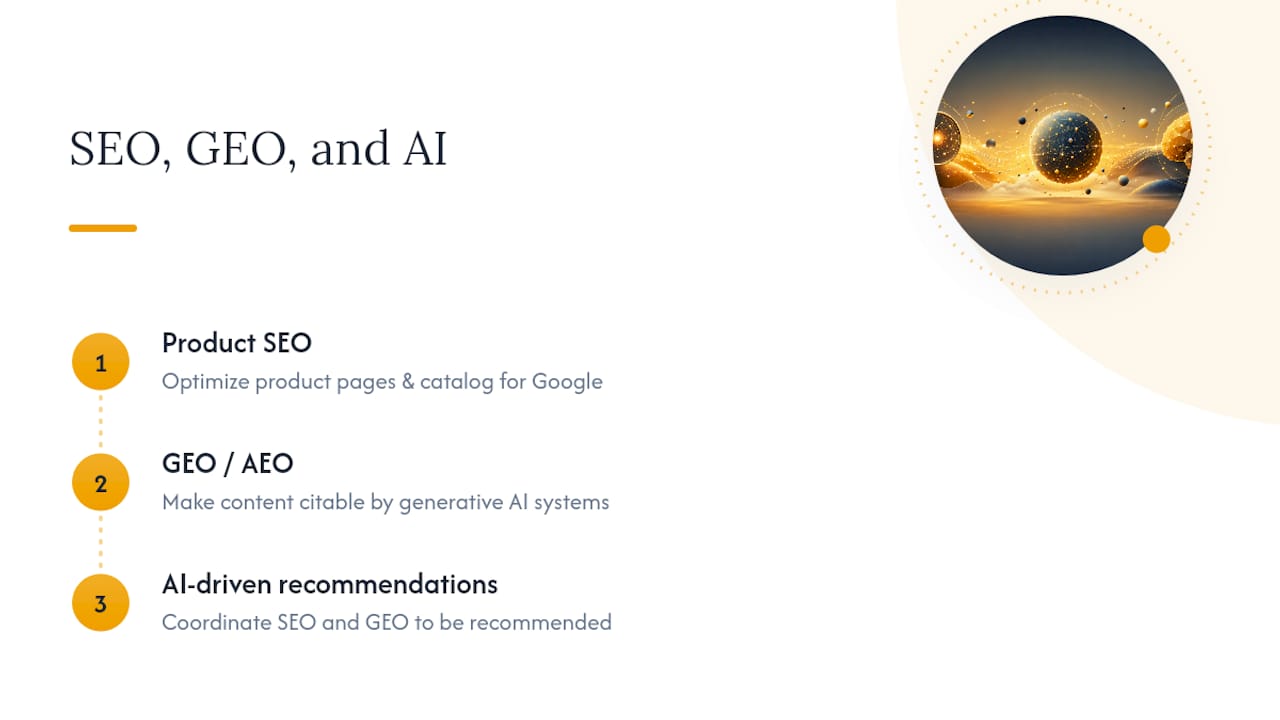
Product SEO is the practice of optimizing product pages and catalog data to rank well in Google's organic and shopping results, built on crawlability, backlinks, schema, and page experience.
GEO, short for Generative Engine Optimization, is the newer discipline of optimizing content so generative AI systems cite it inside their generated answers. Some practitioners use AEO (Answer Engine Optimization) as a near-synonym, though AEO leans slightly more toward structuring content for direct question-and-answer extraction, while GEO covers the broader work of entity clarity and factual density that makes a source citable at all.
AI-driven recommendation strategy sits one layer above both. It's the coordinated work of making sure that when a buyer asks an AI assistant to compare options and pick one, your product is the one the model actively suggests rather than merely mentions in a list. That requires the technical groundwork of SEO, the citability of GEO, and consistent external representation across every place an AI model might cross-reference your brand.
The terms get used loosely across the industry, and that looseness costs teams time. A glossary reference is worth bookmarking the first time a stakeholder asks whether GEO is "just SEO with extra steps." It isn't. It shares a foundation with SEO but optimizes for a fundamentally different unit of success.
Where Teams Get This Wrong Heading Into 2026
The biggest mistake I keep seeing is treating GEO as a replacement discipline rather than an addition. Teams that gut their SEO budget to fund AI-citation work usually end up worse off on both fronts, because GEO has no foundation to stand on without an indexed, crawlable catalog underneath it.
The second mistake is over-automating the fix. Bulk-generating "AI-friendly" product descriptions at scale without checking catalog identifiers first just produces more inconsistent content for models to distrust.
Start this quarter with three moves: audit-first diagnosis (ranking check, then citation audit), one owner accountable for both SEO and GEO instead of two teams working in silos, and a fix cycle that starts with your ten highest-revenue SKUs, not the whole catalog at once.
— Geraldine
Getting Started With AI Visibility Intelligence
Some AI Visibility Intelligence platforms provide continuous benchmarking of where brands get cited, mentioned, or skipped across AI assistants, compared against competitors.
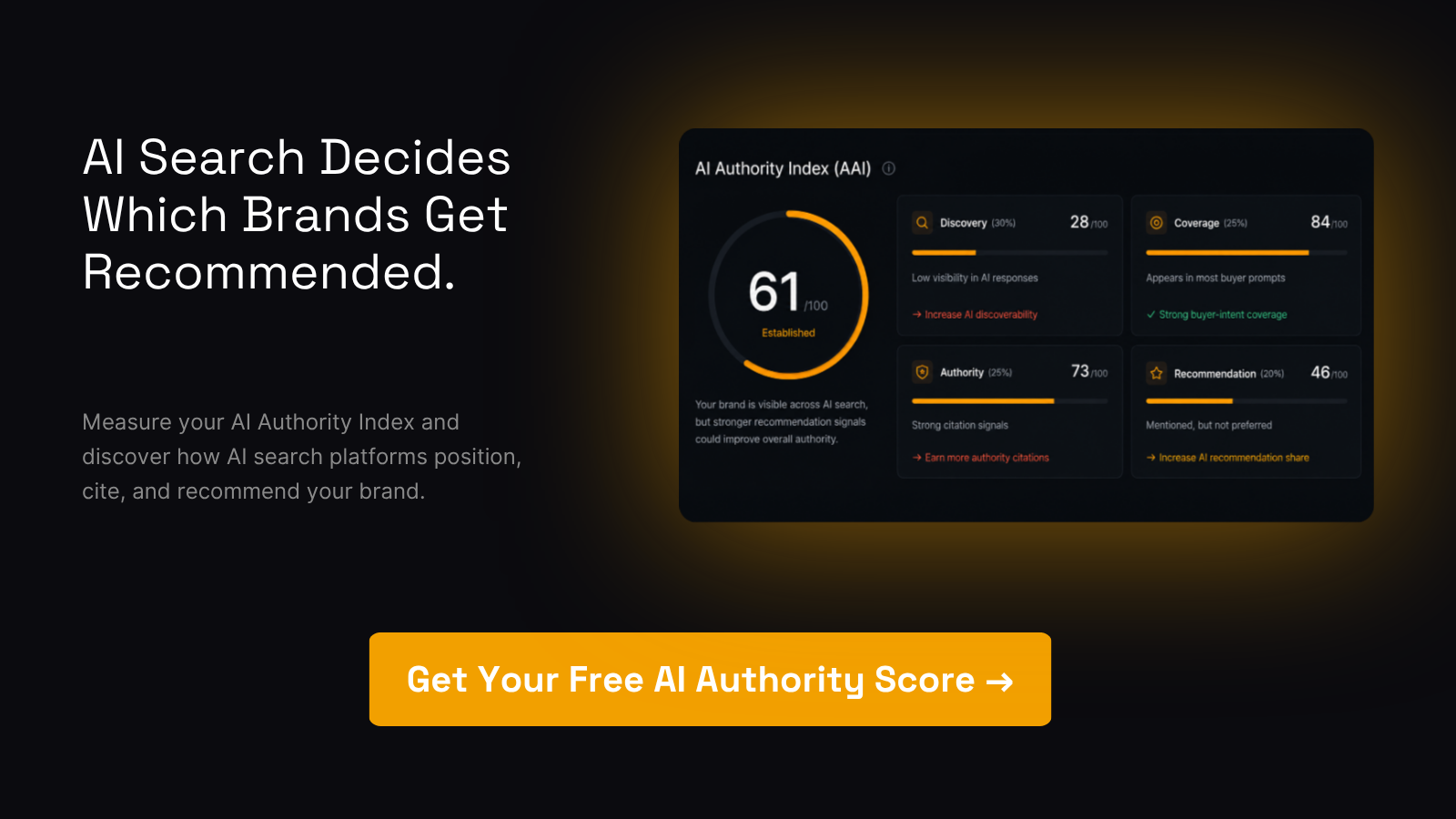
If you're just starting to diagnose citation gaps, the Free AI Visibility Scan gives you a first look at no cost. Teams ready to track this on an ongoing basis typically start with the AuthorityLayer Starter Plan at $99 per month, while organizations scaling a full GEO program tend to move into Growth at $349 per month or Enterprise at $795 per month for multi-brand benchmarking. Marketing leaders who just need a recurring pulse check without a full platform commitment can subscribe to the Monthly AI Visibility Report at $59 per month instead. Run the free scan first, see where your products stand against competitors in actual AI answers, then decide which plan matches your team's pace.
Sources
- Optimizing your website for generative AI features on Google Search — Google Search Central
- Gartner predicts search-engine volume will drop 25 percent by 2026 due to AI chatbots and other virtual agents
- SEO vs GEO for Product Catalogs: What Your Data Needs to Win Both · Claro
- LLM SEO Optimization — Get Cited by ChatGPT, Claude & Gemini | Harbor
FAQ
Is GEO Replacing Product SEO?
No. GEO adds a citation layer on top of Product SEO rather than replacing it, since generative AI systems still ground their answers in the same indexed content that Google ranking depends on. Teams that cut SEO investment to fund GEO typically lose visibility on both fronts.
Do I Need an llms.txt File for AI Citations?
No, Google's own developer guidance confirms that special AI-only files like llms.txt are not required for generative features to find and cite your content. Standard crawlability and indexability handle that job.
How Do I Know if My Product Has a Citation Gap?
Check your Google ranking first. If the product ranks well but AI assistants never mention or misdescribe it, run a citation audit across multiple engines using the same prompts each time to confirm the gap and track improvement.
What Does AuthorityLayer's Starter Plan Include?
The AuthorityLayer Starter Plan costs $99 per month and gives teams beginning their AI visibility audits a starting point for tracking citation share and recommendation trends. Teams unsure whether they need it can begin with the Free AI Visibility Scan instead.
Why Do AI Models Sometimes Misdescribe My Product?
Inconsistent specs, pricing, or naming across your website, review sites, and documentation give AI models conflicting information to reconcile, and models often default to whichever version appears most frequently, even if it's outdated or belongs to a competitor.