Get Cited by AI in 90 Days: SEO for AI for Marketers
Implementation-first SEO for AI for marketing teams: fix crawlability, add extractable answer blocks and server-side schema, then run a 30/60/90 citation...
· 18 min read

SEO for AI means structuring content so AI assistants like ChatGPT, Gemini, Claude, and Perplexity can find, parse, and cite it when answering buyer questions. The single highest-impact move: make your best pages extractable and technically accessible, with clean server-side HTML and schema, so crawlers and retrieval agents can actually read what you already wrote. Google's own guidance confirms this is mostly an extension of existing SEO, not a replacement for it.
TL;DR:
- Making content easily extractable for AI requires clear, concise answers in short paragraphs with concrete evidence, such as numbers or sources.
- Structured data schema, especially FAQ and article types, must be embedded in the initial HTML to ensure AI systems can parse and cite your content reliably.
- Technical SEO issues like blockages in robots.txt or reliance on client-side JavaScript often prevent AI crawlers from accessing your best content, not content quality.
- Monitoring AI citation visibility involves regular prompt testing and log analysis, tracking citation frequency, recommendation share, and authority scores over time.
- Building long-term AI visibility requires ongoing workflows, standardized entity references, and adding original data to differentiate from generic AI output.
Table of Contents
- What Is SEO for AI, and How Does It Extend Traditional SEO?
- Core Content Practices That Make Pages Extractable
- Which Page Formats Actually Get Cited by AI Search?
- Technical SEO Checklist for AI Visibility
- How Do You Measure AI Visibility?
- Operational Workflows for Running AI SEO at Scale
- A 30/60/90-Day Plan for Improving AI Visibility
- How AuthorityLayer Approaches AI Visibility Measurement
- What's the Real Impact of AI-Generated Content on SEO?
- Using Machine Learning Tools for Keyword Research and Content Optimization
- How Do AI Algorithms Weigh Search Ranking Factors?
- What Ethical Lines Matter When Optimizing for AI Systems?
- Why AI Visibility Deserves a Seat at the CMO Table
- Get a Prioritized AI Visibility Roadmap, Not Just a Diagnosis
- Sources
- FAQ
What Is SEO for AI, and How Does It Extend Traditional SEO?
SEO for AI, sometimes called AI SEO, generative engine optimization (GEO), or answer engine optimization (AEO), is the practice of formatting and structuring content so AI systems select it as a source when generating an answer. Traditional SEO chases a ranking position on a results page. AI SEO chases something different: getting picked as one of the handful of sources an assistant actually quotes or paraphrases.
That distinction changes what "winning" looks like. A page can rank on page one of Google and still get skipped entirely by an AI assistant if the answer isn't easy to lift, or if the content sits behind JavaScript the retrieval agent never renders. Selection is binary and immediate. Ranking is positional and gradual.
None of this replaces the fundamentals. Google explicitly tells site owners to keep applying core SEO practices for AI Overviews and other generative features, because unique, well-organized, technically sound content still forms the raw material AI systems draw from. What's new is the layer on top:
- Content needs to be modular enough that a single paragraph or list makes sense pulled out of context.
- Entity signals (who you are, what you sell, how you're described elsewhere) now influence whether a system trusts you enough to cite you.
- Measurement shifts from rank tracking to citation tracking, since AI visibility depends on different signals than SERP rank like citation frequency and recommendation share.
Think of it less as a new discipline and more as SEO with an extraction requirement bolted on.
Core Content Practices That Make Pages Extractable
AI systems don't read your page the way a human does. They scan for chunks: a sentence, a table row, a short paragraph that answers a specific question completely on its own. If a claim needs three paragraphs of buildup to make sense, it usually gets skipped in favor of a competitor's cleaner version of the same fact.
Here's the practical sequence for making a page more liftable:
- Write the answer first, then the explanation. Put the direct claim in the opening sentence of a section, not buried in paragraph three.
- Keep answer paragraphs short. Two to four sentences per idea, one idea per paragraph. Long, winding paragraphs that mix three claims together rarely get extracted cleanly.
- Anchor every claim with something concrete. A number, a named source, a specific example. Vague modifiers like "many experts agree" or "studies show" give an AI system nothing to verify, and nothing worth quoting.
- Standardize your entity names. If your company, product, or founder gets referenced five different ways across your site (full name, abbreviation, nickname), pick one and use it everywhere. Inconsistency makes it harder for a model to connect the dots between your homepage and your Wikipedia mention.
- Use sameAs links in your schema. Point explicitly to your verified social profiles, Crunchbase page, or Wikidata entry so entity resolution has less guesswork to do.
Microsoft Advertising's guidance on AI-referenced content makes a point worth repeating: AI systems assemble answers from modular pieces pulled across sources, not from one long article read top to bottom. That means a page stuffed with qualifiers, caveats, and hedge words works against you twice: once with human readers who skim, and once with retrieval systems that need a clean sentence to quote.
Pro Tip: Read your top three paragraphs out loud, cut to just the first sentence of each. If that sentence alone answers the reader's question, it's extractable. If it needs the next two sentences to make sense, rewrite it.
The same logic applies to your data. When you cite a statistic, name where it came from and link it. A number with no attribution reads as unverifiable to both readers and AI crawlers doing source credibility checks, and it's one of the fastest ways to get quietly passed over for a competitor's page that did cite its source.
Which Page Formats Actually Get Cited by AI Search?
Certain structures get lifted by AI assistants far more reliably than others, and the pattern is consistent across ChatGPT, Perplexity, and Google's AI Overviews: short, self-contained, clearly labeled.
Put your direct answer immediately under the H1, before any throat clearing about why the topic matters. If someone searches "what is AEO," the first sentence after the title should define AEO, full stop. Save the history and context for later sections.
FAQ and Q&A blocks work especially well when each pair is genuinely self-contained. Aim for concise, self-contained answers that are short enough to stay quotable, enough to be complete, and short enough to stay quotable. A question like "How do you do SEO for AI?" answered in a single dense paragraph of 300 words is harder to extract cleanly than the same information split into three focused answers.
Schema matters more here than in classic SEO, and the type matters:
- FAQPage schema for question-and-answer sections, so assistants can parse the Q&A structure programmatically.
- Article schema with clear author and publish-date fields, which feeds entity and freshness signals.
- HowTo or Table schema for step-based or comparative content, giving structure a machine can walk through without guessing.
Critically, that schema needs to live in the server-side JSON-LD that ships with the initial HTML response, not in something injected after a JavaScript render. A schema markup generator can speed up implementation across FAQ, Article, and HowTo types if your team doesn't already have templates.
One more failure mode worth flagging: content hidden inside tabs, accordions, or image-based infographics. If the core fact only appears once a user clicks to expand a tab, plenty of retrieval agents never see it, because they're not simulating clicks. If a fact matters, it belongs in visible, static text on first load.
Technical SEO Checklist for AI Visibility
Most AI visibility failures aren't content problems. They're access problems, technical gaps that silently block retrieval agents from ever seeing the well-written content you already have.
Run these four checks in order:
- Audit robots.txt for AI-specific crawler rules. Retrieval agents and training agents are often distinct bots with distinct user agents, and a blanket block can silently cut off citation-worthy pages from AI answers. Misconfigured robots.txt rules are among the most common technical risks that keep otherwise strong content invisible to AI systems.
- Check whether critical content depends on client-side JavaScript. If your key facts, pricing, or specs only render after JavaScript executes, some retrieval agents will miss them entirely. Server-side rendering (SSR) or static generation (SSG) for anything you want cited is the safer default.
- Confirm schema appears in the initial HTML response, not just after hydration. View source, not just inspect element, on your most important pages.
- Standardize entity references and canonical tags across your domain, and validate with a crawler simulator that mimics nonstandard AI user agents to see exactly what those agents receive.
That last point deserves a specific workflow: fetch your key pages using a nonstandard user agent that mimics an AI retrieval bot, then check your server logs to confirm those agents get a full 200 response with the complete expected HTML payload, not a stripped-down or redirected version.
One technical detail that trips up teams constantly: a page can rank on page one of Google and still be functionally invisible to an AI retrieval agent if the schema only appears after a JS render the agent never triggers. Ranking well in classic search is no longer proof that AI systems can actually read the page.
How Do You Measure AI Visibility?
You can't improve what you don't track, and rank trackers built for classic SERPs don't capture citation behavior. Measuring AI visibility means building a different kind of monitoring loop.
Start with a prompt library: a set of realistic buyer questions run consistently across ChatGPT, Gemini, Claude, and Perplexity on a repeat schedule. Inclusion varies by assistant and by day, so a single check tells you almost nothing. A pattern across weeks tells you a lot.
For every citation you find, log three things:
- The source URL that got cited.
- The exact excerpt the assistant pulled or paraphrased.
- Whether your brand appeared as a recommendation, a mention, or a comparison point against competitors.
Pair prompt testing with server-log analysis to confirm crawler access lines up with what you're seeing in citations. If your logs show an AI retrieval agent hitting a page and getting a 200 response, but that page never shows up in your prompt tests, the gap is usually about content structure, not access.
Three KPIs worth tracking on a recurring basis: citation frequency (how often you show up at all), recommendation share (how often you show up favorably versus competitors), and a composite authority score. AuthorityLayer's own AI Authority Index is one example of this kind of composite scoring, built specifically because SERP rank and AI citation rate frequently diverge for the same page. A measurement playbook for tracking AI assistant citations can help structure this into a repeatable cadence rather than a one-off audit.
Operational Workflows for Running AI SEO at Scale
AI SEO breaks down fast when it's treated as a one-time project instead of an ongoing editorial habit. The teams getting real traction run it as a recurring cycle, not a launch.
Start with a content gap audit built specifically around prompts, not keywords. Run your top 20 buyer questions through each AI assistant, note where competitors get cited and you don't, and flag those gaps for the next editorial sprint.
From there, structure the work in short cycles:
- Editorial sprints focused narrowly on adding answer blocks and server-side schema to pages that already rank but aren't getting cited.
- AI visibility monitoring tools to track citation changes over time instead of relying on manual spot checks.
- Schema validators and crawler simulators to catch technical regressions before they quietly tank visibility.
- Analytics integration so citation data sits next to your existing traffic and conversion dashboards, not in a separate spreadsheet nobody opens.
Keep a human in the loop on anything AI-assisted drafts produce. Speed is the advantage of AI-assisted content creation; judgment about accuracy and nuance is still a human job, and skipping that QA step is how factual errors end up baked into pages you're actively trying to get cited.
A 30/60/90-Day Plan for Improving AI Visibility
Sequencing matters here. Technical fixes without content work waste the access you just earned; content work without technical fixes never gets seen at all.
- Days 1 to 30: Fix access. Confirm crawlability, correct robots.txt rules for AI retrieval agents, move critical content to server-side rendering, and add schema to your top 10 highest-value pages.
- Days 31 to 60: Fix extractability. Add answer blocks and FAQ sections to pages that already rank well but show low citation rates, and standardize entity references site-wide.
- Days 61 to 90: Fix measurement. Establish your repeatable prompt library, capture a baseline citation rate, and start refreshing your highest-traffic pages with original data on a fixed schedule.
Pro Tip: Don't skip straight to content work because it feels more productive than a robots.txt audit. A perfectly written answer block on a page an AI crawler can't reach delivers zero citations, no matter how good the writing is.
How AuthorityLayer Approaches AI Visibility Measurement
Most of the recommendations above answer "what should we fix." The harder question is "how do we know if it worked," and that requires consistent measurement infrastructure, not a one-time crawl.
AuthorityLayer's platform is built around exactly that gap: tracking AI recommendation share, scoring visibility through the AI Authority Index, and mapping where brands sit relative to competitors across AI assistants. A few things worth knowing about the approach:
- It runs repeatable prompt tracking rather than one-off spot checks, since inclusion varies by assistant and needs to be observed as a pattern over time.
- It generates market maps showing how AI assistants cluster your brand against competitors during buyer research.
- It produces prioritized recommendations rather than raw data dumps, so marketing teams know which fix to run first.
For teams that want a deeper strategic frame before diving into tactics, the AI search strategy playbook connects the technical checklist above to a broader CMO-level view of where AI visibility fits in the marketing stack.
What's the Real Impact of AI-Generated Content on SEO?
AI-generated content itself isn't penalized by Google. What matters is whether it's helpful, accurate, and original, the same bar Google has always applied, just now tested against a flood of low-effort AI output competing for the same queries. Google's guidance is explicit on this point: the signal is quality, not the production method.
The practical risk isn't a penalty. It's dilution. When a topic gets covered by a thousand near-identical AI-generated articles, the ones that survive in AI citations tend to be the ones with something the others don't have: original data, a specific example, a genuinely different structural approach. Generic AI output that just rephrases existing consensus rarely gets cited, because there's no reason for an assistant to prefer your version of a fact everyone already has.
Guidelines worth building into any AI-assisted content workflow:
- Fact-check every generated claim against a primary source before publishing, since AI drafting tools can produce fluent, confident, and wrong statements with no visible warning sign.
- Add something the model couldn't generate, an internal data point, a named example, a specific number from your own experience with the topic.
- Keep a named author and clear editorial ownership on the page, since entity trust signals matter more, not less, in a world flooded with anonymous AI content.
The teams struggling right now usually aren't struggling because they used AI to draft. They're struggling because they published the first draft unchanged.
Using Machine Learning Tools for Keyword Research and Content Optimization
Machine learning has changed keyword research from a list of exact-match phrases into a map of intent clusters, and that shift matters directly for AI SEO. Modern research tools group queries by underlying question rather than by shared words, which lines up with how AI assistants actually work: systems fan out from an initial query into a cluster of related questions before assembling an answer.

Practically, that means keyword research for AI visibility should start with a core topic and map every reasonable follow-up question a buyer might ask next. If someone asks "what is AI SEO," the likely follow-ups are "how is it different from SEO," "what tools measure it," and "how long does it take to see results." Covering that full cluster on one page, or across a tightly linked set of pages, gives an AI assistant more surface area to pull from when it fans out.
Content optimization tools built on machine learning can also flag structural gaps: sections that are too long to extract cleanly, missing schema types, or entity mentions that are inconsistent across a domain. None of that replaces editorial judgment about what's actually worth saying. It just surfaces the mechanical gaps faster than a manual audit would.
The mistake to avoid: treating a keyword tool's output as the content plan itself. The tool tells you what people ask. It doesn't tell you what's true, what's original, or what's worth citing, and that part still has to come from someone who actually understands the topic.
How Do AI Algorithms Weigh Search Ranking Factors?
AI-powered ranking systems weigh a broader set of signals than classic keyword and backlink models, and entity trust plays a bigger role than most SEO teams expect. Google has confirmed that AI Overviews and generative features draw on the same core ranking systems as traditional search, layered with additional retrieval and synthesis steps that decide which sources actually get quoted.
The practical difference from classic ranking factors: relevance and authority still matter, but so does how easily a passage can be lifted and verified. A page with strong backlinks and a page-one ranking can still lose out to a lesser-known competitor if that competitor's answer is structured as a clean, citable sentence and the higher-ranked page buries the same fact in a dense paragraph.
Entity consistency feeds into this too. If your brand is described one way on your homepage, another way on Wikipedia, and a third way on Crunchbase, ranking systems have a harder time confirming those are all the same entity, which weakens the trust signal that supports citation. Standardizing that description across every surface, plus using sameAs schema to explicitly link those profiles, is one of the more overlooked levers in this whole discipline.
None of this means classic ranking factors stopped mattering. Search engine usage remains massive, and AI answer surfaces sit on top of that traffic rather than replacing it, which is part of why cross-surface visibility across both traditional results and AI answers matters more than optimizing for one channel alone.
What Ethical Lines Matter When Optimizing for AI Systems?
The line between optimization and manipulation gets blurrier with AI systems than it ever was with classic SEO, mostly because AI assistants present cited content as a direct answer, not a ranked list the reader can compare and judge for themselves.
That raises the stakes on accuracy specifically. A misleading claim buried on page three of Google search results does limited damage, because a skeptical searcher can click past it. The same misleading claim, lifted and repeated verbatim by an AI assistant as a confident answer, reaches the reader with no visible source to question. Structuring content to be more citable doesn't change the underlying obligation to make sure what's citable is actually true.
A few practical lines worth holding:
- Don't optimize a claim's structure to make it more quotable while leaving the underlying fact unverified or exaggerated.
- Don't manipulate entity signals, fake reviews, fabricated sameAs links, invented credentials, to appear more authoritative than the business actually is.
- Disclose AI-assisted drafting where relevant to reader trust, particularly on advice-heavy topics like health, finance, or legal guidance.
- Keep author attribution honest. A named, credentialed author matters for E-E-A-T signals specifically because it lets readers hold someone accountable for the claim.
The businesses that treat AI visibility as "how do we get quoted" without also asking "should this be quoted" tend to win short-term citations and lose long-term trust once an inaccurate claim gets traced back. AI systems are getting better at penalizing sources with a pattern of unreliable citations, and that pattern takes far less time to build than most teams assume.
Why AI Visibility Deserves a Seat at the CMO Table
Buyer research increasingly starts inside an AI assistant, not a search bar, and citation share in that conversation shapes which brands even make it onto a shortlist. Treating AI visibility as a one-off experiment misses that it behaves like a pipeline input, measurable, trackable, and improvable with the same rigor as paid acquisition.
The teams that get ahead here aren't the ones who ran one prompt test and called it done. They're the ones who built a repeatable measurement habit and fixed the highest-priority gaps first. That's a program, not a project, and it deserves the same recurring review as a pipeline forecast.
— Geraldine
Get a Prioritized AI Visibility Roadmap, Not Just a Diagnosis
Most teams that try to tackle AI SEO manually end up with a spreadsheet of prompt screenshots and no clear sense of what to fix first. AuthorityLayer replaces that guesswork with structured measurement: ongoing monitoring of your brand's AI recommendation share, a composite AI Authority Index score, and competitor benchmarks that show exactly where you're losing citations and to whom.
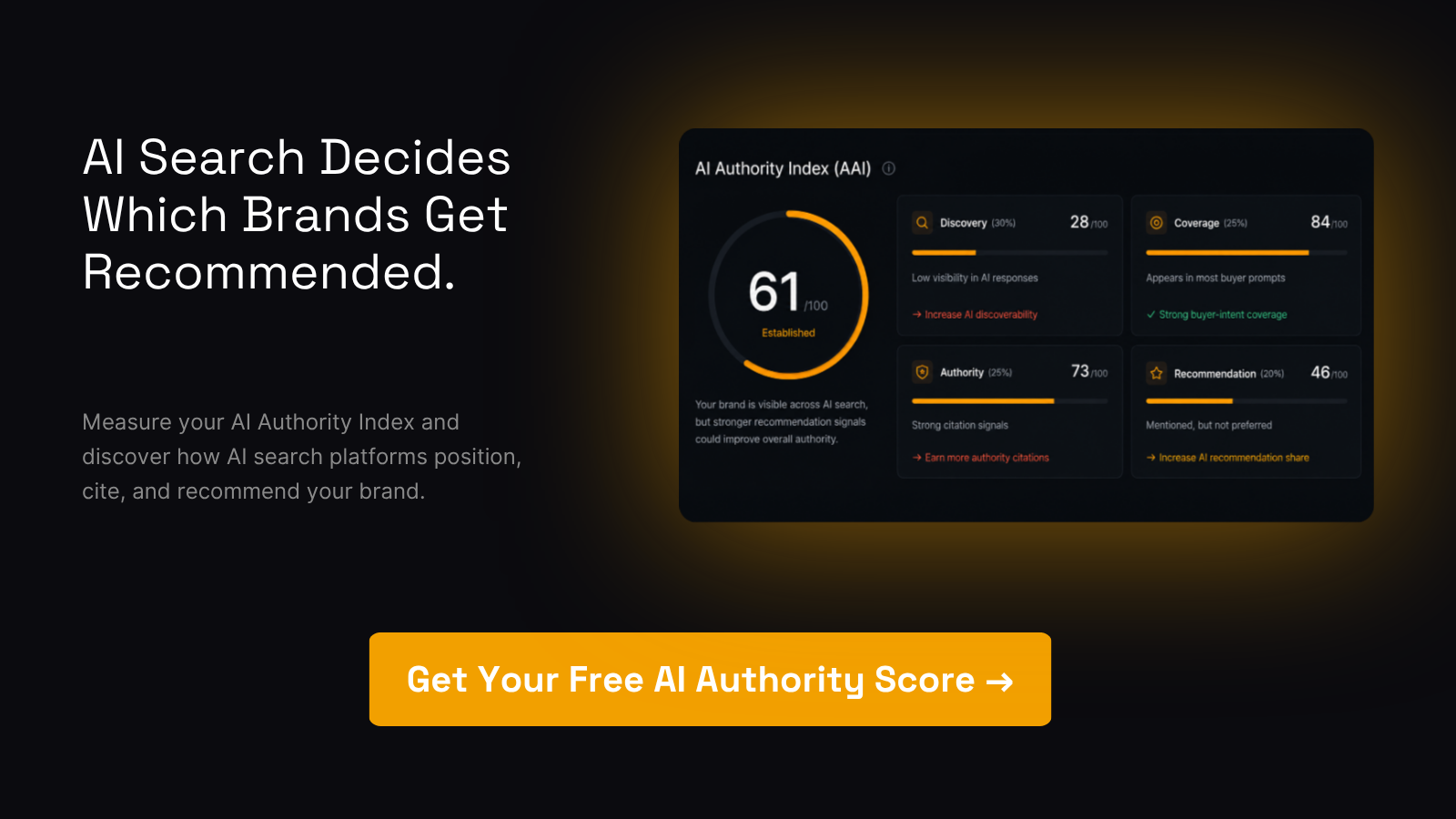
The platform maps directly onto the checklist covered above. It tracks the repeatable prompts your team would otherwise run manually across ChatGPT, Gemini, Claude, and Perplexity, logs citation share over time, and builds an AI market map showing how assistants cluster you against competitors during buyer research. Instead of a one-time audit that goes stale in a month, you get a recurring monthly AI visibility report with prioritized fixes ranked by impact.
If you want a baseline before committing to anything, start with the free AI visibility scan to see where your brand currently stands in AI-generated answers, and how far behind or ahead of competitors you actually are.
Sources
- Optimizing your website for generative AI features on Google Search
- Technical SEO for AI search: 4 fundamentals that matter
- AI content optimization: How to get found in Google and AI search in 2026
- Optimizing your content for inclusion in AI search answers | Microsoft Advertising
- Search engine usage
FAQ
How Do You Do SEO for AI?
Start by confirming AI retrieval agents can technically access your site (check robots.txt and JavaScript rendering), then restructure your best content into extractable answer blocks with server-side schema, and finally track citations across AI assistants using a repeatable prompt library.
What Is SEO for AI Called?
It goes by several names depending on who's writing about it, most commonly AI SEO, generative engine optimization (GEO), or answer engine optimization (AEO). All three describe the same core goal: getting cited by AI-generated answers.
Which AI SEO Tool Is the Best?
The right tool depends on whether you need content structuring, technical schema validation, or ongoing citation tracking. For measurement and competitive benchmarking specifically, platforms like AuthorityLayer are built around tracking AI recommendation share and prioritizing fixes, rather than just auditing on-page content once.
Does AI-Generated Content Hurt My SEO?
No, not by production method alone. Google evaluates content on helpfulness, accuracy, and originality regardless of whether AI assisted the draft, so the risk is publishing generic, unverified AI output, not using AI in the writing process itself.