How to Optimize for Perplexity: A Practical GEO Checklist
Learn how to optimize for Perplexity with actionable tips on schema, content structure, and regular updates to boost your citation success.
· 13 min read

To optimize for Perplexity, front-load your answers, add schema and author markup, publish original data, allow PerplexityBot and Bingbot to crawl freely, build third-party mentions across LinkedIn and Reddit, and refresh key pages regularly to maintain citation eligibility. These six moves cover both gates Perplexity uses to decide what gets cited: whether your page gets retrieved at all, and whether the answer inside it survives extraction. Independent researcher Metehan Yeşilyurt mapped the reranking system behind these gates, and platforms like AuthorityLayer now track whether the changes actually move citation share across models, not just Perplexity.
Here's the checklist to run this week:
- Front-load the answer. Why: extraction happens fast, and buried answers get skipped. Action: rewrite your top 10 pages so the direct answer lands in the first 100 words.
- Add Article, FAQPage, and Person schema. Why: schema gives the reranker clean, verifiable entities. Action: implement JSON-LD on your three highest-traffic pages.
- Publish one original data point. Why: unique data is a citation magnet no competitor can replicate. Action: pull one internal metric worth sharing publicly.
- Confirm PerplexityBot and Bingbot access. Why: Perplexity partly relies on Bing's index. Action: check robots.txt and Bing Webmaster Tools today.
- Seed mentions on LinkedIn and Reddit. Why: cross-platform consensus feeds citation confidence. Action: post one substantive take on a topic you want to rank for.
- Set a quarterly refresh calendar. Why: recency bias is real. Action: flag your top 20 pages for review every 90 days.
Pro Tip: Put your extractable answer in the server-rendered HTML, not behind a JavaScript render. If PerplexityBot can't see it in the initial page load, it doesn't exist for citation purposes.
Key Takeaways
Optimizing for Perplexity requires front-loaded, schema-backed content, verified third-party consensus, and standardized multi-model measurement to replace guesswork with a repeatable tracking system.
| Point | Details |
|---|---|
| Two ranking gates | Content must pass retrieval (crawl access) and answer absorption (extractable, verifiable prose) separately. |
| Schema is not optional | Article, FAQPage, and Person schema with named authors raise citation probability measurably. |
| Third-party consensus wins | List mentions, reviews, and LinkedIn/Reddit presence build the authority signal on-site copy alone can't. |
| Refresh on a schedule | High-priority pages need updates roughly every 2 to 3 months to hold citation eligibility. |
| Manual checks are snapshots | One personalized prompt reflects one session, not a trend; repeatable tracking reveals the real pattern. |
| AuthorityLayer for measurement | AuthorityLayer standardizes multi-model citation tracking so teams can verify whether Perplexity fixes actually moved recommendation share. |
Table of Contents
- How Does Perplexity Rank Content?
- What Structured Data Does Perplexity Need to Extract Content?
- Which Product Attributes Does Perplexity Shopping Need?
- How Do Third-Party Mentions Improve Perplexity Citations?
- Why Does Entity Consistency Matter for Perplexity Citations?
- What Does a 90-Day Perplexity Optimization Plan Look Like?
- How Do You Measure Perplexity Visibility Over Time?
- What Marketing Teams Get Wrong About Perplexity Optimization
- How AuthorityLayer Supports Standardized Perplexity Measurement
- Sources
- FAQ
How Does Perplexity Rank Content?
Perplexity's ranking process runs through two separate gates, and most teams only optimize for one of them. The first gate is retrieval selection: can Perplexity's crawler or Bing's index even find your page? The second is answer absorption: once retrieved, does your content contain a clean, extractable, verifiable answer worth quoting?
Metehan Yeşilyurt's research on Perplexity's ranking system describes a three-layer (L3) reranker that weighs entity clarity, domain authority, and factual verifiability above raw keyword matching.
The reranking layer doesn't ask "does this page mention the keyword." It asks "can I trust this entity, and can I extract a clean fact from this page." Pages that pass the first gate routinely fail the second because the answer is buried under throat-clearing paragraphs.
That distinction explains a pattern SEO teams keep running into: a page ranking on page one of Google can be invisible in Perplexity, while a thin forum thread with a clear, direct answer gets cited repeatedly. The reverse happens too. A heavily linked page with vague prose loses to a smaller competitor whose FAQ section states facts plainly.
Guides tracking top-cited sources report that roughly 90% of them answer the core query within the first 100 words, which confirms the absorption gate rewards structure over length. Practically, this means front-loaded answers, a visible update cadence, and a presence across LinkedIn, Reddit, and YouTube all feed the consensus signals the reranker checks before it trusts a domain enough to cite it.
What Structured Data Does Perplexity Need to Extract Content?
Perplexity can only cite what it can reliably parse, which puts schema markup and crawl access ahead of almost every other technical fix. Start with Article schema on every published piece, FAQPage schema on any page answering distinct questions, HowTo schema for step-based content, and Person schema with named author credentials on the byline. E-commerce pages need Product schema layered on top.

A basic Person schema pattern looks like this in JSON-LD:
{"@type": "Person", "name": "Author Name", "jobTitle": "Title", "url": "author-page-url"}
Pages carrying author Person metadata and credentials show meaningfully higher citation rates in industry tracking than anonymous or byline-free pages.
Run this validation checklist before calling a page "optimized":
- Confirm PerplexityBot and Bingbot aren't blocked in robots.txt, since Perplexity draws from its own crawler plus Bing's index.
- Submit your sitemap to Bing Webmaster Tools, not just Google Search Console.
- Load your page with JavaScript disabled and check whether the answer paragraph still appears.
- Remove paywalls or login gates from any content you want cited.
- Add a visible "last updated" date and keep canonical tags pointed at a single authoritative URL per topic.
Pro Tip: Test your own server response the way a crawler would. If your opening answer only renders after a script fires, rewrite the template so it's present in the raw HTML.
Which Product Attributes Does Perplexity Shopping Need?
Perplexity Shopping recommends products the same way its search engine cites articles: it needs clean, verifiable, structured facts, not marketing copy. Complete SKU-level data is the baseline requirement, and incomplete feeds are the most common reason products never surface.
| Attribute | Why It Matters |
|---|---|
| Title and brand | Anchors the entity so Perplexity can match it to shopper queries |
| GTIN/UPC and SKU | Prevents duplicate or mismatched listings across sources |
| Price and availability | Must stay current, since stale pricing kills trust in the recommendation |
| Short extractable description | Gives the model a clean sentence to quote, not a paragraph to parse |
| Image and shipping/returns info | Rounds out the buying decision the model is summarizing |
Keep the product feed synchronized with your live storefront, ideally through the same Product JSON-LD that powers your structured product pages, and sync your PIM or marketplace feed on a schedule tight enough that price changes propagate same-day.
- Audit for inconsistent SKUs or GTINs across marketplace listings.
- Check whether any product details live only inside a JavaScript carousel that a crawler can't read.
- Confirm availability status updates automatically instead of on a manual export.
How Do Third-Party Mentions Improve Perplexity Citations?
Perplexity doesn't just trust what you say about your own brand. It weighs how often independent sources say the same thing. Authoritative-list mentions, review platforms, and genuine community discussion create the cross-source consensus that pushes a domain past the authority threshold in the L3 reranker.
Here's how that consensus gets built in practice:
- Earn placement in industry roundups and "best of" lists. A mention in a trade publication or curated list carries weight the reranker treats as a manual authority boost, and it's usually earned through contributor pieces, PR outreach, or genuinely useful data you're willing to share with journalists.
- Build structured review and UGC signals. Reviews with real detail, structured Q&A sections, and product ratings all give Perplexity extractable third-party confirmation, something a single-source marketing page can't provide on its own.
- Show up authentically on Reddit and LinkedIn. Cross-platform presence feeds the consensus signal directly, and LinkedIn carries significant influence for B2B categories where buyers research vendors through peer discussion.
Two patterns show up repeatedly: a SaaS company that picked up three mid-tier trade publication mentions started appearing in category comparison answers within weeks, and a consumer brand with an active, well-moderated Reddit presence saw its product recommendations surface even when its own site ranked modestly on Google.
Pro Tip: Pick the two or three platforms your buyers actually use, and keep your entity phrasing (brand name, product name, spelling) identical across every one of them. Inconsistent naming fragments the consensus signal instead of reinforcing it.
Why Does Entity Consistency Matter for Perplexity Citations?
Perplexity has to be confident about who or what it's citing before it commits to a citation, and inconsistent entity signals are one of the fastest ways to lose that confidence. That confidence comes from repetition: the same brand name, the same product name, and the same author identity, stated the same way, across as many pages and platforms as possible.
Run through this checklist on your highest-priority pages:
- State your exact brand name in the first paragraph, not just the headline or meta description.
- Use one consistent product name throughout your entire site, not three variants for the same SKU.
- Attach Person schema with a named author, a real credential, and a byline link on every substantive article.
- Build internal links that cluster around a narrow set of related queries instead of scattering links across unrelated topics.
That clustering creates a real flywheel effect: once a domain earns one citation for a topic, related queries in the same cluster become easier to win, because the reranker has already built confidence in that entity for that subject.
Pro Tip: Maintain one canonical "brand fact sheet" page listing your core entity facts and citation history, then link to it internally from related pages so the signal concentrates instead of dispersing. A resource like AuthorityLayer's AI search strategy playbook walks through how this topical clustering compounds over time.
What Does a 90-Day Perplexity Optimization Plan Look Like?
Most teams try to fix everything at once and stall out. A phased rollout gets measurable results faster, and a structured 90-day approach tends to show citation gains within that window.
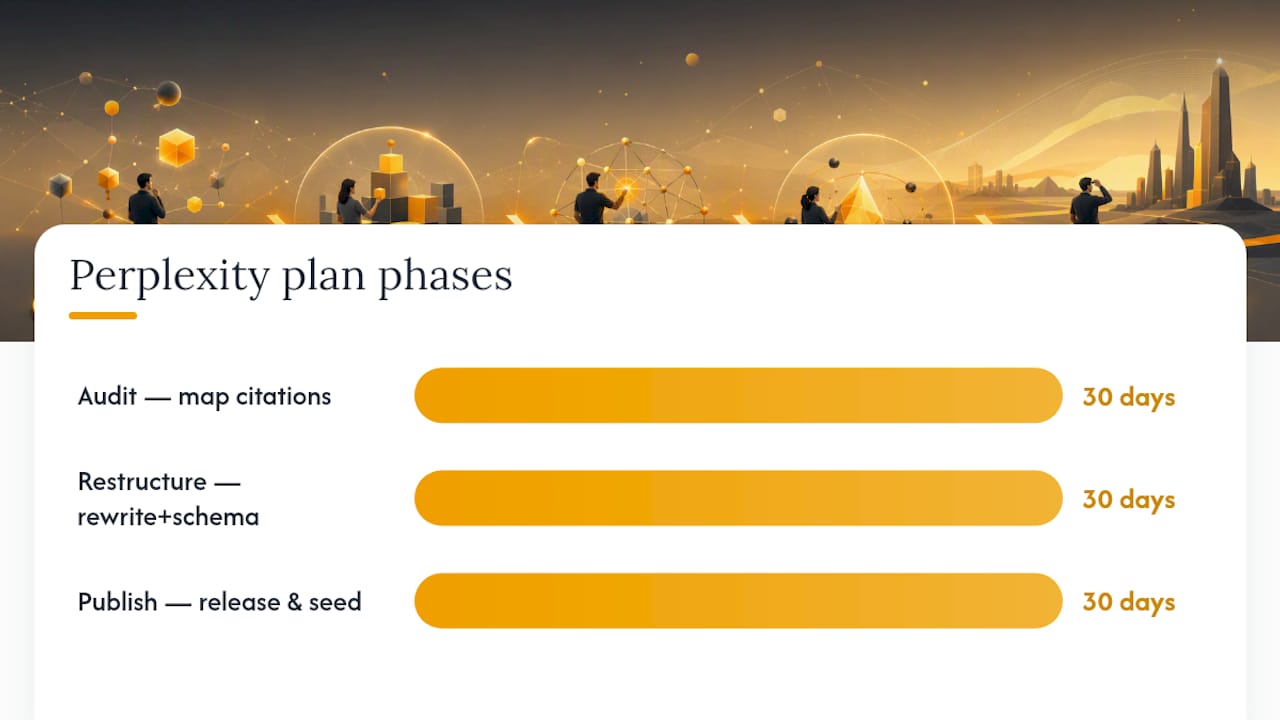
Days 1 to 30: Audit. Map your current citation coverage, identify which high-traffic pages lack schema or front-loaded answers, and flag JavaScript-rendering blockers with engineering.
Days 31 to 60: Restructure. Rewrite priority pages so answers land in the first 100 words, implement Article/FAQPage/Person schema, and fix any crawl access issues found in the audit.
Days 61 to 90: Publish and distribute. Release one original data asset, seed it across LinkedIn and relevant communities, and start tracking citation movement weekly.
Prioritize by impact versus effort: pages with high existing traffic but zero current citations are the highest-value targets, while low-traffic pages with structural problems can wait.
| Owner | Deliverable |
|---|---|
| SEO lead | Citation audit and schema implementation roadmap |
| Content team | Rewritten answer-first copy on priority pages |
| Engineering | Server-side rendering fixes and robots.txt access |
| PR/comms | Third-party placements and original data distribution |
Common pitfalls include indexing failures Bing Webmaster Tools never flags, engineering backlogs that delay JS fixes for months, and teams that publish original data but never distribute it anywhere Perplexity's consensus signals can pick it up.
How Do You Measure Perplexity Visibility Over Time?
A single prompt typed into your own Perplexity account tells you almost nothing reliable. Personalization, session history, and query phrasing all shift what comes back, so one team member's "check" can contradict another's the same afternoon. Standardized, repeatable measurement, run across a fixed set of prompts and models on a schedule, is what turns those snapshots into a trend you can actually act on.
Build your tracking around this structure:
- Baseline audit. Record which of your target queries currently surface your brand, your competitors, or neither.
- Weekly prompt matrix. Run the same 15 to 20 prompts weekly, mixing controlled queries (direct brand mentions) with open ones (category questions where you want to appear).
- Attribution tagging. Since AI-driven discovery often doesn't show up in GA4, tag CRM leads and run post-demo surveys asking how prospects found you.
When comparing AI visibility platforms, weigh them against the same criteria: multi-model tracking (Perplexity plus ChatGPT, Claude, Gemini), prompt-level measurement rather than one-off checks, competitive share of voice, historical trend data, and recommendations you can hand to a content team. AuthorityLayer's methodology is built specifically around that standardized, repeatable approach rather than one-off manual queries, which is the differentiator that matters most once you're tracking more than a handful of prompts across multiple models.
| Measurement Approach | What It Captures |
|---|---|
| Manual prompt checks | A single personalized snapshot, useful for spot checks only |
| Standardized multi-model tracking | Comparable trends across prompts, competitors, and time |
| CRM/attribution tagging | Pipeline influence that GA4 misses entirely |
What Marketing Teams Get Wrong About Perplexity Optimization
Most teams treat Perplexity optimization as a front-end copywriting exercise, rewriting the first paragraph and calling it done. That misses where the real leverage sits: third-party consensus and repeatable measurement matter more than any single sentence rewrite.
A schema fix or a tighter intro paragraph might nudge one page. A steady flow of trade mentions, structured reviews, and consistent entity phrasing across platforms builds the domain-wide authority the reranker actually checks. Treat this as a cross-functional program, content, engineering, PR, and analytics all pulling toward the same entity signals, not a one-time content sprint.
Pro Tip: Assign one person to own the entity consistency check across every department's output. Marketing, PR, and product teams routinely drift on brand phrasing without ever noticing.
How AuthorityLayer Supports Standardized Perplexity Measurement
Everything above works better with a way to prove it's working. AuthorityLayer tracks multi-model citations, recommendation share, and prompt-level trends across Perplexity, ChatGPT, Claude, and Gemini, so you're comparing the same fixed prompt set week over week instead of relying on whoever happened to check their own Perplexity account that morning.
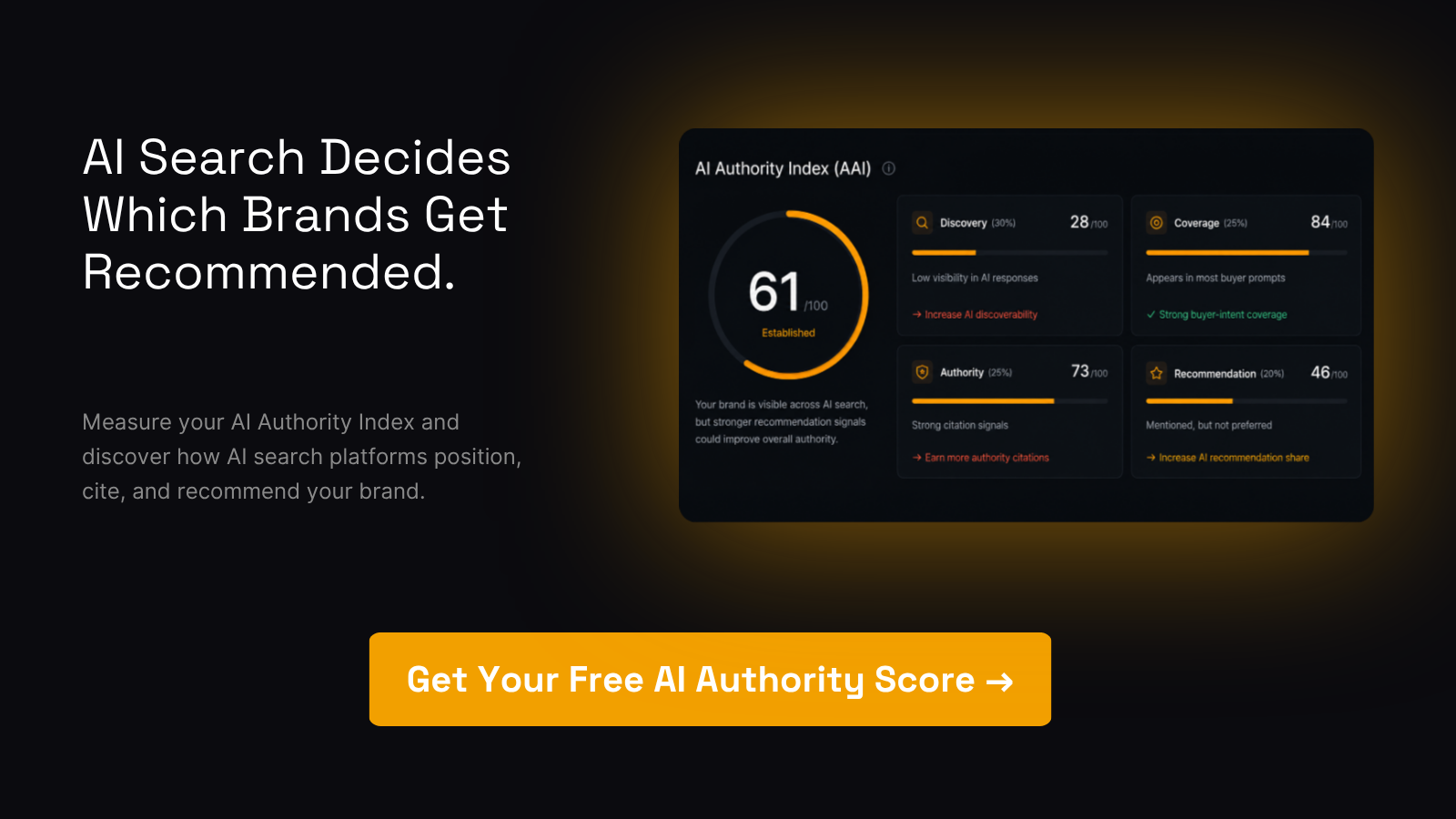
That distinction matters for pipeline attribution specifically: a manual prompt check tells you what one account saw once, while a standardized measurement pipeline shows whether your schema fixes, third-party mentions, and refreshed pages actually moved citation share over the following weeks. AuthorityLayer's AI Authority Index scoring surfaces exactly which competitors are winning specific queries so you know where to focus the next sprint. If you want a baseline before committing to a rollout, start with a free AI visibility scan and see where your current citation gaps actually sit.
Sources
- How To Rank In Perplexity AI: The Complete 2026 Guide - DigeHub
Run the same weekly prompt matrix described above in your own category before trusting any of these findings blindly. Category-specific results vary.
FAQ
How Can I Maximize My Use of Perplexity for Marketing?
Front-load extractable answers, implement Article and Person schema, keep product data synchronized if you sell online, and build third-party mentions on platforms your buyers actually use, then track citation movement with a repeatable weekly prompt set.
Is Perplexity Better Than ChatGPT for Brand Discovery?
They serve different purposes. Perplexity leans on retrieval from live web sources and cites them directly, making it more relevant for SEO/GEO visibility work, while ChatGPT often draws on training data and browsing depending on the mode.
How Do I Use Perplexity on Desktop More Efficiently?
Use the desktop interface to run consistent, repeatable prompt sets rather than one-off casual queries, since session personalization can skew results, and pair that with a standardized tracking tool like AuthorityLayer to catch trends a single account will miss.
How Can Marketing Teams Get Better Results From Perplexity AI?
Treat it as a citation engine, not a search bar: publish clear, sourced, front-loaded content, keep author credentials visible, and maintain a steady cadence of third-party mentions so the reranker has consensus signals to trust.
Recommended
- Generative Engine Optimization: Practical GEO Playbook | AuthorityLayer Insights
- Best Generative Engine Optimization Tools for 2026 | AuthorityLayer Insights
- Insights — AI Visibility Intelligence Reports | AuthorityLayer
- Best Tryprofound Alternatives for AI Visibility in 2026 | AuthorityLayer Insights