SPIV Over Guesswork: How Marketers Should Measure AI Visibility Prompts
Marketers: use SPIV to build measurable prompt sets, apply embeddings and scoring to track AI visibility reliably across models.
· 19 min read

Build a structured, coverage-first prompt set mapped to buyer journey stages and validated with repeatable metrics, not an ad-hoc list of terms you brainstormed in twenty minutes. That structure is what the SPIV framework (Signal, Purpose, Intent, Variance) formalizes. A representative prompt set beats a large one because coverage and repeatability, not volume, are what make AI visibility scores mean anything.
TL;DR:
- Cover prompts across market segments, buyer personas, intent stages, and context variables to ensure stable and meaningful AI visibility measurement.
- Use the SPIV framework to validate prompts by checking signal quality, purpose alignment, buyer stage relevance, and answer variance, rather than guessing or relying on volume.
- Prioritize diverse prompt categories—informational, comparative, instructional, brand, and transactional—to accurately assess different signals and avoid skewed results.
- Source prompts from multiple channels like SEO keywords, forums, transcripts, and AI-assisted generation, tagging them for easy auditing and clustering to improve coverage.
- Regularly review, score, and update your prompt set with a structured process, including validation against a golden eval set and monitoring metrics like entropy and response drift.
Table of Contents
- How to choose the right prompts for AI visibility monitoring
- What prompt categories should you monitor?
- How do you map prompts to the buyer journey?
- Where should you source prompt ideas?
- How do you prioritize which prompts to keep?
- What prompt design choices improve reliability?
- How do you validate and score your prompt set?
- How often should you update your prompt set?
- AuthorityLayer's approach to SPIV in practice
- How do you keep prompt sets fair across segments?
- How should you handle ambiguous or multi-intent prompts?
- Practical perspective: common mistakes and a defensive checklist
- Monthly AI Visibility Report: turning this checklist into a habit
- Sources
- FAQ
How to choose the right prompts for AI visibility monitoring
Most teams build their first AI visibility prompt list the way they'd build a keyword list in 2015: brainstorm what customers might ask, throw in a few competitor names, run it once, and call it done. That approach produces numbers, but not information. If your twenty prompts are all comparative, bottom-funnel questions ("X vs Y for enterprise teams"), your visibility score will swing wildly month to month and tell you nothing about whether ChatGPT or Gemini even knows your brand exists at the awareness stage.
The fix is coverage across four dimensions: market segments, buyer personas, journey/intent stages, and contextual variables (geography, model, phrasing style). A prompt set that samples deliberately across those axes gives you a picture that holds up under scrutiny, and one that changes for a reason you can name rather than random model drift.
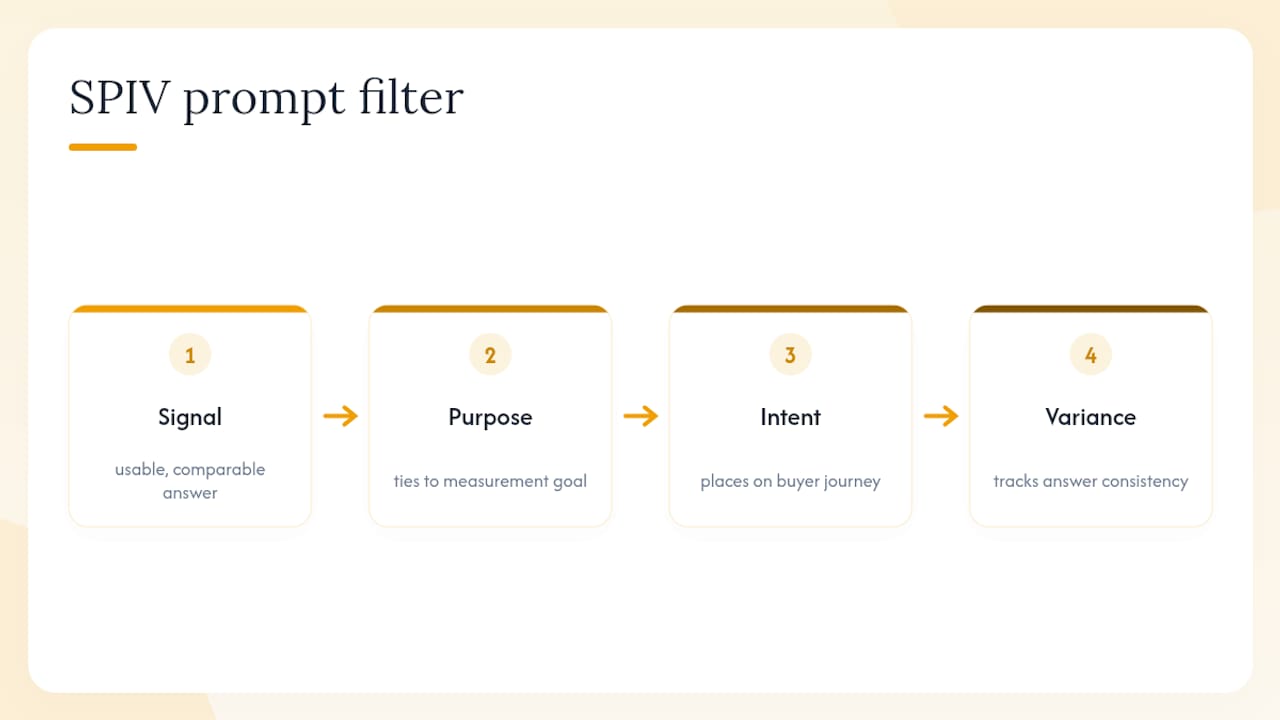
This is where SPIV comes in. Signal asks whether a prompt actually produces a usable, comparable answer across models rather than a refusal or a generic non-answer. Purpose ties each prompt to a specific measurement goal, brand awareness, competitive positioning, or conversion influence, so you know what a shift in the number means. Intent places the prompt on the buyer journey, because a question asked by someone comparing vendors carries different weight than one asked by someone who has never heard of the category. Variance tracks how much an answer changes across repeated runs, models, or phrasings, which tells you whether a result is signal or noise.
None of this replaces judgment. It gives judgment a repeatable process, which is the difference between a monitoring program and a monthly guessing exercise. Authoritylayer's own prompt tracking playbook walks through this in more operational detail, but the core discipline is what the rest of this guide covers: categorize, map, source, filter, design, validate, and maintain.
What prompt categories should you monitor?
Different prompt types surface different signals, and conflating them is the single most common mistake in AI visibility monitoring. A brand that scores well on instructional prompts ("how do I set up X") but invisible on comparative prompts ("best X for enterprise teams") has a completely different problem than a brand that's invisible everywhere.
Five categories cover most of what buyers actually ask AI assistants:
- Informational prompts ask general category questions ("what is a CRM for small teams") and measure whether your brand appears in category-level education, which is often the first place buyers encounter a brand's name.
- Comparative prompts ask the model to weigh options ("Salesforce vs HubSpot for a 20-person sales team") and measure recommendation share and positioning language, not just presence.
- Instructional prompts ask how to accomplish a task ("how to set up email automation") and measure whether your product gets named as the tool for doing the thing, a strong signal of practical trust.
- Brand-specific prompts ask directly about your company ("is [brand] good for mid-market companies") and measure how accurately and favorably the model describes you when asked point-blank.
- Transactional prompts signal near-purchase intent ("best [category] tool under $500/month") and measure whether you show up when the buyer is closest to deciding.
Mixing branded and unbranded phrasing inside each category matters more than most teams realize. Unbranded prompts tell you whether you earn visibility on merit; branded prompts tell you whether the model's existing knowledge of you is accurate and current. A brand that only tracks branded prompts is measuring its own echo, not its actual discoverability. Run both, and weight unbranded prompts more heavily if your KPI is new-buyer discovery rather than existing-customer reassurance.
How do you map prompts to the buyer journey?
Coverage across categories only works if you also distribute prompts across intent stages, because a prompt set weighted entirely toward one stage of the funnel will overstate or understate your real visibility depending on where the gaps sit.
Four buckets map cleanly onto how buyers actually use AI assistants during research:
- Awareness stage: category-education prompts like "what tools help teams manage remote onboarding," where the goal is simply appearing in the conversation at all.
- Evaluation stage: comparative and feature-specific prompts like "which platforms integrate with Slack for approvals," where positioning language and recommendation share matter more than raw presence.
- Conversion stage: transactional and pricing-adjacent prompts like "cheapest enterprise-grade options for X," where showing up close to a purchase decision has outsized business value.
- Post-purchase stage: support and troubleshooting prompts like "how to migrate data into [category] tool," where visibility affects retention and expansion rather than acquisition.
Weighting depends on what you're actually trying to move. If the KPI is top-of-funnel brand discovery, overweight awareness and evaluation prompts. If the KPI is pipeline influence, put more of your budget into evaluation and conversion prompts, since that's where AI assistants most directly shape a shortlist.
Persona and geographic variation is not optional polish; it's a coverage requirement. A prompt phrased for a "startup founder" and the same underlying question phrased for a "director of IT procurement" will surface different answers from the same model, because the model infers different needs from the framing. Similarly, a prompt run in the context of "for teams in Germany" versus no geographic qualifier can shift which local providers get named. If your buyers span multiple personas or regions, your prompt set needs deliberate variants for each, not a single generic phrasing you assume covers everyone.
Where should you source prompt ideas?
The candidate pool is where most monitoring programs quietly fail. Teams either rely on a single source (usually SEO keyword exports) and end up with a skewed, search-engine-shaped prompt set, or they generate prompts ad hoc with no record of where each one came from, making it impossible to audit coverage later.
A reproducible sourcing process pulls from seven places, roughly in this priority order:
- SEO question keywords from your existing keyword research, filtered for question-form and comparison-form queries.
- People Also Ask data, which surfaces the exact phrasing real searchers use for follow-up and clarifying questions.
- Community forums like Reddit threads or industry Slack/Discord communities, where buyers describe problems in their own words rather than marketing language.
- Sales and support transcripts, which are the single richest source of the actual questions prospects ask before they buy and customers ask after.
- Paid-search query reports, since advertisers already know which phrasings convert and those phrasings often make strong prompt candidates.
- LLM-assisted generation, where you ask a model itself to draft variant phrasings of a seed question, kept model-agnostic so you're not overfitting to one assistant's style.
- Tool-suggested prompts from AI visibility platforms that surface prompts based on category and competitor analysis.
Once you have a raw candidate pool, tag each prompt with source, category, intent stage, and persona metadata before you do anything else. Untagged prompts are unauditable prompts. Then use embeddings to cluster near-duplicate phrasings, a technique borrowed directly from prompt optimization research, where clustering candidate prompts by embedding similarity reduces the search space and lets you share information across similar prompts instead of testing each one in isolation. In practice, that means grouping "best CRM for small business" with "top CRM tools for small teams" rather than treating them as separate signals.
Refresh sourcing quarterly at minimum, monthly if your category moves fast (new competitors, new feature categories, seasonal buying patterns). Sample new prompts into your set gradually rather than replacing the whole list at once, or you'll lose the ability to compare trends over time.
Pro Tip: Keep a single source-of-truth spreadsheet with columns for source, category, intent stage, persona, and date added. It turns "why did our score jump this month" from a guessing game into a two-minute lookup.
How do you prioritize which prompts to keep?
Not every candidate prompt earns a spot in your monitoring set, and running everything is both expensive and noisy. A scoring rubric turns prioritization into a repeatable decision rather than a debate.
Score each candidate against six weighted criteria:
- Strategic relevance — does this prompt touch a segment, persona, or product line leadership actually cares about this quarter?
- Topic coverage — does it fill a gap in your category/intent matrix, or duplicate a prompt you already track?
- Volume proxy — does search or forum data suggest real buyers ask something like this, even if you can't measure LLM query volume directly?
- Repeatability — does the prompt produce a stable, comparable answer across repeated runs, or does phrasing sensitivity make it too noisy to trust?
- Expected variance — how much does the answer change across models and time, based on early testing?
- Cost to run — how many tokens, models, and repeat runs does tracking this prompt require monthly?
The academic framing for this problem is useful even if you never touch the underlying math: prompt selection under a fixed budget can be treated as a best-arm identification problem, where the goal is finding the highest-value prompts without exhaustively testing every candidate. You don't need the algorithm. You need the principle: allocate your limited monitoring budget toward prompts most likely to yield a stable, decision-useful signal, and cut the ones that don't.
The budget reality: Most mid-market teams can reliably manage a monitoring set of a moderate number of prompts across multiple models before cost and analysis overhead start outweighing the marginal insight from adding more.
A practical pruning workflow moves prompts through three gates. First, does it pass the relevance and coverage screen? If not, discard. Second, does a two-week pilot run show acceptable variance, meaning the answer doesn't flip wildly between runs? If not, revise the phrasing or discard. Third, does the cost per prompt fit your monthly budget once multiplied across models and cadence? Whatever survives all three gates becomes your active monitoring set.
What prompt design choices improve reliability?
A prompt that generates a different-shaped answer every time you run it is worse than useless. It's actively misleading, because it makes noise look like a trend.
Structure reduces that noise. Put instructions first, then context, then the question, and use delimiters like ### or triple quotes to separate sections clearly. This kind of instruction-first structure with clear delimiters measurably improves repeatability and cuts down on hallucinated tangents. Decide up front whether you need free-form text or a structured output. Free-form answers are easier for a human to read quickly; a JSON schema forces the model to commit to specific fields (brand mentioned: yes/no, position in list, sentiment), which makes automated scoring far more reliable at scale.
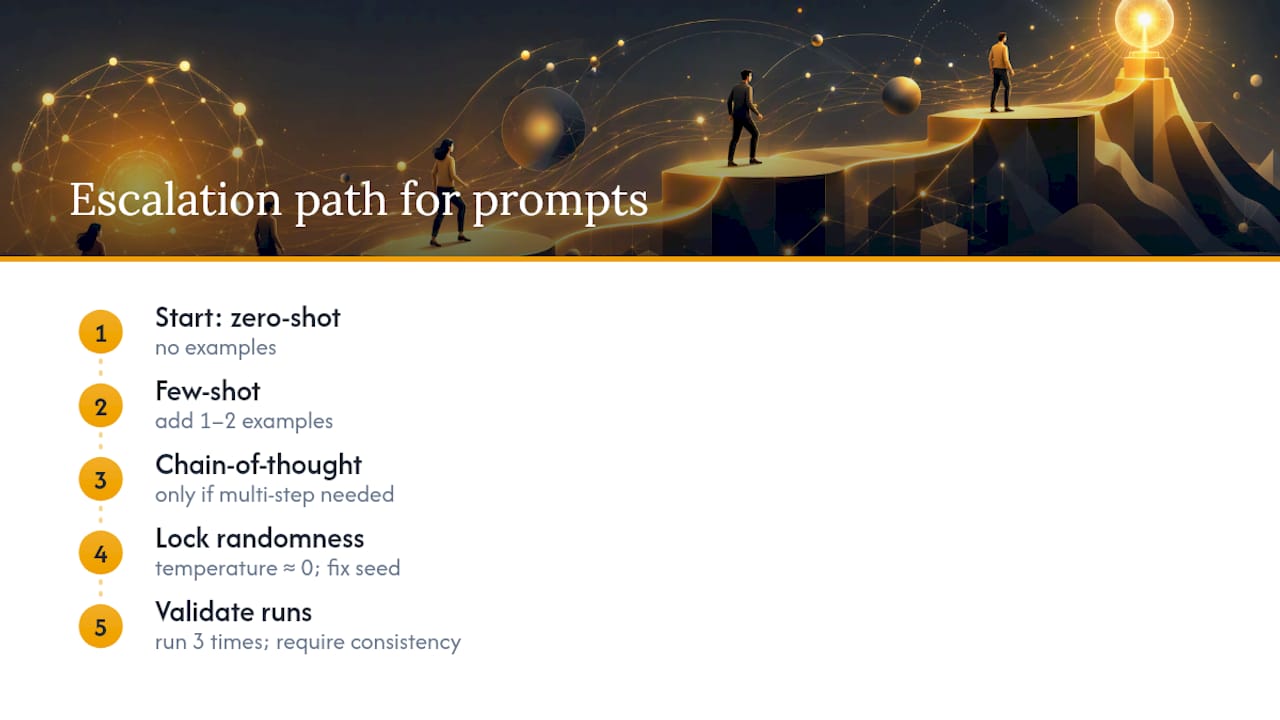
Follow a simple escalation path when a prompt underperforms: start zero-shot (no examples), move to one or two examples (few-shot) if answers are inconsistent, and only add chain-of-thought instructions if the question genuinely requires multi-step reasoning. Most AI visibility prompts don't need chain-of-thought at all, since you're asking the model to recall and rank, not solve a problem. For factual, comparison-style prompts, lock the temperature at or near zero and keep the seed fixed where the API allows it, since low temperature settings are what make repeated runs comparable rather than a new roll of the dice each time.
Write prompts in plain, provider-agnostic markdown rather than syntax specific to one model's quirks, so the same prompt set produces genuinely comparable answers whether you run it through ChatGPT, Claude, Gemini, or Perplexity, a principle laid out clearly in cross-model prompt optimization guidance. For fairness testing and reworded variants, techniques for producing natural, comparable phrasing are covered well in guidance on writing prompts that read naturally across different framings.
To cut hallucinated brand mentions, build a refusal path directly into the prompt. Instructing the model to say "not enough information" when it lacks a confident answer, rather than guessing, is a documented technique for reducing fabricated responses, and it matters enormously for visibility monitoring, where a hallucinated competitor mention can quietly distort your competitive share numbers for months.
Pro Tip: Run every new prompt candidate through the same model three times before adding it to your set. If the brand list, ranking, or sentiment changes noticeably across those three runs, the prompt isn't ready to monitor yet, it's ready to be rewritten.
How do you validate and score your prompt set?
A prompt earns a permanent place in your monitoring set only after it passes a validation protocol, not after someone on the team likes how it reads.
Start with a golden eval set, a fixed group of at least 20 to 30 prompts with manually reviewed expected answer characteristics (should the brand appear, in what position, with what sentiment). OpenAI's own guidance on model accuracy recommends exactly this: optimize the prompt first and build an eval set before reaching for more complex fixes like retrieval-augmented generation or fine-tuning. Run each candidate against that eval set and calculate a pass rate.
Pass-rate thresholds borrowed from prompt engineering practice give you a concrete decision table:
| Pass rate | Action |
|---|---|
| — | Ship as zero-shot, monitor as-is |
| — | Add one worked example (one-shot) and retest |
| — | Move to few-shot with two or three examples |
| — | Rewrite the prompt structure or drop it from the set |
This kind of eval pass-rate decision table turns "does this prompt work" from a vibe check into a documented threshold anyone on the team can apply consistently.
Beyond pass rate, four metrics do the heavy lifting in ongoing SPIV-based measurement. Entropy measures how scattered the model's brand mentions are across a category prompt, high entropy means no brand dominates the conversation, which is actually informative context for your recommendation share number. Gini measures concentration, essentially the inverse of entropy, useful for spotting when one competitor has quietly captured a disproportionate share of mentions. Recommendation share tracks what percentage of relevant answers name your brand specifically versus competitors. Response drift tracks how much an individual prompt's answer changes week over week, which separates real market movement from ordinary model noise. Calibration methods that adjust for a model's baseline tendency to favor certain phrasings, an approach shown to meaningfully improve prompt selection accuracy, are worth building into your scoring pipeline if you're running this at scale.
Retest your full active set across all tracked models at least monthly, and rerun a smaller sample weekly if the category is volatile. A sudden entropy spike or a recommendation-share drop that shows up on one model but not others is usually a model update, not a real market shift, and knowing the difference is the entire point of tracking these metrics in the first place.
How often should you update your prompt set?
Treat your prompt set like a codebase, not a spreadsheet you edit whenever someone has a new idea. Give every prompt a stable ID and a changelog entry noting who added it, why, and what category and intent stage it belongs to.
A workable lifecycle process has four parts:
- Stage new prompts in a pilot pool for two weeks of variance testing before they enter the active monitoring set.
- Automate replay on a fixed schedule, weekly for a volatile sample, monthly for the full set, across every model you track.
- Set anomaly thresholds on entropy and SPIV scores so a sudden swing triggers a review rather than getting reported as fact.
- Roll back any prompt that starts failing its pass-rate threshold to its last validated version, or retire it, rather than letting a broken prompt quietly corrupt a monthly report.
Ownership should be explicit: SEO or content teams typically propose new prompts from keyword and forum research, analytics owns the scoring and anomaly detection, and product or content leadership signs off before a prompt affects a reported metric. Authoritylayer's prompt monitoring playbook lays out a fuller version of this handoff structure for teams running it across multiple brands or product lines.
AuthorityLayer's approach to SPIV in practice
SPIV isn't a theoretical framework we built for this article. It's how Authoritylayer scores prompt sets for every brand it monitors, translating academic prompt-selection research (embedding clusters, calibrated scoring, fixed-budget selection) into something a marketing team can actually run monthly.
- Signal filters out prompts that produce refusals or unusable answers before they ever reach a report.
- Purpose ties every tracked prompt to a specific business question, not just a category topic.
- Intent places each prompt on the buyer journey so awareness gaps and conversion gaps get reported separately.
- Variance flags unstable prompts automatically rather than letting noisy data sit in a client dashboard unquestioned.
The full scoring logic is documented in Authoritylayer's methodology and in a companion piece breaking down SPIV, entropy, and Gini as tracked metrics..
How do you keep prompt sets fair across segments?
Bias in an AI visibility prompt set usually isn't dramatic. It's structural, and it creeps in quietly. A prompt set built mostly from enterprise sales transcripts will systematically underrepresent how a model answers small-business buyers, even though nobody chose that outcome on purpose.
Three checks catch most of this. Second, phrase-test the same underlying question across different registers, casual consumer phrasing versus formal procurement phrasing, since models sometimes surface different brands depending on how technical or informal the question sounds. Third, watch for geographic skew: a prompt with no location qualifier often defaults to whatever market the model's training data weights most heavily, usually the United States, which can quietly erase visibility gaps in other regions if you never test location-specific variants.
Fairness here isn't an abstract ethics exercise. It's a measurement integrity issue. A prompt set skewed toward one persona or geography will tell you a comfortable story about your visibility that simply isn't true for the segments you didn't test. The fix is the same coverage discipline from earlier in this guide: deliberately sample personas, phrasing registers, and geographies rather than defaulting to whichever transcripts were easiest to pull.
How should you handle ambiguous or multi-intent prompts?
Real buyer questions are messy. "Best tool for managing a remote team" could be about project management, communication, time tracking, or all three, and a model will often just pick one interpretation and answer confidently, hiding the ambiguity from you entirely.
Two approaches handle this well. The first is prompt splitting: instead of tracking one ambiguous prompt, break it into two or three explicit variants ("best project management tool for remote teams," "best communication tool for remote teams") so you're measuring distinct signals instead of one blended, unpredictable one. The second is deliberate ambiguity tracking, where you keep the ambiguous version in your set specifically because real buyers ask it that way, and you track which interpretation the model defaults to over time as its own signal. A model that consistently resolves "best tool for remote teams" toward project management software rather than communication software is telling you something real about category association, and that shift itself becomes worth monitoring.
Multi-intent prompts that combine a comparison with a use case, like "which CRM is best for a remote sales team on a budget," need a documented judging rubric before you run them at scale, since a human reviewer scoring "did the brand appear" needs to know whether partial relevance counts. Set that rule during your golden eval-set review, not after you've already collected three months of inconsistent data.
Practical perspective: common mistakes and a defensive checklist
The most common failure is not a bad prompt. It's an unowned prompt set, one nobody audits, versions, or maps back to SPIV. Teams chase volume ("we track 200 prompts") over coverage and end up with a number that moves for reasons nobody can explain.
A six-point checklist fixes most of this: tag every prompt's source and intent stage, cap variance before a prompt goes live, weight branded and unbranded prompts separately, rerun your golden eval set monthly, automate replay rather than manually rerunning prompts, and review entropy shifts before reporting any headline number as fact.
— Geraldine
Monthly AI Visibility Report: turning this checklist into a habit
Building and maintaining a SPIV-scored prompt set by hand, sourcing candidates, clustering embeddings, running pass-rate evals, tracking entropy and drift across four models, is a real operational lift, and most marketing teams don't have a spare analyst to own it full time. That's exactly the gap Authoritylayer's Monthly AI Visibility Report was built to close.
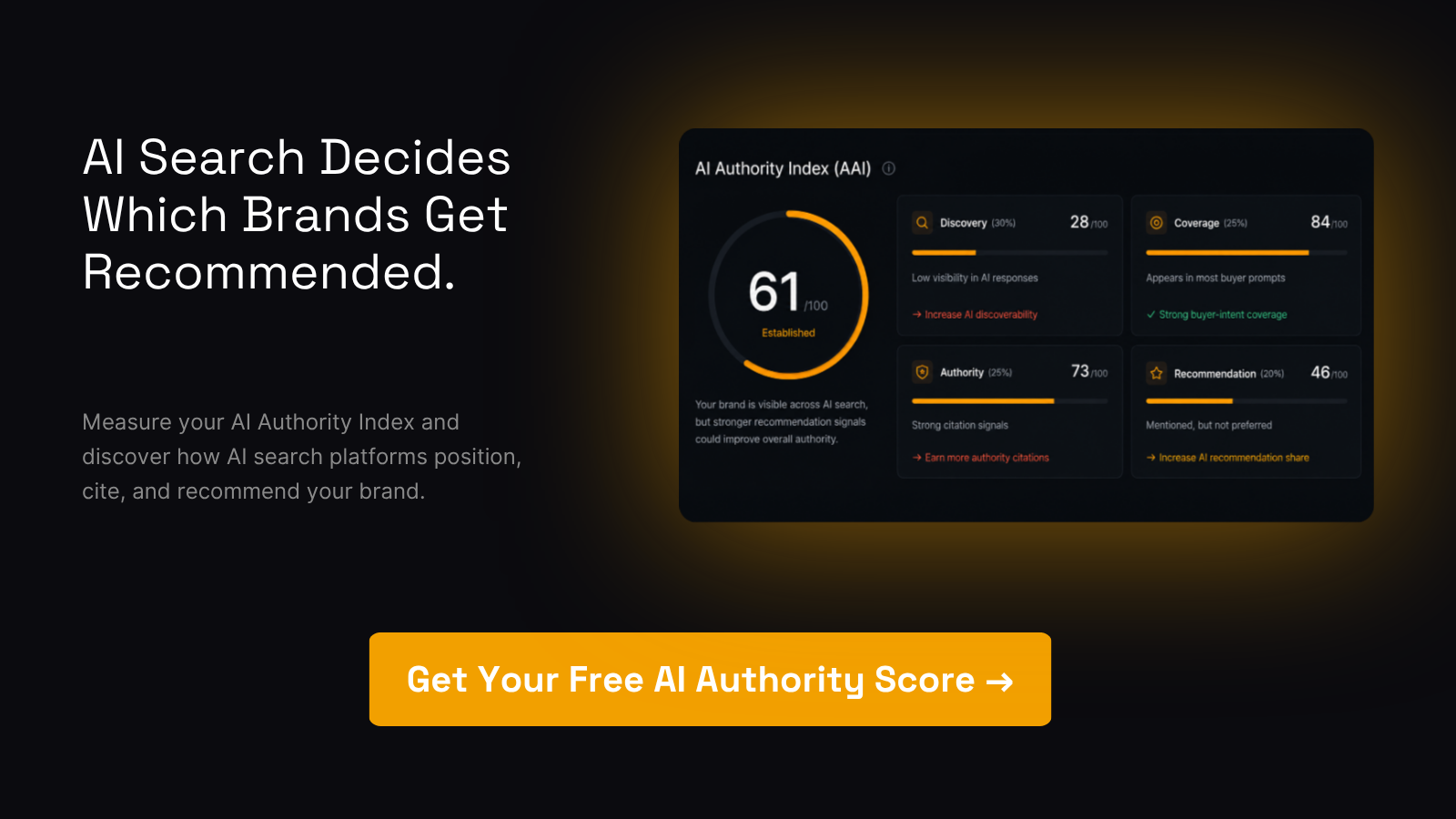
Each report scores your active prompt set against SPIV, tracks entropy and Gini shifts month over month, and reports recommendation share against named competitors across ChatGPT, Gemini, Claude, and Perplexity. Instead of your team manually replaying prompts and eyeballing screenshots, you get a delivered breakdown of where your brand gained or lost ground, and why, tied back to the same intent-stage and persona coverage this guide walks through. If you've been running an ad-hoc prompt list and want a structured baseline instead, the Monthly AI Visibility Report is the fastest way to see where your current coverage actually stands.
Sources
- Best practices for prompt engineering with the OpenAI API | OpenAI Help Center
- Efficient Prompt Optimization Through the Lens of Best Arm Identification
- On probability-based prompt selection methods and calibration (TACL 2024)
- Optimizing LLM Accuracy | OpenAI API
- Optimizing Prompts | Prompt Engineering Guide
FAQ
How do you choose the best AI visibility monitoring tool?
Look for a platform that tracks recommendation share, entropy, and response variability across multiple models, not just presence/absence counts, since a tool that only tells you "you were mentioned" misses whether that mention was favorable or stable over time.
How do you give AI models accurate prompts for reliable results?
Put instructions first, use delimiters to separate context from the question, specify the output format explicitly, and keep temperature low for factual comparison prompts, all of which improve repeatability and reduce hallucinated answers.
Can prompt design help avoid AI hallucination in monitoring reports?
Yes. Instructing the model to say "not enough information" instead of guessing, combined with a validated golden eval set, meaningfully reduces fabricated or inconsistent answers that would otherwise distort your visibility scores.
What are the best prompts to use for AI visibility monitoring?
The strongest sets mix informational, comparative, instructional, brand-specific, and transactional prompts across awareness, evaluation, conversion, and post-purchase intent stages, scored for repeatability rather than picked at random.
How many prompts should a monitoring program track?
Most mid-market programs manage a reliable set of 30 to 80 prompts across three or four models; going larger without a scoring and pruning process usually adds cost and noise rather than better insight.