AI Answer Evaluation for Marketing Leaders: Measure and Win
Unlock your brand's potential with effective AI answer evaluation. Measure visibility, enhance recommendations, and drive real growth today!
· 12 min read

Effective AI answer evaluation measures four signals simultaneously: mentions, citations, linked sources, and recommendation strength, and then traces where in the retrieval-to-recommendation funnel your brand loses share. Run a 50–200 prompt cross-assistant probe across ChatGPT, Claude, Gemini, and Perplexity within the next 30 days. That single diagnostic will tell you more about your brand's actual AI visibility than six months of rank tracking.
The framing matters. AI visibility is now a brand reputation challenge, not a technical SEO task. An assistant that mentions your brand but never recommends it is not a win. A citation without a linked source is not a win. The only outcome that drives pipeline is a recommendation at the decision moment, and most brands are nowhere near that.
Pro Tip: Brief your CMO with one number: recommendation share, the percentage of relevant probes where your brand received an explicit recommendation. Everything else is diagnostic.
Key Takeaways
Effective AI answer evaluation requires tracking all four signals simultaneously — recommendation share is the only one that maps directly to pipeline.
| Point | Details |
|---|---|
| Four-signal framework | Measure mentions, citations, linked sources, and recommendation strength — not mentions alone. |
| The Linkage Gap | 75.7% of known brand facts go undeployed in AI purchase recommendations; closing this gap is the highest-leverage fix. |
| Tier-specific remediation | L1–L2 brands need differentiation work; L4–L5 brands need discoverability first, per the 37,000-run audit. |
| Probe cadence | Run a 50–200 prompt cross-assistant probe within 30 days to establish baseline recommendation share. |
| Authoritylayer | Automates four-signal tracking across ChatGPT, Claude, Gemini, and Perplexity; free scan available at authoritylayer.app. |
Table of Contents
- Why does evaluating AI answers belong in your marketing budget?
- What to measure: the four-signal framework
- How to run a repeatable AI answer evaluation
- How to interpret results and set KPIs
- Layer 3 Activation: closing the gap between known and recommended
- Operationalizing evaluation: who does what and when
- Typical timeline and cost for an evaluation program
- What the empirical evidence actually shows
- The priority that most marketing teams get wrong this quarter
- Authoritylayer gives you the infrastructure to run this at scale
- Sources
- FAQ
Why does evaluating AI answers belong in your marketing budget?
The Linkage Gap is the core problem. The model knew the facts. It just didn't use them when a buyer asked which brand to choose.

That gap has a direct business cost. AI assistants now form early brand impressions that can replace owned channels entirely. A buyer who asks Perplexity "which project management platform should I use?" and gets three names back is not visiting your homepage next. If your brand isn't in those three names, you lost the impression before the funnel even started.
Pro Tip: Assign cross-functional ownership immediately: SEO or GEO leads own probe design, content ops owns fact deployment, and the CMO owns the recommendation share KPI. Without a named owner, the data sits in a spreadsheet.
What to measure: the four-signal framework
Tracking mentions alone misses the behaviors that actually drive outcomes.
The four signals work as a diagnostic stack:
- Mentions: Your brand name appears anywhere in the answer. The baseline signal, and the easiest to inflate.
- Citations: The assistant attributes a specific fact, claim, or data point to your brand. Harder to earn, more durable.
- Linked sources: The answer includes a hyperlink pointing to a page you own or control. Strongest structural signal of authority.
- Recommendation strength: The assistant explicitly recommends your brand for the user's stated need, not merely lists it. The only signal that maps directly to pipeline.
A brand with high mention share but low recommendation strength has a deployment problem, not a discoverability problem. That distinction changes where you invest.
| Signal | What it measures | How to compute |
|---|---|---|
| Mention share | % of probes where brand appears | Brand mentions ÷ total probes |
| Citation share | % of probes with a sourced brand fact | Cited probes ÷ total probes |
| Linked source rate | % of probes with an owned link | Linked probes ÷ total probes |
| Recommendation share | % of probes with explicit recommendation | Recommended probes ÷ total probes |
Recommendation share is the metric executives should see on their dashboard. The others are diagnostic levers that explain why recommendation share is where it is.
How to run a repeatable AI answer evaluation
A one-off probe tells you where you stand today. A repeatable methodology tells you whether your interventions are working. The difference is discipline in prompt design and scoring.
Step 1: Select assistants. Run probes across at least four platforms: OpenAI (ChatGPT), Anthropic (Claude), Google (Gemini), and Perplexity. Each retrieves and weights sources differently, so a brand that performs well on one can be invisible on another. Understanding how AI models shape their responses helps you design prompts that reveal real deployment behavior rather than surface-level mentions.
Step 2: Design prompt clusters. Group prompts by buyer intent: discovery ("what are the best tools for X?"), comparison ("how does Brand A compare to Brand B?"), and decision ("which should I choose for Y use case?"). Each cluster reveals a different failure mode.
Step 3: Add persona variants. Run the same prompt as a first-time buyer, an experienced practitioner, and a budget-constrained buyer. Assistants often return different recommendations depending on framing.
Step 4: Score per turn. Track each assistant turn separately. A brand mentioned in turn one but dropped by turn three has an activation problem at the decision moment.
Step 5: Apply binary scoring first, then grade. Mark each probe as mention/no mention, citation/no citation, link/no link, recommendation/no recommendation. Once you have binary baselines, add a 1–3 strength score to recommendation turns.
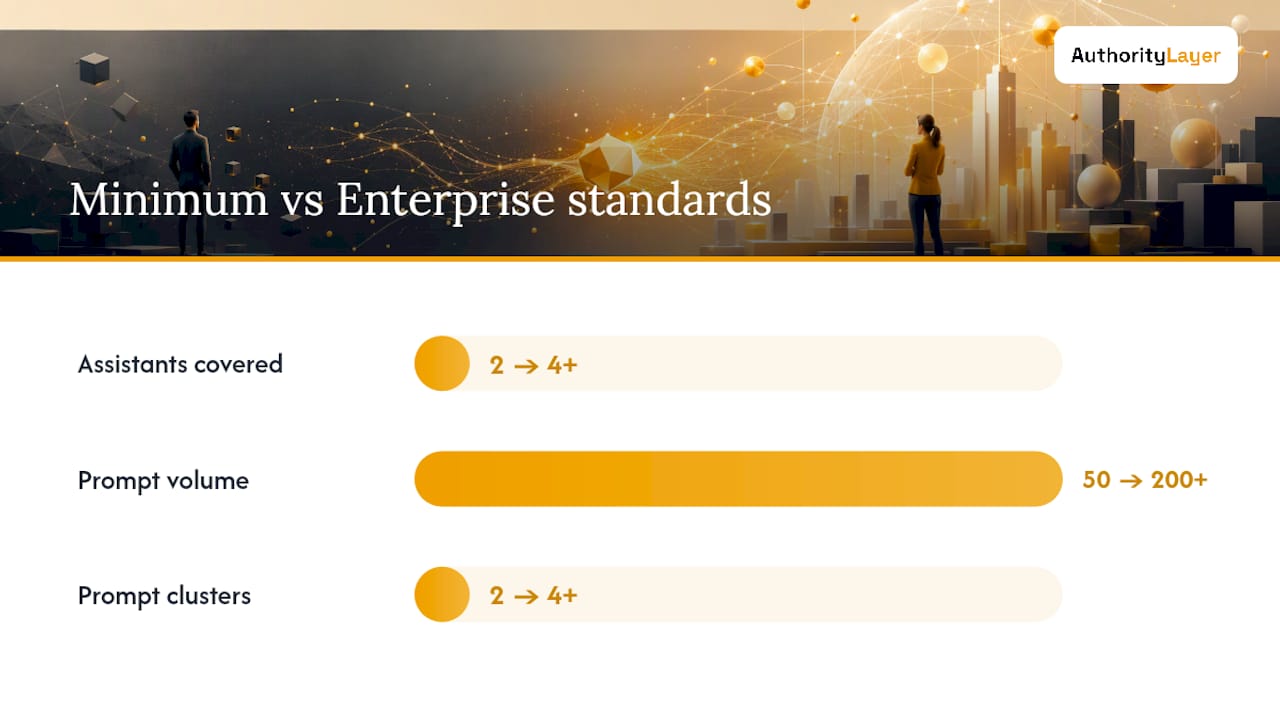
| Methodology element | Minimum standard | Enterprise standard |
|---|---|---|
| Assistants covered | 2 (ChatGPT, Perplexity) | 4+ (ChatGPT, Claude, Gemini, Perplexity) |
| Prompt volume | 50 probes | 200+ probes |
| Prompt clusters | 2 (discovery, decision) | 4+ (discovery, comparison, decision, objection) |
| Scoring | Binary per signal | Binary + graded recommendation strength |
| Cadence | Monthly | Weekly monitoring, monthly deep audit |
Pro Tip: Always include a "why not Brand X?" prompt. Negative-framing probes reveal objections the assistant has absorbed from third-party content, which are often harder to fix than missing mentions.
How to interpret results and set KPIs
The prominence-stratified audit of ~37,000 production runs found that failure modes differ sharply by brand tier. Category leaders (L1–L2) are usually retrieved but fail to convert. Long-tail specialists (L4–L5) often never surface at all. One-size-fits-all remediation misallocates budget.
- L1–L2 brands (category leaders): High mention share, low recommendation strength. The problem is differentiation. Assistants treat these brands as interchangeable. Fix: canonical fact mapping and answer-ready differentiation snippets.
- L3 brands (established challengers): Inconsistent citation. Appears in some assistants, absent in others. Fix: authority-linked anchors and structured content that gives assistants a clear, citable source.
- L4–L5 brands (long-tail specialists): Low mention share across the board. Fix: discoverability work first, activation second.
"Brands optimized toward popular content risk a 'sameness' outcome," according to HBR's analysis of AI brand surfacing. Upstream positioning must be defined before AI amplification, or assistants will compress your brand toward the category center.
KPIs to publish to your exec dashboard:
- Recommendation share (primary)
- Citation share (diagnostic)
- Activation rate: % of decision-turn probes where a linked source appeared
- Linkage Gap score: % of known brand facts not deployed in recommendation probes
Layer 3 Activation: closing the gap between known and recommended
Possession of brand facts in an LLM's training data is not enough. Activation is the work of surfacing the right fact at the exact turn a buyer is deciding. Here is the playbook:
- Map canonical facts. List every claim that differentiates your brand: pricing structure, proof points, certifications, customer outcomes. These are your deployment targets.
- Write answer-ready snippets. Each fact needs a 40–60 word, self-contained paragraph that an assistant can lift verbatim. No jargon, no marketing language. Plain declarative sentences.
- Publish with authority-linked anchors. Each snippet needs a canonical URL. Publish on your own domain, then earn third-party citations pointing to that URL. Assistants weight linked sources heavily.
- Target conversational trigger points. Identify the exact question phrasing that precedes a recommendation turn in your probe data. Write content that answers that question directly.
Pro Tip: Structured data markup (FAQ schema, HowTo schema) increases the probability that an assistant retrieves your snippet at the right turn. It is not a guarantee, but it is a consistent signal.
- Publish a canonical "why us" page with structured FAQ markup
- Update product pages with proof-point paragraphs, not just feature lists
- Earn citations from industry publications that assistants weight as authoritative
Pro Tip: Align your AI search strategy with content ops before publishing new snippets. Inconsistent claims across properties cause assistants to surface older or conflicting positioning.
Operationalizing evaluation: who does what and when
Structured content and central governance reduce the risk of assistants surfacing outdated messaging. That requires clear ownership, not just good intentions.
| Role | Responsibility | Cadence |
|---|---|---|
| SEO/GEO lead | Probe design, scoring, signal tracking | Weekly |
| Content ops | Snippet publishing, fact governance | Bi-weekly |
| Demand gen | Recommendation share reporting | Monthly |
| CMO | Dashboard review, budget allocation | Quarterly |
The tooling must provide: real-time monitoring across assistants, prompt-level traceability (which prompt triggered which response), multi-assistant scans in a single workflow, and source provenance tracking so you know which third-party pages are driving citations. Authoritylayer's platform capabilities cover all four.
- Weekly: run 20–30 probes across two assistants, flag new mention drops or recommendation losses
- Monthly: full 200-probe audit across four assistants, update KPI dashboard
- Quarterly: review Linkage Gap score, reprioritize activation targets, brief exec team
Typical timeline and cost for an evaluation program
| Phase | Timeline | Key deliverables | Success metric |
|---|---|---|---|
| Pilot | Days 1–30 | Baseline probe (50 probes), four-signal scores, Linkage Gap score | Recommendation share established |
| Scale | Days 31 to 90 | 200-probe audit, activation snippets published, KPI dashboard live | Citation share up, activation rate tracked |
| Embed | Days 91 to 180 | Continuous monitoring, quarterly exec reporting, activation iteration | Recommendation share improvement vs. baseline |
Cost bands vary by scope. A pilot using internal resources plus a monitoring tool typically runs $3,000–$8,000 for the first 30 days. A full-scale program with agency support and enterprise tooling runs $15,000–$40,000 per quarter. See Authoritylayer's pricing for platform-specific tiers.
- Internal effort: 8–15 hours/month for a dedicated GEO or SEO lead at pilot scale
- Tooling: the largest variable; platforms range from self-serve to enterprise tiers
- Agency hours: optional for prompt design and activation content writing
What the empirical evidence actually shows
The Linkage Gap research is the clearest quantitative case for this investment.
75.7% of known brand facts are not deployed during AI purchase recommendations — even when the model has already retrieved them. Closing that gap is the highest-leverage intervention available to most marketing teams right now.
- The ~37,000-run prominence audit confirms that failure modes are tier-specific, so generic optimization wastes budget
- Controlled tests show that activation at the decision turn produces the largest measurable lift
- Present these figures to your CFO as a conversion engineering argument, not a brand awareness argument
To present this to executives: frame the Linkage Gap score as a conversion leak, not a visibility metric.
The priority that most marketing teams get wrong this quarter
Most teams I see are still measuring AI visibility the way they measured organic search: impressions and rankings. That framing misses the entire second half of the problem.
The Linkage Gap data makes the case plainly. Your brand being "known" to an LLM is table stakes. The question is whether it gets used at the moment a buyer is deciding. That is an activation problem, and it requires a different kind of work than SEO: canonical fact mapping, answer-ready content, and prompt-level tracing to know exactly where the gap opens.
Three priorities for this quarter: first, run the baseline probe and establish your recommendation share. Second, identify your top three undeployed facts and publish answer-ready snippets for each. Third, set up weekly monitoring so you catch recommendation drops before they compound.
Sequence matters by tier. If you are an L4–L5 brand, discoverability comes before activation. If you are an L1–L2 brand, you almost certainly have a differentiation and deployment problem, not a reach problem.
Authoritylayer gives you the infrastructure to run this at scale
Most marketing teams have the intent to run AI answer evaluations. What they lack is the infrastructure to do it consistently, at scale, across four assistants simultaneously.
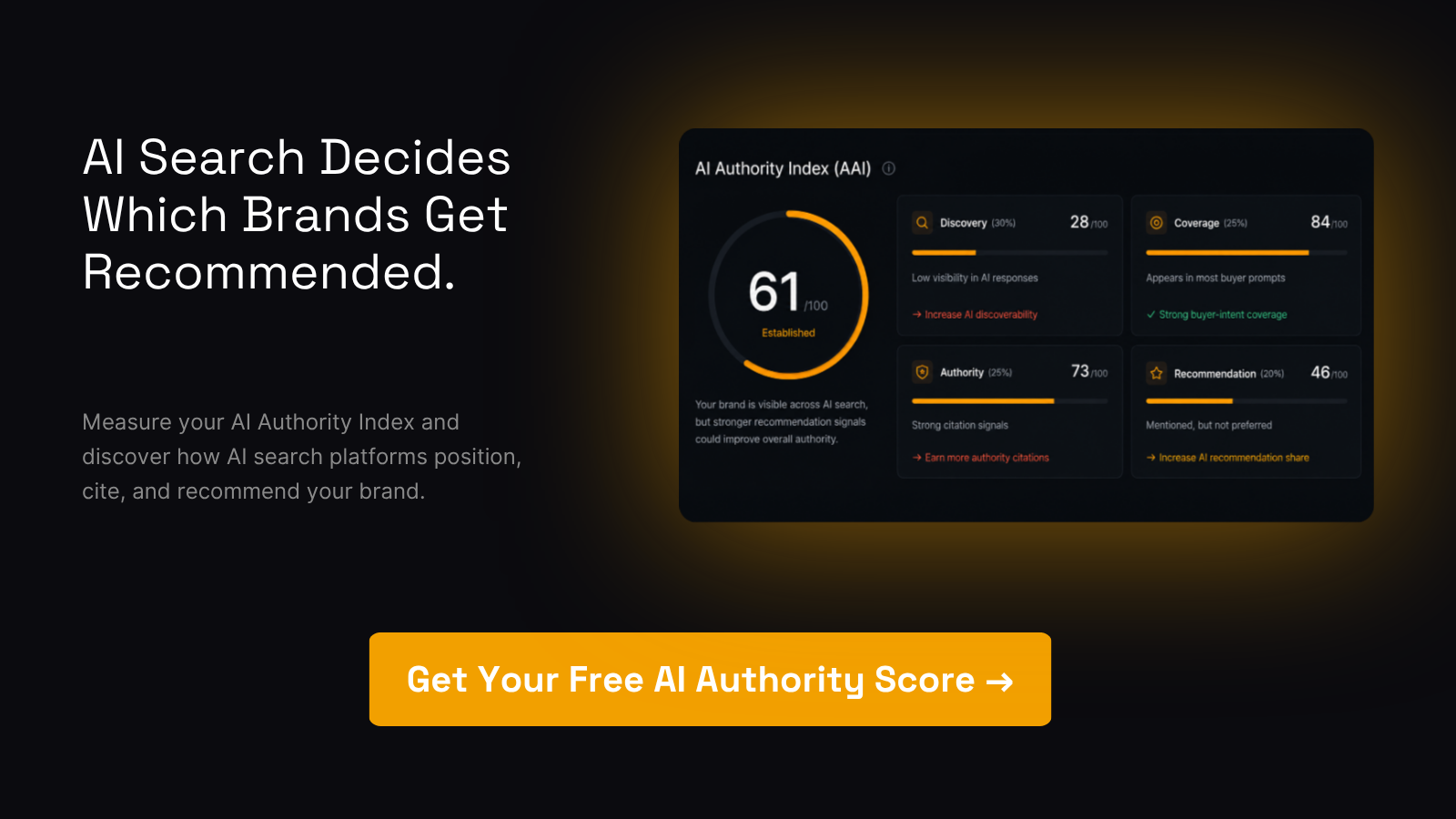
Authoritylayer is the AI visibility intelligence platform built specifically for this workflow. It runs real-time monitoring across ChatGPT, Claude, Gemini, and Perplexity, tracks recommendation share at the prompt level, maps your Linkage Gap score, and surfaces prioritized activation targets. Every signal in the four-signal framework is tracked automatically, so your GEO lead spends time on remediation, not spreadsheet management.
The free AI visibility scan gives you a baseline recommendation share score and Linkage Gap estimate within 24 hours. Enterprise teams get custom prompt libraries, multi-brand dashboards, and dedicated activation playbook support. Run your free scan to see exactly where your brand stands today.
Sources
The claims in this article draw on the following primary sources:
- Beyond Visibility: The Linkage Gap and the case for a third layer of AI-native brand infrastructure
- Prominence-Stratified Failure Modes in Retrieval-Augmented Commercial Recommendation: A 37,000-Run Audit
- Measuring brand presence across AI answer engines
- How to get AI to surface your brand
- AI discovery is now a brand reputation challenge
FAQ
What is AI answer evaluation for brands?
AI answer evaluation measures how AI assistants like ChatGPT, Claude, Gemini, and Perplexity mention, cite, link to, and recommend your brand during buyer research. It uses a four-signal framework to diagnose where in the retrieval-to-recommendation funnel your brand loses share.
What is the Linkage Gap?
The Linkage Gap is the difference between facts an LLM has retrieved about your brand and facts it actually deploys during a purchase recommendation.
How many prompts do you need for a reliable baseline?
A minimum of 50 prompts across two assistants establishes a usable baseline. For statistically reliable benchmarks, 200 prompts across four assistants is the standard, covering discovery, comparison, and decision intent clusters.
Which AI assistants should you include in an audit?
Include ChatGPT, Claude, Gemini, and Perplexity at minimum. Each retrieves and weights sources differently, so a brand visible on one can be absent on another.
How does Authoritylayer support AI answer evaluation?
Authoritylayer tracks all four signals automatically across multiple assistants, maps your Linkage Gap score, and surfaces prioritized activation targets. A free AI visibility scan at authoritylayer.app provides a baseline recommendation share score within 24 hours.
Recommended
- Knowledge Base for AI: What Marketing Leaders Need in 2026 | AuthorityLayer Insights
- Best AI Visibility Tools for Marketing Teams in 2026 | AuthorityLayer Insights
- AI Search Strategy: A CMO Playbook for 2026 | AuthorityLayer Insights
- AI Competitive Intelligence: What Actually Moves Recommendation Share | AuthorityLayer Insights