ChatGPT Restaurant Picks: Owners & Diners Should Check NAP
How ChatGPT ranks restaurants, why it may miss yours, and proven fixes: schema, NAP consistency, descriptive reviews, and reservation feeds to boost...
· 9 min read

ChatGPT decides which restaurants to recommend by blending its underlying language-model knowledge with live web search, structured business listings, and whatever context you provide, such as location and taste preferences, according to OpenAI's own documentation. Personalization through saved memories and reservation partner feeds then shape which specific names rise to the top, a process AuthorityLayer tracks for brands trying to understand their own visibility in these answers.
TL;DR:
- Restaurants with consistent, accurate listings across directories and reservation feeds are more likely to be recommended by ChatGPT, especially if they are included in booking partnerships.
- Freshness of data impacts recommendations, meaning closed restaurants or those with outdated information can still appear, so verification is essential before booking.
- Clear, detailed prompts from users that specify occasion, dietary needs, location, and price range improve the relevance of AI-generated restaurant suggestions.
- Improving your restaurant’s authority signals—such as schema markup, review quality, and reservation feed inclusion—directly increases its risk of surfacing in AI recommendations.
- Regular AI visibility scans help restaurants track and enhance their recommendation share, ensuring their digital presence aligns with AI-driven discovery.
Table of Contents
- How ChatGPT finds and ranks candidate restaurants
- How user context, prompts, and memory shape personalized recommendations
- How reservation integrations and plugins affect recommendations and booking
- Limits, biases, and reliability: where recommendations can go wrong
- AuthorityLayer: measuring and improving your chance of being recommended
- Actionable takeaways for diners and restaurant owners
- See where your restaurant stands with a free AI visibility scan
- FAQ
- Sources
How ChatGPT finds and ranks candidate restaurants
When you ask for a dinner spot, ChatGPT does not simply recall a fixed list from training. It typically rewrites your question into a more targeted search query, then, depending on the request, calls on third-party search partners to pull in current information, a process OpenAI describes in its ChatGPT Search help documentation. This rewriting step matters because a vague prompt like "good dinner spot" gets reshaped using whatever details you supplied, including cuisine, budget, or occasion.
Once the query is rewritten, candidate restaurants get assembled from a mix of sources: structured business listings, restaurant directories, and content the web search partner has indexed. The system then narrows that pool down using a few ranking priorities.
- Prompt match: how well a restaurant's cuisine, price point, or stated occasion fits what you asked for.
- Proximity: whether the restaurant sits near your approximate or precise location.
- Corroboration: whether multiple independent sources describe the restaurant the same way.
That last point is often the deciding factor. A restaurant whose name, address, and specialties show up consistently across a directory, a review site, and its own website reads as more reliable than one with scattered or conflicting mentions. Industry explainers on AI discovery make a similar point: consistency across sources functions as a trust signal, not just a convenience for crawlers, according to an analysis of how restaurants get recommended by ChatGPT.
How user context, prompts, and memory shape personalized recommendations
The same question can produce different restaurant lists depending on who is asking and from where. Location is one major variable: ChatGPT can use an approximate, IP-based location automatically, or a more precise device location if you have enabled it, and the two can produce noticeably different results, especially in dense cities, per OpenAI's search documentation.
Saved memory and preference settings add another layer, feeding into how your query gets rewritten before any search even happens. If you have previously mentioned a dietary restriction or a favorite cuisine, that context can shape future recommendations without you repeating it.
Prompt specificity itself changes outcomes. Peer-reviewed research on food choice behavior suggests that detailed, contextualized requests let a recommendation system match documented attributes to actual needs far more precisely than vague ones, according to a study on determinants of food choice. A few habits help:
- Name the occasion ("date night," "client lunch," "birthday dinner").
- State dietary needs explicitly rather than assuming the model will infer them.
- Include a price range or neighborhood instead of just a city name.
- Mention whether you want somewhere quiet, lively, or good for groups.
How reservation integrations and plugins affect recommendations and booking
Not every recommended restaurant can be booked directly through ChatGPT, and the difference comes down to data partnerships. Reservation partners supply a structured business feed that ChatGPT treats as its own search index for booking purposes, as described in OpenAI's developer specification for restaurant reservation conversion.
That spec also governs how matching works behind the scenes.
- Candidates get matched using fuzzy logic on business name and address, since exact string matches are rare across different data sources.
- Phone number, website URL, and location data help deduplicate near-identical entries before a Reserve action gets routed.
- A restaurant absent from any reservation feed can still get recommended by name, but it will not carry a bookable action.
The practical takeaway: visibility and bookability are two separate wins, and a restaurant needs both.
Limits, biases, and reliability: where recommendations can go wrong
ChatGPT's restaurant picks are only as current as the data behind them, and several failure points are worth knowing before you trust a suggestion blindly.
- Data freshness and crawl lag. A restaurant that closed last month may still appear if indexed pages have not been updated or re-crawled.
- Incomplete listings. New or small restaurants without much of a digital footprint are less likely to surface, regardless of food quality.
- Review manipulation and popularity bias. A restaurant with many generic or purchased reviews can outrank a better but less-reviewed option, since volume often reads as a proxy for trust.
- Hallucination risk. When structured evidence is thin, the model can fill gaps with plausible-sounding but unverified details about hours, menu items, or specialties.
Pro Tip: Before booking anywhere a chatbot suggests, check the restaurant's most recent reviews, confirm current hours on its own website, and verify the reservation directly rather than assuming the first answer is current.
AuthorityLayer: measuring and improving your chance of being recommended
Knowing which signals matter is only useful once you can measure whether your own restaurant is actually showing up. We built our platform to track recommendation share, the proportion of relevant AI answers that name a given business, alongside prompt-level audits that reveal exactly which search phrasings surface you and which ones skip you entirely.
For restaurants, the quickest wins tend to cluster around a few fixes: implementing proper schema markup, correcting inconsistent name and address details across directories, prompting for more descriptive reviews, and confirming inclusion in reservation partner feeds. We help teams prioritize those fixes instead of guessing at which one matters most, then watch recommendation share and prompt-level visibility shift over subsequent scans, a process detailed further in our guide to winning ChatGPT mentions.

Actionable takeaways for diners and restaurant owners
If you are searching, name the occasion, dietary needs, and price range in your prompt, then verify hours and reviews before booking. If you run a restaurant, prioritize schema markup, NAP consistency, descriptive reviews, and reservation feed inclusion, in that order. Either way, treat any AI recommendation as a strong lead, never a confirmed fact.
— Geraldine
See where your restaurant stands with a free AI visibility scan
Reading about schema fields and NAP consistency is one thing. Knowing whether your own restaurant actually shows up when someone asks ChatGPT for a dinner spot nearby is another, and that gap is exactly what we built our Free AI Visibility Scan to close.
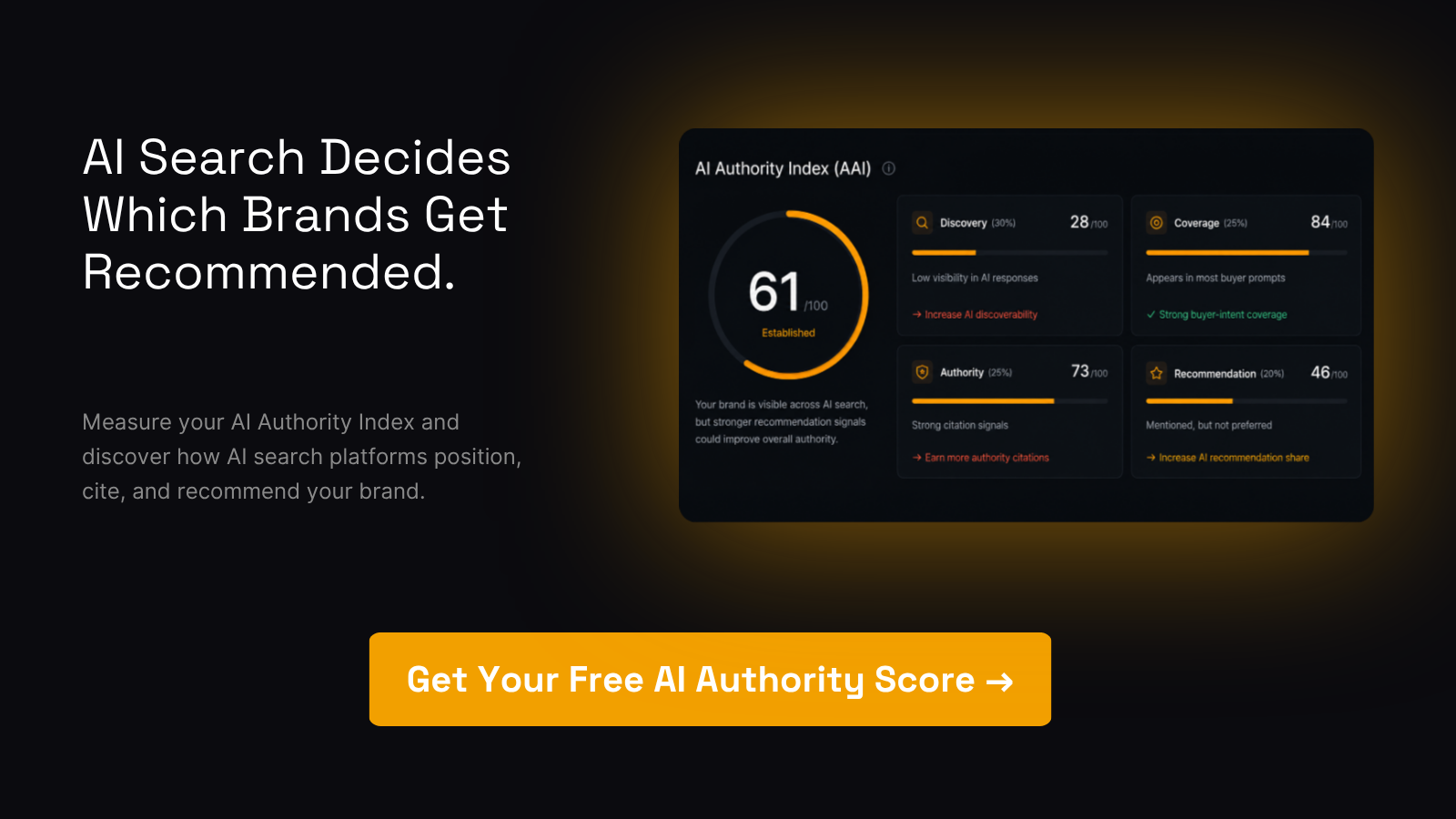
The scan reports where your business currently appears across AI-generated answers, which specific prompts surface competitors instead of you, and a prioritized list of fixes ranked by likely impact rather than guesswork. For restaurants without an internal team to chase this kind of research by hand, BabyLoveGrowth's diagnostic tool offers a similar starting point, and local directory audits like this local SEO ranking guide cover the Google Business Profile side of the equation well. Our scan ties every score back to observable evidence from real AI answers, not an estimate, and provides recommendations ranked by priority rather than as a generic checklist.
Owners who want ongoing tracking rather than a single snapshot can move into our Monthly AI Visibility Report at $59 per month, which keeps watch on recommendation share and prompt-level visibility over time.
- Request your Free AI Visibility Scan and get a baseline reading within days.
- Review the prioritized fix list alongside your team before making changes.
- Re-scan after implementing fixes to confirm movement in recommendation share.
FAQ
Which AI is best for restaurant recommendations?
No single assistant is best for every use case since each draws on different search partners, data feeds, and personalization settings. ChatGPT's strength comes from combining web search with structured listings and reservation partner data, as outlined in OpenAI's search documentation, but results still depend heavily on prompt detail and location settings.
What are the three C's in a restaurant?
Restaurant industry language around "the three C's" varies by source and is not a standardized framework, so definitions differ depending on who is using the term. The more consistently documented consumer research instead points to food, service, atmosphere, and price or value as the dominant factors diners weigh, according to a review of restaurant choice behavior.
How do I attract customers to my restaurant?
Beyond traditional marketing, visibility inside AI-generated answers increasingly matters: implementing structured data, keeping directory listings consistent, and encouraging descriptive reviews all improve your odds of being surfaced by assistants like ChatGPT, according to industry analysis on AI restaurant discovery. Joining reservation partner feeds also increases the chance that a recommendation comes with a bookable action attached.
When rating different restaurants, what factors matter most and why?
Consumer research consistently points to food quality, service, atmosphere, and price or value as the dominant factors, often summarized as the "Big Four," per a restaurant choice literature review. These same categories map closely to the signals AI assistants rely on, since reviews and structured data tend to describe restaurants along those exact dimensions.
Sources
Several concrete inputs raise a restaurant's odds of appearing in a recommendation.
- ChatGPT Search | OpenAI Help Center
- Restaurant reservation conversion spec – Plugins | OpenAI Developers
- How restaurants get recommended by ChatGPT | The Forking Group
- Consumer behavior research (determinants of food choice) — MDPI
These categories echo what consumer-choice research has long identified as the core factors diners weigh: food, service, atmosphere, and price or value, often called the "Big Four," according to a restaurant choice literature review. AI systems are, in effect, trying to approximate these same human judgments from whatever text and data they can find.
Pro Tip: Ask your restaurant's own staff or a few regulars to leave reviews that name a specific dish, occasion, or neighborhood detail. Generic five-star reviews help less than specific, descriptive ones.