Marketers, Measure ChatGPT Vendor Shortlists in 15–30 Prompts
Measurement-first playbook for marketing teams: run 15–30 buyer intent prompts across four engines, track recommendation share, and fix entity and...
· 15 min read

ChatGPT and similar assistants now shortlist vendors the same way a well-briefed analyst would: they pull entity data, weigh third-party evidence, and recommend names with enough consistency that the pattern is measurable. Two levers decide whether your brand makes the list. The first is how consistently your entity is described across the web. The second is whether your content is retrievable at the exact moment a buyer asks. Neither is guesswork once you track them properly, and a single prompt from your own laptop won't show you either one reliably.
TL;DR:
- Consistent entity descriptions across all digital assets significantly improve the likelihood of your brand being recommended in ChatGPT shortlists.
- Citations from open, fresh pages are the strongest signals, making the structuring of comparison and evidence pages crucial for visibility.
- Biases favor larger brands with more web presence and older content, so relying solely on ChatGPT recommendations can misrepresent newer or niche companies.
- Regular, standardized audits of multiple AI engines using buyer-focused prompts help track fluctuations in your recommendation share over time.
- Fixing canonical names, improving comparison content, and ensuring clear, direct first snippets offer the fastest path to increasing your brand’s recommendation rate.
Table of Contents
- How Buyers Use ChatGPT to Research and Shortlist Vendors
- How Do ChatGPT and Other Assistants Retrieve and Ground Answers?
- What Signals Push a Brand Into ChatGPT's Recommendations?
- How Do You Measure Whether ChatGPT Recommends Your Brand?
- What Mistakes Hurt Your Recommendation Readiness Most?
- What Do Real Buyer Queries to ChatGPT Look Like?
- How Should You Prompt ChatGPT to Get a Useful Vendor Shortlist?
- What Are the Limits and Biases of ChatGPT Vendor Recommendations?
- How Does ChatGPT Research Compare to Traditional Vendor Research?
- What Privacy and Data Concerns Come With Using ChatGPT for Vendor Evaluation?
- What Should Marketing Teams Prioritize This Quarter?
- See Your Recommendation Share With Authoritylayer
- Sources
- FAQ
How Buyers Use ChatGPT to Research and Shortlist Vendors
Buyers researching vendors today skip the ten-blue-links routine and just ask. "What are the best CRM platforms for a 50-person sales team?" produces a shortlist in seconds, with reasoning attached. That shortlist isn't random. It's the output of a retrieval and reasoning pipeline that behaves differently depending on the question, the mode ChatGPT chooses, and what evidence it can find about your brand.
This is where most marketing teams get the mental model wrong. They think of ChatGPT as a search engine with a chat interface. It's closer to an analyst with two speeds. In instant mode, it answers fast from an internal index and cached snippets, rarely opening a live page. In thinking mode, triggered by complex or comparison-heavy prompts, it actually browses, opens pages, and reads them before answering.
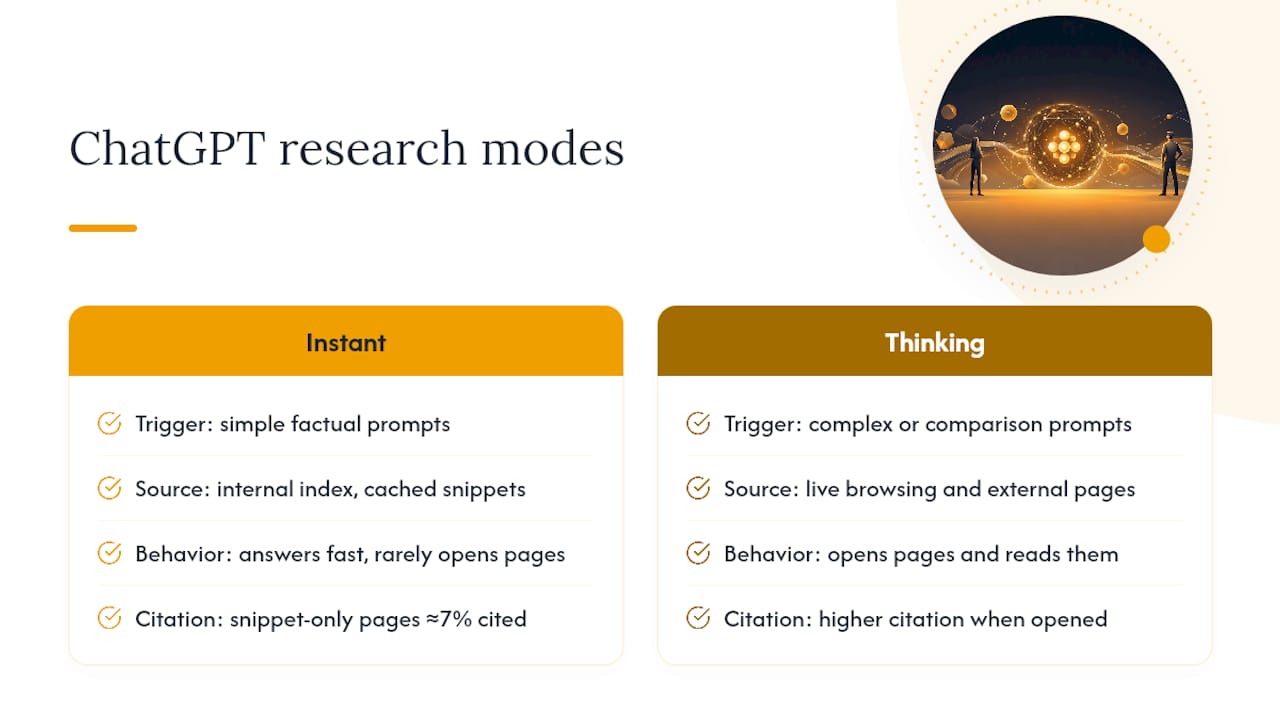
That distinction matters more than most GEO advice admits. Pages it only retrieves as a snippet, without opening, get cited about 7% of the time, according to Search Engine Land's analysis of ChatGPT's retrieval stack. If your best comparison page never gets opened, it's competing at a massive disadvantage no matter how good the content is.
Vendor-research prompts tend to trigger thinking mode more often than simple factual questions do, because comparing options requires synthesis across sources. That's good news for brands with strong evidence trails, and bad news for brands relying on thin, single-source claims about themselves.
How Do ChatGPT and Other Assistants Retrieve and Ground Answers?
Every assistant answer draws from some mix of three layers: a pretrained index of web content, a shared cache of recently fetched pages, and a live "opened pages" pool it reads in real time. Which layer dominates depends entirely on mode.
- Instant mode favors speed. It leans on the index and cache, rarely fetching fresh pages, which means stale or thin data can persist in an answer for a while.
- Thinking mode favors accuracy. It opens multiple pages, compares claims across them, and cites more selectively but more confidently.
- Cache freshness isn't fixed. Popular URLs get refetched often; obscure ones age in the cache for longer stretches, per Search Engine Land's reporting on ChatGPT's index and cache behavior.
- Opened-page citations outperform snippet-only citations by a wide margin, which is the single clearest lever GEO teams can pull.
The practical implication: getting a page into the "opened" pool matters more than optimizing for snippet appearance alone. That means structuring comparison and evidence pages so they're worth opening, not just worth indexing. It also means a brand's visibility can shift within days if a cached copy refreshes after a spike in referral traffic or press coverage, not months, the way classic SEO ranking shifts often do.
What Signals Push a Brand Into ChatGPT's Recommendations?
Recommendation isn't a black box. Research on how large language models select brands points to a repeatable flow: Prompt, retrieval, entity resolution, evidence, trust, then recommendation, as described in FutureFox Labs' research on AI search recommendations. Three signal classes decide where a brand lands in that chain.
- Entity clarity. The model needs to resolve "your brand" to one consistent thing: same name, same category, same core description, across your site, directories, and press mentions. Fragmented naming (three different taglines, two different category labels) produces what amounts to a fuzzy entity vector, and fuzzy entities get recalled less often.
- Evidence density. Comparison pages, expert roundups, and third-party reviews that mention your brand alongside competitors give the model corroborating material to cite. A brand mentioned once on its own homepage has far less evidence weight than one mentioned across a dozen independent sources.
- Trust signals. Structured data, verifiable product and availability details, and review volume all reduce the model's uncertainty about recommending you. Skyscale's analysis of how LLMs decide which brands to recommend found that brands recommended consistently share one trait: they're described the same way, repeatedly, across independent sources.
Different engines weigh these differently. Gemini tends to favor brands with strong Google-indexable evidence, Perplexity rewards citation-first earned media, and Claude leans toward precise, well-sourced claims. A brand strong on one engine can be nearly invisible on another, which is exactly why single-engine testing gives an incomplete picture.
How Do You Measure Whether ChatGPT Recommends Your Brand?
Checking manually feels productive. It isn't a measurement system. Here's a repeatable audit design that produces numbers you can actually trend over time.
- Build a query set of 15 to 30 buyer-intent prompts that mirror how real prospects phrase vendor questions, not brand-name searches. Include comparison prompts, "best for X" prompts, and objection-style prompts ("is [category] worth it for a small team?").
- Test across at least four engines: ChatGPT, Gemini, Claude, and Perplexity. Each has different retrieval habits, so single-engine results overstate or understate your real position.
- Sample each query-engine pair 5 to 14 times, spread across several days or weeks, rather than once. Assistant answers vary run to run, and one lucky or unlucky response tells you nothing about the pattern.
- Record a consistent data schema: the query, engine, timestamp, full response text, whether your brand was mentioned, any citation links, and the crawl date of cited pages where the interface exposes it. That crawl-date field is worth tracking, because Search Engine Land found a way to surface it through an API parameter, and it's a near-free exposure signal almost nobody watches.
- Compute recommendation share (percentage of samples where your brand appears) and a citation-weighted share (weighting mentions that carry a live source link higher than bare mentions).
- Chart both metrics weekly against your top three competitors, and flag any query where your share drops sharply, since that's usually a cache refresh or a competitor's new citation source at work.
Pro Tip: Run your query set the same week every month, and log external events (product launches, press hits, competitor announcements) alongside the data. Correlating share shifts with real-world events turns a spreadsheet into a diagnostic tool.
What Mistakes Hurt Your Recommendation Readiness Most?
Most visibility gaps trace back to a handful of fixable problems, not some unsolvable algorithmic mystery.
- Inconsistent structured data across directories. If your Crunchbase listing, G2 profile, and homepage each describe your category slightly differently, you're feeding the model conflicting entity signals. Standardize the canonical name, category, and one-line description everywhere you appear, including partner and directory listings, a fix TILTD's research on brand description inconsistency links to measurable recall gains within weeks.
- Thin or missing comparison content. If nobody has written "[Your category] tools compared" with your brand included, you're absent from the exact content type assistants cite most in thinking mode. Build comparison pages and expert Q&A content mapped directly to your buyer query set.
- Vague H1s and opening copy. Instant mode leans heavily on snippet text. If your H1 and first 200 characters don't answer the buyer's likely question directly, you lose the snippet-mode battle before thinking mode ever gets involved.
What Do Real Buyer Queries to ChatGPT Look Like?
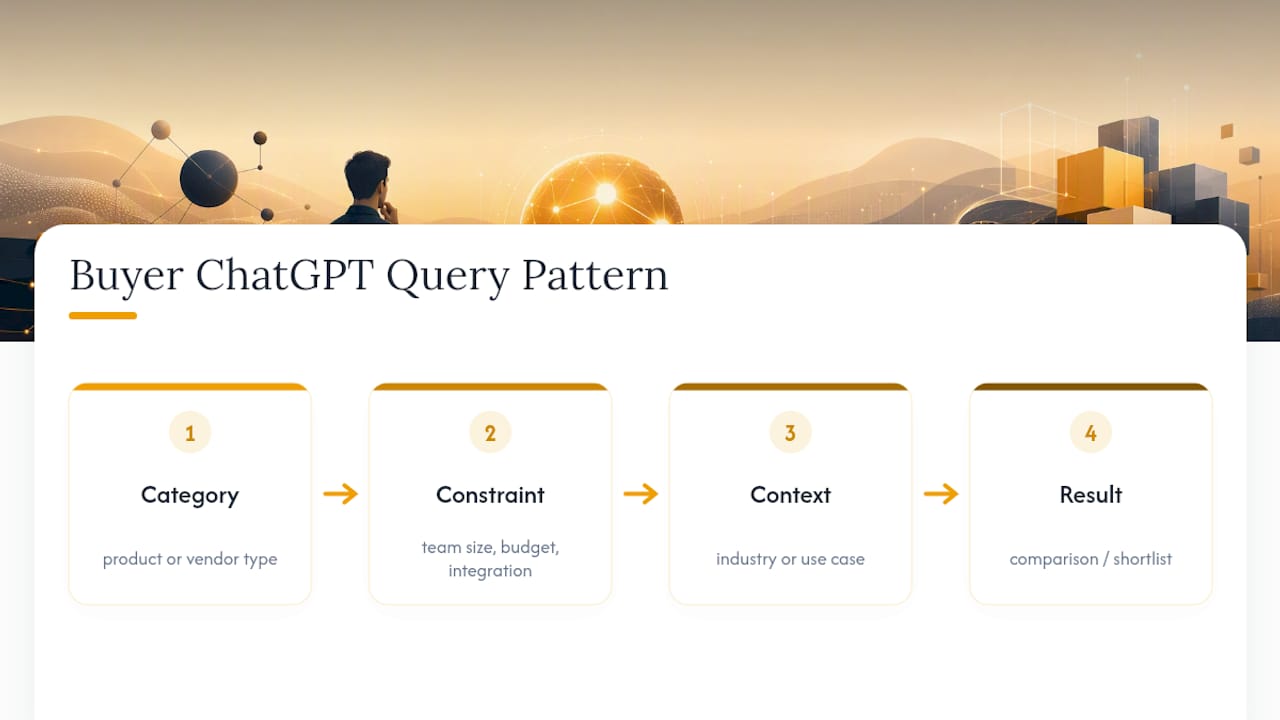
The prompts buyers actually type rarely sound like keyword research. They sound like questions asked to a knowledgeable colleague. A marketing director evaluating attribution software might ask, "What's the best multi-touch attribution tool for a B2B company doing $10M in ARR?" A procurement lead comparing logistics vendors might type, "Compare the top three freight brokers for perishable goods shipping."
Notice the pattern: category plus constraint plus context. Buyers rarely ask for "the best CRM." They ask for the best CRM for a specific team size, budget, integration requirement, or industry vertical. That constraint is exactly what triggers thinking mode and pulls the assistant into comparison content, which is why your comparison pages need to anticipate those constraints, not just your product category.
Other common patterns worth tracking in your own query set: "Is [competitor] better than [your category] for [use case]?", "What should I look for when choosing a [category] vendor?", and "What are the downsides of [category]?" That last one matters more than it looks. Assistants often surface objection-handling content when asked about downsides, and if your competitors have published honest limitation pages while you haven't, they win that exchange by default.
Buyers also chain prompts. They'll ask for a shortlist, then follow up with "which of these has the best customer support?" or "which one integrates with Salesforce?" Each follow-up is a fresh retrieval opportunity, and a fresh chance for your brand to either appear or quietly drop off the list.
How Should You Prompt ChatGPT to Get a Useful Vendor Shortlist?
If you're using ChatGPT yourself to sanity-check your market, the way you phrase the prompt changes what you see. Vague prompts ("best marketing software") produce generic, cache-heavy answers. Specific prompts with real constraints push the model toward thinking mode and richer sourcing.
A few habits worth adopting. Name the use case explicitly: "for a 20-person agency managing client campaigns" beats "for marketers." Ask for trade-offs, not just names: "what are the strengths and weaknesses of each" forces the model to draw on comparison content rather than a flat list. Ask it to cite sources directly, since some interfaces will show links when prompted, which tells you which pages actually got opened. Finally, repeat the same prompt across a few sessions and note whether the answer holds steady or drifts, because drift is itself diagnostic information about how thin your evidence trail is.
None of this replaces structured measurement, but it's a fast, free way to spot obvious gaps before running a formal audit.
What Are the Limits and Biases of ChatGPT Vendor Recommendations?
ChatGPT's shortlists aren't neutral rankings, and treating them as objective truth is a mistake worth naming directly. The model favors brands with more web presence, which structurally advantages larger, older, or better-funded companies over newer entrants with genuinely better products but thinner content trails.
Training data has a recency lag, and even with retrieval layered on top, older, more established claims about a brand can outweigh a recent repositioning or product change if the newer material hasn't accumulated enough evidence density yet. There's also a citation-source bias: assistants that lean on Perplexity-style citation-first retrieval will over-represent brands with strong PR and review coverage, even when a quieter competitor offers a better fit for a specific buyer's constraints.
Prompt phrasing introduces its own bias. Two buyers asking about the same category with slightly different wording can get meaningfully different shortlists, which means no single prompt result represents "the truth" about market position, only one sample of it. And because assistants sometimes personalize responses based on account history or prior conversation context, an internal team member testing their own brand from a logged-in account may see a rosier picture than an anonymous buyer would get. That gap is exactly why standardized, repeatable auditing across clean sessions matters more than any one team member's spot-check.
How Does ChatGPT Research Compare to Traditional Vendor Research?
Traditional vendor research meant search engine results, review sites like G2 or Capterra, referrals, and RFPs. Each method had a known bias: search rewarded SEO investment, review sites rewarded volume of reviews, referrals rewarded network reach. Buyers cross-referenced multiple sources because no single one was trustworthy alone.
ChatGPT-based research collapses that cross-referencing into a single conversational step, which is precisely why it's replacing parts of the traditional funnel rather than supplementing it. The buyer doesn't visit five sites and mentally synthesize; the assistant does that synthesis and presents a shortlist with reasoning already attached. That's faster for the buyer, but it also means whatever synthesis the model does becomes the only synthesis many buyers ever see.
The trade-off is transparency. A G2 category page shows you exactly how many reviews back each ranking and lets you filter by company size or industry. A ChatGPT answer shows you a shortlist and maybe a few citation links, without a visible weighting methodology. Traditional research was slower but auditable. Assistant-based research is fast but opaque, which is exactly why brands need their own visibility measurement rather than relying on buyers to explain what they saw.
What Privacy and Data Concerns Come With Using ChatGPT for Vendor Evaluation?
Buyers and vendors both need to think about what's shared during ChatGPT vendor research. On the buyer side, pasting internal requirements, budget figures, or proprietary evaluation criteria into a consumer ChatGPT session means that data may be used to improve the model unless the account or plan explicitly opts out, which matters for procurement teams handling confidential RFP details.
On the vendor side, monitoring how ChatGPT describes your brand raises a different question: what data are you feeding into monitoring tools, and where does it live? If you're running audits that involve competitor data, pricing comparisons, or internal query sets, check that your monitoring platform handles that data with clear storage and access policies. Authoritylayer's own security practices page lays out how audit data and account information are handled, which is worth reviewing before you connect any evaluation workflow to a third-party platform.
There's also a subtler issue: personalized accounts can surface different answers to the same prompt based on chat history, which means privacy settings and account personalization directly affect the reliability of any manual check you run. That's one more reason a logged-out, standardized sampling approach produces cleaner, more comparable data than checking from your own daily-use account.
What Should Marketing Teams Prioritize This Quarter?
Most teams still treat AI visibility as a curiosity project someone checks occasionally between real priorities. That's backwards. Set an audit cadence, weekly or biweekly, and assign clear dashboard ownership before you invest in any content fixes. Without a baseline, you can't tell whether a change to your homepage actually moved anything three weeks later.
Treat entity consistency as infrastructure, not a content task. Fixing canonical names and category descriptions across directories, partner sites, and press templates is unglamorous work, but it's the foundation everything else sits on. Then prioritize the fixes that raise citation density fastest: digital PR placements, comparison pages, and structured data cleanup outrank a full website redesign in terms of speed to impact.
The gap between what teams assume ChatGPT is doing and what it's actually retrieving is wider than most CMOs realize. Closing that gap starts with measurement, not intuition.
— Geraldine
See Your Recommendation Share With Authoritylayer
Authoritylayer replaces one-off ChatGPT spot-checks with the kind of standardized, multi-engine tracking this article just walked through, so you're comparing apples to apples across ChatGPT, Gemini, Claude, and Perplexity instead of guessing from a single logged-in session.
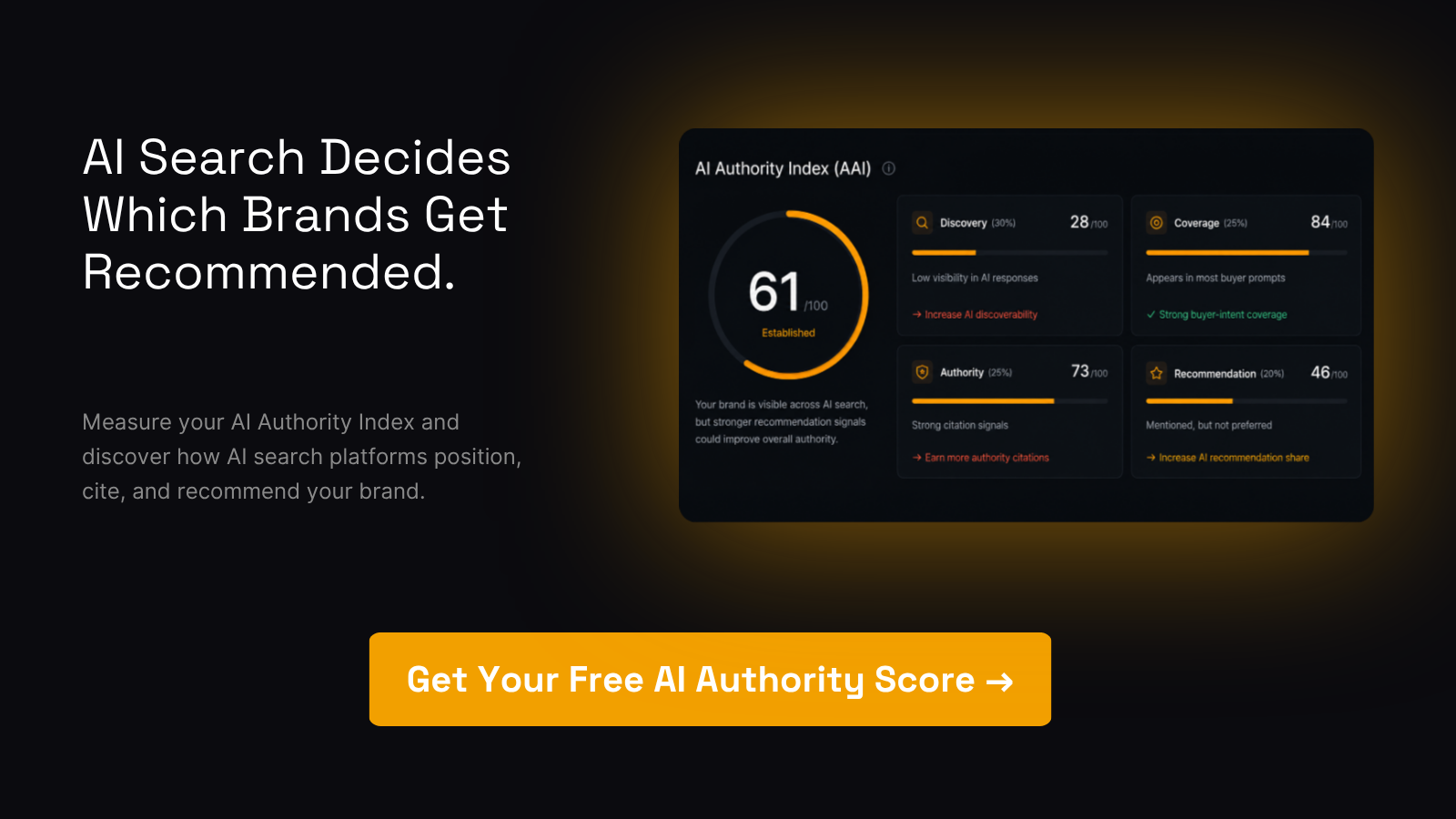
The platform runs your buyer-intent query set across engines on a set cadence, scores your entity's recommendation strength through the AI Authority Index, and tracks prompt-level results over time so you can see exactly where citation density is weak and which competitors are winning specific queries. The typical path starts with a free AI visibility scan, moves into a competitive benchmark once you've added rivals and markets through your workspace setup, and produces a prioritized roadmap of fixes ranked by citation impact. Teams that want ongoing tracking rather than a single snapshot typically graduate to the Monthly AI Visibility Report, which delivers benchmarked recommendation-share data and prioritized next steps every month. Start with the free scan and see where your brand actually stands today.
Sources
- Inside ChatGPT's retrieval stack: The index, cache, and pages it actually reads
- AI Search Recommendations Explained | FutureFox Labs
- How LLMs Decide Which Brands to Recommend (The Mechanism)
FAQ
How Do Buyers Actually Use ChatGPT to Shortlist Vendors?
Buyers type constraint-rich questions ("best [category] for a 50-person team") and ChatGPT synthesizes a shortlist using cached data, live retrieval, and its trained knowledge, often citing sources it opened directly.
Can I Just Ask ChatGPT If It Recommends My Brand?
You can, but a single manual prompt is a snapshot from one session, one mode, and possibly one personalized account; it won't reproduce what an independent buyer with no history sees, which is why standardized, repeated sampling across engines gives a far more reliable answer, as outlined in Authoritylayer's guide to checking ChatGPT recommendations.
How Often Does ChatGPT's View of My Brand Change?
Cached data can refresh within days when a page gets refetched after a traffic spike or new citation, while thin, rarely-visited pages can stay stale for much longer, according to Search Engine Land's reporting on ChatGPT's cache behavior.
What's the Single Highest-Impact Fix for Low Recommendation Share?
Standardizing your canonical name, category, and description across your site and every third-party directory tends to produce the fastest measurable gains, since entity confusion undermines every other signal downstream.
How Many Queries Should a Proper AI Visibility Audit Include?
A solid baseline runs 15 to 30 buyer-intent queries across at least four engines, sampled 5 to 14 times per query-engine pair, which is the audit structure Authoritylayer's methodology is built around.