3.6x Google Reviews: 7 Steps to Get ChatGPT to Recommend Restaurants
Seven practical steps restaurants can use now to turn Google review volume and accurate profiles into ChatGPT recommendations, with a free scan to measure...
· 12 min read

Yes. Google reviews strongly shape whether ChatGPT and similar AI tools recommend your restaurant, but not in the way that most owners assume. Volume, recency, and descriptive review text drive whether your restaurant even gets considered, while your star rating mostly influences order once you're already in the running. The practical fix: build review volume and a complete, consistent Google Business Profile alongside cross-platform mentions, since that combination decides whether AI notices you at all; use a free diagnosis tool to understand why ChatGPT may not recommend your website.
TL;DR:
- Building review volume and maintaining a complete, accurate Google Business Profile are crucial for AI recommendations, as star ratings are less influential at the entry stage.
- Ensuring your restaurant is well documented across reservation platforms and online directories significantly increases the likelihood of it entering the recommendation pool.
- Focus on generating recent, descriptive reviews and securing mentions in third-party sources like food blogs and local listings to improve visibility.
- Regularly remove outdated or incorrect listings and track review growth alongside AI recommendation frequency to sustain and improve your restaurant's visibility.
- Use free diagnostic tools and ongoing monitoring plans to identify gaps and measure progress without relying solely on anecdotal or manual prompt checks.
Table of Contents
- How AI Assistants Find and Rank Restaurants
- Which Review Signals Actually Move the Needle
- Seven Steps to Get ChatGPT to Recommend Your Restaurant
- Measuring Whether It's Working
- Where ChatGPT's Reading of Reviews Breaks Down
- Fake and Incentivized Reviews Create a Different Kind of Risk
- What This Means for Restaurant Marketing Budgets
- Start With a Free Scan, Then Track Your Progress
- Sources
- FAQ
How AI Assistants Find and Rank Restaurants
ChatGPT doesn't rank every restaurant in your city and pick the best one. It works in two distinct stages, and confusing them is why so many owners chase the wrong metric.
The first stage is entry: does your restaurant even make it into the pool of candidates ChatGPT considers for a given query? The second stage is ranking: once you're in that pool, where do you land relative to the others? These are governed by different signals, and that distinction changes what you should spend time on.
ChatGPT's search function can partner with third-party providers and uses your device or IP location to localize results. When it shows restaurant options, it's often pulling live web data alongside indexed sources, then checking whether reservation platforms like OpenTable, Resy, or Yelp can supply availability. If your restaurant isn't documented well across those sources, it may never reach the candidate pool no matter how good your food is.
A large-scale audit tested this directly by comparing AI recommendations against a complete market census of restaurants, cafés, and bars. The findings were specific: review volume and having your own website each significantly predicted whether a restaurant entered the AI's recommendation set, with review volume alone showing an odds ratio of 1.64 per standard deviation increase. Star rating, by contrast, was statistically null at the entry stage. It only mattered once a restaurant had already made it into the surfaced set, where it predicted ordering.
That same audit exposed a second problem: staleness. The researchers found 93 recommendations pointing to permanently closed venues, showing that AI models frequently lean on outdated documentation rather than live status. Common failure modes owners should watch for include:
- Recommendations built on old crawl data that predates a closure, menu change, or relocation.
- Inconsistent results across engines. What Perplexity surfaces and what ChatGPT surfaces for the same query can differ meaningfully.
- Missing reservation integrations, which can keep a restaurant out of booking-enabled results even when it's mentioned in text.
Fixing the documentation gap, not the star rating, is usually the faster route to visibility.
Which Review Signals Actually Move the Needle
Not all review activity carries equal weight in AI's eyes. Four signals matter most, and each maps to a specific action.
Volume is the biggest lever. Analysis of AI-recommended restaurants found they carry roughly 3.6 times more Google reviews than comparable restaurants that don't get recommended. The same research points to rough thresholds, often somewhere around 1,000 to 2,000-plus reviews, where visibility tends to improve. A restaurant with very few reviews and a high star average is, counterintuitively, less likely to surface than a competitor with many reviews and a moderate star rating.
The gap that matters: AI-recommended restaurants average close to 3.6 times the review count of similar restaurants that get passed over, according to 2026 research on AI ranking factors. Volume, not polish, opens the door.
Recency signals that you're still operating and still good. A restaurant with reviews clustered in the last 90 days reads as active and current. One with a review gap stretching back 18 months looks, to a model scanning for reliability, like a business that might have quietly closed.
Descriptive content beats generic praise. Reviews that mention specific dishes, price range, dietary accommodations, or atmosphere give AI concrete phrases to match against a searcher's query. Text that says "amazing food, great service" gives the model almost nothing to work with. Text that says "the lamb tagine and gluten-free options made this an easy pick for our group" gives it several matchable hooks.
Star rating's real job is sorting, not gatekeeping. Once your restaurant clears the entry bar through volume and documentation, rating helps decide where you land among the finalists. Third-party mentions in local listicles, food blog roundups, and structured data attributes add further confidence, since they corroborate what your Google Business Profile already claims.

Seven Steps to Get ChatGPT to Recommend Your Restaurant
This is the order to work through, starting with the highest-leverage move and ending with the measurement habit that tells you whether any of it is working.
- Run review-growth campaigns across platforms, ethically. Ask satisfied guests for reviews at the point of highest satisfaction, right after a great meal, not weeks later by email. Never pay for reviews or offer discounts explicitly in exchange for a positive one; incentivizing "a review" for a small perk is fine, incentivizing a specific rating is not, and it risks your standing on the platform.
- Lock down your Google Business Profile and site schema. Menu, price range, hours, and reservation links all need to match across your website and your profile. A structured data checklist helps here, particularly for restaurants running multiple locations with slightly different hours or menus.
- Coach customers toward descriptive reviews. A simple prompt on a receipt or follow-up text, "What dish stood out?", produces far richer review text than a bare star-rating request.
- Earn mentions beyond Google. Local food blogs, "best of" listicles, and reservation platforms like OpenTable, Resy, and Yelp all function as corroborating sources AI can cite. OpenTable has gone as far as integrating directly with ChatGPT to surface clickable booking links, which makes an active OpenTable listing worth more than it used to be.
- Keep reviews flowing, not just accumulating. Schedule a light post-visit prompt system and respond to every review, positive or negative. Response activity itself is a signal of an operating, attentive business.
- Clean up stale listings immediately. If you've closed a location, changed your name, or moved addresses, chase down duplicate or outdated listings across every platform. This single housekeeping task can produce a fast, visible improvement in some engines because it removes a form of negative confidence from the model's retrieval pool.
- Track the right numbers on a recurring basis. Watch review count growth in rolling 90-day windows, run periodic ChatGPT prompt checks, and note whether your recommendation share is trending up or flat.
Pro Tip: Run the same three or four restaurant-search prompts through ChatGPT once a month and log whether you appear. A single check tells you almost nothing; a four-month trend tells you whether your review campaign is actually changing AI behavior.
Measuring Whether It's Working
Guessing isn't a strategy here. Test it directly by asking ChatGPT variations of "best [cuisine] restaurant in [neighborhood]" or "where should I take a client for dinner near [landmark]" a handful of times across a few days. Expect variability. AI answers shift by phrasing, by session, and sometimes by which search partner ChatGPT taps into for that query, so one absence doesn't mean failure and one appearance doesn't mean you've won.
What you want is a repeatable read on a few numbers: how often you show up across a fixed set of prompts (your recommendation share), which sources get cited when competitors appear instead of you, and whether your review volume growth is tracking upward alongside your AI mention frequency. A step-by-step prompt-audit method gives you a repeatable structure instead of ad hoc spot checks.
This is exactly the gap Authoritylayer's monitoring is built to close: tracking prompt-level visibility across ChatGPT, Gemini, Claude, and Perplexity, benchmarking your recommendation share against nearby competitors, and prioritizing which fix (reviews, schema, or citations) will move the needle fastest. The Starter Plan is built for exactly this kind of ongoing check for a single restaurant or small group.
Where ChatGPT's Reading of Reviews Breaks Down
ChatGPT doesn't read Google reviews the way a person scanning Yelp does. It's working from indexed snapshots and third-party summaries, which means a review posted yesterday may not factor into an answer generated today. Update lag is the single biggest limitation, and it's the direct cause of the closed-venue problem the audit uncovered.
There's also a scale bias baked into the system. Restaurants with thousands of reviews get treated as more "confirmed" than restaurants with a hundred, even when the smaller restaurant's average rating is higher and its recent reviews are more detailed. That favors established, high-traffic spots over quietly excellent newcomers, and it's a structural bias, not a bug you can review your way around quickly.
Language and sentiment processing add another wrinkle. Sarcasm, mixed reviews ("great food, terrible parking"), and reviews written in a language other than English can get misread or under-weighted. A restaurant with strong reviews concentrated in a non-English-speaking neighborhood may be undervalued in English-language ChatGPT queries simply because the model has less to work with in that language. None of this means reviews don't matter. It means the read is imperfect, and owners chasing a single missing review as the explanation for poor AI visibility are usually looking in the wrong place.

Fake and Incentivized Reviews Create a Different Kind of Risk
Fabricated or incentivized reviews create a subtler problem than a bad rating: they can inflate volume, the exact signal AI weighs most heavily at the entry stage, while degrading the descriptive quality that makes reviews useful for matching a searcher's intent. A wall of five-star reviews that all say "great food, will come back" gives ChatGPT almost nothing specific to cite, even though the raw count looks strong.
Google's own detection systems increasingly flag and remove suspicious review clusters, and a mass takedown can cause a visible drop in your review count practically overnight, which is a worse outcome for AI discoverability than having fewer, honest reviews in the first place. There's also a trust cost that compounds over time: once a restaurant has had reviews purged for manipulation, subsequent legitimate reviews may take longer to build back the volume threshold that matters for entry.
The safer path is asking real customers for real, specific feedback rather than manufacturing volume artificially. It's slower, but it's the only version of review growth that actually survives a platform audit and holds up as a durable AI-visibility signal instead of a short-lived one.
What This Means for Restaurant Marketing Budgets
Most restaurant marketing budgets are still built around chasing star rating, since that's the metric owners have watched for a decade. The audit evidence flips that priority: documentation and volume get you discovered, rating only sorts you once you're already visible. Chasing a 4.9 average while ignoring your review count and profile completeness is optimizing for the wrong stage entirely.
A better split allocates spend toward review-generation systems, earning third-party citations through local press and food blogs, and keeping your Google Business Profile and schema data accurate. Treat this as a loop, not a one-time project: better discovery drives more visits, more visits generate more reviews, and that fresh review volume feeds the next round of AI visibility. Staleness will creep back in without ongoing measurement, so build a recheck into your calendar rather than a single cleanup sprint.
— Geraldine
Start With a Free Scan, Then Track Your Progress
Authoritylayer is built for exactly the problem this article walks through: knowing whether ChatGPT, Gemini, Claude, and Perplexity actually recommend your restaurant, and which specific gap, review volume, stale listings, missing citations, is holding you back. Rather than guessing from a handful of manual prompt checks, you get a benchmarked read on your recommendation share against nearby competitors and a prioritized list of what to fix first.
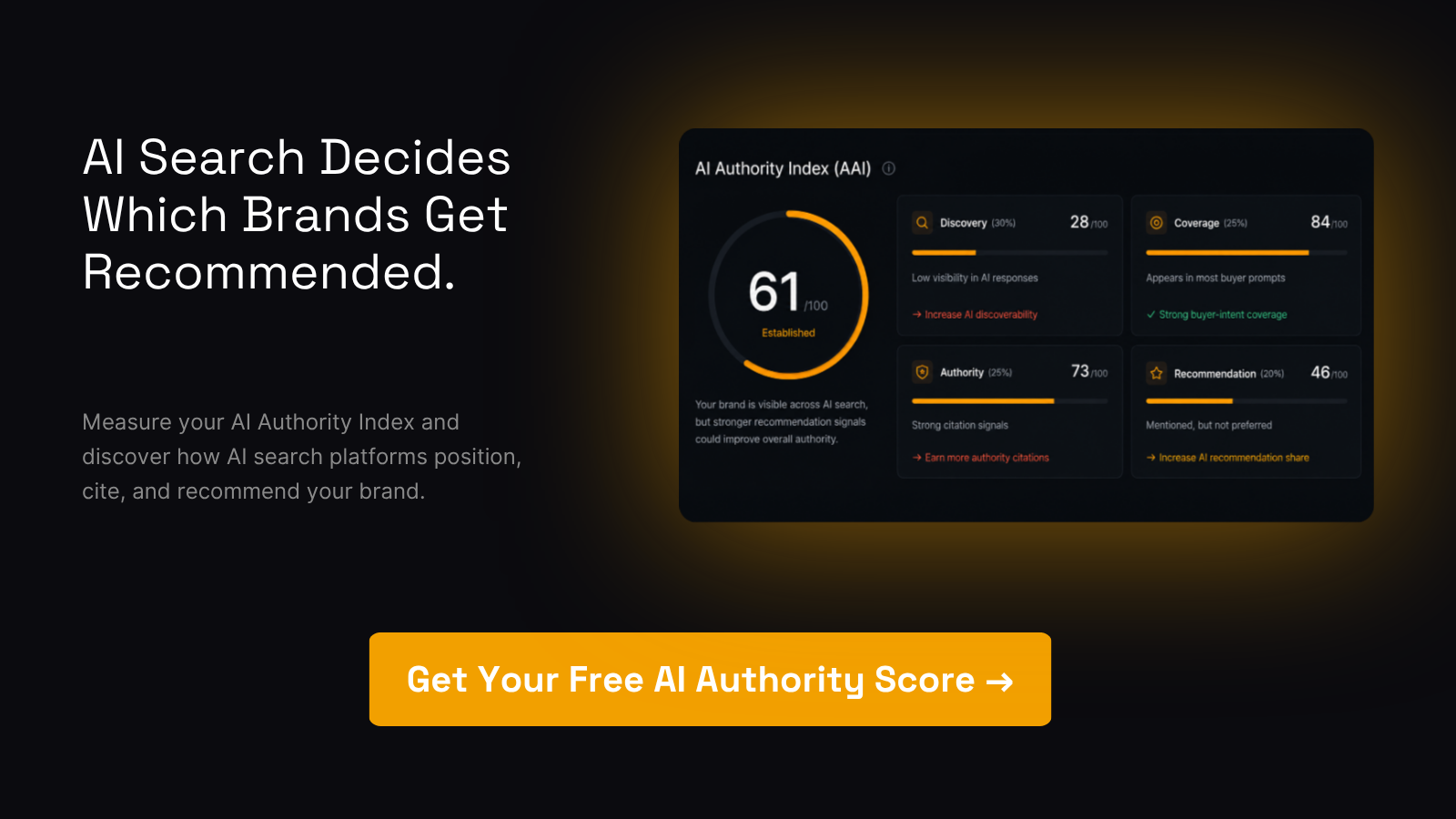
The most useful first move is the Free AI Visibility Scan, which gives you a baseline read on where your restaurant currently stands before you spend another dollar on review campaigns or schema cleanup. From there, the Starter Plan at $99 per month adds ongoing monitoring so you can watch your recommendation share move as your review volume grows, rather than checking in blind every few months. For multi-location groups needing deeper competitive benchmarking, the Growth plan and Enterprise plan scale the same tracking across more markets and more prompts. Run the free scan first. See what it turns up before deciding what tier makes sense.
Sources
- Invisible to the Machine: Auditing AI Restaurant, Cafe, and Bar Recommendation Against a Complete Market Census
- AI ranking factors for restaurants - 2026 research
- Searching the web with ChatGPT | OpenAI Help Center
FAQ
Which AI is best for restaurant recommendations?
No single AI assistant is definitively "best," since ChatGPT, Gemini, Claude, and Perplexity each pull from different search partners and weigh signals differently. The safest approach is checking your visibility across all four rather than optimizing for just one, which is exactly what tools like Authoritylayer's monitoring are designed to track.
Can restaurants remove bad Google reviews?
You can flag reviews that violate Google's policies, like spam, harassment, or content unrelated to an actual visit, and Google may remove them after review. You cannot remove a review simply because it's negative but truthful; the better strategy is responding professionally and building enough recent, positive volume to outweigh it.
How many five star reviews cancel out a one star review on Google?
There's no fixed formula because Google's average is a straightforward mathematical mean, not a weighted algorithm; one low rating among many reviews barely moves your average, while the same low rating among few reviews drags it down significantly. This is part of why AI recommendation systems weigh raw review volume so heavily at the entry stage: a large, active review base naturally dilutes the impact of any single bad rating.
Do Google reviews affect business?
Yes, in both a direct and an indirect way. Directly, reviews shape a customer's decision to walk in the door; indirectly, and increasingly important, review volume and content now shape whether AI assistants like ChatGPT surface your restaurant to someone searching for a place to eat at all.
What does Authoritylayer's Starter Plan include?
The Starter Plan costs $99 per month and is built for ongoing AI visibility monitoring, tracking how often ChatGPT and similar tools recommend your restaurant and flagging the specific gaps holding you back. It's designed as the practical next step after running the free scan, once you know you need continuous tracking rather than a one-time check.