AI Visibility Audit: A Practical Framework for 2026
Enhance your brand's presence with an AI visibility audit. Discover how AI assistants perceive your business and ensure you’re visible to buyers.
· 20 min read

An AI visibility audit measures whether AI assistants can find, read, and recommend your brand when buyers ask relevant questions. The fastest way to get a baseline is to run a prompt sweep across ChatGPT, Google Gemini, Perplexity, and Anthropic Claude, then log whether your brand is named, which URL gets cited, and how accurately the assistant describes what you do.
This matters because AI citations don't mirror Google rankings. A nontrivial share of pages ChatGPT cites most have zero first-page Google organic visibility. If your SEO strategy is your only visibility strategy, you're already invisible to a growing slice of buyers who never click a blue link. An AI visibility audit is a different job than a traditional SEO audit: it evaluates whether models will select and name your brand in an answer, not whether your page ranks in a list.
Table of Contents
- What should your AI visibility audit actually measure?
- How do you build a prompt library that holds up over time?
- How do you run tests across ChatGPT, Gemini, Perplexity, and Claude?
- What should you log for every test response?
- How do you turn raw audit data into priorities?
- How do you turn audit findings into a prioritized fix plan?
- How do you benchmark share-of-voice without publishing a vendor comparison?
- The 30-minute AI visibility audit playbook
- What KPIs and reporting cadence should you use?
- Why consistent brand messaging matters for AI assistants
- Compliance and ethical considerations when optimizing for AI visibility
- Key Takeaways
- The audit works when one person owns it
- Authoritylayer gives your team a head start on AI visibility
- Useful sources and tools
- FAQ
What should your AI visibility audit actually measure?
Before you run a single prompt, define what success looks like. Without clear scope, you'll collect data that's hard to compare and impossible to prioritize.
Set your audit goals first. The four most common objectives are: brand awareness in AI answers (is your brand named at all?), product recommendation share (does an assistant recommend you when a buyer is evaluating options?), accuracy of brand descriptions (does the assistant describe your product correctly?), and competitive displacement (are rivals named instead of you on prompts where you should win?).
Choose buyer personas and intent levels. High-value prompts map to purchase, evaluate, and compare intent. A prompt like "What's the best AI visibility platform for a B2B SaaS company?" is worth more than "What is AI visibility?" because it sits closer to a buying decision.

Select your platforms. At minimum, test ChatGPT/OpenAI, Google Gemini, Perplexity, and Anthropic Claude. Each handles grounding differently: Gemini pulls from Google's index, Perplexity cites live web sources with URLs, ChatGPT's behavior varies by whether web browsing is enabled, and Claude tends to reason from training data unless given retrieval tools. Those differences affect which pages get cited and why.
Define your scope checklist:
- Pages to test: homepage, top product pages, FAQ pages, comparison pages, and any high-traffic blog content
- Geographic and market coverage (U.S. focus, or specific verticals)
- Competitive set: use internal labels (Competitor A, Competitor B) for share-of-voice calculations; keep actual names out of public artifacts
- Audit cadence: monthly until stable, then quarterly
How do you build a prompt library that holds up over time?
A prompt library is the backbone of a reproducible audit. Without one, every test run is a different experiment.
Prompt categories to cover:
- Branded queries: "What is [Brand]?" / "What does [Brand] do?"
- Unbranded buyer intent: "Best AI visibility tool for enterprise marketing teams"
- Comparison prompts: "How does [Brand] compare to other AI monitoring platforms?"
- How-to and troubleshooting: "How do I know if AI assistants are recommending my brand?"
- Local or vertical variations: "Best AI brand monitoring tool for SaaS companies in the U.S."
Sample prompt templates by category:
| Category | Sample Prompt | Buyer Stage | Intent |
|---|---|---|---|
| Branded | "What is [Brand] and what does it do?" | Awareness | Informational |
| Unbranded | "What tools help measure AI recommendation share?" | Consideration | Evaluation |
| Comparison | "Recommend 3 AI visibility platforms with URLs and one-line reasoning" | Decision | Purchase |
| How-to | "How do I audit my brand's visibility in ChatGPT answers?" | Awareness | Informational |
| Vertical | "Best AI monitoring platform for B2B SaaS marketing teams" | Consideration | Evaluation |
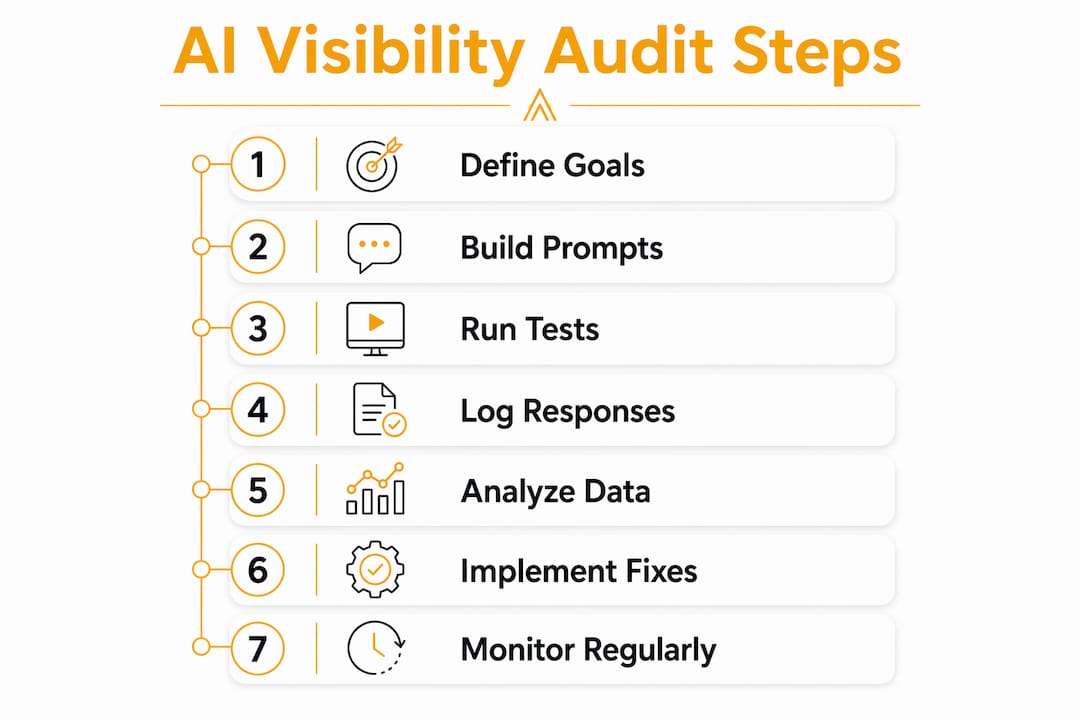
Metadata to record per prompt: persona, intent type, expected answer format (definition, list, recommendation), priority tier (high/medium/low), and tags (brand, product, topic, competitor).
Store everything in a shared CSV or Google Sheet with columns for prompt text, category, platform tested, date run, and tester initials. That structure makes the audit reproducible by anyone on the team.
Pro Tip: Include at least one canonical prompt that asks assistants to "recommend 3 vendors/solutions for X — include URLs and one-line reasoning." This prompt reliably surfaces citation behavior and shows you exactly which pages get named.
How do you run tests across ChatGPT, Gemini, Perplexity, and Claude?
The choice between manual testing and automation depends on scale. For a first audit or a 30-minute MVP, manual is fine. For ongoing monitoring across dozens of prompts and four platforms, you need a more systematic approach.
Prepare your prompt library. Export your prioritized prompts to a CSV. Group by intent tier so you run high-value prompts first.
Run manual tests for the MVP. Open each assistant in a fresh session (no conversation history that could bias responses). Paste each prompt exactly as written. For ChatGPT, use the GPT-4o interface with browsing enabled when you want web-grounded responses. For Gemini, use the standard web interface. For Perplexity, note whether the response cites URLs inline. For Claude, use Claude.ai.
Use APIs for scale. OpenAI's API, Anthropic's API, and Perplexity's API all support programmatic prompt submission. Google's Gemini API is accessible via Google AI Studio. Scripting with Python, Selenium, or Playwright lets you run the same prompt set across platforms and capture raw response objects automatically. Note rate limits: OpenAI's tier-based limits, Anthropic's usage tiers, and Perplexity's API quotas all affect how quickly you can run a full sweep.
Run live AI visibility checkers for technical crawlability. Tools that fetch pages with GPTBot user agents and run real queries against ChatGPT, Claude, and Gemini produce a live snapshot of whether your brand appears in answers. These are faster than manual prompt runs for the technical layer of the audit.
Capture full responses. Screenshot the UI response and store the raw API response object. Both matter: the UI screenshot shows formatting and citation links as a buyer would see them; the raw object lets you parse mentions and URLs programmatically.
Log results immediately. Don't batch logging for later. Fill in your tracker row-by-row as you run each prompt so nothing gets lost or misattributed.
For a no-cost technical layer, the open-source codedpills/ai-visibility-audit project crawls pages, runs signal analyzers, and computes a GEO Score out of 100 with prioritized fixes. It's self-hostable and covers entity clarity, structured data, AI crawlability, and brand authority in one pass.
What should you log for every test response?
Consistent logging is what separates a one-off experiment from a repeatable audit. Every response needs the same fields, every time.

Core tracker schema:
| Field | Description | Example |
|---|---|---|
| Prompt ID | Unique ID from your prompt library | P-042 |
| Platform | Which assistant | Perplexity |
| Date/Time | Timestamp of test | — |
| Full Response | Paste or API object | [raw text] |
| Brand Mentioned | Y / N | Y |
| Cited URL(s) | Any URL the assistant linked | /product/ai-monitoring |
| Top-Cited Owned Page | Which of your pages was cited | /product/ai-monitoring |
| Citation Quality | Authoritative / Topical / Weak / None | Authoritative |
| Accuracy Rating | 1–5 human-assessed score | 4 |
| Sentiment/Stance | Positive / Neutral / Negative / Absent | Positive |
| Tester Initials | Who ran this test | JM |
Metric definitions to align your team:
- Mentions: Binary (Y/N) — was the brand named at all?
- Citation rate: Percentage of responses that include a URL pointing to your domain
- Citation quality: How authoritative and topically relevant is the cited page?
- Accuracy score: Human-assessed 1–5 rating of whether the assistant described the brand correctly
- AI recommendation share: Your brand's mentions as a share of all brand mentions across a prompt set and platform
Tagging ambiguous cases: When an assistant describes your product category without naming you, tag it "implied." When it names a brand that sounds like yours but isn't, tag it "misattribution." Both patterns matter for analysis.
How do you turn raw audit data into priorities?
Raw data tells you what happened. Analysis tells you why and where to focus.
Start with branded vs. unbranded patterns. If you're named on branded prompts but absent on unbranded buyer-intent prompts, the problem is authority and content coverage, not crawlability. If you're absent even on branded prompts, the problem is likely technical.
Identify your top-cited owned pages. Do the pages being cited match the pages you'd want cited for each prompt? A blog post being cited instead of your product page on a purchase-intent prompt is a misalignment worth fixing.
Spot message drift. If different pages describe your product differently, or if third-party profiles (Crunchbase, G2, Wikipedia) use different terminology, LLMs will produce inconsistent or inaccurate summaries. Consistent brand messaging across owned pages and third-party profiles directly reduces fragmentation in AI-generated descriptions.
Surface technical blockers:
- robots.txt rules that block GPTBot, Anthropic's Claude-Web, or Google's AI crawlers
- Client-rendered pages that ship empty HTML shells (AI crawlers don't execute JavaScript)
- Missing structured data (FAQ schema, HowTo schema, Article schema)
- No author bylines, visible dates, or external citations
Triage checklist:
- Which high-intent prompts show zero brand mentions?
- Which pages are cited but shouldn't be (misaligned content)?
- Which pages should be cited but never appear?
- Are there third-party profiles with outdated or incorrect descriptions?
- Are any technical blockers silently preventing crawl access?
How do you turn audit findings into a prioritized fix plan?
Not all fixes are equal. A JavaScript rendering issue that blocks every AI crawler is worth fixing before you rewrite a single paragraph of copy.
Fix technical access first. Check robots.txt for rules blocking GPTBot, ClaudeBot, or Google-Extended. If your site is client-rendered, add server-side rendering or prerendering for pages that need to be citable. Add an llms.txt file to signal which pages are available for AI systems to use.
Add trust signals to priority pages. Trust signals that help AI systems cite your pages include clear H1s, author bylines, visible publication dates, FAQ schema, HowTo schema, and external citations or press coverage. These are fast to add and measurable within weeks.
Rewrite top pages with answer-first copy. Lead with a 75–120 word direct answer to the question the page targets. AI assistants pull from the opening of a page disproportionately. A product page that buries its core claim in paragraph four will lose to a competitor whose page leads with it.
Consolidate duplicate answers. If three blog posts answer the same question differently, LLMs will average them into a confused summary. Pick one canonical page, redirect or noindex the others, and make that page the definitive answer.
Correct third-party profiles. Claim and update your Crunchbase, G2, LinkedIn, and Wikipedia entries. Outdated descriptions on high-authority third-party sites are a common source of AI inaccuracy.
Run a PR push for external citations. Earned coverage on authoritative domains increases the signal that your brand is credible. This is the highest-effort fix, but it compounds over time.
Assign each fix an owner, an estimated time, and a success signal (e.g., citation rate on product comparison prompts increases from 10% to 30% within 60 days).
How do you benchmark share-of-voice without publishing a vendor comparison?
Competitive benchmarking is most useful when it's private and longitudinal. A single snapshot tells you where you stand today; a series of snapshots tells you whether your fixes are working.
Build an internal benchmark table with columns for: prompt tested, your brand mentions (Y/N), Competitor A mentions, Competitor B mentions, citation URLs per brand, and share-of-voice per prompt and platform. Use generic labels (Competitor A, Competitor B) in any artifact that leaves your team. Keep actual competitor names in your internal tracker only.
Competitive benchmarking best practices:
- Measure share-of-voice as a percentage: your mentions divided by total brand mentions across all tested brands for a given prompt set
- Track changes over time rather than single snapshots; a 90-day trend is far more useful than a one-time number
- Segment by platform: your share on Perplexity may differ significantly from your share on ChatGPT, and the fix for each may be different
- Set specific reclaim targets tied to prompt categories (e.g., increase share on product comparison prompts by 20 percentage points in 90 days)
- Use AI competitive intelligence frameworks to translate benchmark gaps into content and technical priorities
The 30-minute AI visibility audit playbook
This is the minimum viable audit. Run it before committing to a full program, or use it as a fast check after deploying fixes.
Minutes 0–5: Pick several high-priority prompts. Pull from your prompt library or write them now. Include at least two unbranded buyer-intent prompts, one branded query, and one comparison prompt. Prioritize prompts that map to your highest-value product pages.
Minutes 5–15: Run prompts on ChatGPT and Gemini. Use fresh sessions. Paste each prompt exactly. Note whether your brand is named, whether a URL is cited, and what the assistant says about you. Don't edit or paraphrase the response yet.
Minutes 15–20: Capture responses and citations. Screenshot each response. Note the cited URL (if any) and the top-cited owned page. Flag any response where your brand is absent, misidentified, or described inaccurately.
Minutes 20–25: Quick tally and triage. Count: How many prompts named your brand? How many cited a URL? How many responses were accurate? Any prompt where you're absent and a competitor is named is a priority gap.
Minutes 25–30: Decide 3 immediate fixes. Based on the tally, pick the three highest-impact actions. Common quick wins: unblock a crawler in robots.txt, add FAQ schema to a product page, or rewrite the opening paragraph of a page that's being cited with inaccurate copy.
Pass/fail signals that indicate a deeper problem:
- No brand mention on a branded query: likely a technical crawl block or a brand name that's too new or inconsistently used
- No URL cited on any prompt: structured data and trust signals are probably missing
- Incorrect product description: message drift across pages or third-party profiles
When to escalate to a full audit: If you miss on more than half of your high-intent prompts, or if any technical accessibility failure surfaces, the 30-minute playbook has done its job. Move to a full audit with the complete prompt library and all four platforms.
What KPIs and reporting cadence should you use?
Measurement without a cadence is just data collection. Build a reporting model before you start fixing things, so you can prove the fixes worked.
Core KPIs:
- AI recommendation share: Your brand's share of all brand mentions across your prompt set and platforms (the primary metric)
- Citation rate: Percentage of responses that include a URL pointing to your domain
- Top-cited owned pages: Which pages are being cited, and do they match your intended landing pages?
- Accuracy score: Average human-assessed accuracy rating across all responses
- AI-driven referral traffic: Where measurable via server logs or analytics, track traffic from AI assistant referrers
Dashboard wireframe:
- Prompt-level share-of-voice table (brand mentions per prompt, per platform)
- Platform breakdown: ChatGPT / Gemini / Perplexity / Claude side-by-side
- Technical health flags: robots.txt status, HTML content ratio, structured data presence
- Action status tracker: open fixes, in-progress, completed, and verified
Reporting cadence that works in practice: Run daily or weekly quick checks (3–5 priority prompts) immediately after deploying fixes to catch regressions fast. Run a full audit monthly until your citation rate and accuracy scores stabilize. Drop to quarterly strategic re-audits once you're consistently appearing on high-intent prompts. Set an alert rule: if citation rate drops more than 15 percentage points week-over-week, trigger an immediate technical check before assuming a content issue.
Why consistent brand messaging matters for AI assistants
AI visibility audits serve a different job than traditional SEO audits. They evaluate whether models will select and name your brand in an answer, which requires entity clarity and answer-first content, not just keyword density or backlink count.
The single most common root cause of low AI visibility isn't a missing schema tag. It's inconsistent messaging. When your homepage, product pages, and third-party profiles describe your brand differently, LLMs average those signals into a vague or inaccurate summary. A centralized, model-friendly Brand Messaging Guideline (under 1,000 words, covering approved terms, banned claims, and answer-first standards) is the prerequisite for reliable AI summaries.
What Authoritylayer's methodology covers:
- Prompt sweeps across ChatGPT, Gemini, Perplexity, and Claude to measure mention rate and citation behavior
- Crawler checks to surface robots.txt blocks, JavaScript rendering issues, and missing trust signals
- Citation capture and quality scoring to identify which pages are being cited and whether they're the right ones
- AI Authority Index scoring to benchmark your brand's recommendation share against your competitive set
- Prioritized remediation tasks mapped to impact, so teams know what to fix first
Teams that run this methodology consistently typically fix technical crawl access first (fast, high impact), then add trust signals and answer-first copy to priority pages, then address third-party profile alignment. The measurable outcome is an increase in citation rate and a reclaim of recommendation share on high-intent prompts. Authoritylayer's AI visibility measurement methodology and Academy resources provide reproducible scoring templates for teams that want to run this themselves.
For deeper reading on what signals actually move AI recommendations, the AI trust signals guide covers the full checklist of technical and content factors that affect whether AI assistants cite your pages.
Compliance and ethical considerations when optimizing for AI visibility
Optimizing for AI visibility raises a set of questions that traditional SEO never had to answer. The core principle is the same as it's always been: don't manipulate, inform.
Accuracy over optimization. The goal of an AI visibility audit is to help AI assistants describe your brand correctly, not to game them into saying things that aren't true. Stuffing pages with keywords designed to trigger AI citations, or creating fake third-party profiles to inflate brand mentions, violates the terms of service of most AI platforms and will eventually backfire when models are updated or audited.
Transparency in structured data. FAQ schema and HowTo schema are legitimate signals that help AI systems understand your content. Using them to mark up content that doesn't actually answer the question they claim to answer is a form of deception. Schema should reflect what's on the page, not what you wish were on the page.
Respect AI crawl preferences. If a platform has published guidance on how it wants to be crawled (such as robots.txt directives for specific bots), follow it. An llms.txt file is a cooperative signal, not a loophole. Using it to override a platform's stated crawl preferences is ethically questionable and practically risky.
Competitive benchmarking ethics. Keep competitor names internal. Publishing a comparison that misrepresents a competitor's AI visibility score, or running prompts designed to make a competitor look bad, creates legal and reputational risk. Measure your own improvement; don't engineer others' decline.
Data privacy. If your audit involves logging AI-generated responses that include user-identifiable information (rare, but possible in enterprise deployments), handle that data under your organization's standard privacy policies.
Key Takeaways
A complete AI visibility audit requires technical crawlability, consistent brand messaging, and a repeatable prompt-testing process across ChatGPT, Gemini, Perplexity, and Claude.
| Point | Details |
|---|---|
| Start with a 30-minute sweep | Run several prompts on ChatGPT and Gemini, log mentions and citations, and identify 3 immediate fixes. |
| Fix technical access first | Unblock AI crawlers in robots.txt, add server-side rendering for JS-heavy pages, and add an llms.txt file. |
| Track three core KPIs | AI recommendation share, citation rate, and top-cited owned pages give you a complete picture of progress. |
| Align messaging across all surfaces | Inconsistent descriptions across owned pages and third-party profiles cause AI inaccuracy; a single messaging spec fixes this. |
| Use Authoritylayer for ongoing monitoring | Authoritylayer provides prompt tracking, citation capture, competitive benchmarking, and prioritized remediation tasks in one platform. |
The audit works when one person owns it
The teams that get the most out of an AI visibility audit aren't the ones with the biggest budgets. They're the ones with a single accountable owner who coordinates across SEO, content, and engineering without letting the work fall into a gap between departments.
In practice, that owner is usually the SEO or GEO lead. Their job is to run the prompt sweeps, interpret the data, and translate findings into tickets for the dev team and briefs for the content team. Without that coordination role, technical fixes get deployed without content updates, or content gets rewritten without anyone checking whether the crawler can actually read it.
The team structure that works: an audit owner (SEO/GEO lead) who runs the process, a technical contact (dev or infra) who handles robots.txt, rendering, and schema, a content owner who rewrites priority pages and manages third-party profiles, and an executive sponsor (head of marketing or CMO) who reviews quarterly results and keeps the program funded.
The routine that works: weekly quick checks on 3–5 priority prompts, two-week sprints for priority fixes, and a quarterly strategic review tied to marketing goals. The quarterly review is where you update your prompt library, reassess your competitive set, and decide whether your AI visibility roadmap needs a new direction.
Authoritylayer gives your team a head start on AI visibility
Most marketing teams run their first AI visibility audit manually, spend three weeks building a tracker in Google Sheets, and then realize they need to do it again next month. Authoritylayer is built for the team that wants to skip that part.
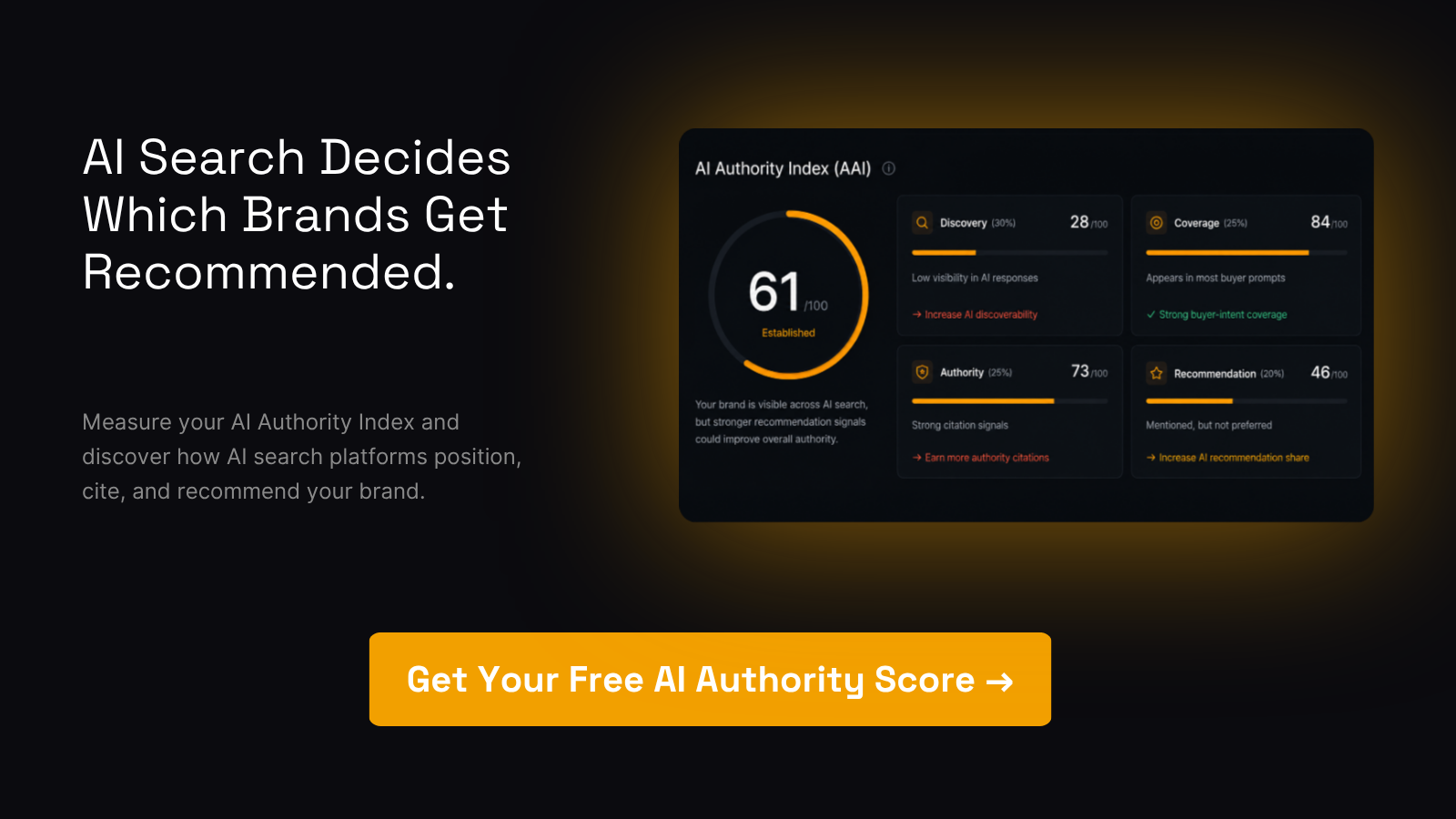
Authoritylayer monitors your brand's presence across ChatGPT, Gemini, Perplexity, and Claude in real time, tracks citation behavior across your full prompt library, and surfaces prioritized fixes ranked by impact. You get reproducible audit templates, measurement dashboards, and a competitive benchmark that shows exactly where rivals are taking recommendation share from you. The Starter plan gives you an immediate crawlability and citation check with no setup overhead. For teams managing multiple brands or markets, the Enterprise plan handles program-level visibility management with custom reporting and dedicated support. Run your first scan and see where you stand.
Useful sources and tools
- Authoritylayer Academy: How AI visibility is measured — Reproducible scoring methodology and reporting templates for AI visibility audits
- Authoritylayer Insights — Reports and analysis on AI visibility, GEO, and recommendation share
- Online Labs AI Visibility Checker — Live checker that fetches pages with GPTBot user agents and runs real queries against ChatGPT, Claude, and Gemini
- codedpills/ai-visibility-audit (GitHub) — Open-source GEO audit tool that computes a scored readiness report across entity clarity, structured data, crawlability, and brand authority
- Almontas/ai-visibility-audit (GitHub) — Self-hostable Next.js/React audit tool that grades sites on crawler access, structured data, content readability, brand footprint, trust signals, and LLM visibility
- SiteSpeak AI Score My Site — Readiness checker with guidance on llms.txt and server-side rendering for AI crawlability
- Best AI visibility tools for marketing teams — Comparison of tools and approaches for teams building an ongoing monitoring program
When sharing audit results, always note which platforms were tested, which interface or API version was used, and the date the prompts were run. Results vary by platform version and grounding configuration.
FAQ
What is an AI visibility audit?
An AI visibility audit measures whether AI assistants like ChatGPT, Gemini, Perplexity, and Claude name, cite, and accurately describe your brand when asked buyer-relevant questions. Unlike a traditional SEO audit, it focuses on whether models select your brand as an answer, not whether your page ranks in search results.
How long does an AI visibility audit take?
A minimum viable audit takes about 30 minutes: pick several prompts, run them on ChatGPT and Gemini, log mentions and citations, and identify a few immediate fixes. A full audit covering all four major platforms and a complete prompt library takes several hours for the first run.
Which AI platforms should I test in an audit?
Test at minimum ChatGPT/OpenAI, Google Gemini, Perplexity, and Anthropic Claude. Each uses different grounding and citation behavior, so your brand's visibility can vary significantly across them.
What are the most common reasons a brand is invisible to AI assistants?
The three most common causes are AI crawlers blocked by robots.txt or CDN rules, client-rendered pages that ship empty HTML shells AI crawlers can't read, and missing trust signals like clear H1s, author bylines, and structured data.
How does Authoritylayer support an AI visibility audit?
Authoritylayer provides real-time monitoring across ChatGPT, Gemini, Perplexity, and Claude, with prompt tracking, citation capture, competitive benchmarking, and prioritized remediation tasks. The Authoritylayer methodology and Academy resources offer reproducible scoring templates teams can use to run and track audits over time.
Recommended
- How AI visibility is measured — AuthorityLayer Academy
- AI Competitive Intelligence: What Actually Moves Recommendation Share | AuthorityLayer Insights
- Best AI Visibility Tools for Marketing Teams in 2026 | AuthorityLayer Insights
- Enterprise — Run AI Visibility as a Strategic Channel | AuthorityLayer