CMOs: Turn Prior, Exposure and Fan Out into ChatGPT Advertising Wins
A practical, measurable playbook for CMOs to lift ChatGPT advertising visibility. Track prior, exposure, and fan-out and follow a 30–90 day roadmap to win...
· 15 min read

ChatGPT advertising means earning visibility and recommendation share inside ChatGPT and other AI assistants, not buying media placement. The single most useful thing a marketing leader can do this week is measure baseline recommendation share: run a set of buyer-intent prompts and record how often, and how favorably, your brand appears. This should sit with the CMO or head of SEO/GEO, not be left to a generalist content team.
TL;DR:
- Improving recommendation share requires fixing on-page relevance, increasing inbound citations, and enhancing evidence framing, depending on your current exposure and fan-out levels.
- The three key signals—prior, exposure, and fan-out—must be optimized separately for effective AI recommendation visibility, rather than relying on a combined strategy.
- Ensuring your site is crawlable by OpenAI's search bots and configuring robots.txt properly is essential for AI systems to access and cite your content reliably.
- Regular measurement of citation and mention rates through prompt audits and dashboards helps track progress and identify which interventions drive visibility improvements.
- Building your brand’s organic AI presence depends on existing PR, review, and listing efforts, aligned with technical optimization and clear, verifiable claims.
Table of Contents
- Why AI assistant recommendation share matters for brands now
- How generative assistants decide: the three signal paths that predict brand mentions
- Technical discoverability: robots, crawlers, indexing, and snippet mechanics to check today
- Measurement playbook: metrics, dashboards, and experiments that prove lift in ChatGPT visibility
- 30 to 90 day tactical checklist for CMOs and SEO/GEO teams
- Types of advertising strategies utilizing ChatGPT
- Examples and case studies of successful ChatGPT advertising implementations
- Best practices and ethical considerations in ChatGPT advertising
- Integration of ChatGPT advertising with existing marketing channels
- Challenges and limitations of using ChatGPT for advertising
- Future trends and innovations in ChatGPT-driven advertising
- Geraldine's perspective: surprises and practical lessons from monitoring AI visibility
- AuthorityLayer next steps: free scan and Starter Plan
- Sources
- FAQ
Why AI assistant recommendation share matters for brands now
Consumer reliance on AI-generated summaries is no longer a fringe behavior. Roughly six in ten U.S. consumers now use AI summaries at least some of the time when researching purchases, and younger shoppers lean on them more heavily, according to NIQ's discovery research. That shift moves the moment of discovery earlier and outside your owned channels, into a conversation you cannot fully see or control.
Roughly six in ten U.S. consumers rely on AI summaries at least some of the time, per NIQ, which means a growing share of first impressions form before a prospect ever reaches your site.
- Buyers increasingly form opinions from an assistant's synthesis rather than a list of blue links.
- Winning early in that synthesis requires machine-readable, verifiable evidence, not just persuasive copy.
- Brands that ignore this shift risk being invisible at the exact moment intent is highest.
How generative assistants decide: the three signal paths that predict brand mentions
A large-panel study of brand visibility in AI search identifies three distinct paths that predict whether a brand gets mentioned: historical prior, own-domain exposure, and branded fan-out. The historical prior is your existing footprint, how often the model has already encountered your brand during training. Own-domain exposure means the assistant actually retrieves and cites your own pages as evidence. Branded fan-out is third-party distribution: press coverage, retailer listings, reviews, and other sites mentioning your brand in relevant contexts.
The magnitude here is the part CMOs underestimate. Own-domain exposure alone raises mention probability from a low baseline up to roughly half or more than half on GPT and Gemini respectively, and when exposure combines with branded fan-out, mention rates climb to 91.4% on GPT and 100% on Gemini, according to the fitted stage model of brand visibility. That is roughly a 15 to 20 times lift from exposure alone relative to baseline, with fan-out amplifying the effect further.
This gives marketing teams a decision framework instead of a guessing game:
- If your content rarely surfaces for relevant prompts, fix on-page relevance and structure before anything else.
- If pages exist but are not retrieved, invest in retrieval and distribution: better indexing signals, more inbound citations, stronger topical coverage.
- If your pages are retrieved but not chosen or favorably framed, work on evidence framing: concise claims, clear differentiators, and third-party corroboration.
Treat prior, exposure, and fan-out as three separate levers rather than one blended "AI SEO" effort. A brand with strong prior and weak exposure needs different work than one with strong exposure and weak fan-out, and conflating them wastes budget on the wrong fix. Our breakdown of how ChatGPT, Gemini, and Claude decide what to recommend walks through prioritization in more depth.
Technical discoverability: robots, crawlers, indexing, and snippet mechanics to check today
Before optimizing content, confirm the assistant can actually reach it. OpenAI operates several distinct crawlers, and treating them as one thing is a common, costly mistake.
- Allow OAI-SearchBot in robots.txt. OpenAI's developer documentation confirms this bot powers inclusion in ChatGPT's search features, separate from GPTBot, which governs model training data.
- Decide your GPTBot stance deliberately. Blocking GPTBot opts you out of training data use but does not affect search inclusion, so do not confuse the two settings.
- Check server logs for OpenAI user agents. Confirm OAI-SearchBot and ChatGPT-User are actually hitting your site and not being silently blocked by a CDN or firewall rule.
- Test UTM and referral tracking. OpenAI's publisher guidance notes the utm_source=chatgpt.com parameter, which lets you confirm referral traffic in analytics.
- Audit page mechanics that affect selection. Make the first 200 characters after your H1 self-contained and informative, write descriptive alt text, keep page payload small, and never hide critical claims behind JavaScript rendering.
Instant-mode responses often skip opening pages entirely and lean on cached snippets, according to analysis of ChatGPT's retrieval stack, which makes snippet quality matter as much as ranking position.
Pro Tip: Treat your robots.txt file as a discoverability setting, not a security setting, and review it every quarter as OpenAI adds new agents.
Measurement playbook: metrics, dashboards, and experiments that prove lift in ChatGPT visibility
Citations and mentions are not the same signal, and conflating them hides where the real problem sits. A citation means your page was pulled into the evidence set. A mention means your brand name appeared in the answer. You can be cited without being mentioned, and mentioned from third-party fan-out without ever being cited directly, so both need their own dashboard.
| Metric | What it tells you | How to capture it |
|---|---|---|
| Recommendation share | How often your brand appears across a prompt panel | Manual or automated prompt runs, logged weekly |
| Evidence exposure rate | How often your pages are cited as sources | Response parsing for domain citations |
| Mention conditional on citation | Whether being cited actually converts to being named | Cross-tab citations against mentions |
| Prompt-set win rate | Share of a fixed prompt set where you outrank rivals | Fixed panel, re-run on a cadence |
| Recrawl and refresh frequency | How current your cited pages are | Log analysis for OAI-SearchBot visits |
- Run a fixed prompt panel on a consistent cadence so week-over-week changes reflect real shifts, not prompt drift.
- Deploy canary pages, small, deliberately changed pages, to isolate which edits move citation or mention rates.
- Use chronological holdouts, comparing pre- and post-change periods, to separate your intervention from seasonal noise.
- Attribute downstream conversions from chatgpt.com referral traffic where UTM tracking is in place.
Our ChatGPT citations monitoring playbook covers instrumentation details for teams building this out internally.
30 to 90 day tactical checklist for CMOs and SEO/GEO teams
A phased rollout keeps the work moving without waiting on a full quarter of research before acting.
- Days 0 to 14: Run a baseline prompt audit across 20 to 30 buyer-intent prompts, complete a Free AI Visibility Scan or equivalent, allow OAI-SearchBot in robots.txt, and deploy two or three canary pages.
- Weeks 3 to 6: Tighten page fit with concise evidence snippets near the top of key pages, add structured schema, consolidate near-duplicate content into canonical pages, and push branded fan-out through press outreach, retail listings, and review platforms.
- Days 45 to 90: Run controlled prompt experiments comparing edited pages against controls, scale whatever moved the needle, and set a recurring monitoring cadence with an incident playbook for sudden visibility drops.
Pro Tip: Start canary pages in week one, not week six. You need a clean before-and-after baseline before you start changing everything else.
Our 15 to 30 prompt audit guide offers a template for step one.
Types of advertising strategies utilizing ChatGPT
Within the AI visibility sense of this topic, "advertising strategies" means the organic tactics that shape how ChatGPT surfaces and frames your brand, since ChatGPT does not currently sell traditional sponsored placements inside conversations. Conversational positioning is the core discipline: structuring content so it answers the exact comparison questions buyers type into ChatGPT, such as "best X for Y use case."
Interactive campaigns extend this by building assets designed to be quoted directly, short, well-labeled comparison tables, pricing breakdowns, and specification sheets that an assistant can lift cleanly into an answer. Structured data and schema markup function similarly to ad creative in this context: they package your value proposition into a form a machine can parse and repeat accurately.
Branded fan-out campaigns act as a distribution strategy. Getting third parties, review sites, industry press, retailer pages, to describe your product in consistent, favorable language increases the odds an assistant encounters and repeats that framing. This is closer to public relations than paid media, but it functions as your advertising channel in an assistant-mediated market.
Finally, prompt-targeted content strategy means writing pages that map directly to the phrasing real buyers use in ChatGPT, discovered through prompt audits rather than traditional keyword research tools. The channel has changed, but the discipline of matching content to actual buyer language has not.
Examples and case studies of successful ChatGPT advertising implementations
Public, verifiable case studies specific to ChatGPT recommendation share are still limited given how new this measurement discipline is, and we avoid citing specific brand results we cannot verify. What is documented is the mechanism behind successful implementations: the large-panel study behind the fitted stage model shows that combining own-domain exposure with branded fan-out reliably pushes mention rates from single digits into the 90s on GPT and to 100% on Gemini.
That pattern, exposure plus fan-out, describes the shape of every successful implementation this research captures, regardless of industry.
Teams building their own internal case study should track the same before-and-after structure: baseline mention rate, intervention (new pages, schema, PR push), and post-intervention mention rate across a fixed prompt panel. Without that discipline, "it worked" claims are not verifiable, which is exactly the gap AI visibility measurement is meant to close.
Best practices and ethical considerations in ChatGPT advertising
The core best practice is straightforward: make claims that are true and verifiable, because assistants increasingly draw on third-party corroboration, not just your own copy. Overstating capabilities in owned content risks being contradicted by a review site or comparison article the assistant also retrieves, which damages trust more visibly than a vague claim would.
Transparency matters in a different way here than in traditional advertising. There is no sponsored label available inside a ChatGPT answer, so any attempt to manipulate an assistant into favorable framing through hidden text, cloaking, or misleading structured data is both an ethical problem and a practical one: OpenAI's crawlers and ranking logic are not static, and manipulative tactics tend to be short-lived while damaging long-term credibility.
Respecting crawler settings is itself an ethical baseline. Attempting to selectively serve different content to OAI-SearchBot than to human visitors, a practice sometimes called cloaking, undermines the reliability of AI-mediated discovery for everyone, not just your own results.
Accessibility and accuracy overlap here too. Informative alt text, accurate specification data, and honest comparison content serve disabled users and AI retrieval systems simultaneously, which is a rare case where good practice and good ethics point the same direction. Brands that treat AI visibility as a shortcut to inflate claims usually find the effect is temporary and the reputational cost is not.

Integration of ChatGPT advertising with existing marketing channels
AI visibility work does not replace existing channels, it depends on them. Branded fan-out, one of the two strongest levers in the research behind the fitted stage model, is built largely from PR, retail listings, and reviews your team may already be generating for other reasons. The task is connecting those existing efforts to AI visibility goals rather than starting a separate workstream.
SEO and AI visibility overlap heavily but are not identical. Traditional SEO work, clean site structure, fast pages, strong internal linking, supports both Google rankings and ChatGPT's retrieval, particularly in thinking mode, which pulls more heavily from web-scale indexes according to analysis of ChatGPT's retrieval architecture. Our SEO for AI assistants measurement playbook covers where the two disciplines diverge.
Social media and email contribute indirectly by building the kind of external mentions and brand recognition that feed the historical prior signal over time. A product frequently discussed on social platforms and covered in newsletters builds footprint that shows up later in model training data, even though the effect is slower and harder to attribute than direct exposure or fan-out.
The practical integration step is adding one question to existing channel reviews: does this campaign generate content an AI assistant could plausibly cite or echo. That single filter reorients existing budget without requiring a new team.
Challenges and limitations of using ChatGPT for advertising
The most immediate challenge is measurement itself. Unlike a search engine results page, there is no persistent, publicly queryable ranking to check, which means every measurement effort requires running your own prompt panels and accepting some variability between runs. Responses are not deterministic, so a single prompt run can mislead if treated as ground truth.

Attribution is a second limitation. Even with UTM tracking in place, NIQ's research on AI-assisted discovery notes that consumers frequently use AI for research and then complete purchases elsewhere, so a clean line from AI mention to conversion is often unavailable.
Instant and thinking modes behave differently, drawing on different underlying systems according to analysis of the retrieval stack, which means a fix that improves instant-mode selection may not move thinking-mode results at all. Teams need to test across both regimes rather than assuming one optimization covers the product.
Finally, this channel offers no paid placement lever, no bidding mechanism to guarantee inclusion. Every gain comes from earned exposure and fan-out, which is slower and less controllable than a media buy, and requires sustained content and distribution work rather than a budget increase alone.
Future trends and innovations in ChatGPT-driven advertising
Expect the three-path model, prior, exposure, and fan-out, to become the working framework most marketing teams adopt as AI visibility measurement matures, replacing today's ad hoc prompt-checking. As more brands invest in this discipline, competitive benchmarking will matter more: knowing your recommendation share relative to named competitors, not just in isolation, will become standard practice.
Crawler and retrieval mechanics will likely keep evolving, with OpenAI already maintaining distinct agents for search, training, and advertising functions per its developer documentation. Marketing teams that build monitoring infrastructure now will adapt faster as these mechanics shift than teams starting from scratch later.
The gap between AI-assisted research and AI-completed purchase, currently wide according to NIQ's consumer research, is likely to narrow as assistants add more transactional capability, which raises the stakes of being the recommended option at the research stage rather than only at the final search stage.
Geraldine's perspective: surprises and practical lessons from monitoring AI visibility
The most consistent surprise in this work is how often citation and mention diverge. A page can be pulled as evidence and the brand still goes unnamed, or the reverse: no citation at all, yet the brand appears because fan-out did the work instead. Teams that only watch one metric miss half the picture.
The second lesson is how small a lever can matter in instant mode. A rewritten opening sentence has moved selection outcomes more than a page-one Google ranking. Guessing does not scale here. Prompt panels and canary pages turn AI visibility into something you can actually manage instead of hope for.
— Geraldine
AuthorityLayer next steps: free scan and Starter Plan
Measuring recommendation share by hand across dozens of prompts is slow, and most teams stop after the first audit. There are platforms that build that measurement into ongoing systems: observable evidence from real AI answers, a single benchmarking index instead of scattered spreadsheets, and prioritized recommendations tied to what is actually moving your citation and mention rates.
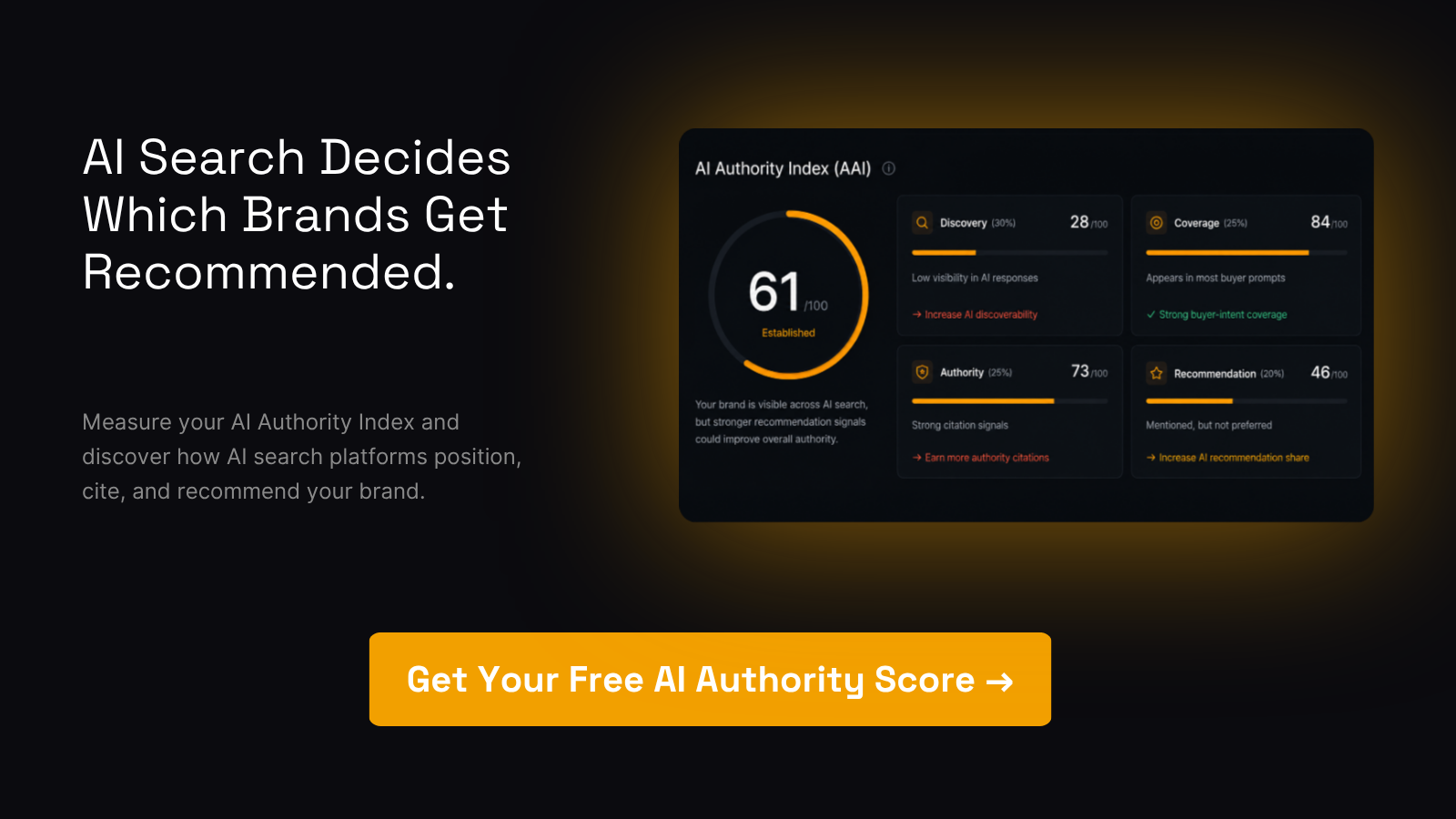
- Start with the Free AI Visibility Scan to see your current baseline across ChatGPT, Gemini, Claude, and Perplexity.
- Move to the Starter Plan at $99 per month for ongoing monitoring and prioritized fixes once you have a baseline worth tracking.
- Scale to Growth or Enterprise as your prompt panel and competitive set expand.
Sources
For technical setup, start with OpenAI's developer documentation on bots and the ChatGPT Search help center article. For the research behind the three-path model, see the fitted stage model study. For adoption context, see NIQ's AI discovery research. For additional tactical reading, see this partner guide on optimizing for ChatGPT.
- From Prompt to Recommendation:A Fitted Stage Model of Brand Visibility in AI Search
- OpenAI developer docs — bots
- Visibility in the age of AI: how product discovery is being rewritten (NIQ)
FAQ
What does "recommendation share" mean in ChatGPT advertising?
Recommendation share is the percentage of relevant buyer-intent prompts where an assistant names your brand, measured across a fixed prompt panel run on a consistent cadence. It is distinct from citation rate, which only measures whether your pages were pulled as evidence.
Do I need to allow both GPTBot and OAI-SearchBot?
No, they control different things: OAI-SearchBot governs inclusion in ChatGPT's search features, while GPTBot governs whether your content is used for model training, according to OpenAI's developer docs. You can allow one and block the other depending on your goals.
How is own-domain exposure different from branded fan-out?
Own-domain exposure means the assistant retrieves and cites your own website as a source. Branded fan-out means third parties, press, retailers, review sites, mention your brand, and the fitted stage model research found combining both raised mention rates to 91.4% on GPT and 100% on Gemini.
Can I buy paid ad placement inside ChatGPT conversations today?
This article covers organic AI visibility and recommendation share, which is earned through content, technical setup, and distribution rather than purchased placement. AuthorityLayer's platform focuses on measuring and improving that earned visibility across ChatGPT, Gemini, Claude, and Perplexity.
How long does it take to see a change in AI recommendation share?
Based on the phased approach in this playbook, initial baseline data comes within the first two weeks, and measurable shifts from page and distribution changes typically show up in the 45 to 90 day range as canary pages and controlled experiments complete a full cycle.