LLM SEO for Marketers: How to Win AI Citations
Discover LLM SEO strategies to boost AI citations. Optimize your content now to enhance visibility across major platforms. Start today!
· 18 min read

LLM SEO is the practice of optimizing your content and brand signals so that large language models like ChatGPT, Google Gemini, Anthropic Claude, and Perplexity cite you in their generated answers. The single highest-leverage action to start with: make your content extractable. That means writing self-contained answer capsules of 40–150 words, adding Article and FAQPage schema at the template level, publishing entity signals with sameAs links, and tracking your Share of Model across models rather than just watching organic clicks.
Immediate next steps:
- Write a canonical answer capsule for every core topic page (40–150 words, answer-first, followed by supporting bullets or a short table)
- Implement Article/BlogPosting and FAQPage schema at the template level
- Set up a prompt set and run it weekly across ChatGPT, Gemini, Claude, and Perplexity to measure citation frequency
Table of Contents
- What is LLM SEO and how does it differ from traditional SEO?
- Core principles that make your content citable by LLMs
- What technical foundations support LLM discovery and citation?
- What content formats do LLMs prefer when generating answers?
- How do you measure AI visibility and Share of Model?
- Step-by-step implementation plan with realistic timelines
- What risks and manipulative tactics should you avoid?
- Key Takeaways
- The measurement gap most LLM SEO programs miss
- Authoritylayer gives you the AI visibility data your team actually needs
- Useful sources
- FAQ
What is LLM SEO and how does it differ from traditional SEO?
Traditional SEO optimizes for a position on a results page. LLM SEO, sometimes called large language model optimization (LLMO) or generative engine optimization (GEO), optimizes for a citation inside an AI-generated answer. The objective shifts from rank to reference: instead of chasing a #1 blue link, you are competing for Share of Model, the percentage of relevant AI responses in which your brand appears.
The pipeline is different, too. Generative engines use retrieval-augmented generation (RAG): the model retrieves live documents, grounds its answer on them, and synthesizes a response. That means freshness, crawlability, and structured data all feed directly into whether your content gets pulled into the grounding layer.
Platforms where this matters most:
- OpenAI / ChatGPT — conversational queries, product comparisons, brand recommendations
- Google Gemini — AI Overviews and AI Mode inside Google Search
- Anthropic Claude — research-oriented and professional queries
- Perplexity — citation-heavy answer engine with visible source attribution
Traditional SEO still matters. Pages that rank in organic results continue to feed AI Overviews, and the overlap between top organic results and AI citations has shifted but not disappeared. The practical implication: treat LLM SEO as additive, not a replacement. Fix crawlability and technical hygiene first, then layer on the citation-specific tactics.
"LLM optimization signifies a huge shift toward optimizing for visibility — not necessarily for clicks." — Search Engine Land
The metric difference is the clearest way to explain the shift to a skeptical stakeholder. Organic SEO measures sessions, rankings, and CTR. LLM SEO measures citation frequency, citation sentiment, Share of Model, and AI referral conversion rate. According to a16z, the move from page rank to model share reflects fundamentally different retrieval and incentive structures in AI-native search.
Core principles that make your content citable by LLMs
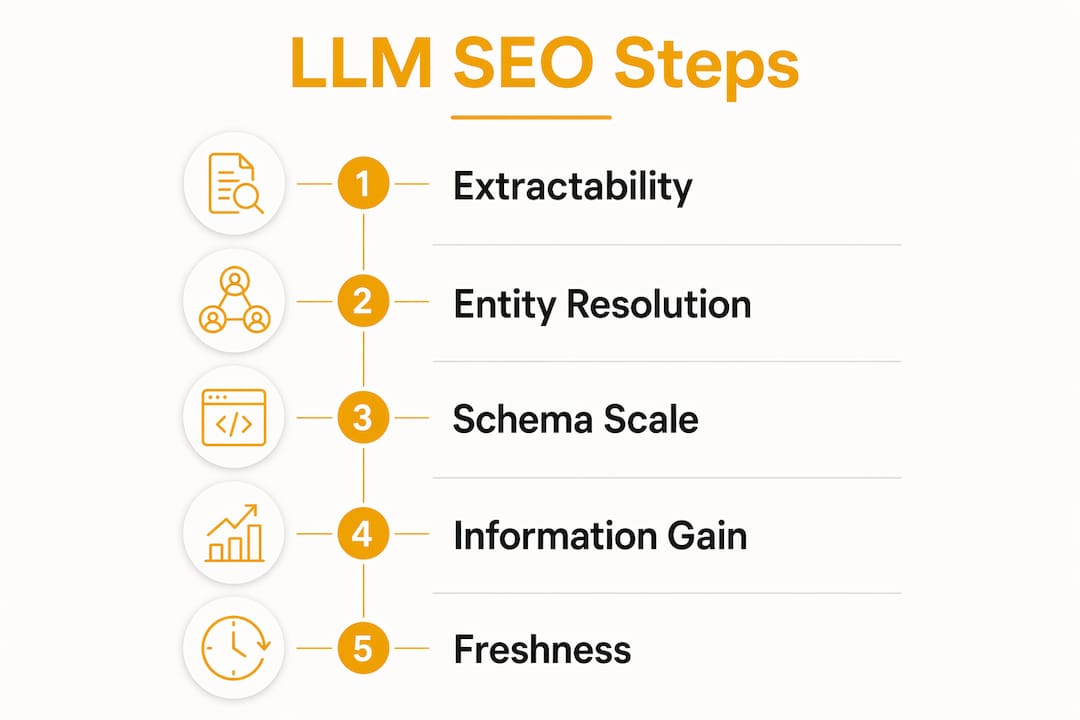
Six principles separate content that gets cited from content that gets ignored.

1. Extractability. LLMs pull passages, not pages. Each key section needs to stand alone as a self-contained answer. If a paragraph requires the surrounding context to make sense, it will not be extracted cleanly.
2. Entity resolution. Models need to know unambiguously who you are. Person and Organization schema with sameAs arrays pointing to LinkedIn, Wikipedia/Wikidata, and major media bylines materially improve entity resolution and lower ambiguity in citations.
3. Schema at scale. Article, FAQPage, and Person schema applied at the template level propagate across your entire content set in one deployment. Schema is not a page-by-page task.
4. Information gain. Original data appears 4.1× more often in cited content than in uncited content. Proprietary surveys, original benchmarks, and first-party data give models a reason to cite you rather than a generic source.
5. Freshness. RAG-based engines favor recently indexed content. A stale page with good structure will lose to a fresh page with equivalent structure.
6. Distributed mentions. LLMs learn from what the broader web says about you, not just your own site. Mentions on high-authority publications, industry forums, and reference sites like Wikipedia all feed model confidence.
Here is what the difference looks like in practice:
Poor answer capsule (not extractable): Strong answer capsule (extractable): The second version can be lifted verbatim and placed in an AI answer without losing meaning.
Pro Tip: The practical unit of optimization for LLM citation is the answer capsule: a 40–150 word passage that states the answer first, then justifies it, preceded by a question-format H2 heading. Structure it as a visible paragraph with immediate supporting bullets or a short data table.
What technical foundations support LLM discovery and citation?
Crawlability is the floor. If a model's retriever cannot access your page, nothing else matters. Run through this checklist before investing in content tactics:
- Confirm all key pages return HTTP 200 and are included in your XML sitemap
- Verify robots.txt does not block Googlebot, GPTBot, ClaudeBot, or PerplexityBot
- Check canonical tags point to the correct URL on every template
- Audit JavaScript rendering: content rendered only client-side may not be indexed
- Review crawl budget allocation in Google Search Console — prioritize high-value content directories
- Validate structured data using Google's Rich Results Test and Bing's Markup Validator in Bing Webmaster Tools
- Add an
llms.txtfile as a low-cost optional signal (some providers read it; Google does not require it)
Google Search Central is explicit that foundational SEO best practices apply directly to generative AI features. No special AI-only file replaces solid crawlability and structured data.
Schema types to implement at the template level
| Schema Type | Where to Apply | Primary Benefit |
|---|---|---|
| Article / BlogPosting | Every editorial page | Signals content type, author, publish date |
Person (with sameAs) |
Author bio pages and bylines | Resolves author identity across the web |
Organization (with sameAs) |
Homepage and About page | Disambiguates brand from other entities |
| FAQPage | FAQ blocks within articles | Directly feeds Q&A extraction by LLMs |
| BreadcrumbList | All content pages | Communicates site hierarchy to retrievers |
Apply these using JSON-LD in the <head> of each page template. A short example for FAQPage:
{
  "@context": "https://schema.org",
  "@type": "FAQPage",
  "mainEntity": [{
    "@type": "Question",
    "name": "What is Share of Model?",
    "acceptedAnswer": {
      "@type": "Answer",
      "text": "Share of Model is the percentage of AI-generated responses that mention your brand for a defined prompt set, measured across ChatGPT, Gemini, Claude, and Perplexity."
    }
  }]
}
Schema.org is the authoritative vocabulary reference for all types listed above.
"Structured data helps but is not required specifically for generative AI — what matters is that your pages are crawlable, indexed, and technically sound." — Google Search Central
Template-level schema deployment is the fastest path to scale. One engineering sprint can propagate FAQPage and Article schema across hundreds of pages simultaneously, rather than adding markup page by page.
What content formats do LLMs prefer when generating answers?
The editorial patterns that perform best in AI citations share one trait: they are structured for extraction, not just for reading.

Answer-first sections. Every major section should open with a direct, complete answer in the first one or two sentences. Supporting evidence, examples, and caveats follow. This mirrors how LLMs construct their own outputs, which is why they favor it as source material.
FAQ blocks distributed in-article. Weave Q&A sections into relevant parts of an article using question-format H2 headings, not just a single FAQ block at the end. LLMs frequently pull from FAQ-style content when answering conversational queries.
Comparison tables with generic labels. Tables are highly extractable. Use them for feature comparisons, metric definitions, and process steps. Label columns and rows clearly.
Short data anchors. A single original statistic or benchmark, properly attributed, gives a model a citable fact. Pages with original data are cited far more often than pages that only synthesize existing information.
Author bylines with sameAs links. Every article should carry a byline linked to a Person schema entity. This signals E-E-A-T (Experience, Expertise, Authoritativeness, Trustworthiness) at the page level.
Editorial dos and don'ts
| Do | Don't |
|---|---|
| Open every section with a direct answer | Bury the answer after three paragraphs of context |
| Use question-format H2 headings | Use vague headings like "More Information" |
| Publish original data with attribution | Syndicate content without adding unique value |
| Keep answer capsules to 40–150 words | Write long paragraphs with no clear answer sentence |
| Add FAQPage schema to every FAQ block | Add schema without matching visible on-page content |
| Maintain consistent entity names across all pages | Use multiple brand name variants across your site |
For answer engine optimization more broadly, the same structural principles apply: clarity, attribution, and self-contained passages are the common thread across every AI platform.
"LLMs prioritize content that offers original, one-of-a-kind insights over repeated information that already appears in existing content." — Search Engine Land
Pro Tip: Entity consistency matters more than most teams realize. If your brand appears as "Acme Corp," "Acme Corporation," and "Acme" across different pages, models may treat these as separate entities and split citation credit. Pick one canonical name and use it everywhere.
How do you measure AI visibility and Share of Model?
Clicks and rankings do not capture AI influence. A brand can appear in hundreds of AI-generated answers per day and show zero AI-attributed sessions in Google Analytics if users never click through. That is why the measurement framework has to change.
Core metrics to track:
- Share of Model: Percentage of sampled AI responses that mention your brand for a defined prompt set
- Citation frequency: Raw count of responses citing your brand per model per week
- Citation sentiment: Positive, neutral, or negative framing in the response
- AI referral conversion rate: Sessions from AI platforms divided by conversions from those sessions
- Topical authority distribution: Which subject areas LLMs associate with your brand across models
AI-referred visitors convert at materially higher rates than traditional organic search visitors in multiple practitioner studies, with some case study datasets showing 9×–11× higher conversion rates. That makes Share of Model a revenue-relevant metric, not just a vanity one.
Sample KPI framework
| Metric | Measurement Method | Cadence |
|---|---|---|
| Share of Model | Prompt set run across 4 LLMs; brand appearances / total responses | Weekly |
| Citation frequency | Count brand mentions per model per prompt category | Weekly |
| Citation sentiment | Manual or automated sentiment scoring of response text | Bi-weekly |
| AI referral conversion rate | GA4 / analytics segmented by AI referral source | Monthly |
| Topical authority distribution | Topic tagging of prompts where brand appears | Monthly |
Building your prompt set. Start with 20–50 prompts that reflect real buyer queries in your category. Include navigational prompts ("What is [Brand]?"), comparative prompts ("Best tools for [use case]"), and informational prompts ("How do I [task]?"). Run the full set across ChatGPT, Gemini, Claude, and Perplexity. Document which models cite you, in what context, and with what sentiment. Repeat on a weekly cadence and track changes after content or schema deployments.
Industry practitioners advise tracking citations and model-specific presence across all four major platforms because each model has different training data, retrieval logic, and citation behavior. A brand that dominates in ChatGPT responses may be nearly invisible in Perplexity.
Authoritylayer automates this entire workflow: it runs prompt sets across ChatGPT, Gemini, Claude, and Perplexity, scores your AI visibility against competitors, and surfaces prioritized recommendations. The platform's AI Authority Index gives you a single benchmark score to track quarter over quarter.
Step-by-step implementation plan with realistic timelines
Schema and entity changes take approximately 4–12 weeks to fully propagate into a model's retrieval signals. Plan your measurement cadence accordingly: do not judge a schema deployment by results in week one.
Implementation timeline
| Phase | Timeframe | Key Tasks | Responsible Role |
|---|---|---|---|
| Quick wins | Several weeks | Crawlability audit, robots.txt review, sitemap update, Article/FAQPage schema at template level, canonical answer capsules on top 20 pages | Engineering + Content |
| Mid-term | Weeks 6–12 | Person/Organization schema with sameAs, prompt set build and baseline measurement, FAQ blocks added to top 50 pages, digital PR outreach for brand mentions |
Content + PR |
| Long-term | Months 3–6 | Original data publication (surveys, benchmarks), topic cluster build-out, Share of Model tracking cadence, competitor benchmarking, schema validation sweep | Content + Analytics |
Priority checklist by effort:
- Schema baseline (1–2 person-weeks, Engineering): Deploy Article, FAQPage, and Organization schema at template level. Validate with Google's Rich Results Test.
- Answer capsule audit (2–3 person-weeks, Content): Rewrite the opening section of your top 50 pages to lead with a 40–150 word extractable answer capsule.
- Entity signal setup (1 person-week, Content + Engineering): Add Person schema with
sameAsto all author pages. Link to LinkedIn, Wikipedia/Wikidata, and major media bylines where they exist. - Prompt set and baseline (1 person-week, Analytics): Build a 30–50 prompt set and run it across four LLMs. Document baseline Share of Model before any further changes.
- Digital PR for distributed mentions (ongoing, PR): Target three to five high-authority publications per quarter for brand mentions and citations.
- Original data publication (2–4 person-weeks per asset, Content): Publish at least one original data asset per quarter — a survey, benchmark, or proprietary analysis.
Pro Tip: Run your prompt set immediately after deploying schema changes, then again at weeks 4, 8, and 12. The 4–12 week propagation window means early results will understate the eventual impact. Patience in measurement is as important as speed in implementation.
What risks and manipulative tactics should you avoid?
The tactics that work in the short term for gaming traditional search tend to backfire faster in LLM SEO, because models are trained on the broader web and can detect patterns of inauthentic behavior.
Red flags to avoid:
- Inauthentic brand mentions: Paying for or fabricating brand mentions on low-quality sites. Models weight mention quality, not just quantity.
- Mass micro-pages: Creating hundreds of thin, near-duplicate pages targeting slight keyword variations. This dilutes entity signals and can trigger scaled content abuse warnings.
- Fabricated citations: Inventing statistics or attributing quotes to sources that do not contain them. LLMs cross-reference, and fabricated citations erode trust when discovered.
- Over-reliance on llms.txt: Treating the
llms.txtfile as a primary optimization lever. Google does not require it, and its impact across other platforms is inconsistent. Use it as a low-cost optional signal, nothing more. - Keyword stuffing in schema: Filling schema fields with keyword-dense text that does not match visible page content. This creates a mismatch that validators and models both flag.
Platform-specific cautions. Google has issued explicit warnings about scaled content abuse, particularly content generated at volume without meaningful information gain. The standard is whether the content demonstrates genuine expertise and adds value a user cannot find elsewhere.
Cross-model behavior differs in ways that matter operationally. Perplexity shows visible citations, making it easier to audit. ChatGPT's citation behavior varies by query type and whether web search is enabled. Gemini's AI Overviews draw heavily from indexed Google Search results. Claude tends toward research-oriented queries and weights source credibility heavily. A tactic that improves citation frequency in one model may have no effect in another.
"Foundational SEO still matters for generative features — ensure crawlability, follow Search Console guidance, and don't rely on experimental files alone." — Google Search Central
Defensible best practices:
- Attribute all statistics to named, linkable sources within the content itself
- Maintain a consistent canonical brand name across every page, schema field, and offsite mention
- Test schema changes in a staging environment before deploying to production
- Document your prompt set and measurement methodology so results are reproducible
- Disclose AI-assisted content where platform policies or audience expectations require it
Key Takeaways
LLM SEO requires optimizing for citation and Share of Model, not just rank: implement Article and FAQPage schema at the template level, write 40–150 word extractable answer capsules, publish original data, and measure brand citation frequency weekly across ChatGPT, Gemini, Claude, and Perplexity.
| Point | Details |
|---|---|
| Schema is the fastest lever | Deploy Article, FAQPage, and Organization schema at the template level to propagate changes across your full content set in one sprint. |
| Answer capsules drive extraction | Write 40–150 word answer-first passages preceded by question-format H2 headings; these are the unit LLMs extract when generating responses. |
| Original data multiplies citations | Pages with original data are cited 4.1× more often than pages that only synthesize existing information. |
| Measure Share of Model weekly | Build a 30–50 prompt set, run it across four LLMs, and track citation frequency and sentiment on a weekly cadence. |
| Authoritylayer automates the measurement stack | Authoritylayer benchmarks your Share of Model against competitors across ChatGPT, Gemini, Claude, and Perplexity, and surfaces prioritized recommendations for improvement. |
The measurement gap most LLM SEO programs miss
Most teams implementing LLM SEO get the content side roughly right within a quarter. They add schema, rewrite section openings, and publish a few original data assets. What they consistently underestimate is the measurement side.
The temptation is to proxy AI visibility with organic traffic or AI referral sessions in GA4. Those numbers are real, but they are incomplete. A brand can be cited in thousands of AI responses per week and generate almost no trackable referral traffic, because users read the answer and act without clicking. That invisible influence is where the real competitive advantage accumulates, and it is exactly what Share of Model captures.
The other gap is cross-model consistency. Teams tend to test in ChatGPT because it is the most familiar platform, then assume their results generalize. They do not. Claude weights source credibility differently than Perplexity does. Gemini's AI Overviews draw from a different retrieval pool than ChatGPT Search. A brand that appears confidently in ChatGPT responses may be absent or mischaracterized in Claude, and you will not know unless you measure across all four.
The programs that move fastest are the ones that set up a structured prompt set and baseline measurement before making any content changes. Without a baseline, you cannot attribute improvements to specific tactics, and you cannot make the case internally for continued investment. Measurement is not the last step. It is the first.
Authoritylayer gives you the AI visibility data your team actually needs
If you have read this far, you already know the tactics. The harder part is knowing whether they are working, and where your brand stands relative to competitors across ChatGPT, Gemini, Claude, and Perplexity right now.
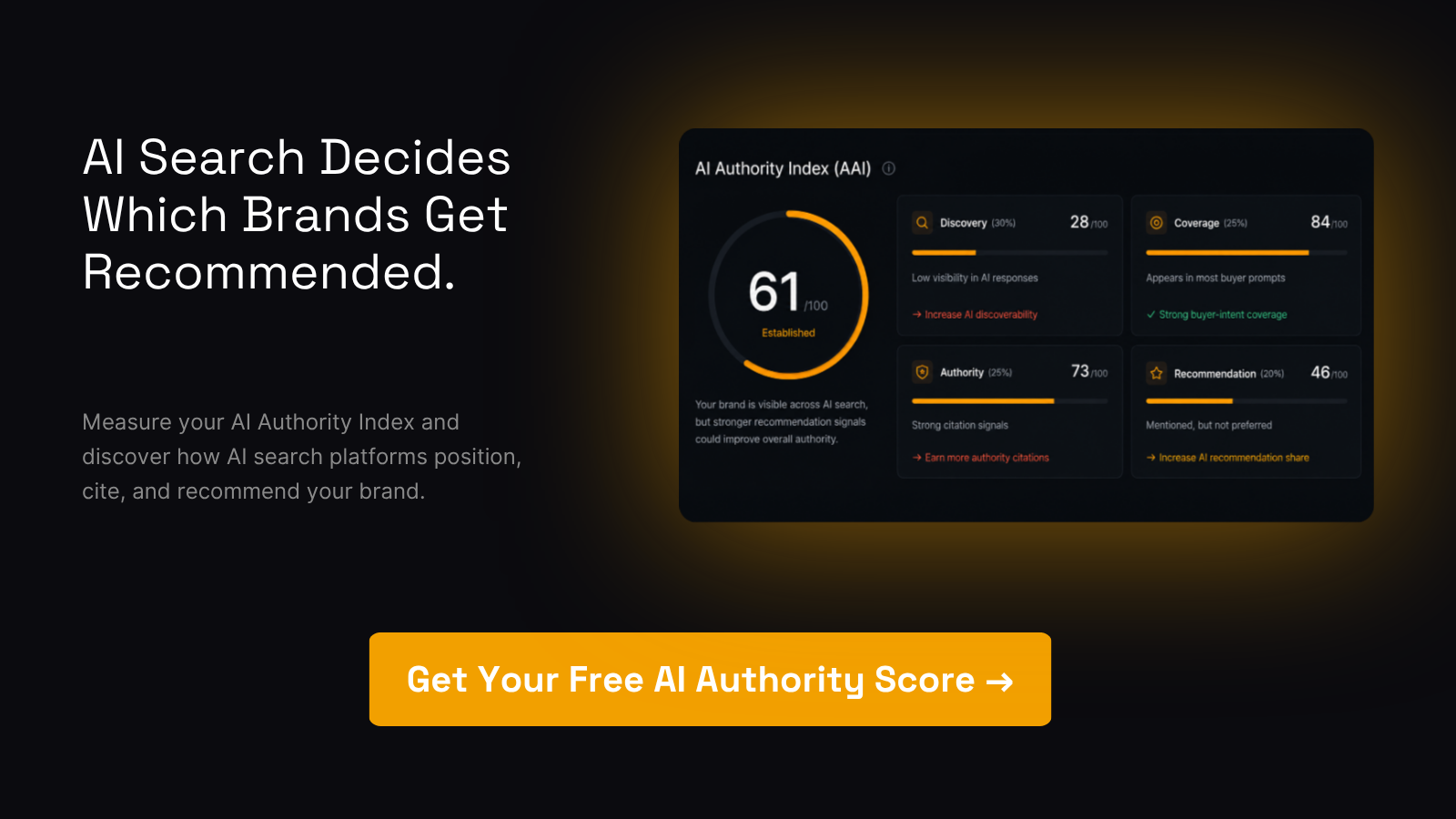
Authoritylayer is the AI Visibility Intelligence platform built specifically for that problem. It runs your prompt set across all four major LLMs, scores your Share of Model against named competitors, tracks citation sentiment over time, and delivers prioritized recommendations so your team knows exactly what to fix next. No manual spreadsheet sampling. No guessing which model is underperforming.
Marketing teams using Authoritylayer get a single AI Authority Index score they can report to leadership, a competitor benchmark they can act on, and a clear view of which content gaps are costing them citations. Whether you are starting your first AI visibility measurement or scaling an existing program, the enterprise plan covers multi-brand organizations with advanced competitive analysis and custom reporting. Run your first AI visibility scan and see where you stand today at authoritylayer.app.
Useful sources
- Google's Guide to Optimizing for Generative AI Features — Google Search Central's primary reference for how crawlability, structured data, and foundational SEO feed generative AI features. Start here for implementation guidance.
- How Generative Engine Optimization (GEO) Rewrites the Rules of Search — a16z's essay introducing the shift from page rank to model share. Essential context for framing LLM SEO as a strategic priority to leadership.
- LLM SEO: Optimize Content for AI Engines — Nadia Mohamed's practitioner guide covering schema implementation, answer capsule structure, entity signals, and measurement. One of the most cited practitioner references in the space.
- What Is LLMO? Optimize Content for AI and Large Language Models — Search Engine Land's taxonomy of SEO, AEO, GEO, and LLMO, with the five pillars of LLM optimization. Useful for aligning terminology across your team.
- Forget What You Know About Search. Optimize Your Brand for LLMs. — Harvard Business Review's executive-level framing of the consumer shift to AI platforms, including survey data on adoption rates. Useful for making the business case internally.
- Schema.org — the authoritative vocabulary for structured data markup. Reference it when implementing Article, Person, Organization, and FAQPage schema.
- JSON-LD — the recommended format for embedding structured data. Use alongside Schema.org for all template-level implementations.
- Answer Engine Optimization: A 2026 Guide for Marketers — practical companion guide on optimizing content for AI-powered answer engines, with tactical overlap on structure and citation hygiene.
- Authoritylayer AI Visibility Measurement Methodology — explains how Share of Model, citation frequency, and AI Authority Index scores are calculated and tracked.
FAQ
What is LLM SEO?
LLM SEO is the practice of optimizing your content, brand signals, and technical infrastructure so that large language models like ChatGPT, Gemini, Claude, and Perplexity cite your brand in their generated answers. The goal is Share of Model, not just search rank.
How is LLM SEO different from traditional SEO?
Traditional SEO targets keyword rankings and organic clicks on a results page. LLM SEO targets citation frequency and Share of Model inside AI-generated answers, where users often act without clicking through to a website at all.
Which LLM platform should you prioritize first?
There is no single best platform: ChatGPT, Gemini, Claude, and Perplexity each have different retrieval logic and user bases. Measure across all four from the start, since a brand that performs well in one model can be absent in another.
Is SEO going away because of AI?
Traditional SEO is not going away. Pages that rank in organic results still feed AI Overviews, and technical SEO hygiene remains the foundation for LLM discoverability. LLM SEO is additive, not a replacement for existing search optimization.