Marketers Catch Gaps Before Rivals With Real Time AI Monitoring
See how marketing leaders track AI mentions, sources, and recommendations, test prompts, and turn visibility gaps into prioritized work using research.
· 7 min read

Real-time AI monitoring is the practice of tracking how AI assistants discover, describe, and recommend your brand while buyers research, so you can see where you appear and where you vanish. Its value is simple: you spot visibility gaps before competitors fill them. Start by building a prompt matrix and a sampling plan.
Key Takeaways
Real-time AI monitoring reveals how brands appear in AI assistants, allowing marketers to improve visibility and influence in AI-driven search results.
| Point | Details |
|---|---|
| Track recommendation share | Monitor the percentage of AI answers that recommend your brand to assess visibility impact. |
| Observe citation placement | Check whether your brand appears in inline citations, source panels, or not at all in AI responses. |
| Use multiple surfaces and layers | Sampling both interfaces and APIs across platforms reveals the full scope of brand visibility. |
| Prioritize high-impact fixes | Focus on quick, defensible changes that increase recommendation share, like structured data or expert pages. |
| AuthorityLayer offers monitoring tools | We provide real evidence, scoring, and prioritized recommendations to help improve AI brand visibility. |
Table of Contents
- What does real-time AI monitoring cover?
- Why does monitoring AI answers matter now?
- Which metrics and signals should you track?
- How do you set up a practical monitoring workflow?
- How do you turn results into prioritized actions?
- How can you start monitoring with AuthorityLayer?
- FAQ
What does real-time AI monitoring cover?
In this article, real-time AI monitoring means watching how AI assistants find, describe, and recommend brands during buyer research. It answers three questions: does the assistant mention you, what does it say, and does it recommend you over alternatives. It does not cover model observability, meaning the tracking of an AI model's own performance or behavior. That is a separate discipline with a different audience, and we leave it aside here.
The surfaces worth watching are Google AI Overviews, ChatGPT, Gemini, and Perplexity. For each one, you also decide whether to observe the consumer interface, the API, or both. That choice matters more than it sounds. Audit research shows that interfaces and APIs expose different source layers: citation panels, inline citations, and API responses are not equivalent, and ChatGPT and Gemini often differ in which domains they display. A final citation list is not a complete record of what shaped an answer. If you sample only one layer, you will misread your visibility, so decide early and document which layer each data point came from.
Why does monitoring AI answers matter now?
Because the answer itself is becoming the destination. Pew Research found that when a Google AI summary appeared, users clicked a traditional result link on 8% of visits, compared with 15% when no summary appeared. Clicks on links inside the summary were just 1% of visits. People read the summary and, more often than not, stop there.
The exposure is wide. Pew's survey of U.S. adults reports that 58% encountered AI summaries at least sometimes, though people are mixed on how useful and trustworthy those summaries are. Mixed trust does not mean low influence. A buyer who skims a summary still walks away with a shortlist in mind.
Generative search also moves influence upstream. What assistants trust and ingest from the wider web now shapes who get discovered, and a brand cited directly inside an AI answer earns trust that a brand buried in the underlying results does not. The implication for marketing leaders: appearing in the AI answer is worth more than ranking beneath it. Our guide to AI Overviews optimization covers the quick wins for that surface.
Which metrics and signals should you track?
Track signals you can turn into dashboards and alerts. These core signals cover most of what a marketing leader needs:
- Recommendation share: the percentage of sampled answers that recommend your brand. This is your headline number.
- Citation frequency and placement: whether you appear inline, in a source panel, or not at all.
- Prompt-trigger coverage: which prompt variants surface you, from broad category queries to niche, constraint-heavy ones.
- Cross-model agreement and volatility: how often platforms name the same brands, and how often one platform repeats itself across runs.
- Visibility breadth: which intents and use cases bring you up, and which never do.
- A composite index: one benchmark score, such as an AI Authority-style index, so you can chart the trend and report it upward.
Volatility deserves special attention. Practitioner-level research finds that AI visibility is stochastic and platform-dependent, and agreement on top-recommended brands across models can be low. A single run proves almost nothing. Repeated, multi-platform samples are what turn noise into a signal you can defend in a budget meeting.
How do you set up a practical monitoring workflow?
Keep the first pass simple. Instrument what matters most, then widen coverage.
- Choose your surfaces and layers. Pick from AI Overviews, ChatGPT, Gemini, and Perplexity, and decide whether you observe interfaces, APIs, or both.
- Build a prompt matrix. Cover core buying intents, niche cues, and product constraints such as budget, team size, or integration needs. Our prompt audit guide shows how to structure a prompt matrix.
- Set sampling cadence. Run continuous sampling for your critical intents and scheduled repeat snapshots for broader coverage.
- Capture evidence. Save the rendered answer, inline citations, and source panels, as screenshots plus structured fields, so you can re-analyze later.
- Aggregate and alert. Roll results into a dashboard with a benchmark score, and set alerts for drops in recommendation share on critical prompts.
Pro Tip: Log which prompt wording produced each answer. When a result changes, you can tell whether the assistant moved or your prompt did.
For teams that also care about Google's summaries, this practical AI Overviews playbook offers an outside view on optimizing that surface.
How do you turn results into prioritized actions?
Start by respecting the noise. Low agreement between platforms is not a verdict, it is a reason to sample more. Multi-platform, repeated observation reduces false negatives, so you do not rebuild a strategy around one unlucky run.
Next, hunt for hidden gaps. Research shows that brands that seem missing can often be retrieved with highly specific, distinctive cues. If a niche prompt surfaces you but a broad one does not, your content is retrievable, just not competitive for the general query. That tells you where to push.
Then rank fixes with three questions: how much would this lift recommendation share, how hard is it to ship, and how defensible is the result against competitors. High impact, low effort, hard to copy goes first. Typical moves include short canonical answer snippets, structured data, expert pages for specialist queries, and fixes informed by competitive benchmarking. To verify a single assistant, follow our steps for checking whether ChatGPT recommends your brand.

How can you start monitoring with AuthorityLayer?
We built AuthorityLayer as an AI Visibility Intelligence platform that measures, benchmarks, and helps you prioritize fixes for how AI assistants recommend your brand. You get observable evidence from real AI answers, an explained score, and prioritized recommendations instead of raw mention counts.
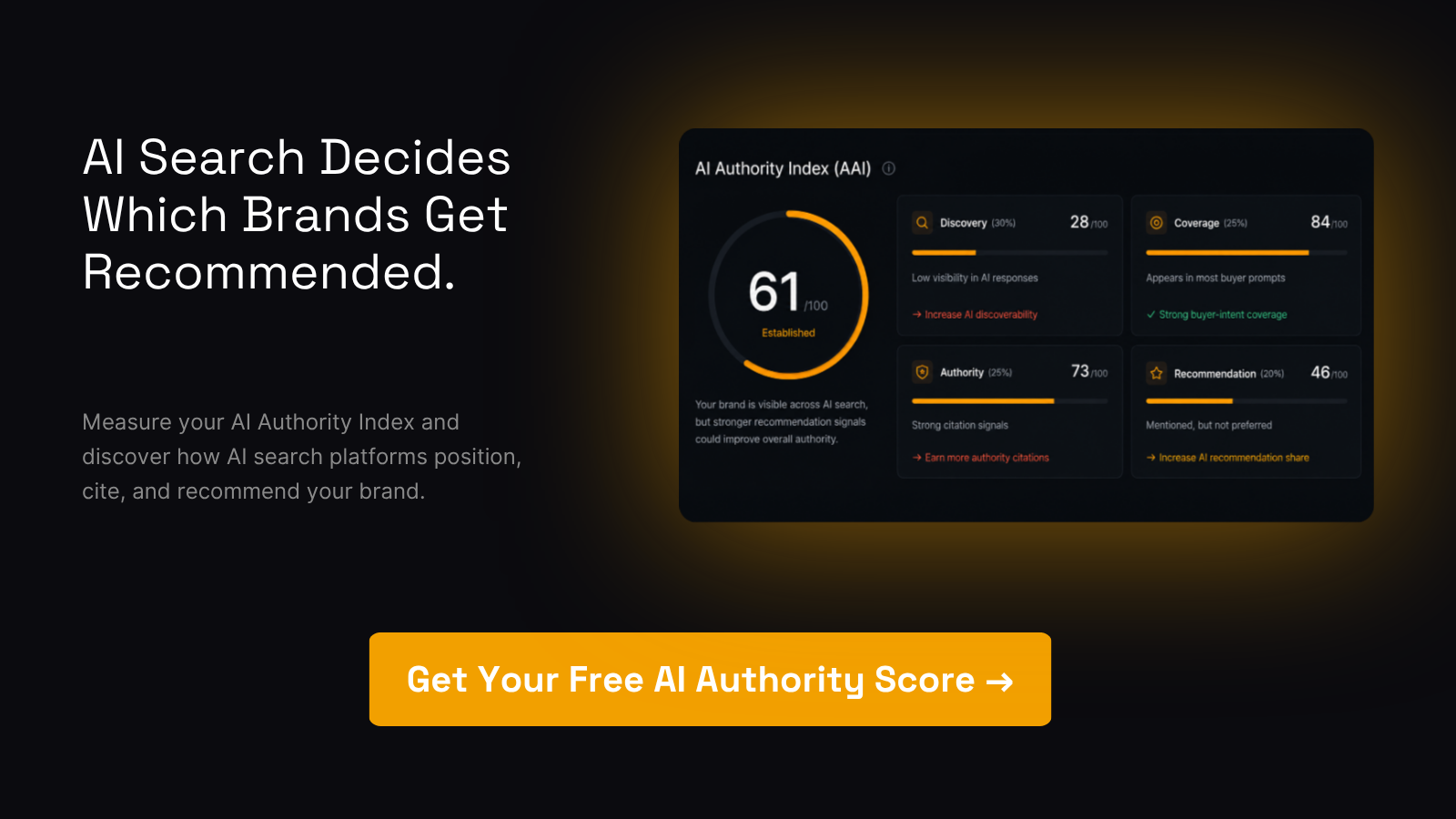
The fastest start is our Free AI Visibility Scan, which gives you a quick read on where you stand. From there, you can get the Monthly AI Visibility Report for $59 per month. If you want continuous monitoring, compare our Starter, Growth, and Enterprise plans, and run your first scan today.
FAQ
What is real-time AI monitoring for brands?
It is the ongoing tracking of how AI assistants discover, describe, and recommend your brand. You sample answers across platforms, record whether you are mentioned or recommended, and watch how that changes over time.
How often should you sample AI answers?
Sample your most important buying intents continuously, and run repeated snapshots for broader coverage. AI visibility is stochastic and platform-dependent, so repeated observations matter more than any single run.
Why do interfaces and APIs give different results?
They expose different source layers. Audit research shows that citation panels, inline citations, and API responses are not equivalent, so capture more than one layer before drawing conclusions.
What should you fix first after a scan?
Start with the prompts where you are absent but a niche variant retrieves you. Those are the clearest retrievability gaps, and short canonical answers and expert pages often close them fastest.