Best Otterly Alternatives for GEO & AI Visibility Teams
Discover the best Otterly alternatives for GEO and AI visibility teams. Explore top picks like Authoritylayer for superior monitoring and insights.
· 18 min read

For most marketing and SEO teams replacing Otterly, Authoritylayer is the recommended pick. It covers the full AI visibility stack: multi-engine monitoring, competitive benchmarking, and prioritized recommendations across ChatGPT, Gemini, Claude, and Perplexity. If Authoritylayer is more than your current stage requires, the categories worth evaluating next are enterprise AI visibility suites, cross-engine reporting platforms, SEO-suite AI toolkits, and prompt-tracking specialists.
Top picks at a glance:
- Authoritylayer — full AI Visibility Intelligence platform with recommendation share tracking and prioritized next steps; best for mid-market and enterprise GEO teams
- Enterprise AI visibility suites (e.g., Profound AI, Scrunch AI) — deep enterprise controls, multi-brand support, and SLA-backed onboarding
- Cross-engine reporting platforms (e.g., Rankshift, LLM Pulse, Peec AI) — prompt-level tracking across multiple assistants with reporting dashboards
- SEO-suite AI toolkits (e.g., Semrush AI features, Writesonic) — familiar interfaces for teams already embedded in traditional SEO workflows
- Prompt-tracking specialists — narrow tools focused on prompt-level visibility without broader recommendation or competitive analysis
Immediate next step: Run a free AI visibility scan to get a baseline before committing to any pilot. A pilot lasting several weeks with a small set of tracked prompts across the major assistants is enough to validate whether a platform delivers real signal.
Table of Contents
- How do the top Otterly alternatives compare at a glance?
- Why are teams looking for Otterly alternatives?
- How were these alternatives evaluated?
- Detailed profiles: Authoritylayer and the alternative categories
- How do you choose the right Otterly alternative?
- Why Authoritylayer is the recommended pick
- Key Takeaways
- The part most teams get wrong about AI visibility tools
- What a pilot with Authoritylayer actually covers
- Useful sources and further reading
- FAQ
How do the top Otterly alternatives compare at a glance?
| Dimension | Authoritylayer | Enterprise AI visibility suites | Cross-engine reporting platforms | SEO-suite AI toolkits | Prompt-tracking specialists |
|---|---|---|---|---|---|
| Best for | Mid-market and enterprise GEO/AI visibility teams | Large multi-brand organizations with procurement requirements | Teams needing prompt-level tracking across assistants | SEO teams adding AI monitoring to existing workflows | Narrow prompt-level visibility without full analysis |
| Model/assistant coverage | ChatGPT, Gemini, Claude, Perplexity | Varies; typically ChatGPT and Gemini | ChatGPT, Perplexity, Claude; Gemini varies | ChatGPT-centric; others vary by tool | Usually ChatGPT and Perplexity |
| Prompt-level visibility | Yes, with quota by plan tier | Yes, enterprise quotas | Yes, core feature | Limited or add-on | Yes, core feature |
| Actionability | Prioritized recommendations and AI Authority Index scoring | Recommendations vary; often requires analyst interpretation | Dashboards; limited prioritized next steps | Keyword-centric; AI recommendations limited | Minimal; data-only output |
| Pricing / trial | Starter plan + free scan available | Custom enterprise pricing; demos required | Freemium to mid-range paid tiers | Bundled with existing SEO suite subscription | Free tiers common; paid tiers vary |
| Integrations & reporting | API, BI exports, alerts, dashboards | API and BI; enterprise SLA | API and CSV; dashboards | Native to SEO suite; limited AI-specific exports | CSV or basic API |
| Enterprise features | SAML, data controls, secure data handling | SAML, SSO, data residency options | Varies; SAML rare at lower tiers | Dependent on parent suite | Minimal |
| Ease of setup | Guided onboarding; Academy resources | Longer procurement and onboarding cycle | Self-serve with documentation | Familiar for existing users; AI setup varies | Fast setup; limited configuration |
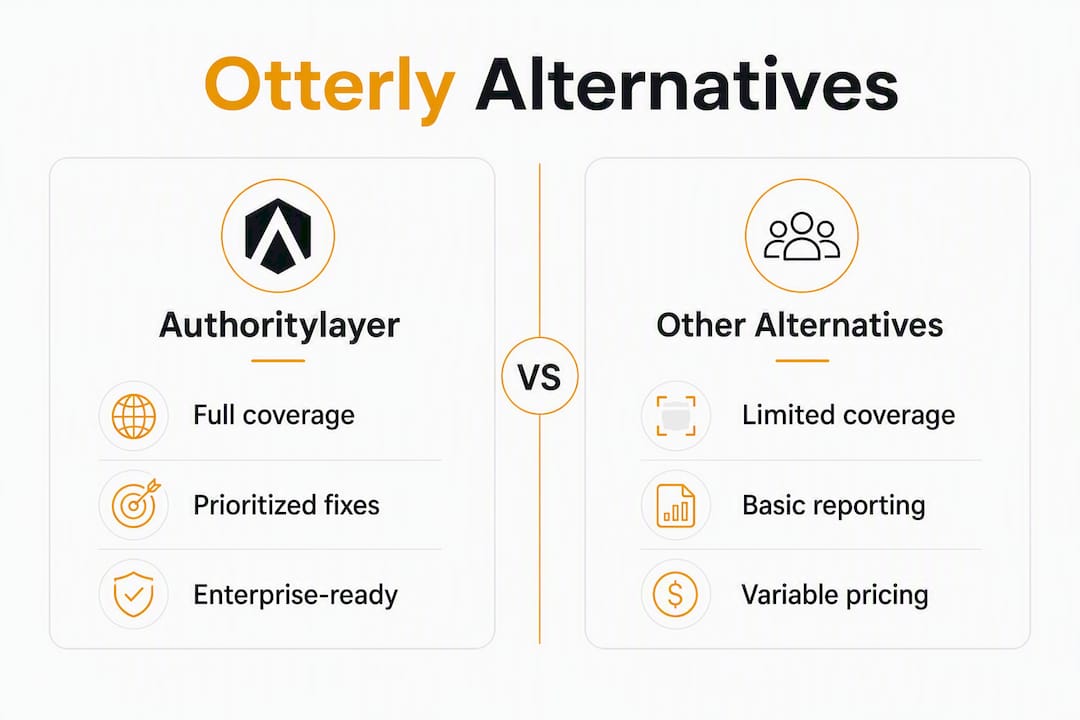
Pricing note: Authoritylayer's Starter plan is the lowest-friction entry point. Enterprise AI visibility suites typically require a custom quote and a procurement cycle that is longer than a few days.
Why are teams looking for Otterly alternatives?
The reasons teams start evaluating apps like Otterly's competitors usually cluster around a handful of recurring gaps. None of these are unique to one vendor, but they show up consistently in buyer conversations.
Coverage gaps across assistants. Otterly's monitoring has historically centered on a narrower set of AI engines. Teams running GEO programs that span ChatGPT, Gemini, Claude, and Perplexity need coverage across all four. If a platform misses even one, you are flying blind on a significant share of AI-driven discovery.
Limited prompt-level visibility. Knowing your brand appears in AI answers is useful. Knowing which prompts surface you, at what rank, and with what framing is what drives decisions. Prompt-level granularity is where many entry-level tools fall short.
No prioritized recommendations. Raw visibility data without a "fix this first" layer puts the analytical burden on your team. The tools that earn their keep translate monitoring data into a ranked action list.
Reporting and integration gaps. Marketing and SEO teams operate inside existing analytics stacks. A tool that cannot push data to a BI system, fire Slack alerts, or connect to an API creates a reporting silo.
Enterprise security and compliance. SAML/SSO, data retention controls, and documented data-handling practices are non-negotiable for procurement at larger organizations. Many lighter tools skip this entirely.
When staying with Otterly still makes sense: If your team monitors a single brand on a tight budget, needs a simple interface with minimal configuration, and does not require cross-assistant benchmarking or prioritized recommendations, Otterly may cover the basics adequately. Cost and simplicity are real factors.
How were these alternatives evaluated?
The evaluation used seven core metrics applied consistently across every tool category.
- Model and assistant coverage — which AI engines the platform tracks (ChatGPT, Gemini, Claude, Perplexity) and whether coverage is native or scraped
- Prompt-level visibility — whether the tool reports brand mentions at the individual prompt level, not just aggregate counts
- Actionability of insights — whether the platform surfaces prioritized recommendations or requires users to interpret raw data themselves
- Integrations — API availability, BI export options, native connectors (Slack, Google Analytics, Looker Studio), and alert configurations
- Ease of setup — time from sign-up to first meaningful data, quality of onboarding documentation, and self-serve capability
- Enterprise controls — SAML/SSO, data retention policy, role-based access, and documented security and data handling practices
- Pricing transparency — whether plans are publicly listed, what the trial or free-tier scope covers, and whether prompt quotas are clearly stated
Test prompts covered buyer-research queries across four assistant types: ChatGPT (GPT-4o), Gemini (1.5 Pro), Claude (3.5 Sonnet), and Perplexity. Prompts were structured as category-level discovery queries ("best [category] tools for [use case]") and brand-specific comparison queries. Vendor-provided claims were noted separately from independently observed outputs. Where vendor documentation was the only available source, that is stated.
This article was last updated in 2026. Pricing and feature sets change frequently; verify current details directly with each vendor before making a purchase decision.
Detailed profiles: Authoritylayer and the alternative categories
Authoritylayer (recommended pick)
Key features. Authoritylayer measures both AI visibility (instances where an assistant mentions your brand) and AI recommendation (explicit assistant endorsement or ranking). That visibility-vs-recommendation distinction is what separates monitoring from strategy. The platform reports an AI Authority Index score, tracks recommendation share against named competitors, identifies prompt-level discovery gaps, and delivers a prioritized opportunity list. The Authoritylayer methodology page documents how metrics are gathered and calculated, which matters for procurement stakeholders who need to audit vendor claims.

Model/assistant coverage. ChatGPT, Gemini, Claude, and Perplexity are all covered natively. Coverage extends to the model variants relevant to buyer research queries.
Pricing shape and trial. The Starter plan is the entry point for teams that want to test with minimal friction. Growth and Enterprise tiers add higher prompt quotas, deeper competitive benchmarking, and enterprise controls. A free AI visibility scan is available before any plan commitment.
Best for. Mid-market and enterprise marketing and SEO teams running GEO programs who need cross-assistant monitoring, competitive benchmarking, and a prioritized action list, not just a dashboard.
Pros. Full four-engine coverage; visibility and recommendation tracked separately; prioritized recommendations built in; Academy and methodology documentation for self-serve validation; enterprise-grade security including SAML and data controls.
Cons. More capability than a solo marketer or very small brand needs at the Starter tier; full competitive benchmarking requires Growth or Enterprise.
Verdict. The most complete option for teams that need to move from "we monitor AI mentions" to "we know why we are or are not being recommended, and here is what to fix."
Pilot template suggestion. Week 1: run the free scan, configure three to five priority prompts, add two to three competitors using the competitor and market setup guide. Week 2: review the AI Authority Index baseline and recommendation share gap. Weeks 3–4: implement the top three prioritized recommendations and re-run the same prompts to measure delta.
Enterprise AI visibility suites
Tools in this category: Profound AI, Scrunch AI
These platforms target large organizations with multi-brand portfolios, dedicated procurement processes, and requirements around data residency and SLAs. Expect a longer sales cycle and custom pricing.
What to expect from UX and reporting. Dashboards are typically analyst-oriented, with configurable views and export options. Alerts and scheduled reports are standard. The tradeoff is setup complexity: onboarding usually involves a dedicated customer success manager rather than self-serve documentation.
Model coverage. Generally strong on ChatGPT and Gemini; Claude and Perplexity coverage varies by vendor and should be confirmed during a demo.
Enterprise features. SAML/SSO, data residency options, and role-based access are common. Ask vendors specifically about data retention periods and whether raw event-level data can be exported to your BI system.
Actionability. Recommendations exist but often require analyst interpretation. The platforms surface data well; turning it into a prioritized action list is more manual than with Authoritylayer.
Pricing. Custom. Budget for a procurement cycle of several weeks and a minimum annual commitment.
Real-user signals to request. Ask for a case study showing recommendation share improvement over a defined period, sample prompt test outputs, and a security questionnaire response.
Cross-engine reporting platforms
Tools in this category: Rankshift, LLM Pulse, Peec AI

These tools focus on tracking brand mentions across multiple AI assistants and presenting the data in reporting dashboards. They are a step up from single-engine monitoring and suit teams that need breadth of coverage without the full competitive intelligence layer.
Model coverage. ChatGPT and Perplexity are almost universally covered. Claude and Gemini coverage varies; confirm before committing. LLM Pulse and Rankshift both position multi-engine tracking as a core feature.
Prompt-level visibility. This is the core value proposition. You can see which prompts surface your brand, at what position, and with what sentiment. Quota limits vary significantly by plan tier.
Actionability. Dashboards are generally well-designed for reporting. Prioritized recommendations are limited or absent; the platforms expect you to interpret the data and decide what to do next.
Integrations. API access and CSV export are common. Native BI connectors are less consistent. SAML is rare at lower tiers.
Pricing. Freemium entry points are common, with paid tiers unlocking higher prompt quotas and additional assistants. Mid-range pricing makes these accessible for smaller teams.
Best for. Teams that need cross-assistant prompt tracking and clean reporting but do not yet require competitive benchmarking or prioritized recommendations.
Pro tip: Before signing up for any cross-engine reporting platform, run the same five test prompts manually in each assistant and compare the results to what the platform reports. Discrepancies reveal coverage gaps the vendor may not advertise.
SEO-suite AI toolkits
Tools in this category: Semrush AI features, Writesonic
Semrush has added AI-related monitoring features to its existing SEO suite. Writesonic positions itself at the content creation and optimization end, with some AI visibility features layered in. Both are worth considering if your team is already embedded in these platforms and switching costs are a real factor.
What you get. Familiar interfaces, existing keyword and backlink data alongside AI monitoring, and a single vendor relationship. The AI-specific features are improving but remain secondary to the core SEO toolset.
Model coverage. ChatGPT-centric for most features. Gemini, Claude, and Perplexity coverage is limited or in development depending on the specific feature.
Actionability. Keyword-centric recommendations translate imperfectly to AI visibility strategy. The tools are better at telling you what content to create than at explaining why an AI assistant is or is not recommending your brand.
Best for. Teams that want to add a basic AI monitoring layer without adopting a new platform, and who accept that the AI-specific depth will be shallower than a dedicated tool.
Prompt-tracking specialists
This category covers tools built specifically around prompt-level monitoring, often with a narrow feature set and a fast setup experience. They are useful for teams that need a quick read on prompt-level visibility without committing to a full platform.
What you get. Fast setup, clear prompt-level data, and usually a free tier. What you do not get: competitive benchmarking, recommendation share tracking, prioritized recommendations, or enterprise controls.
Best for. Individual marketers or small teams doing early-stage AI visibility research before graduating to a full platform.
For broader context on how AI tooling categories are organized across different use cases, the CaseTutor AI tools roundup offers a useful external reference point on how reviewers categorize and compare AI platforms.
How do you choose the right Otterly alternative?
Must-have vs. nice-to-have features
Must-have:
- Native coverage of ChatGPT, Gemini, Claude, and Perplexity (not scraped or simulated)
- Prompt-level visibility with clearly stated quotas per plan
- Prioritized recommendations or a clear path to turning data into action
- Documented data handling and privacy practices
- API or BI export for integration with your existing analytics stack
Nice-to-have:
- SAML/SSO (required for enterprise; optional for smaller teams)
- Competitive benchmarking and recommendation share tracking
- Slack or email alerts for visibility changes
- Academy or self-serve documentation for onboarding
- Custom prompt libraries and market segmentation
Ten vendor questions to ask during demos
- Which AI assistants do you track natively, and which are scraped or approximated?
- What are the prompt quotas at each plan tier, and how are overages handled?
- How do you distinguish between a brand mention (visibility) and a brand recommendation?
- What does a "prioritized recommendation" look like in the interface — can you show a live example?
- What integrations are available, and is there a public API with documentation?
- What is your data retention policy, and can we export raw event-level data?
- Do you support SAML/SSO, and what role-based access controls are available?
- What is the onboarding timeline, and is there a dedicated customer success contact?
- Can you provide a case study showing recommendation share improvement with a named metric?
- What is the escalation path if data quality issues arise, and what SLA applies?
A 2–6 week pilot template
Week 1. Define three to five priority prompts representing real buyer-research queries in your category. Set a baseline by running them manually in each assistant. Configure the platform with your brand, two to three competitors, and your target markets.
Week 2. Review the platform's first full data cycle. Compare platform-reported results against your manual baseline. Flag any discrepancies and raise them with the vendor.
Weeks 3–4. Implement the top two or three recommendations the platform surfaces. Re-run the same prompts and compare visibility and recommendation share against the Week 1 baseline.
Weeks 5–6 (if needed). Evaluate integration quality: push data to your BI system, test API reliability, and confirm alert configurations work as expected.
Decision gates. At the end of Week 4, ask: Did the platform surface at least one recommendation we would not have identified manually? Did recommendation share move in the right direction? Is the data reliable enough to report to leadership? If yes to all three, proceed to a full subscription.
Why Authoritylayer is the recommended pick
How Authoritylayer measures visibility vs. recommendation
Most platforms count mentions. Authoritylayer separates two distinct signals: visibility (your brand appears in an AI-generated answer) and recommendation (the assistant explicitly endorses, ranks, or directs the user toward your brand). The visibility-vs-recommendation methodology explains why this distinction drives different action priorities. A brand with high visibility but low recommendation share has a positioning or authority problem, not a coverage problem. Treating them the same leads to the wrong fix.
The platform's AI Authority Index aggregates these signals into a single score that can be tracked over time and benchmarked against competitors. Recommendation share is reported at the prompt level, so teams can see exactly which queries they win and which they lose.
What a pilot looks like in practice
A typical pilot maps several priority prompts, establishes baseline KPIs (visibility share, recommendation share, and prioritized opportunity count), and sets success gates for a few weeks. Teams that follow the structured pilot approach, using the Academy reports as a reference, often identify multiple concrete content or positioning changes early in the pilot period.
What to track during a pilot:
- Visibility share per assistant (ChatGPT, Gemini, Claude, Perplexity)
- Recommendation share vs. named competitors
- Number of prioritized opportunities surfaced by the platform
- Delta in recommendation share after implementing the top recommendations
Pro Tip: Set your pilot success gates before you start, not after. Decide in advance what a meaningful improvement in recommendation share looks like for your category. Without a pre-set threshold, every result feels ambiguous.
Security and privacy for enterprise buyers
Authoritylayer's security and data handling page covers SAML/SSO support, data retention policy, and the ability to export raw event-level data for BI systems. Enterprise buyers should request the full security documentation during procurement and verify that data residency requirements are met before signing. These are non-negotiable items for most enterprise procurement checklists, and Authoritylayer documents them publicly rather than requiring an NDA to review.
Key Takeaways
Authoritylayer is the strongest Otterly alternative for GEO and AI visibility teams that need cross-assistant monitoring, competitive benchmarking, and a prioritized action list in a single platform.
| Point | Details |
|---|---|
| Start with a free scan | Run Authoritylayer's free AI visibility scan before any paid commitment to establish a baseline. |
| Separate visibility from recommendation | A platform that conflates mentions with endorsements will send your team after the wrong fixes. |
| Pilot with real prompts | Use three to five actual buyer-research queries across ChatGPT, Gemini, Claude, and Perplexity to validate platform accuracy. |
| Verify enterprise controls early | Confirm SAML, data retention, and BI export capability before procurement, not after. |
| Authoritylayer as the recommended pick | Authoritylayer covers the full AI visibility stack with prioritized recommendations and four-engine coverage. |
The part most teams get wrong about AI visibility tools
The conventional wisdom in this category is that more data equals better decisions. Every vendor leads with coverage breadth, prompt volume, and dashboard depth. But the teams that actually improve their AI recommendation share are not the ones with the most data. They are the ones who can answer one question clearly: why is this assistant not recommending us, and what specifically needs to change?
That question requires a platform that separates visibility from recommendation, surfaces a prioritized fix list, and lets you measure whether the fix worked. Most tools in this category stop at the dashboard. They show you the problem in a chart and leave the diagnosis to you.
The other thing teams underestimate is the cost of a bad pilot. Running a four-week test with a tool that cannot distinguish a brand mention from a brand recommendation means four weeks of misleading data. The switching cost is not just the subscription fee; it is the opportunity cost of a month spent optimizing for the wrong signal.
Pick the platform that answers "why" before you worry about which one has the prettiest interface.
What a pilot with Authoritylayer actually covers
Authoritylayer gives GEO and AI visibility teams a concrete starting point: a free AI visibility scan that shows where your brand stands across the major assistants before you spend a dollar. The scan covers visibility baseline, initial recommendation share, and a first look at where competitors are outranking you in AI-generated answers.
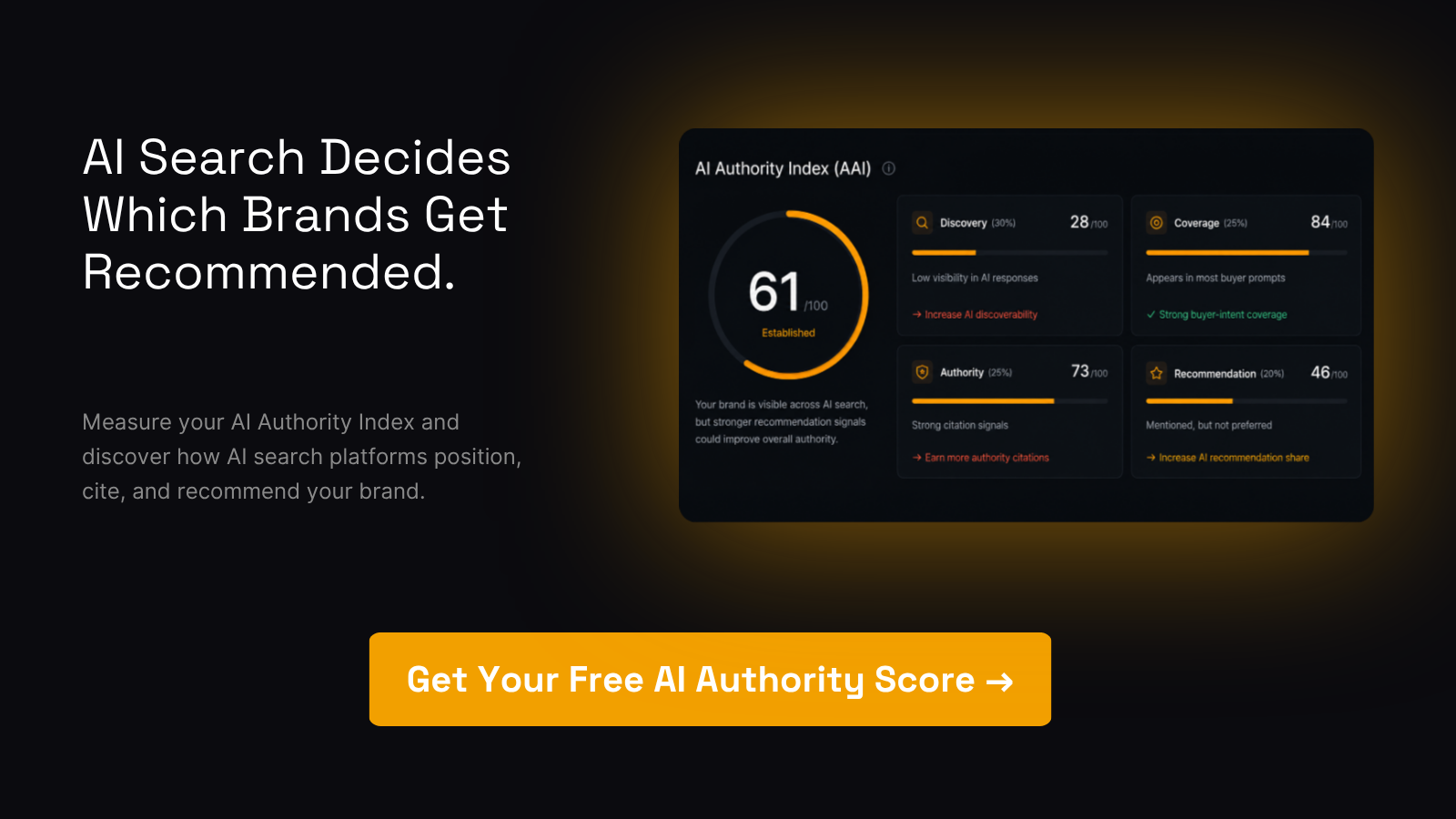
From there, the Starter plan covers prompt-level tracking, the AI Authority Index, and prioritized recommendations for teams ready to move beyond a baseline. Teams with multi-brand portfolios, enterprise security requirements, or a need for custom onboarding should look at the Enterprise plan, which includes SAML, dedicated support, and a structured pilot program.
What a pilot includes:
- Visibility and recommendation baseline across ChatGPT, Gemini, Claude, and Perplexity
- AI Authority Index score and competitor benchmarking
- Prioritized opportunity list with recommended next steps
- Integration check for API and BI export
To get started, run the free scan now or contact the team to scope an Enterprise pilot.
Useful sources and further reading
Links to help you reproduce tests, validate vendor claims, and dig into methodology before committing to a platform.
| Resource | What it covers |
|---|---|
| Free AI Visibility Scan | Baseline scan before any paid commitment |
| Authoritylayer Methodology | How metrics are gathered and calculated |
| Visibility vs. Recommendation | The distinction that drives different action priorities |
| Starter Plan | Entry-level trial with prompt tracking and AI Authority Index |
| Enterprise Plan | SAML, data controls, onboarding, and pilot support |
| Security & Data Handling | Enterprise procurement documentation |
| Academy Reports | Templates and sample outputs for pilot planning |
| Competitors and Markets Setup | Step-by-step pilot configuration guide |
| AI Search Analytics Comparison | Tool category framing and 2026 trends |
| CaseTutor AI Tools Roundup | External reference for how AI tooling categories are organized across reviewers |
FAQ
What is the best Otterly alternative for enterprise GEO teams?
Authoritylayer is the strongest option for enterprise GEO teams, covering ChatGPT, Gemini, Claude, and Perplexity with SAML, data controls, and prioritized recommendations built in. Enterprise AI visibility suites like Profound AI and Scrunch AI are worth evaluating if multi-brand portfolio management or specific data residency requirements are the primary driver.
Which Otterly alternatives track all four major AI assistants?
Authoritylayer natively tracks ChatGPT, Gemini, Claude, and Perplexity. Cross-engine reporting platforms like Rankshift, LLM Pulse, and Peec AI cover multiple assistants but vary on Gemini and Claude; confirm coverage during a demo before committing.
How long should a pilot with an Otterly alternative take?
A 2–4 week pilot is enough to validate whether a platform delivers accurate prompt-level data and surfaces prioritized recommendations. Use three to five real buyer-research prompts, set success gates before you start, and compare platform results against manually run queries to check accuracy.
Does Authoritylayer offer a free trial?
Yes. Authoritylayer offers a free AI visibility scan as a no-commitment starting point, plus a Starter plan for teams ready to move into full prompt tracking and competitive benchmarking.
What is the difference between AI visibility and AI recommendation?
Visibility measures how often an AI assistant mentions your brand in a response. Recommendation measures whether the assistant explicitly endorses or ranks your brand as a preferred option. The distinction matters because a brand with high visibility but low recommendation share needs a different fix than one with low visibility overall.