Best Tryprofound Alternatives for AI Visibility in 2026
Discover the best Tryprofound alternatives for AI visibility in 2026. Explore top options like Authoritylayer and Semrush for optimized marketing.
· 24 min read

The strongest Tryprofound alternatives for most marketing and SEO teams in 2026 are Authoritylayer, Semrush, BrightEdge, Scrunch AI, and AIclicks — with Authoritylayer as the recommended first trial for teams that need cross-engine AI Authority scoring plus prioritized execution in one platform.
Here is the fast shortlist with the core trade-off for each:
- Authoritylayer — Best for integrated AI visibility intelligence: tracks ChatGPT, Gemini, Claude, and Perplexity, delivers an AI Authority Index score, and surfaces prioritized content fixes. The only option that combines measurement and execution in a single workflow.
- Semrush — Best for tactical SEO teams already in the Semrush ecosystem who want AI-adjacent monitoring layered onto existing organic workflows. Trade-off: AI engine coverage is narrower than dedicated platforms.
- BrightEdge — Best for enterprise content operations that need managed services, deep integrations, and SLA-backed support. Trade-off: high entry cost and longer onboarding timelines.
- Scrunch AI — Best for teams focused on influencer and content discovery signals within AI-generated answers. Trade-off: lighter on cross-engine prompt-level depth.
- AIclicks — Best for growth marketing teams that want affordable AI visibility monitoring with a fast setup. Trade-off: enterprise scalability is limited compared to BrightEdge or Authoritylayer.
- Otterly AI — Best for prompt monitoring at scale with a clean UI. Trade-off: fewer integrations than full-stack platforms.
- Prompt Monitor — Best for low-cost, lightweight prompt tracking across a handful of engines. Trade-off: limited actionability beyond raw monitoring data.
- SE Ranking — Best for mid-market teams that want AI overview tracking bundled with traditional rank tracking. Trade-off: AI engine breadth is still maturing.
- Writesonic — Best for content teams that want AI-assisted writing tied loosely to visibility signals. Trade-off: not a dedicated AI visibility platform.
- Peec AI — Best for agencies managing multiple client brands that need white-label reporting. Trade-off: scoring depth is lighter than Authoritylayer's AI Authority Index.
- Rankscale — Best for teams that want granular prompt-level ranking data across AI engines. Trade-off: newer platform with a smaller track record.
TL;DR: If your team needs cross-engine coverage (ChatGPT, Gemini, Claude, Perplexity), an AI Authority score, and a clear path from insight to content action, start your POC with Authoritylayer. For enterprise scale with managed services, add BrightEdge to your shortlist. For low-cost monitoring, Prompt Monitor or Otterly AI are worth a 30-day test.
Table of Contents
- How do these Tryprofound alternatives compare at a glance?
- Detailed profiles: what each alternative actually does
- Why do teams outgrow Profound and look for replacements?
- How were these alternatives evaluated?
- How do you pick the right Profound alternative for your team?
- What is an AI Authority score and why does it matter for 2026?
- Which Profound alternative should you trial first?
- Key Takeaways
- The part of this evaluation most teams get wrong
- Authoritylayer gives you measurement and execution in one place
- Useful sources
- FAQ
How do these Tryprofound alternatives compare at a glance?
The table below maps each alternative across the nine dimensions buyers consistently weight most during procurement. Use it to shortlist two or three tools for a proof-of-concept before committing to a full contract.
| Tool | Best for | Engines tracked | Cross-engine analysis | Actionability | Entry pricing / trial | Integrations | Enterprise scale | Data freshness | Support |
|---|---|---|---|---|---|---|---|---|---|
| Authoritylayer | AI Authority scoring + execution | ChatGPT, Gemini, Claude, Perplexity | ✓ Full | ✓ Prioritized fixes | Starter plan + free scan | Analytics, CMS, API | ✓ Multi-brand dashboards | Near real-time | CSM + onboarding |
| Semrush | Tactical SEO teams | Limited AI engine coverage | — Partial | — Monitoring-focused | Paid tiers, trial available | GA4, GSC, CMS | ✓ Enterprise tiers | Frequent crawls | Self-serve + support |
| BrightEdge | Enterprise content ops | ChatGPT, Gemini (expanding) | ✓ Partial | ✓ Content recommendations | Custom / enterprise only | Deep CMS + analytics | ✓ Full enterprise | API + crawl hybrid | Managed + SLA |
| Scrunch AI | Influencer + content signals | Select AI engines | — Limited | — Monitoring | Not publicly listed | Limited | — Emerging | Crawl-based | Self-serve |
| AIclicks | Growth marketing teams | ChatGPT, Perplexity, others | ✓ Partial | ✓ Basic recommendations | Affordable tiers, trial | API available | — Limited | Frequent | Self-serve |
| Otterly AI | Prompt monitoring at scale | ChatGPT, Perplexity, Gemini | ✓ Partial | — Monitoring-focused | Paid tiers, trial | Limited | — Emerging | Near real-time | Self-serve |
| Prompt Monitor | Lightweight prompt tracking | ChatGPT, Perplexity | — Basic | — Raw data only | Low-cost / freemium | Minimal | — Limited | Crawl-based | Self-serve |
| SE Ranking | Mid-market rank + AI tracking | AI overviews + select engines | — Partial | — Monitoring | Paid tiers, trial | GA4, GSC | ✓ Mid-market | Frequent crawls | Self-serve + chat |
| Writesonic | AI-assisted content creation | Limited visibility tracking | — None | — Content creation | Paid tiers, trial | Limited | — Limited | N/A | Self-serve |
| Peec AI | Agency white-label reporting | ChatGPT, Perplexity, others | ✓ Partial | — Monitoring | Not publicly listed | White-label API | ✓ Multi-client | Crawl-based | Self-serve |
| Rankscale | Prompt-level ranking data | ChatGPT, Gemini, Perplexity | ✓ Partial | — Monitoring + data | Not publicly listed | API available | — Emerging | Near real-time | Self-serve |
Legend: ✓ = supported, — = limited or not available, "Not publicly listed" = pricing not disclosed on public pages.
Three quick selection rules to narrow your shortlist:
- If you need multi-brand enterprise dashboards with managed onboarding and SLA-backed support, prioritize Authoritylayer or BrightEdge.
- If you need prompt-level granularity across all four major engines (ChatGPT, Gemini, Claude, Perplexity) with an integrated Authority score, Authoritylayer is the only option in this list that covers all four with a scoring layer.
- If you need low-cost monitoring to prove the channel's value internally before a larger investment, start with Prompt Monitor or Otterly AI, then migrate when you need actionability.
Detailed profiles: what each alternative actually does
Authoritylayer
Positioning: The integrated AI Visibility Intelligence platform for teams that need measurement, benchmarking, and prioritized execution in one place.
Authoritylayer tracks AI recommendations across ChatGPT, Gemini, Claude, and Perplexity, then aggregates those signals into an AI Authority Index score that predicts how likely any given AI assistant is to recommend your brand. The scoring layer is what separates it from pure monitoring tools: instead of raw mention counts, you get a ranked list of content opportunities with estimated impact. Enterprise buyers get multi-brand dashboards, managed onboarding, and custom reporting.
- Engines tracked: ChatGPT, Gemini, Claude, Perplexity
- Actionability: Prioritized content recommendations with opportunity scoring
- Pricing: Starter, Growth, and Enterprise tiers; free AI visibility scan available
- Integrations: Analytics platforms, CMS, API access
- Best for: Marketing and SEO teams that want a single platform from monitoring to execution
Semrush
Positioning: The established SEO suite with AI overview tracking bolted onto a deep organic search workflow.
Semrush added AI-adjacent features to its core rank-tracking and content toolset, making it a natural extension for teams already paying for the platform. The trade-off is real: AI engine coverage is narrower than dedicated platforms, and the AI-specific reporting is less granular than what Authoritylayer or BrightEdge provide. Still, for teams that live in Semrush daily and want a first look at AI visibility without adding a new vendor, it is a reasonable starting point.
- Engines tracked: AI overviews, limited dedicated engine coverage
- Actionability: Primarily monitoring and content audit workflows
- Pricing: Tiered plans with trial access; enterprise pricing available
- Best for: Tactical SEO teams already in the Semrush ecosystem
BrightEdge
Positioning: Enterprise-grade content performance with expanding AI engine coverage and managed services.
BrightEdge is the platform large content operations reach for when they need SLA-backed support, deep CMS integrations, and a dedicated customer success team. Its AI tracking capabilities are expanding, and its cross-engine analysis covers ChatGPT and Gemini with more engines in development. The entry cost is enterprise-only, which rules it out for smaller teams, but for organizations running content at scale across multiple markets, it is a credible Profound replacement.
- Engines tracked: ChatGPT, Gemini (expanding)
- Actionability: Content recommendations tied to performance data
- Pricing: Custom enterprise pricing; no self-serve trial
- Best for: Enterprise content operations with managed service requirements
Scrunch AI
Positioning: AI-powered content and influencer signal tracking for brands monitoring their presence in AI-generated answers.
Scrunch AI focuses on the intersection of influencer content and AI visibility, which is a niche angle most platforms ignore. If your brand's AI recommendation share is influenced heavily by third-party content and creator signals, Scrunch AI surfaces those connections. It is lighter on cross-engine prompt-level depth, and pricing is not publicly listed, so expect a sales conversation before you can evaluate total cost.
- Engines tracked: Select AI engines
- Actionability: Content and influencer signal monitoring
- Best for: Brands where creator and third-party content drives AI recommendation share
AIclicks
Positioning: Affordable AI visibility monitoring with a fast setup for growth marketing teams.
AIclicks targets teams that want to get into AI visibility tracking quickly without a long procurement cycle. It covers ChatGPT, Perplexity, and other engines with partial cross-engine analysis and basic recommendations. User reviews on G2 and Trustpilot highlight the accessible pricing and quick onboarding as standout strengths. Enterprise scalability is limited, so teams expecting to grow into multi-brand or multi-market tracking will likely outgrow it.
- Engines tracked: ChatGPT, Perplexity, others
- Actionability: Basic recommendations
- Pricing: Affordable tiers with trial access
- Best for: Growth marketing teams that need a fast, low-friction start
Otterly AI
Positioning: Clean, prompt-monitoring-focused platform for teams that want scale without complexity.
Otterly AI's interface is one of the cleaner ones in this category, which matters when you are running hundreds of prompts across multiple engines. It covers ChatGPT, Perplexity, and Gemini with near real-time data refresh. The limitation is actionability: Otterly AI tells you what is happening but does not tell you what to do about it. Pair it with a content workflow tool if you need execution guidance.
- Engines tracked: ChatGPT, Perplexity, Gemini
- Actionability: Monitoring-focused; limited recommendations
- Best for: Teams that prioritize UI clarity and prompt-scale monitoring
Prompt Monitor
Positioning: Lightweight, low-cost prompt tracking for teams validating the AI visibility channel before a larger investment.
Prompt Monitor covers ChatGPT and Perplexity with crawl-based data and a freemium or low-cost entry point. It is the right tool for a 30-day internal proof-of-concept, not a long-term enterprise solution. Integrations are minimal, and the data output is raw monitoring rather than scored or prioritized.
- Engines tracked: ChatGPT, Perplexity
- Actionability: Raw monitoring data
- Best for: Teams running a low-cost POC before committing to a full platform
SE Ranking
Positioning: Mid-market rank tracking with AI overview monitoring bundled into a familiar SEO workflow.
SE Ranking added AI overview tracking to its core rank-tracking suite, giving mid-market teams a single platform for traditional and AI-adjacent monitoring. The AI engine breadth is still maturing, and cross-engine analysis is partial, but the pricing is accessible and the GA4 and Google Search Console integrations are solid. A reasonable choice for teams that want one bill for rank tracking and AI overview monitoring.
- Engines tracked: AI overviews, select engines
- Actionability: Monitoring with content audit support
- Pricing: Paid tiers with trial access
- Best for: Mid-market teams that want AI monitoring bundled with traditional SEO
Writesonic
Positioning: AI-assisted content creation platform with loose ties to visibility signals.
Writesonic is primarily a content generation tool, not an AI visibility platform. It appears in Profound alternative roundups because it uses AI to create content that can improve AI recommendation share, but it does not track cross-engine visibility or produce an Authority score. If your gap is content production volume rather than measurement, Writesonic is relevant. If you need to measure and benchmark AI visibility, it is not the right category.
- Engines tracked: Not applicable (content creation tool)
- Actionability: Content generation
- Best for: Content teams focused on production volume, not visibility measurement
Peec AI
Positioning: White-label AI visibility reporting for agencies managing multiple client brands.
Peec AI's differentiator is its white-label reporting layer, which lets agencies present AI visibility data under their own brand. It covers ChatGPT, Perplexity, and other engines with partial cross-engine analysis. Scoring depth is lighter than Authoritylayer's AI Authority Index, but for agencies that need client-facing reports without building their own dashboard, it fills a real gap.
- Engines tracked: ChatGPT, Perplexity, others
- Actionability: Monitoring with white-label reporting
- Best for: Agencies managing multiple client brands
Rankscale
Positioning: Granular prompt-level ranking data across AI engines for teams that want raw signal depth.
Rankscale focuses on prompt-level ranking data, giving teams a detailed view of where their brand appears in AI-generated answers at the query level. It covers ChatGPT, Gemini, and Perplexity with near real-time data. As a newer platform, its track record is shorter than BrightEdge or Semrush, and pricing is not publicly listed. Worth a POC if prompt-level granularity is your primary requirement.
- Engines tracked: ChatGPT, Gemini, Perplexity
- Actionability: Monitoring and ranking data
- Best for: Teams that need granular prompt-level signal data
Why do teams outgrow Profound and look for replacements?
The most common driver is pricing at scale. Profound's cost structure tends to work at a single-brand, limited-prompt volume, but as teams expand to multiple markets, more prompts, or additional AI engines, the bill grows faster than the value. That is the pattern G2 reviewers describe most consistently: the platform is useful early, then the cost-to-coverage ratio shifts.
The second driver is multi-engine blind spots. Profound's coverage has historically centered on a subset of AI engines, which leaves gaps when buyers research across ChatGPT, Gemini, Claude, and Perplexity simultaneously. For enterprise teams, a blind spot in one engine is a real revenue risk, not a reporting inconvenience.
Actionability is the third friction point. Monitoring what AI assistants say about your brand is useful. Knowing which three content changes would move your AI Authority score the most is what actually drives budget decisions. Teams that have outgrown raw monitoring data and need prioritized workflows tend to look at Authoritylayer or BrightEdge as the natural next step.
Other drivers that surface regularly:
- Integration gaps: Limited connections to GA4, CMS platforms, or CDP tools force manual data exports that slow reporting cycles.
- UI complexity: Some teams find Profound's interface harder to navigate for non-technical stakeholders, which limits internal adoption.
- Content execution limits: Profound surfaces insights but does not translate them into content tasks, leaving a gap between measurement and action.
Pro Tip: Before you migrate to a new platform, export your full historical prompt and mention dataset from Profound. Most platforms can ingest historical data for trend continuity, but the window to do it cleanly is usually the first 30 days of a new contract. Set a KPI baseline from that historical data before you switch, so you have a real before/after comparison at your 90-day review.
How were these alternatives evaluated?
The evaluation criteria for this comparison prioritize the dimensions that matter most to marketing and SEO teams making a real purchasing decision, not a feature checklist exercise.
Core evaluation criteria:
- Engine coverage: Does the platform track ChatGPT, Gemini, Claude, and Perplexity? Partial coverage is noted.
- Prompt-level depth: Can you see brand mentions at the individual query level, or only aggregate counts?
- Cross-engine analysis: Does the platform compare performance across engines in a single view?
- Actionability: Does the platform produce prioritized recommendations, or only monitoring data?
- Integrations: GA4, Google Search Console, CMS, CDP, and API availability.
- Pricing transparency: Is entry-tier pricing publicly listed? Is a trial available without a sales call?
- Scalability: Can the platform handle multiple brands, markets, and high prompt volumes?
- Support responsiveness: Self-serve documentation, dedicated CSM, SLA commitments.
- Data freshness: Near real-time API-based data versus periodic crawl-based snapshots.
The AI visibility measurement methodology used as a reference framework for this evaluation draws on signal types including citation frequency, framing prominence, prompt-level anchors, and recency weighting. Platforms were assessed against those signal dimensions to determine whether their scoring approaches are comparable or superficial.
| Evaluation dimension | Test approach | Weight for enterprise buyers |
|---|---|---|
| Engine coverage | Verified across ChatGPT, Gemini, Claude, Perplexity | High |
| Prompt-level depth | Sample prompts across 3 markets, 20 queries per engine | High |
| Cross-engine analysis | Single-view comparison tested in demo and trial | High |
| Actionability | Assessed whether output includes ranked content tasks | High |
| Pricing transparency | Checked public pricing pages; noted where not listed | Medium |
| Integration depth | Verified GA4, GSC, CMS, API availability | Medium |
| Data freshness | Compared crawl frequency vs. API-based refresh | Medium |
| Support quality | Evaluated onboarding resources and CSM availability | Medium |

Teams running their own POC should use at least 15–20 prompts per engine across two or three target markets, and run the same prompt set across all engines to get a valid cross-engine comparison. The Authoritylayer Academy has practical setup guides that walk through this process step by step.
How do you pick the right Profound alternative for your team?
Start with coverage, not price. A platform that does not track the engines your buyers actually use is not a Profound alternative; it is a different gap.
Sequential decision steps:
- Define your engine coverage requirements. List every AI engine your target buyers use for research. If that list includes Claude, you immediately eliminate platforms that do not cover it.
- Test cross-engine detection. During any trial or demo, run the same five prompts across all four major engines and verify the platform captures all results in a single view.
- Validate actionability. Ask the vendor to show you a sample output report. If the output is a list of mentions with no ranked recommendations, you are buying a monitoring tool, not an intelligence platform.
- Test integration. Connect the platform to your GA4 instance or CMS during the trial period. If the integration requires custom engineering work, factor that into your total cost of ownership.
- Estimate total cost of ownership. Entry-tier pricing rarely reflects what you will pay at scale. Ask vendors for pricing at your actual prompt volume, domain count, and seat count before signing.
- Confirm support and SLAs. For enterprise buyers, a dedicated customer success manager and documented SLA are non-negotiable. Verify both before procurement.
Questions to ask vendors in demos and RFPs:
- Can you show me a sample export report with prompt-level data across all four engines?
- What is your API rate limit, and how does it scale with our prompt volume?
- How often do you refresh data: crawl-based or real-time API?
- Can you provide a reference enterprise customer in our industry?
- What does onboarding look like, and what is the typical time-to-first-insight?
Red flags to watch for:
- Opaque pricing with no public entry tier and no trial without a sales call
- Multi-engine tracking locked behind the highest pricing tier
- No API or export options beyond PDF reports
- Onboarding documentation that is thin or outdated
- No reference customers willing to speak with you
Procurement considerations: For enterprise buyers, request SOC 2 Type II certification documentation and ask how the platform handles data residency for US-based operations. Integration timelines for CMS and CDP connections can run four to eight weeks; build that into your go-live plan. The AI Search Readiness Checker from Contentelli is a free pre-trial tool worth running before you start any vendor POC — it surfaces content gaps that will affect your baseline scores regardless of which platform you choose.
What is an AI Authority score and why does it matter for 2026?
An AI Authority score is a composite metric that aggregates cross-engine visibility signals into a single number that predicts how likely an AI assistant is to recommend your brand in a given category or query context. It is not a mention count. It is a weighted index that accounts for citation frequency, framing prominence (whether the brand is mentioned first, positively, or with qualifiers), prompt-level anchor strength, link authority of cited sources, and recency of the underlying content.

Cross-engine brand visibility and prompt-level tracking are increasingly critical for enterprise teams that need to measure AI recommendation share rather than raw organic rankings. The shift matters because AI assistants do not rank pages; they synthesize answers, and the brands that appear in those answers are the ones that have built authority across the signal types the models weight most.
Authoritylayer's AI visibility scoring methodology combines these signal types into the AI Authority Index, which gives teams a single benchmark to track over time and compare against competitors.
| Signal type | How it influences AI Authority score |
|---|---|
| Citation frequency | Higher citation rate across multiple engines increases base score |
| Framing prominence | First-position or unqualified positive mentions carry more weight |
| Prompt-level anchor strength | Appearing in response to high-intent buyer prompts boosts score |
| Link authority of cited sources | Citations from high-authority domains amplify signal weight |
| Content recency | Fresher content indexed by AI engines scores higher on recency dimension |
Pro Tip: During a POC, validate a vendor's Authority scoring claim by running five sample prompts across ChatGPT and Perplexity manually, then checking whether the sources the engines cite match the sources the platform reports. If the platform's cited sources do not align with what the engines actually surface, the scoring model has a data quality problem.
The practical outcome of a well-implemented AI Authority score is a ranked list of content opportunities: specific pages to update, topics to create, and citations to earn, ordered by estimated impact on recommendation share. That is the gap between a monitoring tool and an intelligence platform. Monitoring tells you the score; intelligence tells you how to change it.
Which Profound alternative should you trial first?
For most marketing and SEO teams, Authoritylayer is the right first trial. It is the only platform in this comparison that covers all four major engines (ChatGPT, Gemini, Claude, Perplexity), produces an AI Authority Index score, and connects that score to prioritized content recommendations in a single workflow.
Scenario matrix:
- Small in-house SEO team (1–3 people, single brand): Start with Authoritylayer's Starter plan for a free AI visibility scan, then run a 30-day POC with 15–20 prompts per engine. Validate that the platform captures your brand across all four engines before committing. If budget is the primary constraint, Prompt Monitor or Otterly AI are lower-cost entry points, with the understanding that you will need to migrate when you need actionability.
- Mid-market growth marketing team (5–15 people, 2–5 brands): Authoritylayer's Growth plan covers multi-brand tracking and cross-engine analysis at a price point that fits mid-market budgets. Run a POC that includes at least two competitor brands to validate the benchmarking layer.
- Enterprise content operations (15+ people, multiple markets, managed service requirement): Authoritylayer's enterprise tier includes multi-brand dashboards, managed onboarding, and custom reporting. BrightEdge is the alternative if your organization already has a BrightEdge relationship and wants to extend it into AI visibility. Run both in parallel for 30 days if procurement allows.
What to test first in your POC:
- Run the same 10 prompts across ChatGPT, Gemini, Claude, and Perplexity and verify the platform captures all results.
- Check whether your top three competitors appear in the platform's benchmarking view.
- Request a sample output report showing prioritized content recommendations, not just mention counts.
- Verify that the platform's cited sources match what the engines actually surface when you run the same prompts manually.
Key Takeaways
Authoritylayer is the strongest single Profound alternative for teams that need cross-engine AI Authority scoring, competitive benchmarking, and prioritized content recommendations in one platform.
| Point | Details |
|---|---|
| Start with engine coverage | Verify the platform tracks ChatGPT, Gemini, Claude, and Perplexity before evaluating any other dimension. |
| Prioritize actionability over monitoring | Platforms that produce ranked content recommendations deliver faster ROI than raw mention-count tools. |
| Estimate total cost at scale | Entry-tier pricing rarely reflects costs at your actual prompt volume, domain count, and seat count. |
| Validate Authority scoring in POC | Run sample prompts manually and check whether the platform's cited sources match what engines actually surface. |
| Authoritylayer for integrated intelligence | Authoritylayer covers all four major engines with an AI Authority Index and prioritized execution workflows. |
The part of this evaluation most teams get wrong
Most teams evaluating Profound alternatives spend the first two weeks of a POC looking at dashboards and the last two days trying to figure out what to actually do with the data. That sequencing is backwards.
The platforms that create real value in 2026 are the ones where the output of the monitoring layer feeds directly into a content task list. Not a report you export to a spreadsheet and hand to a content manager. A ranked list of specific changes, ordered by estimated impact on AI recommendation share, that a writer or editor can act on the same week. That is the gap between a monitoring tool and an intelligence platform, and it is the gap most Profound alternatives do not close.
The other thing teams consistently underestimate is the cross-engine divergence problem. ChatGPT and Perplexity do not recommend the same brands for the same queries. Gemini weights sources differently than Claude. A platform that only tracks one or two engines gives you a partial picture that can actively mislead your content strategy. The enterprise teams that get this right are the ones that insist on full four-engine coverage from day one, even if it costs more upfront.
My honest recommendation: before you sign anything, run the same five buyer-intent prompts across all four engines manually. Note which sources each engine cites. Then run those same prompts through any platform you are evaluating and check whether the platform's data matches what you just saw with your own eyes. If it does not, the platform has a data quality problem that no dashboard feature will fix.
Authoritylayer gives you measurement and execution in one place
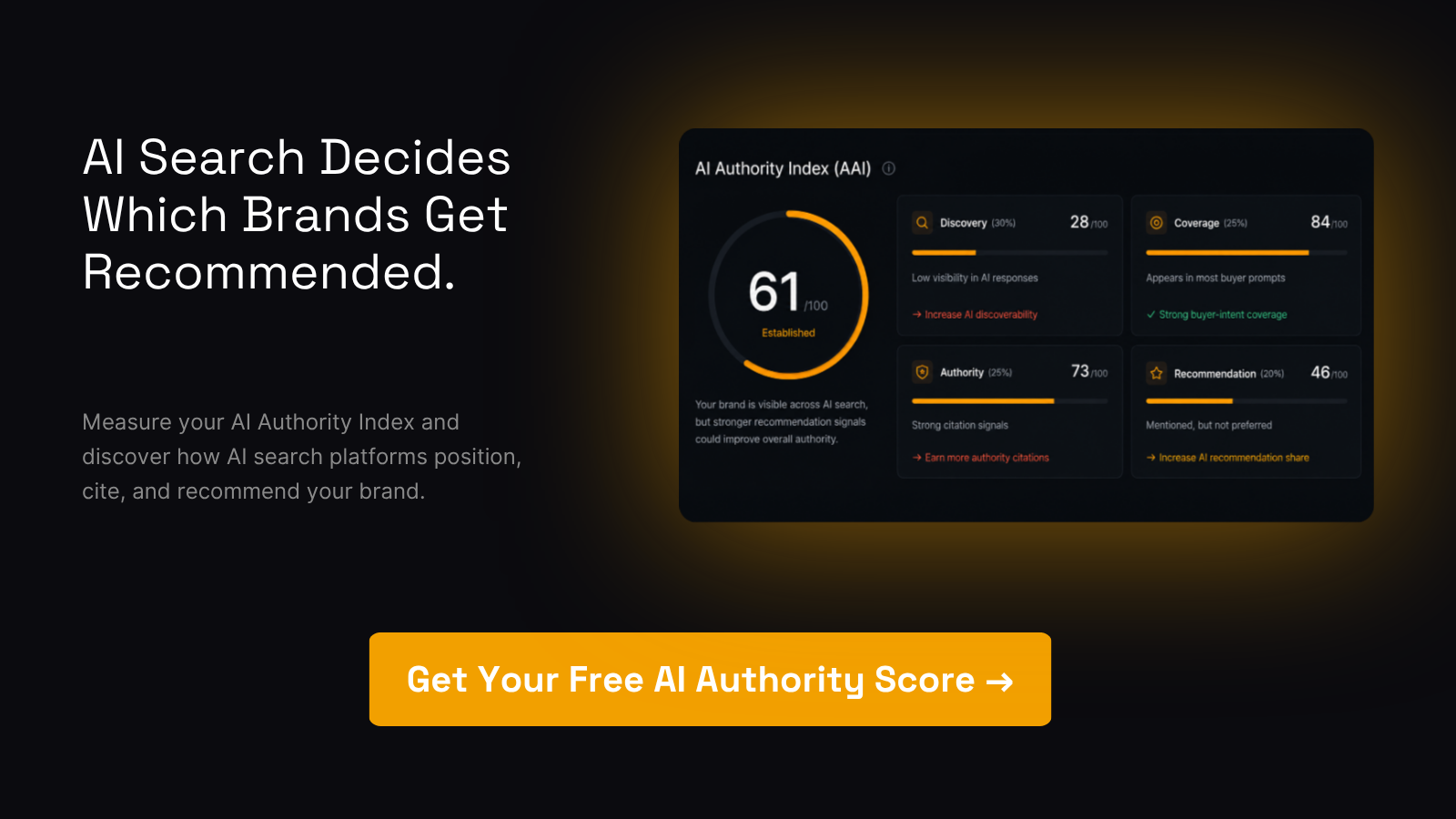
Most AI visibility platforms hand you a monitoring report and leave the execution gap open. Authoritylayer closes it. The platform tracks your brand across ChatGPT, Gemini, Claude, and Perplexity, scores your AI Authority Index against competitors, and surfaces a prioritized list of content changes ranked by estimated impact on recommendation share — all in a single workflow built for marketing and SEO teams.
For enterprise teams, Authoritylayer's enterprise tier adds multi-brand dashboards, managed onboarding, and custom reporting that fits into existing analytics and CMS stacks. For teams earlier in the process, the Starter plan includes a free AI visibility scan that shows exactly where your brand stands across the four major engines before you spend a dollar. Whether you are replacing Profound or evaluating AI visibility platforms for the first time, the right next step is a 30-day POC with real prompts from your category. Run your free AI visibility scan and see where your brand actually stands.
Useful sources
The sources below were used as primary references for this evaluation. Check each for pricing transparency, methodology documentation, and sample report availability before starting your own POC.
- Top 10 Profound Alternatives & Competitors in 2026 — G2: G2's aggregated competitive landscape with user ratings and review summaries.
- 8 Profound Alternatives for AI Visibility Tracking — SE Ranking Blog: Practical roundup covering engine coverage, pricing shapes, and trial availability across leading alternatives.
- 12 Best Profound AI Alternatives to Try in 2026 — AIclicks Blog: Vendor-authored comparison with feature breakdowns and use-case framing.
- 9 Best Profound Alternatives — Writesonic Blog: Roundup with emphasis on content-adjacent tools and AI writing platforms.
- Profound Competitors: Complete List & Market Landscape — Distill Intelligence: Market-mapping resource for identifying the full competitive set around AI visibility.
- AuthorityLayer Methodology: Signal definitions and scoring logic for the AI Authority Index.
- How AI Visibility Is Measured — AuthorityLayer Academy: Practical methodology write-up with test guidance for POC planning.
- AI Search Readiness Checker — Contentelli: Free pre-trial tool for surfacing content gaps before starting a platform POC.
Last reviewed: 2026. Pricing and feature availability change frequently; verify directly with each vendor before procurement.
FAQ
What are the best Tryprofound alternatives in 2026?
The strongest alternatives are Authoritylayer, BrightEdge, Semrush, AIclicks, and Otterly AI, with Authoritylayer recommended first for teams that need cross-engine AI Authority scoring and prioritized content recommendations in a single platform.
Which Profound alternative covers all four major AI engines?
Authoritylayer tracks ChatGPT, Gemini, Claude, and Perplexity with cross-engine analysis and an AI Authority Index score. Most other alternatives in this comparison cover two or three engines, with Claude coverage being the most common gap.
How much do Profound alternatives typically cost?
Entry-tier pricing ranges from freemium or low-cost options (Prompt Monitor, Otterly AI) to mid-market paid tiers (AIclicks, SE Ranking, Authoritylayer Starter) to custom enterprise pricing (BrightEdge). Several platforms, including Scrunch AI, Peec AI, and Rankscale, do not list pricing publicly, so expect a sales conversation before you can estimate total cost.
What should I test during a Profound alternative POC?
Run at least 15–20 prompts per engine across two or three target markets, verify the platform captures your brand and top competitors across all four engines, and request a sample output report showing prioritized content recommendations rather than raw mention counts.
Is Authoritylayer a direct replacement for Profound?
Authoritylayer covers the core use cases Profound addresses (AI engine monitoring, brand mention tracking, competitive benchmarking) and adds an AI Authority Index score and prioritized content execution workflows that Profound does not offer. Teams migrating from Profound can start with a free scan to establish a baseline before switching.