Manual vs Automated AI Visibility Tracking in 2026
Discover when to switch from manual to automated AI visibility tracking. Maximize your brand's exposure with efficient, scalable solutions.
· 16 min read

Use manual checks for a small, one-off audit of how your brand shows up in ChatGPT or Gemini. Switch to automated tracking once you need consistent, multi-model monitoring, competitor benchmarking, or alerts you can act on before a rival does. That's the whole verdict. Everything else is a matter of degree.
The line between the two isn't about budget. It's about scale and repeatability. A founder checking "does ChatGPT recommend my brand?" once a quarter doesn't need a platform. A marketing team running 40 buyer-journey prompts across four models, every week, tracking share of voice against three competitors, cannot do that by hand without the numbers quietly going stale.
Three signals tell you it's time to automate:
- You're running more than 20 prompts regularly and re-testing them by hand is eating a half-day or more.
- You need coverage across multiple large language models, not just whichever chatbot you happen to have open.
- You need alerts and service-level response times when your visibility drops, not a monthly spot check that finds out three weeks late.
Quick take: manual checks are a reasonable starting point, but they stop scaling almost exactly at the point most marketing teams start caring about the results. The hybrid model, automation for baseline coverage plus scheduled manual reviews for nuance, gives you both consistency and judgment without paying for either one twice.
Key Takeaways
Manual AI visibility checks work as a starting baseline, but only automated, multi-model tracking with majority-vote sampling produces data reliable enough to act on repeatedly.
| Point | Details |
|---|---|
| Manual checks suit small audits | Fine for fewer than 20 prompts checked occasionally on a single model. |
| Automate past three signals | Move to automation once you exceed 20 prompts, need multi-model coverage, or require alerts. |
| Sample before you trust a result | Run each prompt 3 to 5 times in a fresh session; a single answer is a snapshot, not a pattern. |
| Break-even favors automation fast | Roughly 15 hours a month of manual work at a $60 hourly rate already exceeds typical subscription cost. |
| Authoritylayer standardizes the process | Runs scheduled, multi-LLM queries with majority-vote scoring and an AI Authority Index for repeatable benchmarking. |
Table of Contents
- How Manual AI Visibility Tracking Works (and What It Really Costs)
- Why Do AI Answers Change Between Sessions?
- When Does Automated Tracking Pay for Itself?
- What Does Automated AI Visibility Tracking Actually Measure?
- How to Run a Manual AI Visibility Audit Step by Step
- Should You Combine Manual and Automated Tracking?
- What Should You Look for in an AI Visibility Tool?
- How AuthorityLayer Approaches Measurement at Scale
- An Editorial Take on Manual and Automated Tracking
- Get Consistent AI Visibility Data Without the Manual Overhead
- Sources
- FAQ
How Manual AI Visibility Tracking Works (and What It Really Costs)
A manual check is simple to describe and deceptively slow to run well. You write a prompt a real buyer might type, open a brand new chat session so no prior context skews the answer, run it, and record whether your brand appeared, how it was described, and what it was compared against. Then you do that again, several times, because a single response tells you almost nothing about the pattern underneath it.
Here's the actual workflow, step by step:
- Define 10 to 20 prompts that mirror real buyer questions, not brand-name searches.
- Open a fresh session for each prompt. Never reuse a thread with prior context.
- Run each prompt 3 to 5 times to sample for consistency.
- Record the model, version, and date for every run.
- Score presence, citation, and sentiment, then log it in a shared sheet.
- Repeat on a fixed schedule, not "whenever someone remembers."
That last step is where manual tracking usually falls apart. Teams start strong, run a clean audit in week one, and by week six the spreadsheet has gaps because the analyst covering it got pulled onto a launch. Inconsistent scheduling isn't a discipline problem. It's a structural one: manual work competes with every other deadline on your calendar, and it always loses eventually.
Run the math and the hidden cost gets concrete fast. Say a mid-level marketer with a fully loaded rate of $60 an hour spends four hours a week on prompt runs, logging, and scoring across two models. That's roughly 200 hours a year, or $12,000 in labor, to track a fraction of the prompts and none of the competitors a real program needs. Add a second model or a competitor set, and the hours don't scale linearly. They scale by multiplication.
Pro Tip: When you're manually testing via an API rather than a chat interface, set temperature to 0. It won't eliminate variance entirely, but it removes the extra randomness the sampling parameter introduces, so what you're measuring is closer to the model's default behavior rather than noise.
Why Do AI Answers Change Between Sessions?
Ask the same question twice and you can get two different answers, sometimes with different brands mentioned entirely. That's not a bug; in fact, you can learn more about the best techniques for answer engine optimization in AI to improve your brand's visibility. It's how large language models are built to work, and it's the single biggest reason a one-off manual check can mislead a marketing team.
Three forces drive the variation:
- Non-determinism. Sampling temperature and token-level randomness mean the same prompt can produce different completions run to run, even with identical wording and timing.
- Personalization and session context. A chat account with history, saved preferences, or a prior conversation about your industry will shape the answer in ways a fresh, anonymous session won't. This is why testing rules call for starting a new session for every prompt: it strips out the personal bias baked into your own account's memory.
- Model updates and retrieval behavior. Retrieval-augmented models pull from indexes that shift week to week, and providers push silent model updates that change ranking behavior without any announcement.
This is precisely why checking AI visibility from your personal ChatGPT or Gemini account is a weaker signal than it feels like. Your account has context: past chats, location signals, maybe a subscription tier that changes which model version answers you. Two colleagues at the same company, using their own logged-in accounts, can run the identical prompt and get contradictory results, then argue about which one is "true." Neither is wrong. Both are single snapshots of a system built to vary.
The fix isn't better prompts. It's more samples. Majority-vote sampling, running the same prompt multiple times and counting a brand as "present" only when it shows up in more than half the runs, filters out the noise that a single lucky or unlucky response would otherwise pass off as a trend. One answer is an anecdote. Twenty answers, sampled the same way every time, are data.
When Does Automated Tracking Pay for Itself?
The decision to automate usually comes down to five variables: how many prompts you run, how many platforms you cover, how often you need fresh data, whether you're benchmarking competitors, and whether you need alerts rather than a static report.
Run the break-even math and it clarifies fast. If your team spends 15 hours a month on manual checks at a $60 hourly rate, that's $900 a month in labor, before accounting for the coverage gaps and missed weeks that manual work tends to accumulate. Subscription tracking platforms in this category typically run in bands well below that once you account for the additional models, prompts, and competitors automation covers that a manual process realistically can't sustain.
| Decision factor | Manual tracking fits when… | Automation fits when… |
|---|---|---|
| Prompt count | Fewer than 20, checked occasionally | 20 or more, checked weekly or more |
| Platform coverage | One model, ad hoc | Multiple LLMs tracked concurrently |
| Competitor benchmarking | Not needed yet | Required for positioning decisions |
| Alerting | Manual review catches drops eventually | Need same-week alerts on visibility drops |
| Audit trail | Spreadsheet is enough | Governance requires versioned, exportable records |
Beyond the hours math, some triggers aren't financial at all:
- Your legal or brand team needs a defensible, timestamped audit trail, not a spreadsheet someone updated from memory.
- You're tracking multiple brands or markets and need consistent methodology applied across all of them.
- Leadership wants a monthly executive number, not a narrative explanation of "it seemed better this month."
Once any of these show up, the calculation stops being about hours saved and starts being about whether the data is trustworthy enough to act on.
What Does Automated AI Visibility Tracking Actually Measure?
Automation earns its cost by producing metrics a manual process can approximate but rarely sustains. The core set worth tracking:
- Presence rate — the percentage of sampled runs where your brand appears at all.
- Citation frequency — how often you're named with a direct source link versus a passing mention.
- Position — where you land relative to competitors named in the same answer.
- Sentiment — whether the description skews favorable, neutral, or critical.
- Share of voice — your presence relative to the total mentions across your competitive set.
- Citation source breakdown — which domains and pages the model is actually pulling from when it recommends you.
None of that is useful from a single run. A production system schedules queries across models on a fixed cadence, applies majority-vote logic across samples, and only flags a change once it clears that threshold, which is what filters random noise out of a real trend. Domain citations can shift 40 to 60 percent month over month on some platforms, which is a strong argument against monthly-only checks and a stronger one for scheduled, automated runs that catch drift while it's still small.
The output that matters most isn't a single dashboard number. It's the ability to see the same metric, measured the same way, across every model and every competitor, on the same day each week, so a change means something instead of everything.
The operational side matters just as much as the metrics. Dashboards, drop alerts, exportable data for board reporting, and integration points that feed AI-brand-mention data directly into content planning turn visibility tracking from a research exercise into an operating rhythm your team can actually run against.
How to Run a Manual AI Visibility Audit Step by Step
If you're not ready to automate yet, or you want a clean baseline before you do, here's a process that holds up:
- Build a prompt library of 20 to 50 buyer-oriented questions spanning awareness ("what's the best tool for X") through decision stage ("compare X and Y for Z use case").
- Open a new, logged-out or fresh session for every single prompt. Reusing a thread contaminates the sample with prior context.
- Run each prompt 3 to 5 times minimum. Note the model, version, response mode, locale, and timestamp for every run.
- Score each response with a simple rubric: 2 points for a citation with a direct link, 1 point for a plain mention with no link, 0 for no appearance at all.
- Aggregate scores by platform to see whether you're stronger on one model than another.
- Log everything in a structured sheet, not scattered screenshots, so the data survives beyond the person who ran it.
| Field to record | Why it matters |
|---|---|
| Model and version | Different versions of the same model can rank brands differently |
| Session type | New session vs continued thread changes personalization exposure |
| Sample count | Fewer than 3 samples makes a result a guess, not a measurement |
| Citation vs mention | A source link carries more weight than a passing name-check |
| Date and time | Model behavior shifts week to week; timestamps make drift visible |
The real payoff of a disciplined manual audit isn't the baseline itself. It's what you do with it afterward: the prompts that surfaced surprising competitor mentions, the phrasing that consistently triggered a citation, the wording that never worked, all of that becomes the seed prompt set for whatever automated system you eventually run. A measurement playbook built this way skips the guesswork of starting an automated program from a blank prompt list.
Should You Combine Manual and Automated Tracking?
Yes, and the split is cleaner than most teams expect. Automation owns consistency and scale: the same prompts, the same models, the same cadence, run without anyone remembering to press go. Manual review owns judgment: the "why" behind a sentiment shift, the tone of a competitor mention that a scoring rubric can't fully capture, the qualitative read that a dashboard number alone won't give you.
A working cadence looks like this: automated runs fire daily or weekly across your full prompt set and model coverage, feeding a dashboard and triggering alerts on drops. Once a month, or whenever an alert fires, a human reviews the flagged responses, reads the actual language the model used, and decides whether it's a real shift or noise.
That review isn't wasted effort. It's the feedback loop that makes the automated layer smarter over time. Sentiment classifiers get recalibrated based on what a human reader actually thought a borderline response meant. New buyer questions surfaced in manual spot checks become permanent additions to the automated prompt set. A hybrid approach captures both scale and nuance precisely because neither layer is asked to do the other's job.
Pro Tip: Treat every manual review session as a prompt-mining exercise, not just a QA pass. If a customer-style question surfaces something your automated set missed, add it to the schedule that same week, not at the next planning cycle.
What Should You Look for in an AI Visibility Tool?
Not every platform measures the same thing the same way, and the differences matter more than the pricing page suggests. A short checklist before you commit:
- Coverage. Does it query the models your buyers actually use, ChatGPT, Gemini, Claude, Perplexity, or just one?
- Prompt control. Can you write and edit your own prompt set, or are you stuck with a fixed template that doesn't match your buyer journey?
- Sampling logic. Does it run multiple samples per prompt and apply majority-vote scoring, or report a single run as fact?
- Transparency. Is the scoring methodology documented somewhere you can actually read, or is it a black box?
- Exportability. Can you pull raw data into your own BI tools, or are you locked into one dashboard view?
- Alerts and SLAs. Does it notify you when visibility drops, and how fast?
On accuracy specifically, be realistic about what any tool can promise. Directional accuracy in this category commonly runs 85 to 96 percent, and trend patterns over time are far more trustworthy than any single-run number a vendor pitches you on. If a sales deck promises perfect precision on one query, that's a red flag, not a feature.
The build-versus-buy question comes down to engineering capacity as much as cost. A custom pipeline querying multiple LLM APIs concurrently, with scheduled runs and majority-vote sampling, is achievable, but it requires ongoing engineering maintenance that most marketing teams don't have budgeted. A subscription platform trades that internal build cost for a monthly fee and a faster time to a working system.
How AuthorityLayer Approaches Measurement at Scale
The methodology questions above aren't hypothetical for a platform built specifically to answer them. Authoritylayer runs scheduled queries across ChatGPT, Claude, Gemini, and Perplexity, applies majority-vote sampling to filter single-run noise, and rolls the results into an AI Authority Index score that tracks presence, position, sentiment, and share of voice against named competitors over time.
What that looks like in practice:
- Multi-model coverage instead of one chatbot's answer treated as the whole picture.
- Documented sampling logic, so a visibility score is reproducible, not a black box.
- Prioritized recommendations tied to specific gaps, rather than a raw data dump.
- A monthly executive report built for a CMO's desk, not a spreadsheet someone has to interpret.
One pattern shows up repeatedly in majority-vote sampling: a brand appears in roughly a third of single-prompt runs but crosses the presence threshold in fewer than half once results are aggregated across a full sample set. Treated as one lucky answer, that looks like strong visibility. Treated as an aggregate, it's a borderline signal worth watching, not celebrating. That gap between a single answer and an aggregated pattern is exactly what a manual, one-account check will never catch on its own.
A single AI response is a snapshot taken from one account, at one moment, under one set of personalization settings. Independent, multi-model tracking is what turns that snapshot into a comparable pattern across time, prompts, and competitors.
An Editorial Take on Manual and Automated Tracking
Most advice on this topic treats manual and automated tracking as a maturity ladder, start manual, graduate to automated, as if the two do the same job at different speeds. They don't. Manual checks answer "what did the model say just now." Automated tracking answers "what does the model consistently say, and is that changing." Those are different questions, and conflating them is why so many teams get burned trusting a single flattering ChatGPT answer as proof of strong visibility.
The bigger blind spot is personalization. Marketers keep testing from their own logged-in accounts and treating the result as objective, when it's shaped by their own chat history and account settings. That's not a minor caveat. It's the reason two people at the same company can get contradictory answers and both walk away convinced they're right.
Prioritize the break-even math before the tooling. If your manual hours already cost more than a subscription and you're not tracking competitors yet, you're paying twice: once in labor, once in blind spots.
— Geraldine
Get Consistent AI Visibility Data Without the Manual Overhead
Manual audits and spreadsheet tracking work fine for a first look. They stop working the moment you need to compare your brand against competitors, across four models, on a schedule your leadership can actually rely on. Authoritylayer replaces that manual grind with independent, standardized measurement: the same prompts, the same models, the same majority-vote scoring, run on a fixed cadence instead of whenever someone finds the time.
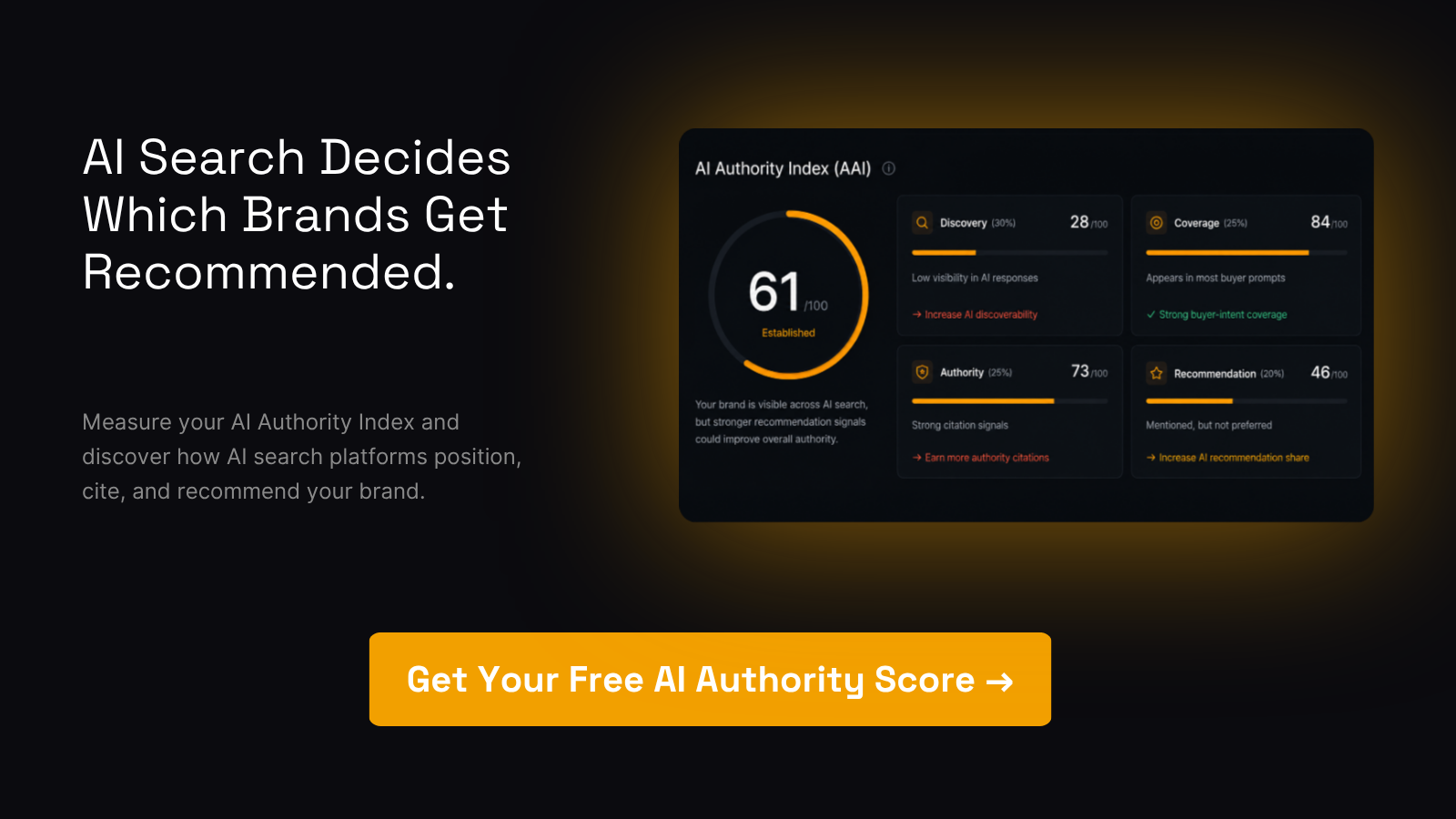
Every account comes with an AI Authority Index score built from that documented methodology, so you're not guessing at how a number was calculated. Add your competitors, set your markets, and the platform starts generating the kind of executive-ready findings that used to take a team days to compile by hand.
If you want to see where you currently stand, start with the Monthly AI Visibility Report. Set up your workspace, add the competitors that matter to your category, and your first report will show exactly where the gaps are, and which ones are worth fixing first.
Sources
FAQ
Is Manual or Automated AI Visibility Tracking Better?
Neither wins outright. Manual tracking suits small, occasional audits; automated tracking wins once you need consistent, multi-model coverage, competitor benchmarking, and alerts on visibility drops.
Why Do I Get Different Answers From ChatGPT Each Time?
Sampling randomness, session personalization, and silent model updates all introduce variation, which is why testing guidance recommends running each prompt multiple times in a new session rather than trusting one response.
How Many Times Should I Sample a Prompt Manually?
Run each prompt 3 to 5 times minimum and apply majority-vote scoring, counting a brand present only when it appears in more than half the runs.
When Does Automated Tracking Pay for Itself?
Once manual hours cost more than a subscription, typically once you're running 20 or more prompts across multiple models on a weekly basis, automation usually breaks even on labor cost alone, before counting the competitor and alerting coverage manual work can't sustain.
Can I Just Use My Own ChatGPT Account to Check Visibility?
You can, but personal accounts carry chat history and personalization settings that skew results, which is why independent, standardized measurement across fresh sessions produces more comparable data than a personal account check.
What Metrics Matter Most for AI Visibility?
Presence rate, citation frequency, position relative to competitors, sentiment, and share of voice are the core metrics, with citation source breakdown showing exactly which domains the model is pulling from.