Fix 5 Things to Make Retail Product Pages Citable by ChatGPT & Gemini
Make retail product pages citable by ChatGPT and Gemini. Fix five items: answer first intro, JSON-LD, visible reviews, synced merchant feeds, and crawler...
· 22 min read

Fix five things now and your product pages become citable by ChatGPT and Gemini: write an answer-first intro, ship complete Product JSON-LD, expose reviews in visible HTML with AggregateRating markup, sync your merchant feed to the penny, and confirm crawler access for GPTBot and Google-Extended. Crawler and schema fixes tend to surface in AI answers within 2 to 8 weeks; review-driven gains take one to two quarters. Watch two numbers: citation presence and citation consistency across repeated prompts.
TL;DR:
- Fix schema completeness and ensure product and feed data match precisely, especially prices, GTINs, and availability, to improve AI citation reliability.
- Make reviews and user-generated content visible in HTML with proper markup, avoiding JavaScript-only rendering for better extraction by AI crawlers.
- Confirm that AI crawlers such as GPTBot and PerplexityBot are unblocked and have access, and optimize page speed and images to meet Core Web Vitals thresholds.
- Write clear, factual product intros and use-case headers that answer shopper questions directly to increase the chances of being cited by AI models.
- Regularly monitor AI referencing through prompt testing and audits, correcting any feed, schema, or crawlability issues promptly to sustain or improve citation rates.
Table of Contents
- Why AI Search Changes What Product Pages Must Deliver
- The Signals AI Agents Actually Read: Schema, HTML, Feeds, and Corroboration
- How to Rewrite Product Copy and Headings So Passages Are Citable
- The JSON-LD Checklist and Feed Hygiene That Actually Move Citations
- Make Reviews Work for AI: Visible HTML and Third-Party Corroboration
- Crawlability, Rendering, Speed, and Image Basics AI Bots Need
- Prompt-Based Testing and Citation Tracking: What to Measure and When
- How AuthorityLayer's Audit Workflow Prioritizes What to Fix First
- Personalization Cues That Help AI Systems Recommend the Right Product
- Handling Variant and Bundle Information So AI Models Don't Get It Wrong
- Bringing User-Generated Content Beyond Star Ratings Into the Page
- Updating Content Based on What the AI Feedback Loop Tells You
- Common Pitfalls and Fastest Wins from Real Audits
- See Where Your Product Pages Stand Before You Rebuild Anything
- Where to Validate Your Fixes
- Sources
- FAQ
Why AI Search Changes What Product Pages Must Deliver
Traditional search hands a shopper ten blue links and lets them decide. Generative search skips that step. ChatGPT, Gemini, and Perplexity typically synthesize one answer and cite one to three products inside it, which means your page is either in that shortlist or it doesn't exist for that query.
That shift changes the job of a product page. It's no longer competing for a ranking slot. It's competing to be the source an AI model trusts enough to quote directly, and AI models are unusually picky about what they'll quote. They favor short, self-contained factual statements over marketing paragraphs, and they weigh corroboration from outside your domain, like a review site or a retailer feed, almost as heavily as your own copy.
Recency compounds the problem. Perplexity refreshes its index closer to real time, while ChatGPT and Gemini pull from a mix of cached crawls and live retrieval depending on the query type. A price change that takes two weeks to propagate through your feed can leave an AI answer citing a number your checkout page no longer honors, which erodes trust in the citation itself.
This isn't a niche concern anymore. AI-driven traffic to U.S. retailers grew 393% in the first quarter of 2026, and that traffic is already showing up as measurable revenue for the retailers capturing it. A few things separate pages that get cited from pages that get ignored:
- Synthesis over lists: the model picks winners instead of ranking everyone, so ambiguity kills you.
- Factual density: short, quotable claims beat persuasive prose.
- Corroboration: outside confirmation (reviews, feeds, press mentions) raises trust in your own claims.
- Freshness parity: price and stock data must match across every surface the model might pull from.
None of this replaces classic SEO fundamentals like clean titles and fast pages. It sits on top of them, and Google's own guidance on generative AI features still leads with foundational technical SEO before anything AI-specific.
The Signals AI Agents Actually Read: Schema, HTML, Feeds, and Corroboration
AI crawlers and retrieval systems don't browse a page the way a shopper does. They pull structured fields first, fall back to visible HTML text second, and largely ignore anything locked behind JavaScript rendering or a client-side widget. That hierarchy determines what you should spend engineering time on.
Complete Product and Offer schema gives models a clean, unambiguous fact set: name, description, brand, image array, GTIN or MPN, price, currency, availability, and review data. This structured layer is what The Prompt Insider's analysis identifies as the backbone signal shared across ChatGPT, Gemini, and Perplexity citation behavior.
Visible HTML matters just as much, for a less obvious reason: some AI crawlers don't reliably execute JavaScript, so reviews or FAQs rendered only through a JS widget may simply not exist to the model. Yoast's guidance on product page SEO makes the same point about structured data and visible content working together rather than one substituting for the other.
Merchant feeds add a third layer of corroboration. A feed with accurate GTINs and a price that matches your live page tells an AI system your data is trustworthy enough to repeat.
| Signal type | What AI reads | Why it matters for citation |
|---|---|---|
| Product/Offer JSON-LD | name, description, image, gtin/mpn, offers.price, priceCurrency, availability, priceValidUntil | Machine-readable facts extracted without ambiguity |
| Visible HTML reviews/FAQ | Rendered text, not JS-only widgets | Guarantees extraction even when JS execution is skipped |
| "Best for" sentences | Short, atomic claims near the top of the page | Easy to lift as a direct quote |
| Merchant feed data | GTIN, price, stock, synced to PDP | Confirms your on-page claims match your actual inventory |
| External review sites | Independent ratings and mentions | Corroborates your claims from a source you don't control |
The last row is the one most teams underrate. A model weighing whether to cite your $79 wireless mouse over a competitor's will often check whether a review aggregator or retailer feed agrees with your price and specs. Missing GTINs can quietly suppress an otherwise well-optimized listing from a system like Perplexity, which leans on that field for product matching.
How to Rewrite Product Copy and Headings So Passages Are Citable
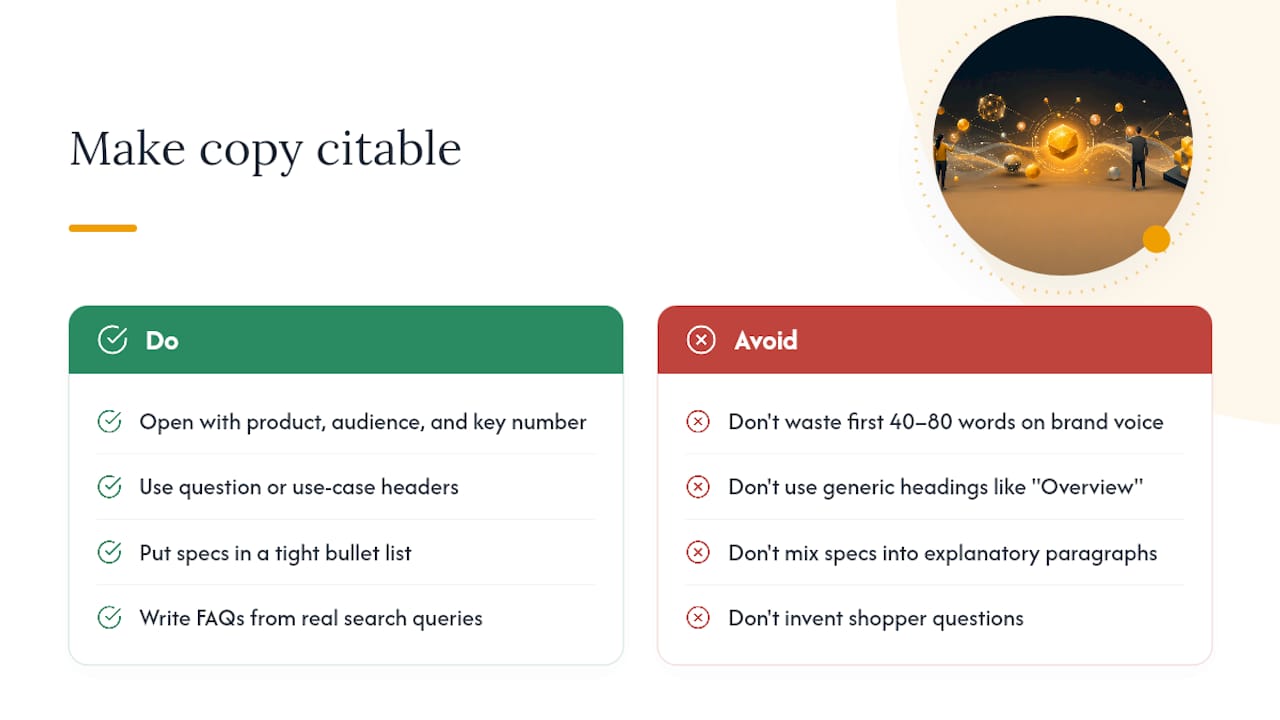
Your first 40 to 80 words are the single highest-leverage piece of copy on the page. That's the block a model is most likely to lift verbatim, and it's also the block most ecommerce teams waste on brand voice instead of facts.
1. Open with what it is, who it's for, and the key number. A workable formula: [Product name] is a [category] built for [use case], priced at [price], with [one defining spec]. That's it. Save the storytelling for a section further down the page.
2. Use question-based or use-case headers, not generic labels. "Overview" and "Details" tell an AI model nothing. "Best for Small Kitchens" or "How Long Does the Battery Last?" gives it a heading it can match directly against a shopper's question, and ShopAccino's guidance on AI search optimization specifically calls out use-case headers as a citability lever most PDPs skip.
3. Separate bullet facts from explanatory prose. Specs, dimensions, and compatibility belong in a tight bullet list. Reserve full sentences for anything that needs context, like why a material choice matters or how a feature behaves in practice. Mixing the two into one paragraph makes both harder to extract.
4. Write FAQ items around actual search phrasing. Pull the exact wording shoppers use in People Also Ask boxes and support tickets, not the wording your product team prefers internally. "Is this dishwasher safe?" gets cited. "Care Instructions" does not.
Here's a comparison of the same product intro, written two ways:
Weak: "Experience next-level comfort with our revolutionary ergonomic chair, designed to transform your workday."
Citable: "The Vantage Task Chair is a mesh-back office chair built for 6+ hour workdays, priced at $329, with adjustable lumbar support and a 12-year warranty."
The second version has no adjectives doing emotional work. It has a name, a use case, a price, a spec, and a guarantee. That's what gets quoted.
Pro Tip: Run your product intro through a simple test: could someone answer "what is this and who should buy it" using only your first sentence? If it takes two sentences to answer, an AI model will probably skip both and paraphrase instead of citing you directly.
Keep your FAQ section short, 3 to 6 items, and map each one to a real query pattern rather than inventing questions no shopper actually asks. That discipline also sets up the FAQPage schema markup you'll want in place before the next section.
The JSON-LD Checklist and Feed Hygiene That Actually Move Citations
Most PDP schema failures aren't missing fields. They're mismatched ones. A price of $49.99 in Product JSON-LD next to a Merchant Center feed still showing $54.99 doesn't just risk a Google Shopping suspension. It teaches an AI system your page isn't a reliable source, and that judgment can persist across future queries.
Build your Product schema around this field set, and treat every item as required unless you have a specific reason to skip it:
name,description,brand, andskufor basic identityimageas an array, not a single URL, ideally 3 to 5 anglesgtin13ormpnfor cross-platform product matchingoffers.priceandoffers.priceCurrencymatched exactly to your feedavailabilityusing schema.org's InStock/OutOfStock/PreOrder values, never a custom stringpriceValidUntilset whenever a price is time-limited, so systems know when to re-checkaggregateRatingwith realratingValueandreviewCount, never left empty or hardcoded
An empty or hardcoded aggregateRating block is one of the more common failures auditors find. It usually happens when a template was copied across thousands of SKUs before reviews existed, and nobody circled back once reviews started coming in.
Validate everything through Google's Rich Results Test before it ships, and re-check after any template change. Schema that validates once but breaks silently after a platform migration is a recurring cause of citation drop-off that teams don't notice for months.
Feed hygiene deserves its own cadence, separate from your content calendar. Push price and stock updates to your merchant feed on the same schedule you update your live page, ideally same-day, and treat any gap between feed and PDP as a bug, not a formatting inconsistency. The Prompt Insider's research notes that Perplexity specifically requires accurate GTINs and accepts Google Shopping CSV feeds via SFTP, which means a feed built loosely for Google Shopping alone may not satisfy every AI engine pulling from it.
Quick gut check: if you can't answer "what does our AggregateRating field currently show, and does it match our storefront" without opening a dashboard, that field is probably stale.
Complete Product schema paired with Offer and AggregateRating data is exactly the combination The Prompt Insider identifies as the shared structural signal behind citation behavior on ChatGPT, Gemini, and Perplexity alike. Getting these fields right isn't a one-time project. It's closer to inventory management: something that degrades quietly if nobody owns it.
Make Reviews Work for AI: Visible HTML and Third-Party Corroboration
Reviews rendered only inside a lazy-loaded carousel widget might as well not exist to a crawler that skips JavaScript execution. The fix is almost embarrassingly simple: render at least a handful of full review text blocks directly in the page's HTML, with dates and reviewer context, before any JS enhancement loads on top.
Mark that content up with Review and AggregateRating schema so the structured data and the visible text tell the same story. A mismatch between what's marked up and what's rendered is a red flag that some systems will simply discard.
A few tactics worth building into your review pipeline:
- Send review copies to a short list of trusted third-party reviewers on a regular pitch cadence, not just once at launch.
- Ask for data sheets or spec confirmations from reviewers who publish comparison content, since that corroborates your own schema claims from an outside source.
- Pull the most quotable line from your highest-rated reviews and feature it as a standalone sentence near your comparison table or spec block, not buried in a scroll of unrelated feedback.
- Refresh featured excerpts quarterly so the visible proof doesn't look frozen from launch day.
That last tactic matters more than it sounds. Insight from The Prompt Insider suggests visible, quotable sentences placed near comparison tables specifically increase the odds of being picked up by engines like Perplexity, which favor fast, corroborated listings over polished but unverifiable ones.
Pro Tip: Write your top review excerpt as if it needs to stand alone with zero context, because to an AI model pulling a single sentence, it will. "Runs quiet even on carpet, lasted 14 months of daily use" gets quoted. "Great product, highly recommend" does not.
Third-party corroboration doesn't require a PR budget. A single accurate, well-maintained listing on an independent review site can do more for citation odds than another round of on-page copywriting.
Crawlability, Rendering, Speed, and Image Basics AI Bots Need
None of the schema or copy work matters if the crawler never reaches the page, or reaches it and gives up before your content renders. Start with access, not content.
Confirm GPTBot, Google-Extended, and PerplexityBot aren't blocked by robots.txt, a firewall rule, or an overly aggressive Cloudflare bot-fight setting that treats AI crawlers like scrapers. Many teams block these unintentionally while trying to stop content-scraping bots, then wonder why their pages never surface in AI answers. Consider publishing an /llms.txt file pointing to your key product and category pages. It's not a formalized standard yet, but crawler logs show GPTBot fetching it where it exists, which makes it a low-cost hedge.
Rendering speed affects whether a crawler waits around for your JavaScript to finish or grabs whatever HTML loaded first. Target Core Web Vitals thresholds specifically:
- Largest Contentful Paint under 2.5 seconds
- First Input Delay under 100 milliseconds
- Cumulative Layout Shift under 0.1
Product images need the same discipline. Name files descriptively (vantage-task-chair-mesh-back-side.jpg, not IMG_4821.jpg), write alt text that describes the actual product and use case rather than stuffing keywords, and implement responsive srcset so mobile users aren't downloading a desktop-sized hero image. Lazy-load below-the-fold images, but never lazy-load your primary product image or the first review block, since that's exactly the content you need visible on first paint.
Neil Patel's product page SEO checklist still treats page speed and image optimization as core levers, and that hasn't changed just because AI retrieval entered the picture. It's added a new reason to care about the same fundamentals.
Prompt-Based Testing and Citation Tracking: What to Measure and When
You can't fix what you don't measure, and citation tracking for AI answers looks nothing like a rank-tracking dashboard. Here's a repeatable process:
- Build a battery of 20 to 50 prompts per priority SKU, phrased the way real shoppers ask ("best noise-canceling headphones under $200 for flights," not your own product name).
- Run that battery weekly across ChatGPT, Gemini, and Perplexity, recording which SKU gets cited, which source link the model shows, and whether the answer changed from the prior week.
- Log a simple delta: cited or not, same source or different, price/spec accuracy in the citation versus your live page.
- Flag any citation that references outdated pricing or discontinued stock immediately, since that's often a feed sync failure, not a content problem.
- Automate alerts for lost citations and feed parity errors so a regression doesn't sit undetected for a month.
Citation presence at this scale behaves more like a binary switch than a ranking position. Being cited or not matters more than exactly where you land in an answer, which is why tracking inclusion across prompt variations beats obsessing over word-for-word phrasing.
Expected timeline: crawler and schema fixes typically show first movement within 2 to 8 weeks, copy and citability rewrites land in a similar window, and review-coverage gains compound more slowly, usually over one to two quarters as third-party corroboration accumulates. Don't judge a schema fix on week two data and don't expect a review campaign to move citation rates before its second quarter.
How AuthorityLayer's Audit Workflow Prioritizes What to Fix First
Most teams don't lack ideas for what to improve. They lack a way to rank forty possible fixes against limited engineering time, and that's where an impact-versus-effort framework earns its keep.
A practical audit checks four things at once: schema parity between your PDP and your feed, crawl access for the major AI bots, review coverage and visible markup, and consistency of product identifiers across every surface. This approach involves measuring what real AI answers currently show, then working backward to the fixes that would change those answers fastest.
A simple prioritization matrix helps here:
- High impact, low effort: fixing an empty
aggregateRatingfield, unblocking a crawler, correcting a stalepriceValidUntil. - High impact, higher effort: rewriting your top 50 PDP intros to be citable, building out visible review HTML at scale.
- Lower impact, still worth doing: image alt text sweeps, FAQ expansion on mid-tier SKUs.
Run your top 10 revenue SKUs through that lens first. That's where a wrong price or a missing GTIN costs you the most, and where a fix is easiest to verify against real prompt results within weeks.
Personalization Cues That Help AI Systems Recommend the Right Product
AI assistants increasingly try to match a shopper's stated constraints, like budget, use case, or a stated preference, to a specific product rather than a generic category. Your page needs to hand it the cues to do that matching correctly.
Explicit use-case labeling does more work here than most teams expect. A heading like "Best for Apartment Living" or "Built for Frequent Travelers" gives a model a direct hook to match against a query like "what's a good [category] for someone in a small apartment." Without that label, the model has to infer the fit from scattered specs, and inference is where mismatches happen.
Price framing matters too. State clearly whether a product sits at the entry, mid, or premium tier of your catalog, and say so in plain language rather than assuming the number alone communicates it. "Our most affordable model in this line" or "our premium option for heavy daily use" gives an AI system a comparative anchor it can repeat confidently.
Compatibility and constraint data, like size ranges, skin types, dietary restrictions, or technical requirements, should appear as explicit statements near the top of the page, not buried three sections down. A model trying to answer "is this safe for sensitive skin" needs that answer accessible in a single, unambiguous sentence.
None of this requires new technology. It requires treating your product copy as an answer key for a specific set of shopper questions, rather than a persuasive narrative built around your brand's preferred framing.
Handling Variant and Bundle Information So AI Models Don't Get It Wrong
Variants and bundles are where product schema most often breaks down, because most templates were built for a single SKU, not a size, color, or bundle matrix. When an AI model can't tell which variant your review count or price actually refers to, it either picks the wrong one or skips citing you at all.
Give each meaningful variant its own Product entry with its own sku, gtin, and offers block, connected through schema.org's isVariantOf and ProductGroup structure rather than crammed into one generic listing. A 16-ounce and a 32-ounce version of the same product should never share a single price field if their prices differ, and they shouldn't share a single review count if reviews were left for one size specifically.
Bundles need their own clarity. If a bundle combines three individually sold items at a discount, say so explicitly in the description, and list the component SKUs so a model isn't left guessing whether the bundle price represents one item or three. "This bundle includes the Vantage Chair, the matching footrest, and a 5-year extended warranty for $429, a $60 savings versus buying separately," gives a model everything it needs to cite the offer accurately.
Where variants affect a core spec, like battery life differing between color options due to a hardware revision, state that difference directly rather than letting a single generic spec block imply uniformity. Getting this wrong doesn't just risk a bad citation. It risks a citation that quotes a price or spec that doesn't match what the shopper actually receives, which is the fastest way to lose trust in your brand's data across every future query.
Bringing User-Generated Content Beyond Star Ratings Into the Page
Reviews are the most obvious form of user-generated content, but they're not the only signal AI systems can pull from, and teams that stop at star ratings are leaving corroboration on the table.
Customer photos and videos, when captioned with real context ("used daily for six months, shown here on a glass-top stove"), give a model descriptive text tied to a real use case rather than a marketing claim. Q&A sections where shoppers ask and other shoppers answer function almost like a crowdsourced FAQ, and they tend to surface exactly the phrasing real buyers use, which maps naturally to conversational search intents.
Forum and community mentions, whether from a branded community or an unaffiliated space like a subreddit or a niche enthusiast forum, act as third-party corroboration even when you don't control the platform. That's valuable precisely because you don't control it. A model weighing whether to trust your claims has more reason to believe them when an unrelated shopper made the same point independently.
Where you syndicate this content matters. A customer photo buried in a JS-only lightbox gallery gets the same treatment as a review in a lazy-loaded carousel: invisible to a crawler that skips script execution. Surface at least a few representative pieces, captions included, directly in page HTML.
Treat UGC integration as an extension of the same review strategy already covered, not a separate initiative. The tactics overlap almost completely: visible markup, real context, and third-party voices you don't fully control.
Updating Content Based on What the AI Feedback Loop Tells You
Your prompt battery isn't just a scorecard. It's a feedback mechanism that should change what you edit next, and the teams that treat it that way improve faster than teams that run it and file the results away.
When a prompt check shows a competitor getting cited instead of you for a query you should win, don't just note it. Pull that competitor's PDP and compare its intro, its schema completeness, and its review visibility against yours line by line. The gap is usually specific: they have a priceValidUntil field and you don't, or their review count is visible in HTML and yours loads via JavaScript.
When a citation shows your product but with an outdated price or a discontinued variant, treat that as a feed-sync incident, not a content update. Fix the sync process, not just the individual field, since the same failure will recur on the next price change if the root cause goes unaddressed.
Build a lightweight review cycle: weekly for citation presence and feed parity, monthly for content and schema gaps against top competitors, quarterly for a full audit of review coverage and third-party corroboration. That cadence matches the timelines these fixes actually take to show movement, so you're not making decisions on data that hasn't had time to reflect a change yet.
Common Pitfalls and Fastest Wins from Real Audits
The same five blockers show up in almost every audit: JS-rendered reviews invisible to crawlers, empty aggregateRating fields, feed and PDP price mismatches, blocked or throttled AI crawlers, and generic headings that give a model nothing to quote. Most get fixed in a single engineering sprint once someone actually lists them out.
For a fast proof point, pick your top 10 SKUs by revenue and test three things this week: render your reviews in visible HTML, fill and validate your aggregateRating field, and confirm GPTBot and PerplexityBot aren't blocked. Small, verifiable moves like these tend to show up in prompt checks before bigger content rewrites do, which makes them the right place to build momentum with a skeptical team.
— Geraldine
See Where Your Product Pages Stand Before You Rebuild Anything
Most of what's in this playbook is diagnostic work before it's fix work: knowing which SKUs already get cited, which ones are invisible, and which specific field or crawler block is causing it. That's exactly what Authoritylayer's Free AI Visibility Scan is built to surface. Run it and you get back your top blockers and a prioritized checklist, so you're fixing the highest-impact issue first instead of guessing which of forty possible problems matters most.

From there, Authoritylayer's paid plans turn that one-time scan into ongoing measurement: Starter at $99 a month for teams getting their first regular read on AI citation, Growth at $349 a month for teams tracking multiple product lines and competitors, and Enterprise at $795 a month for multi-brand organizations running this at scale. Teams that just want a recurring pulse without the full platform can start with the Monthly AI Visibility Report at $59 a month. Run the free scan first, see exactly where your top SKUs stand in ChatGPT and Gemini answers today, and decide from there which plan matches how often you need to check.
Where to Validate Your Fixes
Use Google's Rich Results Test to confirm your Product and Review schema parses correctly, Google's generative AI optimization guide for foundational structured data guidance, Google Merchant Center's help documentation for feed and GTIN requirements, and PageSpeed Insights to check your Core Web Vitals against the 2.5 second LCP target. For broader product-page fundamentals, Yoast's product page SEO guide and this partner resource on optimizing product pages for sales and SEO round out the checklist.
Sources
- AI traffic to US retailers rose 393% in Q1 and it’s boosting their revenue too — TechCrunch
- Optimizing your website for generative AI features on Google Search — Google Developers
- Product page SEO — Yoast
- How Product Pages Get Recommended by ChatGPT, Gemini, & Perplexity — The Prompt Insider
FAQ
How Can I Optimize My Product Listing Pages for AI Search?
Start with a factual, 40 to 80 word intro naming the product, its use case, and its price, then add complete Product JSON-LD with GTIN, price, and availability fields. Expose reviews in visible HTML with AggregateRating markup and keep your merchant feed synced to the same price shown on the page.
How Do I Optimize Product Pages for ChatGPT and Gemini Specifically?
The core work is the same across both: citable copy, complete schema, and crawler access, since both models rely on shared signals like structured data and third-party corroboration. Gemini leans more heavily on Google's own ecosystem, so Merchant Center feed accuracy and Knowledge Graph consistency carry extra weight there.
How Do I Optimize a Website for AI Search Overall?
Beyond individual product pages, confirm robots.txt and any firewall rules aren't blocking GPTBot, Google-Extended, or PerplexityBot, and consider adding an /llms.txt file pointing to key pages. Pair that access with the same structural fundamentals, clean schema, visible content, and fast page speed, that Google recommends for generative AI features.
Can ChatGPT Do SEO Work for My Product Pages?
ChatGPT can help draft copy variations, generate FAQ questions, or audit a schema snippet for obvious errors, but it doesn't crawl your live site or verify what's actually rendering. Use it as a drafting and brainstorming tool, then verify every technical claim with a real crawler test or Rich Results Test.
How Long Does It Take to See Results From These Changes?
Crawler and schema fixes typically show first movement in 2 to 8 weeks, while review-driven citation gains compound more slowly, usually over one to two quarters. Running a weekly prompt battery is the fastest way to catch early movement instead of waiting for a quarterly review.
Does AuthorityLayer Track Whether My Products Get Cited by AI?
Yes. Authoritylayer's platform monitors how AI assistants like ChatGPT, Gemini, Claude, and Perplexity discover and cite brands, and its Free AI Visibility Scan is the fastest way to see where your current pages stand before committing to a paid plan.