CMOs: 30–90 Day Tiered Plan to Get Restaurants Recommended by ChatGPT
A measurement-first playbook for CMOs: use a tiered 30–90 day plan, track 50–100 prompts weekly, fix retrieval gaps, and earn the citations that win...
· 15 min read

Run a focused AI visibility program, roughly 50 to 100 prompts tracked weekly across ChatGPT, Perplexity, and Gemini, and pair it with generative engine optimization and authority seeding. That combination is what actually moves recommendation share, not one-off content pushes. Start with a baseline read this week; expect a defensible trend line by day 90. Everything below explains why that sequence works and where to invest first.
TL;DR:
- Brands at lower tiers need to focus on improving discoverability through technical fixes and authoritative seed content before messaging.
- Regularly run cross-engine prompts and log detailed metrics to accurately diagnose visibility issues and track progress over at least 90 days.
- Prioritize authoritative, data-rich content with consistent structured data, canonical URLs, and clear entity signals to enhance AI citation and recommendation rates.
- Negative social sentiment and review language can influence AI recommendations; managing reputation and generating positive citations is crucial.
- Use a disciplined measurement approach and dedicated dashboards to identify specific failure modes, avoid guesswork, and effectively scale visibility efforts.
Table of Contents
- How Do You Diagnose Why ChatGPT Isn't Recommending You?
- How Do You Measure Whether ChatGPT Recommends Your Restaurant?
- What Should You Fix First at Each Prominence Tier?
- Which GEO Tactics Actually Move Recommendation Share?
- What Belongs on Your AI Visibility Dashboard?
- What Does a 30 to 90 Day Rollout Actually Look Like?
- What Mistakes Derail Most ChatGPT Visibility Efforts?
- What Do Real Recommendation Wins Look Like?
- Do Reviews and Social Sentiment Affect ChatGPT Recommendations?
- How Does Structured Data Help ChatGPT Recognize Your Restaurant?
- Why Measurement Beats Guesswork in AI Visibility
- Turn This Playbook Into a Running Program
- Sources
- FAQ
How Do You Diagnose Why ChatGPT Isn't Recommending You?
Not every brand has the same problem, and that's the first thing most marketing teams get wrong. A 37,000-run audit of retrieval-augmented recommendations found that visibility failures cluster into five prominence tiers, and each tier fails for a different reason.
L1 and L2 brands (category leaders and strong challengers) get retrieved almost every time. Their problem, when they have one, is positioning: they surface but lose the final recommendation to a competitor with sharper persona fit. L3 brands sit in a messier middle, sometimes retrieved, sometimes not, with inconsistent citation sourcing. L4 and L5 brands face something closer to catastrophic invisibility: the same audit found that roughly half of L4 to L5 brands never surface at all, regardless of how many prompts you throw at the models.
Three failure stages explain most of this: S1 (never retrieved), S2 (retrieved but not cited), and S3 (cited but not recommended). Cross-model agreement on which brand wins a given category sits at just 41.6%, and recommendation concentration across brands carries a mean Gini coefficient of 0.28, meaning visibility is unevenly hoarded by a small set of winners.
- Confirm your tier before choosing tactics: L1/L2 needs positioning work, L4/L5 needs raw discoverability work.
- Don't assume a single ChatGPT test tells you your tier. Run it across engines first.
Tier diagnosis has to be engine-aware, not engine-specific.
How Do You Measure Whether ChatGPT Recommends Your Restaurant?
Measurement has to be a repeatable protocol, not a spot check. Here's the build:
- Build a 50 to 100 prompt set split roughly evenly across branded queries ("is [restaurant] good for a business dinner"), category queries ("best steakhouse downtown"), and use-case queries ("where should I take out-of-town clients"). Write prompts in the language actual buyers use, not internal marketing terms.
- Cover at least three engines. ChatGPT, Perplexity, and Gemini or Google AI Overview form the minimum viable set; add Claude or others as budget allows.
- Set cadence by context. Weekly runs form the steady-state baseline cadence; daily runs suit launch or event windows; monthly runs are the minimum frequency for credibility. Run every prompt from a clean context window so history doesn't bias the answer.
- Log every run in a consistent schema: one row per prompt, per engine, per run date.
| Field | What it captures |
|---|---|
| Mentioned (Y/N) | Whether your brand appears at all |
| Position in answer | First mentioned, buried, or comparison-only |
| Cited sources | Which domains the model pulled from |
| Sentiment | Positive, neutral, negative framing |
| Competitors named | Who shares the answer with you |
From that log, track mention rate, citation rate, AI share of voice, and prompt coverage alongside source mix and any assisted conversions you can trace. AuthorityLayer's methodology follows this same logic at platform scale.
What Should You Fix First at Each Prominence Tier?
Prescriptions differ sharply by tier, and applying an L4 fix to an L1 brand wastes budget. Here's the breakdown:
- L1: You're retrieved reliably. Focus on defensive positioning: direct comparison content against your closest named competitor, and third-party citations certified enough that models trust them over generic listicles.
- L2: You surface often but lose ground to sharper positioning. Build persona-targeted messaging for your top use-case prompts and shore up the review and comparison pages models actually cite.
- L3: A hybrid problem. Fix technical retrieval issues (canonical URLs, structured entity data) while simultaneously improving positioning copy. Prioritize your highest-volume prompts first rather than spreading effort evenly.
- L4: Retrieval is the real blocker. Seed authority lists, publish canonical posts on domains models already pull from heavily, and pursue earned editorial coverage rather than owned content alone.
- L5: Same as L4 but localized. Region-specific aggregators, native-language content, and explicit regional signals (city names, neighborhood terms, local landmarks) matter more than generic authority.
Pro Tip: If you don't know your tier yet, don't guess. A single week of cross-engine baseline prompts will place you on the ladder faster than any internal debate about brand strength.
Positioning and product fit determine what happens after retrieval, which is exactly why L1 and L4 brands need almost opposite playbooks.
Which GEO Tactics Actually Move Recommendation Share?
Generative engine optimization works differently than search engine optimization, and the biggest mistake CMOs make is porting over old SEO habits unchanged. Experimental work on marketing language found that authority-style language and credible third-party signals meaningfully lift recommendation share, while scarcity tactics and promotional copy barely move the needle at all.
What works in practice:
- Publish data-rich, canonical pages with explicit entity signals (your restaurant's name, cuisine type, neighborhood, and price tier stated plainly, not implied).
- Keep canonical URLs stable. Models cite pages consistently only when the citation trail doesn't break every few months.
- Build comparison pages and persona-fit copy that help you survive the jump from "retrieved" to "recommended," since being cited is not the same as being chosen.
- Fix the boring technical layer: crawlable content, consistent metadata, no orphaned pages the models can't verify against your main site.
First movers on authority language get more benefit than late adopters, since universal adoption eventually erodes the edge, per the same GEO language research. Move now, not next quarter.
What Belongs on Your AI Visibility Dashboard?
Your executive dashboard needs six widgets, and if it has more than ten, someone is going to stop looking at it. Keep the core set tight: AI share of voice, mention rate, citation rate, top cited domains, a prompt coverage heatmap, and AI-assisted conversions.
Decision rules matter more than the raw numbers:
- Mention rate up, citation rate down: you're being talked about but not sourced. Fix your canonical content, not your PR.
- Sentiment flips negative: treat it as a reputation event, not a ranking blip. Investigate the source pages driving that sentiment immediately.
- Share of voice shifts by engine: don't average across engines. A win in ChatGPT and a loss in Gemini are two different problems needing two different fixes.
| Cadence | Purpose |
|---|---|
| Weekly | Operational runs across all prompts and engines |
| Monthly | Leadership summary and trend check |
| 90 days | Minimum window for a statistically defensible trend |
A repeatable weekly program beats an expensive one-time audit every time, because AI answers shift week to week in ways a quarterly snapshot will miss entirely.
What Does a 30 to 90 Day Rollout Actually Look Like?
Marketing leaders don't need a theory of AI visibility. They need a calendar.
- Month 1: Run baseline prompts across your engine set, fix your top three retrieval blockers (usually missing structured data, broken canonical tags, or thin entity pages), publish one or two data-rich canonical resources, and start weekly reporting immediately.
- Month 2: Pursue authority seeding through earned editorial and high-coverage third-party platforms, build out comparison content, and clean up internal linking so your own site reinforces the entity signals models look for.
- Month 3: Scale your prompt set, automate the reporting cadence, and compare share-of-voice against your baseline. Double down on whatever moved the needle.
Pro Tip: Define your success metric before month one ends, not after month three. "Citation rate lift" and "share-of-voice gain vs baseline" are measurable; "better AI presence" is not.
Give the full measurement framework 90 days before you judge it. Anything shorter is noise, not signal.
What Mistakes Derail Most ChatGPT Visibility Efforts?
The most common mistake is treating a single ChatGPT query as proof of anything. Teams that test once, see their name missing, and panic often chase the wrong fix entirely.
The second mistake is confusing being mentioned with being recommended. A model can cite your restaurant in a comparison list and still send the diner to a competitor in the final sentence. That gap between retrieval and recommendation is exactly what most audits measure, and it's where positioning work pays off more than volume of content.
Third: assuming traditional SEO wins translate directly. A page ranking first on Google can be entirely absent from an AI Overview or a ChatGPT answer, because the retrieval logic and ranking signals differ. Structured data and clear entity signals matter more here than backlink volume ever will.
Fourth: over-indexing on one engine. Optimizing exclusively for ChatGPT while ignoring Perplexity or Gemini means you're managing to a partial picture, and the Gini coefficient of 0.28 on recommendation concentration means the winners in one engine aren't always the winners in another.
Fifth: expecting instant results. Retrieval-and-ranking behavior in these models is stochastic by nature. A single week of favorable prompts doesn't confirm a trend, and a single bad week doesn't confirm decline either.
What Do Real Recommendation Wins Look Like?
Patterns from prominence-tiered audits point to a consistent shape for restaurants and hospitality brands that climb from invisible to recommended. The brands that move tiers share a few traits worth naming plainly.
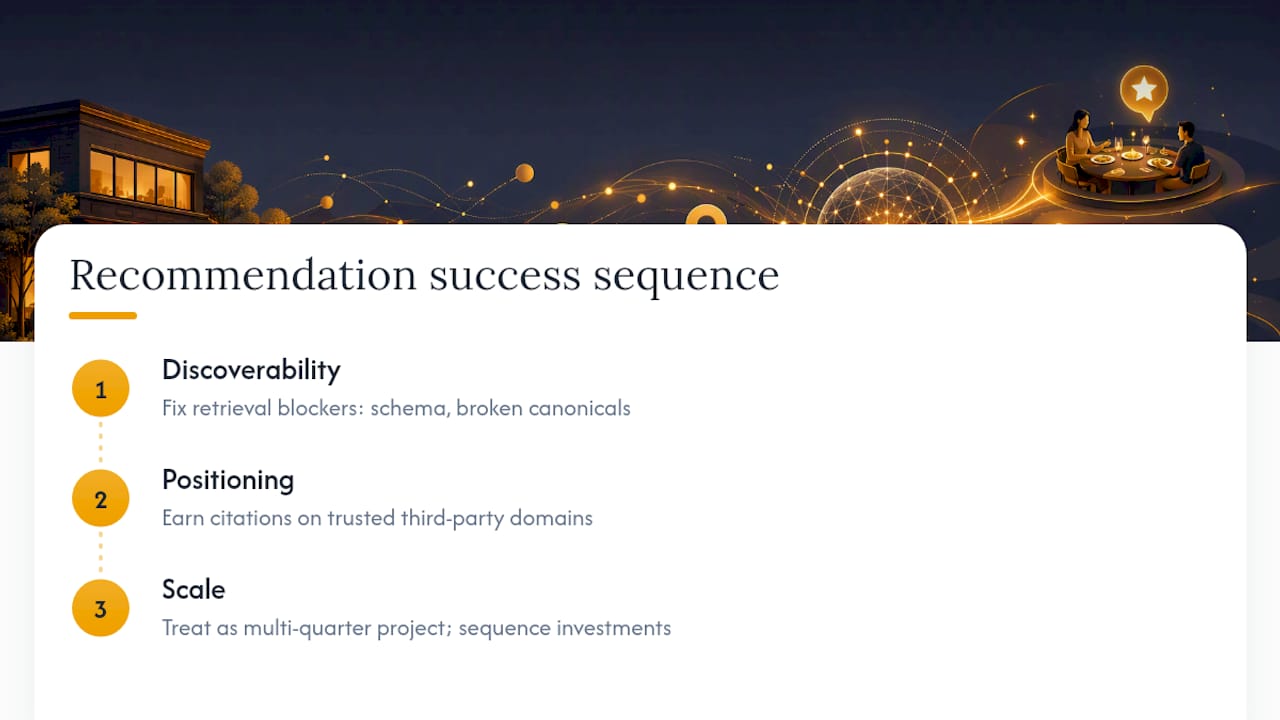
They fix retrieval before they fix messaging. An L4 brand chasing better copy while its site still lacks basic structured data is solving the wrong problem first. The audits on failure modes consistently show that retrieval failures dominate at the lower tiers, so content polish delivers close to nothing until the underlying page is actually indexable and citable.
They earn third-party citations instead of manufacturing them. Authority language works because it's credible, not because it's confident. A brand that gets written about on a widely-retrieved industry or local media domain sees its citation rate climb in a way that self-published claims never replicate. That's the mechanism behind the L4 to L5 prescription: seed the domains models already trust, rather than trying to out-shout them from your own site.
They treat the climb as a multi-quarter project, not a sprint. Brands that jump from L4 toward L2 in under 90 days are rare, and the ones that do it usually started from a specific, fixable retrieval gap (missing schema, broken canonicals) rather than a deep brand-awareness problem. The pattern is fix the mechanical blocker first, then invest in positioning once you're reliably retrieved.
The through-line across every success case is sequencing: discoverability, then positioning, then scale. Skip a step and the investment in the next one underperforms.
Do Reviews and Social Sentiment Affect ChatGPT Recommendations?
Sentiment shapes the final recommendation step more than most CMOs assume. Once a restaurant clears retrieval and citation, the model still has to decide whether to actually recommend it, and that decision leans on the tone of what's being cited, not just the fact of the citation.
A restaurant with dozens of citations pulling from consistently negative review language is working against itself even while technically visible. This is why sentiment sits on the executive dashboard alongside mention rate and citation rate: a rising mention count paired with sliding sentiment is often an early warning sign, not a win.
Social sentiment feeds this loop indirectly. Models don't typically pull live social feeds, but the aggregator and review sites they do cite often summarize or reflect social conversation, especially after a viral moment, a health inspection story, or a public complaint that spreads. That means your social reputation strategy and your AI visibility strategy are no longer separate workstreams. A sentiment shift on a heavily cited review platform can ripple into how the model frames you within days.
The practical takeaway: treat negative review clusters as a content problem, not just a reputation problem. Responding publicly, resolving the underlying issue, and generating fresh positive citations all feed back into how models describe you the next time someone asks for a recommendation.
How Does Structured Data Help ChatGPT Recognize Your Restaurant?
Structured data gives models an unambiguous signal about who you are, which matters enormously when the alternative is inference from messy prose. Schema markup for restaurants (cuisine type, price range, location, hours, menu items) turns implicit facts into explicit entity data that retrieval systems can match against a prompt with far less guesswork.
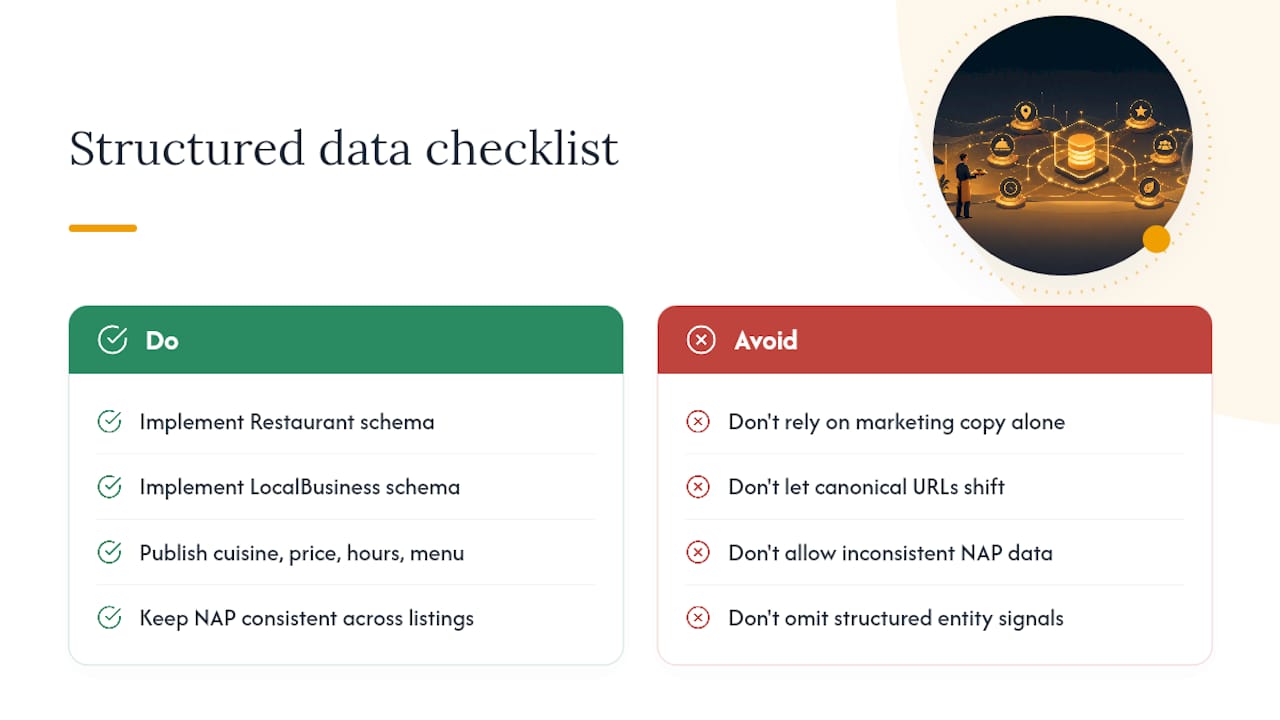
This matters more for AI visibility than it ever did for traditional search rankings, because these models are synthesizing an answer from multiple sources in real time rather than just ranking a results page. A page with clean, structured entity signals is easier to cite accurately and harder to misrepresent. A page relying purely on marketing copy forces the model to interpret tone and infer facts, which increases the odds of an incomplete or incorrect citation.
The practical checklist is short: implement Restaurant and LocalBusiness schema, keep NAP (name, address, phone) data consistent across your site and every third-party listing, and make sure canonical URLs don't shift every redesign cycle. Inconsistency across these signals is one of the quieter reasons an otherwise strong brand still gets misclassified or skipped entirely in an AI answer.
Why Measurement Beats Guesswork in AI Visibility
AI assistants are becoming a discovery layer that sits ahead of search, and most marketing teams are still treating it like a curiosity rather than a channel with its own metrics. That's a mistake. The brands making real progress are the ones running the same disciplined measurement they'd apply to paid media or SEO, just pointed at a different set of engines.
What tends to surprise CMOs the most isn't that their brand is invisible. It's how unevenly invisible they are, strong in one engine, absent in another, with no single explanation until they look at the data by tier and by engine separately. Prioritized recommendations work because they replace a scattershot content calendar with a short list of fixes tied to an actual failure mode. Clients who treat this as a quarterly discipline, not a one-time project, tend to see the clearest movement in citation rate first, sentiment and share-of-voice second.
If you haven't run a baseline yet, that's the honest starting point. Everything else in this playbook only works once you know where you actually stand.
— Geraldine
Turn This Playbook Into a Running Program
This platform offers an alternative to guessing your way through AI visibility. Instead of manually running prompts across three browser tabs every week, you get benchmarked, prioritized recommendations built from the same measurement discipline this whole playbook describes.
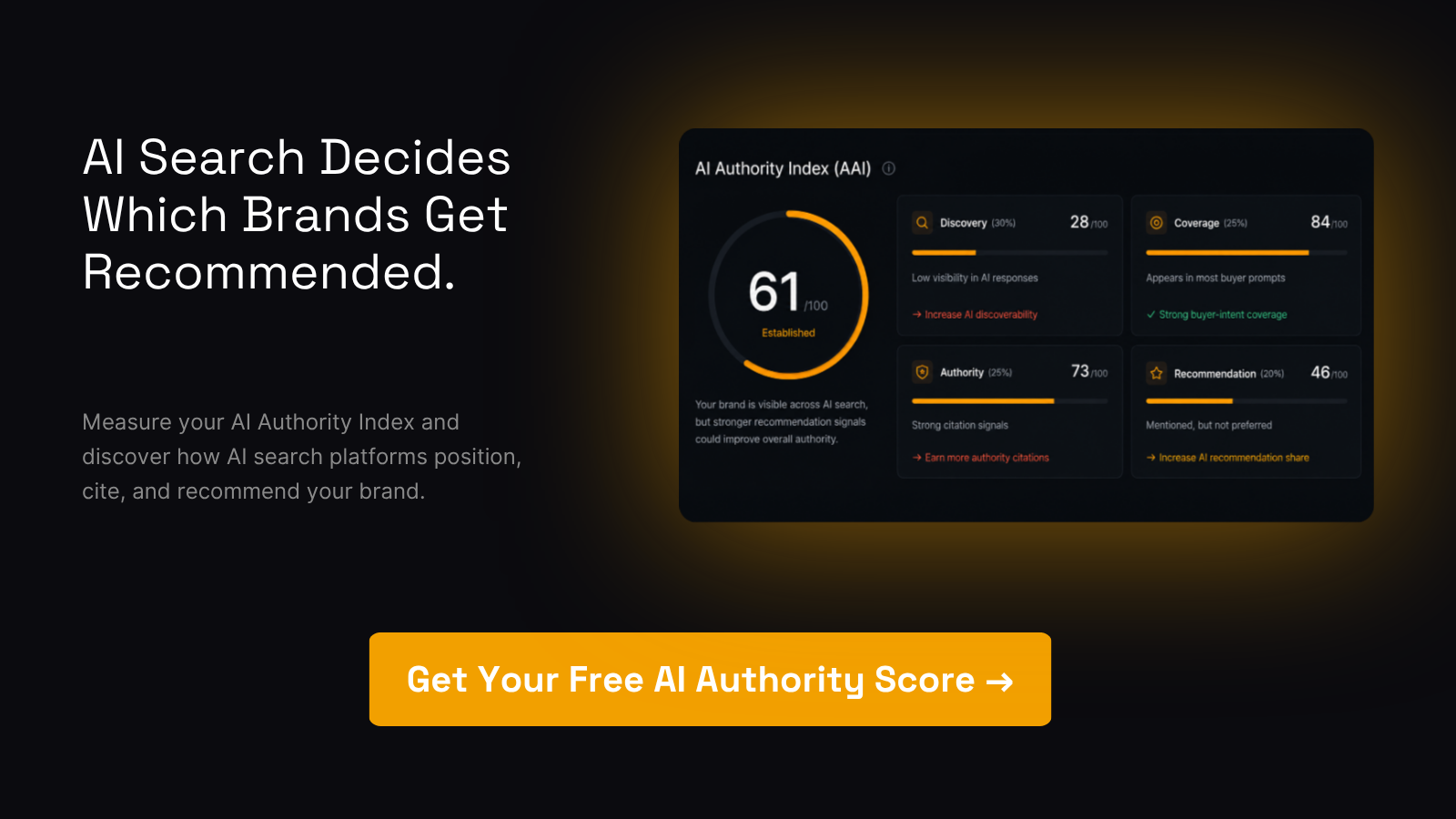
The Monthly AI Visibility Report tracks your prompts across ChatGPT, Perplexity, and Gemini on a recurring basis, benchmarks you against named competitors, and hands you a prioritized fix list instead of a raw data dump, starting at $59 per month. If you want to see where you stand before committing to anything, the Free AI Visibility Scan gives you a no-cost first read on your current tier. Teams ready to run the full weekly program described above can start on the Starter plan at $99 per month and scale up as the data justifies it. Run the scan this week, and you'll know your prominence tier before your next marketing meeting.
Sources
The prominence tiers and failure-mode breakdown come from a 37,000-run audit of retrieval-augmented recommendations, which documents the L4 to L5 invisibility problem in detail. Cross-model agreement figures and the 0.28 Gini coefficient come from a multi-industry empirical map of brand ownership across large language models. The GEO findings on authority language versus promotional copy draw on experimental research into marketing language and LLM recommendations. Dashboard structure and cadence recommendations follow published guidance on building a meaningful AI search visibility dashboard.
- Prominence-Stratified Failure Modes in Retrieval-Augmented Commercial Recommendation: A 37,000-Run Audit
- How to build a meaningful AI search visibility dashboard
FAQ
How Many Prompts Do I Need to Track ChatGPT Visibility?
A defensible starting set runs 50 to 100 prompts split across branded, category, and use-case queries, refined quarterly as you learn which prompts actually reflect buyer language. Fewer than 50 makes trends unreliable given how stochastic model outputs tend to be.
How Long Before I See a Real Trend in AI Recommendations?
Give it 90 days at a minimum, with weekly runs feeding a monthly leadership summary. Shorter windows get skewed by normal week-to-week variance in how these models retrieve and rank sources.
Does Being Mentioned by ChatGPT Mean It's Recommending Me?
No. A mention just means you were retrieved and cited; a recommendation means the model chose you over competitors in its final answer. That gap between citation and recommendation is the core diagnostic most brands miss.
What Does Authoritylayer's Monthly AI Visibility Report Actually Include?
It delivers benchmarked mention rate, citation rate, and share-of-voice tracked across engines, paired with prioritized fixes tied to your specific prominence tier, at $59 per month. Plans that include full program setup and reporting tools start with the Starter tier at $99 per month.
Should I Prioritize ChatGPT Over Other AI Engines?
No single engine deserves exclusive focus, since cross-model agreement on top brands sits at only 41.6%. Cover ChatGPT, Perplexity, and Gemini at minimum before drawing conclusions about your overall visibility.