90 Day Compliance Plan to Get Your Dental Clinic Recommended by ChatGPT
Compliance guide for dental clinics: fix crawlability, add Dentist schema, sync listings, surface review evidence, and monitor AI visibility.
· 16 min read

Make your clinic crawlable, publish verifiable service and clinician pages, add Dentist and LocalBusiness schema, keep your profiles and reviews consistent everywhere, and test with real prompts. Do these five things and you materially raise the odds that ChatGPT cites your clinic when a patient asks for a recommendation. Results build over weeks to months, and no single fix guarantees a mention, but the combination compounds.
TL;DR:
- Consistently matching core facts across your website, listings, and reviews significantly improves the likelihood of being cited by ChatGPT in local recommendations.
- Ensuring your website is crawlable by review of robots.txt, firewalls, and XML sitemaps is crucial for AI to discover and cite your practice accurately.
- Publishing clear, verified information on each treatment and practitioner, and structuring content with direct answers at the top, helps AI extract accurate facts.
- Adding and validating structured data using Dentist and LocalBusiness schema enhances AI understanding, but must match real content and pass validation tests.
- Regularly testing your clinic’s appearance with AI prompts and maintaining a prioritized fix schedule over weeks to months increases citation frequency and visibility.
Table of Contents
- How ChatGPT decides which dental practice to recommend
- Make sure ChatGPT can actually crawl your website
- What to publish so AI assistants can extract the right facts
- Add Dentist and LocalBusiness schema and check it actually validates
- Keep your business facts identical everywhere they appear
- Turning patient reviews into evidence AI assistants can use
- Test your clinic the way a patient would ask about it
- Measuring your AI recommendation share instead of guessing
- What to expect week by week and month by month
- Why ChatGPT's answers can lag behind your latest update
- Building visibility signals beyond your own website
- Keeping patient data safe while using AI tools for marketing
- Using social presence to reinforce what AI assistants find elsewhere
- My 90-day priority plan for practice owners
- Get a clearer picture with a free AI visibility scan
- Where to verify the details yourself
- Sources
- FAQ
How ChatGPT decides which dental practice to recommend
ChatGPT's search feature can query the web, rewrite a patient's question into a more targeted search, and pull facts from multiple pages before answering, according to OpenAI's own documentation. That means a single well-optimized page is not enough. The assistant is comparing what your website says against what your Google Business Profile, directory listings, and review sites say, then favoring the version of the truth that shows up consistently.
Location matters too. OpenAI notes that ChatGPT can use approximate location from a device's IP address, and a user can optionally share a more precise device location for local queries. A few things follow from this:
- The assistant tends to trust facts it can verify in more than one place.
- It favors pages that answer a question directly instead of burying the answer in marketing copy.
- It treats your website, listings, and reviews as one evidence network, not separate channels.
Understanding this shifts the whole strategy from "rank on Google" to "be the version of the truth that shows up everywhere."
Make sure ChatGPT can actually crawl your website
None of the content work matters if the assistant's crawler cannot reach your pages. OpenAI recommends allowing crawlers so relevant pages remain discoverable, which puts the technical basics first.
- Check your robots.txt and meta robots tags to confirm you are not accidentally blocking search or AI crawlers.
- Review CDN and firewall bot rules, since aggressive bot protection can silently block legitimate crawlers along with spam.
- Scan your host or server logs for blocked crawler requests, especially after a security plugin update.
- Submit a current XML sitemap and use canonical tags so duplicate pages do not confuse indexing.
- Use your search console's URL inspection tool to confirm your key service pages are actually indexed.
Pro Tip: Ask a developer to fetch your homepage and top three service pages using a plain command-line request with no browser rendering; if the content looks empty, a crawler may be seeing the same blank page.
What to publish so AI assistants can extract the right facts
Content structure matters as much as content quality here. Build one authoritative page for each major treatment, and a separate page for each service-location combination if you operate in more than one city. Front-load the answer: the first paragraph of a dental implants page should state what the procedure is, who it typically suits, and roughly what it involves, before any marketing language appears.
Practitioner pages deserve the same treatment. Include verifiable credentials, degree and licensing information, and years in practice where that is accurate and can be confirmed, along with links to any relevant certifying bodies. FDI's advertising guidance calls for accuracy and balance in professional promotion, and that standard applies directly to how you write these pages, per FDI's policy on advertising in dentistry.
A few structural habits make pages easier for an assistant to lift and cite accurately:
- Put a short, direct answer at the top of every FAQ entry, then expand below it.
- State candidacy, risks, and alternatives for every treatment, not just the benefits.
- Avoid absolute claims like "pain-free" or "guaranteed results" that FDI flags as the kind of exaggerated language that undermines trust.
- Keep clinical claims reviewed by a licensed clinician before publishing.
Pro Tip: Write each treatment page as if a patient will read only the first two sentences and nothing else. That is often exactly what happens when an AI assistant summarizes it.
FDI and the ADA both treat AI-era digital advertising as governed by the same professional ethics as any other advertising: accurate, evidence-supported, and honest about limitations.
Add Dentist and LocalBusiness schema and check it actually validates
Structured data does not guarantee a citation, but it gives machines a clean, unambiguous version of your facts to work from. Google's own documentation recommends using the most specific subtype available, which for a dental practice is Dentist, a subtype of LocalBusiness, according to Google Search Central's structured data guidance.
| Property | What it should contain |
|---|---|
| name | Exact legal or trading name of the clinic |
| address | Full postal address matching your listings |
| telephone | Primary contact number, same format everywhere |
| url | Canonical website URL |
| openingHours | Current hours in schema.org time format |
| medicalSpecialty or knowsAbout | Services offered, matching visible page content |
| employee | Nested Physician or Person objects for each practitioner |
| aggregateRating | Only if genuine review data backs it |
A working JSON-LD example for a dental practice, including aggregateRating and review fields, is available in schema.org's Dentist reference. Once implemented, validate with Google's Rich Results Test and a schema linter, then do a manual check to confirm every markup field matches what a visitor actually sees on the page. Google's guidance stresses that mismatched or stale markup, or facts hidden only inside images, undermine the trust structured data is supposed to build.
Keep your business facts identical everywhere they appear
Entity matching, the process by which an AI assistant decides that your website, your Google Business Profile, and a directory listing all refer to the same clinic, depends on consistency. Google's local business documentation is explicit that core facts need to match across every surface.
Audit these fields first, since they carry the most weight:
- Name, address, and phone number, written the same way on every platform.
- Website URL, using the same canonical domain everywhere it is listed.
- Hours of operation, updated the moment they change, including holidays.
- Clinician names and titles, matching exactly between your site, GBP, and directories.
Start the audit with Google Business Profile, then move to major directories and any health-specific directories your specialty relies on. A practical guide to Google Business Profile optimization walks through the listing fields worth double-checking first. When you find a mismatch, correct it at the source, note the date and what changed, and recheck it in your next audit cycle rather than assuming the fix stuck.
Turning patient reviews into evidence AI assistants can use
Reviews do double duty: they build patient trust, and they give an AI assistant specific, checkable detail to cite. The ADA reports that a large majority of dentists receive online patient reviews, so the question is not whether to manage them, it is how well, according to ADA guidance on managing online reviews.
- Ask satisfied patients to mention something specific, like the procedure, how their insurance was handled, or what the visit felt like, rather than a generic star rating.
- Never incentivize reviews or write and post them yourself; the ADA treats fabricated or incentivized reviews as a professional and legal risk.
- Respond to every review, positive or negative, without disclosing any protected health information, consistent with ADA guidance.
- Track new reviews weekly and note when an AI assistant appears to be citing specific review language in its answers.
Pro Tip: A review that says "the hygienist explained every step of my deep cleaning and my insurance covered most of it" gives an assistant far more to work with than five stars and no comment.
Test your clinic the way a patient would ask about it
The only way to know whether any of this is working is to ask ChatGPT the same questions a prospective patient would.
- Build a short list of test prompts: your clinic's name directly, an unbranded query like "best dentist for veneers in [city]," and a service-plus-location combination.
- Run the same prompts every few weeks, save the full response, and open every link the assistant cites.
- When a cited source has an outdated or wrong fact, fix that source directly rather than trying to reword your own site around the error.
- Track three things over time: whether you appear at all, whether the citation is accurate, and whether the mention seems to be sending traffic.
Repeat this cycle every 30 to 90 days. Practitioner writeups on how ChatGPT Search behaves consistently point to this fix-the-source approach as more reliable than trying to prompt-engineer your way into a mention, as described in analysis of ChatGPT Search query behavior.
Measuring your AI recommendation share instead of guessing
Manually running test prompts tells you what is happening today, but it will not tell you where you stand against other clinics in your area or which fix matters most. That is the gap an AI visibility intelligence approach is built to close, tracking how often assistants like ChatGPT, Gemini, Claude, and Perplexity mention a business during buyer research, and where the gaps are relative to competitors.
A structured audit flow looks like this:
- Run an initial scan to see where your clinic currently appears, or fails to appear, in AI-generated answers.
- Get a gap list showing which facts, pages, or listings are likely holding you back.
- Work through a prioritized list of fixes rather than guessing which one matters most.
- Re-test on a schedule to confirm the fixes actually changed your citation rate.
An AI Authority Index style score gives you a single number to track over time, so a scan is not just a one-time snapshot but a baseline you can measure future progress against. AuthorityLayer's own methodology for how AI visibility is measured explains how that scoring works in more detail.
What to expect week by week and month by month
In the first few weeks, expect crawlability fixes and schema corrections to remove obvious blockers, not to produce citations on their own. Between one and three months, consistent listings and stronger practitioner and service pages tend to start showing up in test prompts, particularly for unbranded, location-specific queries.
The real gains are compounding: a new review with specific procedural detail, paired with a freshly updated service page and validated schema, gives an assistant three consistent signals instead of one. Assign someone, whether an office manager or a marketing lead, to own the listings audit and review monitoring on a monthly cadence, and schema validation on a quarterly one.

Why ChatGPT's answers can lag behind your latest update
ChatGPT's web search feature can pull current information at the time of a query, but the model's own training data has a cutoff, and cached or indexed versions of your pages can lag behind what is actually live. That means a schema fix or a new practitioner page might not show up in an assistant's answer immediately, even after search engines have recrawled it.
Two things affect how fast an update surfaces. First, how often your site is actually recrawled, which depends partly on how frequently you publish and how clean your sitemap is. Second, whether the assistant's live search step pulls your updated page at all for a given query, since OpenAI's documentation describes ChatGPT rewriting prompts and running targeted searches rather than always pulling from a single cached snapshot.
The practical implication is patience paired with verification. Do not assume a fix failed because it is not reflected in a test prompt after a few days. Give it a few weeks, keep testing on your regular cadence, and treat a lag as normal rather than a sign that the underlying fix was wrong.
Building visibility signals beyond your own website
AI assistants draw on more than your website and listings. Professional and community visibility feeds into the same evidence network, even though it looks nothing like conventional search engine optimization.
Speaking at a local dental society event, contributing to a professional association's patient education materials, or being quoted in local news coverage all create additional, independently published mentions of your clinic and its clinicians. These are exactly the kind of third-party, verifiable sources that give an assistant more places to confirm a fact.
Sponsoring a community health event or partnering with a local school on dental education creates the same kind of external mention, often with a natural link back to your site. None of this replaces the technical and content work covered earlier, but it adds sources outside your direct control, which tend to carry more weight precisely because you did not write them yourself.
Keeping patient data safe while using AI tools for marketing
Using AI tools to draft content, analyze reviews, or monitor your visibility introduces a data handling question that dental practices cannot treat casually. Never input protected health information into a general-purpose AI tool, whether that is a patient's name paired with treatment details or anything that could identify an individual from a review or case note.

When responding to online reviews, the ADA's guidance is direct: never disclose protected patient information in a public reply, even to correct a patient's account of their own visit, according to ADA reputation management guidance. The same discipline applies when using AI to draft review responses or marketing copy: strip out identifying details before any patient-related text goes into a third-party tool.
If your practice uses an AI platform for visibility monitoring or content generation, confirm what data it stores and whether it meets your regulatory obligations before connecting it to systems that touch patient records.
Using social presence to reinforce what AI assistants find elsewhere
Social media content will not get your clinic cited by ChatGPT on its own, but active, consistent profiles add another verifiable layer to the same evidence network. A practice's Instagram or Facebook page with an accurate address, current hours, and real patient interactions functions as one more place where your core facts can be confirmed.
Posts that answer real patient questions, such as what to expect during a first visit or how a specific procedure works, mirror the same front-loaded, direct-answer structure that works on your website. Responding to comments and messages in a timely, professional way also reinforces that the practice is active and legitimate, which matters for the kind of general trust signals that feed into how confidently an assistant treats your other sources.
Keep the same discipline here as everywhere else: no exaggerated claims, no PHI in public replies, and business details that match your website and Google Business Profile exactly.
My 90-day priority plan for practice owners
If you only have bandwidth for three things this quarter, start here. Assign an office manager to lead a full Google Business Profile and directory audit in month one, correcting every mismatch found. Have your marketing lead or a contractor rebuild practitioner and top-service pages in month two, with a clinician reviewing every clinical claim. Bring in a developer for month three to implement and validate Dentist schema across all key pages.
Each task needs one clear owner and a recheck date. Momentum here beats perfection.
— Geraldine
Get a clearer picture with a free AI visibility scan
Everything in this guide can be done manually with a spreadsheet, a developer, and a recurring calendar reminder to rerun test prompts. AuthorityLayer exists for clinics and marketing teams who would rather see the gaps laid out and prioritized than piece them together by hand.
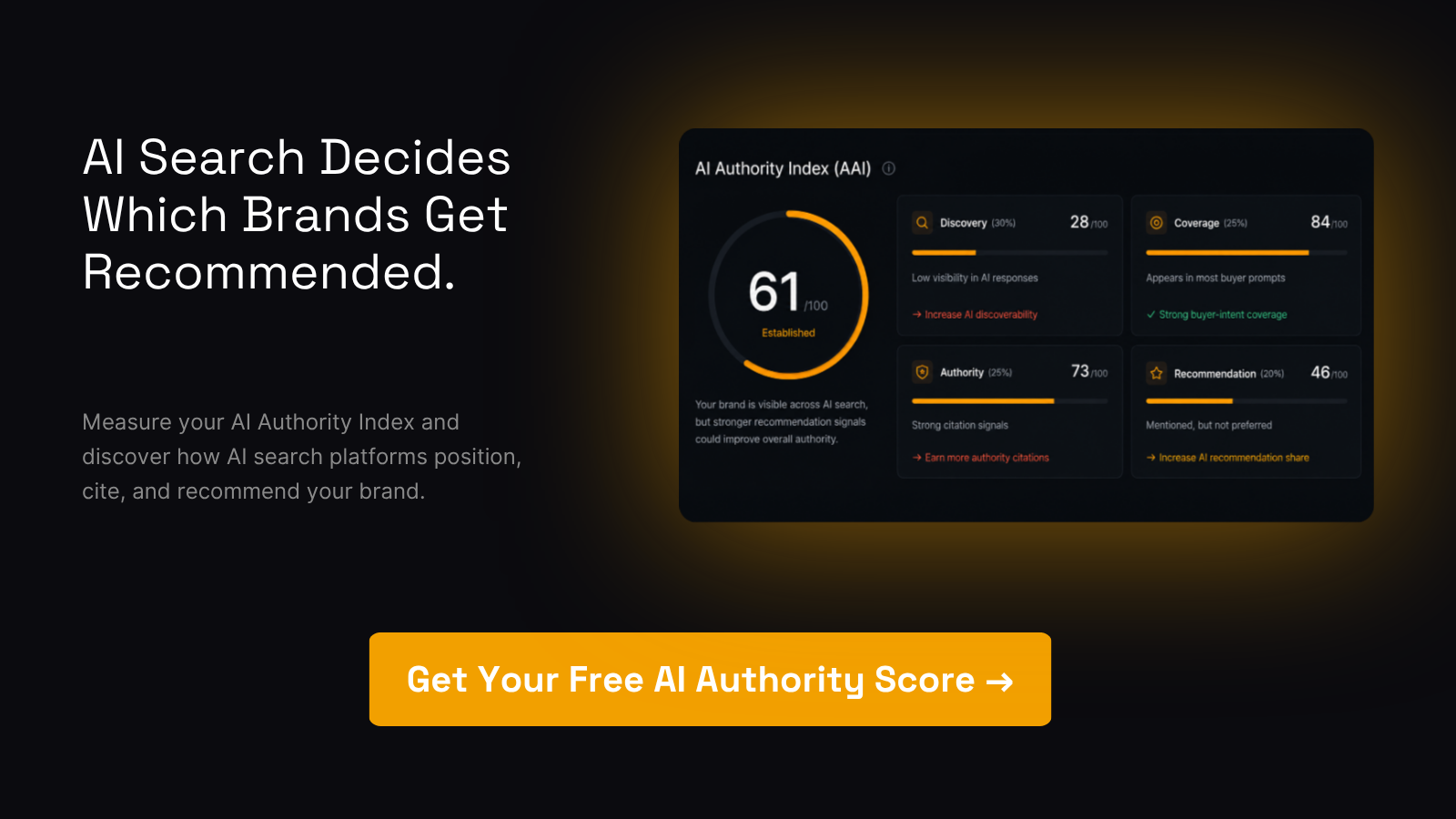
The platform benchmarks how often AI assistants like ChatGPT, Gemini, Claude, and Perplexity mention your practice compared to others in your market, then turns that into a prioritized list of fixes instead of a wall of raw data.
- The Free AI Visibility Scan shows where your clinic currently stands before you commit to anything.
- A starter plan fits a smaller practice that wants ongoing monitoring and basic prioritized recommendations.
- Growth and enterprise plans suit larger groups or organizations that need deeper competitive benchmarking and reporting.
Start with the Free AI Visibility Scan to see where your clinic stands today, or go straight to the Starter plan if you already know you want ongoing tracking.
Where to verify the details yourself
For hands-on implementation, check Google's LocalBusiness structured data guidelines before publishing schema, and use the Rich Results Test to confirm it validates. Review the ADA's reputation management guidance and FDI's advertising policy before publishing clinical claims. For schema code, a partner implementation guide covers common developer mistakes.
Sources
- How to search in ChatGPT | OpenAI Help Center
- Protect your practice’s reputation | American Dental Association
- FDI: Advertising in Dentistry (policy guidance)
FAQ
Which AI is best for dentistry?
No single AI assistant is officially built for dentistry, but patients commonly use general-purpose tools like ChatGPT, Gemini, Claude, and Perplexity for local recommendations. The best approach is making your practice's facts consistent and verifiable everywhere, since that helps across every assistant rather than optimizing for just one.
What is the 50-40-30 rule in dentistry?
This is not a standard, universally defined rule in dental practice management or clinical guidance, and definitions vary depending on the source. If you have seen it referenced for scheduling, revenue mix, or case acceptance, check the original source directly, since no major dental body publishes it as an official standard.
What is the 2 2 2 rule in dentistry?
Like some informal rules mentioned in practice management or patient education, the "2 2 2 rule" is not a term defined by the ADA, FDI, or other major dental authorities. There is no single agreed definition worth treating as a standard.
What is the 80/20 rule in dentistry?
The Pareto principle is sometimes applied informally to suggest that a large share of a practice's revenue or patient issues come from a smaller share of causes or patients. It is not a clinical or regulatory standard, so treat it as a general business heuristic rather than a dental-specific rule.
How long does it take to get recommended by ChatGPT?
There is no fixed timeline, since it depends on how many fixes your site needs and how often AI assistants recrawl your pages. Most practices should expect technical and schema fixes to take effect within weeks, while stronger content and review signals tend to show up in test prompts over one to three months.