How to Get Your SaaS Product Recommended by ChatGPT, Gemini, and Claude
Measurement-first playbook for B2B SaaS: a 30/90/180-day roadmap, repeatable prompt-audits, and a technical checklist to earn recommendations from...
· 12 min read

The fastest way to earn AI recommendations is to make your product citable by the sources these assistants already trust, then publish extractable, answer-first pages that state your positioning in plain sentences. Layer on structured product feeds where they exist, confirm bots can actually read your site, and keep pricing and comparisons current. Get those four right and you show up more often than competitors chasing schema alone.
TL;DR:
- Prioritize making your site crawlable, publishing a clear pricing page, and adding answer-first, comparison-focused pages with named stats to increase AI recommendations.
- Focus on securing independent third-party proof like reviews and editorial mentions, which weigh heavily across all AI sourcing methods.
- Build entity clarity through consistent schema, links, and external profiles, and ensure your key facts are extractable from static HTML for better AI trust.
- Implement structured product feeds and keep data like pricing and availability updated regularly to support AI indexing, especially for ChatGPT.
- Use ongoing prompt audits and tracking tools to measure progress and adjust your optimization efforts over 3 to 6 months for maximum visibility.
Table of Contents
- How ChatGPT, Gemini, and Claude actually source their answers
- What makes a product citable and worth recommending
- The 30, 90, and 180-day roadmap for AI visibility
- The technical checklist your engineering team needs to run
- How to measure whether any of this is working
- What actually moves the needle, and what doesn't
- Where AuthorityLayer fits once you start measuring
- Where to go for the primary documentation
- Sources
- FAQ
How ChatGPT, Gemini, and Claude actually source their answers
Each assistant pulls information differently, and that difference should shape where you spend effort first.
ChatGPT blends what the model learned during training with live retrieval through Bing's index, plus a dedicated shopping research mode that asks clarifying questions before surfacing options. For commerce queries, OpenAI has built the Agentic Commerce Protocol (ACP), which lets merchants submit structured product feeds so the assistant can index current attributes like pricing and availability directly, rather than scraping them from a webpage. OpenAI describes this shopping flow as a multistep experience that searches the web and produces tailored buyer guides, pulling from merchant-supplied data or third-party provider metadata when it is available.
Gemini leans heavily on Google's own index and Knowledge Graph, which means entity clarity matters more here than almost anywhere else. If Google's systems cannot confidently identify your company as a distinct entity, tie it to your product category, and connect it to reviews and citations elsewhere on the web, Gemini has a harder time recommending you with confidence. Google's own guidance for generative AI features recommends applying foundational SEO practices and producing genuinely useful, people-first content rather than chasing generative-specific tricks.
Claude takes a different path. Its web search tool gives the model live access to pages and returns cited sources, and newer versions support dynamic filtering that lets Claude narrow results to the most relevant pages before they ever enter its context window. That filtering step means dense, well-sourced documents with clear comparisons and named figures are more likely to survive the cut and get synthesized into an answer.
The practical implications:
- For ChatGPT commerce queries, structured feeds and shopping eligibility matter as much as page content.
- For Gemini, entity signals and classic SEO fundamentals carry more weight than clever prompting-adjacent tactics.
- For Claude, long-form, citation-dense pages with explicit comparisons tend to outperform thin marketing copy.
Treat these as three separate discovery channels, not one unified "AI SEO" target. A page built only for one engine will underperform on the others.
What makes a product citable and worth recommending
AI assistants recommend what they can verify, and verification depends on signals that already exist across your public footprint.
Third-party proof does more work than anything you publish yourself. Practitioner benchmarks looking at SaaS citation patterns found that review platform presence and editorial coverage are the dominant drivers of whether a product gets cited or recommended by generative engines, ahead of on-page optimization alone. Reviews on G2 or Capterra, mentions in editorial roundups, and threads in communities like Reddit give assistants independent confirmation that your product does what you say it does.
Entity clarity is the second lever. Assistants need to resolve "your company" as a single, unambiguous entity before they can confidently recommend it. That means Organization and SoftwareApplication schema on your site, a consistent sameAs network linking your official profiles, and, where eligible, a Wikidata or Wikipedia entry that ties your brand to a category.
Extractability is the third. Pages written with a clear 40 to 75 word lede under the H1, explicit "X vs Y" framing, and named statistics or direct quotes are easier for a model to lift cleanly into an answer than prose that buries the point three paragraphs down.
A multi-engine prompt audit (asking the same buyer questions across ChatGPT, Gemini, Claude, and Perplexity) is the clearest way to see which of your pages get cited and which third-party sources are doing the citing. Running one gives you a baseline before you change anything.
Ranked by leverage, the signals to prioritize are:
- Third-party reviews and editorial mentions that assistants can cite as independent proof.
- Entity clarity through schema, sameAs links, and a Wikidata or Wikipedia entry.
- Extractable, answer-first page structure with named comparisons and stats.
- Freshness, with pricing and benchmark data updated on a set cadence, ideally every 90 days.
- Technical accessibility, meaning bots can read your key facts without executing JavaScript.
None of these work in isolation. A perfectly structured comparison page with no third-party corroboration is easy for a model to find and hard for it to trust.
The 30, 90, and 180-day roadmap for AI visibility
Turning those signals into results means sequencing the work, not trying to do everything in the first sprint.
Immediate, within days:
- Confirm bots can actually crawl your site by checking server logs for GPTBot, ClaudeBot, and Google-Extended activity.
- Publish a public pricing page if you do not have one, since assistants routinely decline to recommend products whose pricing is hidden behind a form.
- Add a one-sentence product fit statement and a short pricing summary in visible HTML on your homepage, not buried in a PDF or gated behind JavaScript.
Thirty to ninety days:
- Publish answer-first "alternatives to [category]" and persona-specific use-case pages that name your product's fit for a specific buyer, not a generic audience.
- Complete and actively solicit reviews on G2 and Capterra, since incomplete profiles are functionally invisible to assistants scanning for social proof.
- Pursue curated roundups and earned media placements in publications your buyers already read, which do more for citation share than another blog post on your own domain.
Three to six months:
- If your product is eligible for commerce feeds, implement OpenAI's Agentic Commerce Protocol so ChatGPT can index your catalog directly rather than inferring it from HTML.
- Pursue a Wikidata entry to anchor your entity in the graphs Gemini and other engines draw on.
- Scale community engagement on forums and review sites where your category gets discussed, since these become the third-party mentions assistants cite later.
Pro Tip: Run a 15 to 30 prompt audit before you start and again at 90 days. Comparing the two tells you which fixes actually moved the needle instead of guessing.
Assign an owner to each phase rather than treating this as a side project for whoever has spare time. Crawlability and pricing pages are usually an engineering or web ops fix measured in days. Review generation and earned media are marketing-owned and take weeks to show results. Feed integration and Wikidata work often need a mix of product, legal, and content input, which is why they land in the six-month window. Set a monthly refresh cadence for your highest-traffic comparison and pricing pages once the initial push is done, since stale numbers are one of the fastest ways to lose a citation you already earned. Our companion guide on running a prompt audit walks through building that first prompt set in more detail.
The technical checklist your engineering team needs to run
None of the content or reputation work matters if assistants cannot actually read your pages, so this is the layer to verify first and re-check after every major site change.
- Disable JavaScript in your browser and reload your key pages: your H1, lede, pricing, and schema should still be visible in the raw HTML, since many assistants do not execute client-side rendering before extracting facts.
- Check your robots.txt file for explicit allowances for GPTBot, ClaudeBot, PerplexityBot, Google-Extended, and Bingbot, since a blanket disallow rule can silently remove you from every engine at once.
- Implement Organization and SoftwareApplication schema, along with AggregateRating or Review schema where you have earned ratings, and make sure it is rendered server-side in the initial HTML rather than injected after page load.
- If you sell a product eligible for commerce feeds, follow OpenAI's onboarding checklist for file upload versus API integration, confirm which fields are required, and set a cadence for keeping the feed current, since stale feed data is treated as a reliability problem by the assistant.
- Monitor server logs monthly for bot visits and cross-reference against your published pages to confirm the crawlers are actually reaching the content you care about.
A page that reads perfectly in a browser but hides its facts behind a JavaScript render is invisible to most of this ecosystem. Fix the plumbing before investing further in content.
How to measure whether any of this is working
You need a method you can repeat every month, or you are just guessing at correlation.
Build a set of 20 buyer-focused prompts spanning three categories: direct comparisons ("X vs Y for [use case]"), alternatives queries ("best alternatives to X"), and use-case questions ("best tool for [specific job]"). Run each prompt three to five times per engine, since assistants do not return identical answers on repeat queries, and log whether your product appears, where it ranks in the response, which sources get cited, and how your product is framed relative to competitors.
| Metric | What it tells you | Typical signal window |
|---|---|---|
| Recommendation rate | Share of prompts where your product appears at all | 60 to 90 days |
| Citation share | Which sources the assistant credits when it mentions you | 60 to 90 days |
| AI-driven trial signups | Whether visibility converts to pipeline | 3 to 6 months |
| Branded search uplift | Whether AI mentions drive people to search your name directly | 3 to 6 months |
Pro Tip: Log the exact prompt wording and date for every audit run. Small phrasing changes shift results enough to make month-over-month comparisons meaningless without it.
Expect early signal within 60 to 90 days if you have fixed crawlability and pricing visibility. Meaningful movement in recommendation rate and citation share tends to take closer to six months, once reviews accumulate and roundup placements go live. AuthorityLayer's own methodology for tracking recommendation share follows this same structure: repeated prompt sampling, source attribution, and a scoring model that turns raw mentions into a comparable index over time.

What actually moves the needle, and what doesn't
Most teams start with schema markup because it feels controllable and finite. It is not where the leverage is. Schema helps an assistant confirm what you already are, but it cannot manufacture trust an assistant does not already have from third-party sources. I have watched teams spend a full quarter perfecting structured data while a competitor with three solid G2 review pages and one editorial mention in a trusted roundup pulled ahead in citation share.
The quick wins that consistently pay off: making pricing public, fixing JavaScript-only rendering on money pages, and asking existing customers for reviews on the platforms buyers actually check. The low-ROI effort, in my experience, is chasing every emerging "AI SEO" tactic without first confirming bots can read your site at all. Fix the foundation, then earn the proof. The order matters more than the tactics themselves.
— Geraldine
Where AuthorityLayer fits once you start measuring
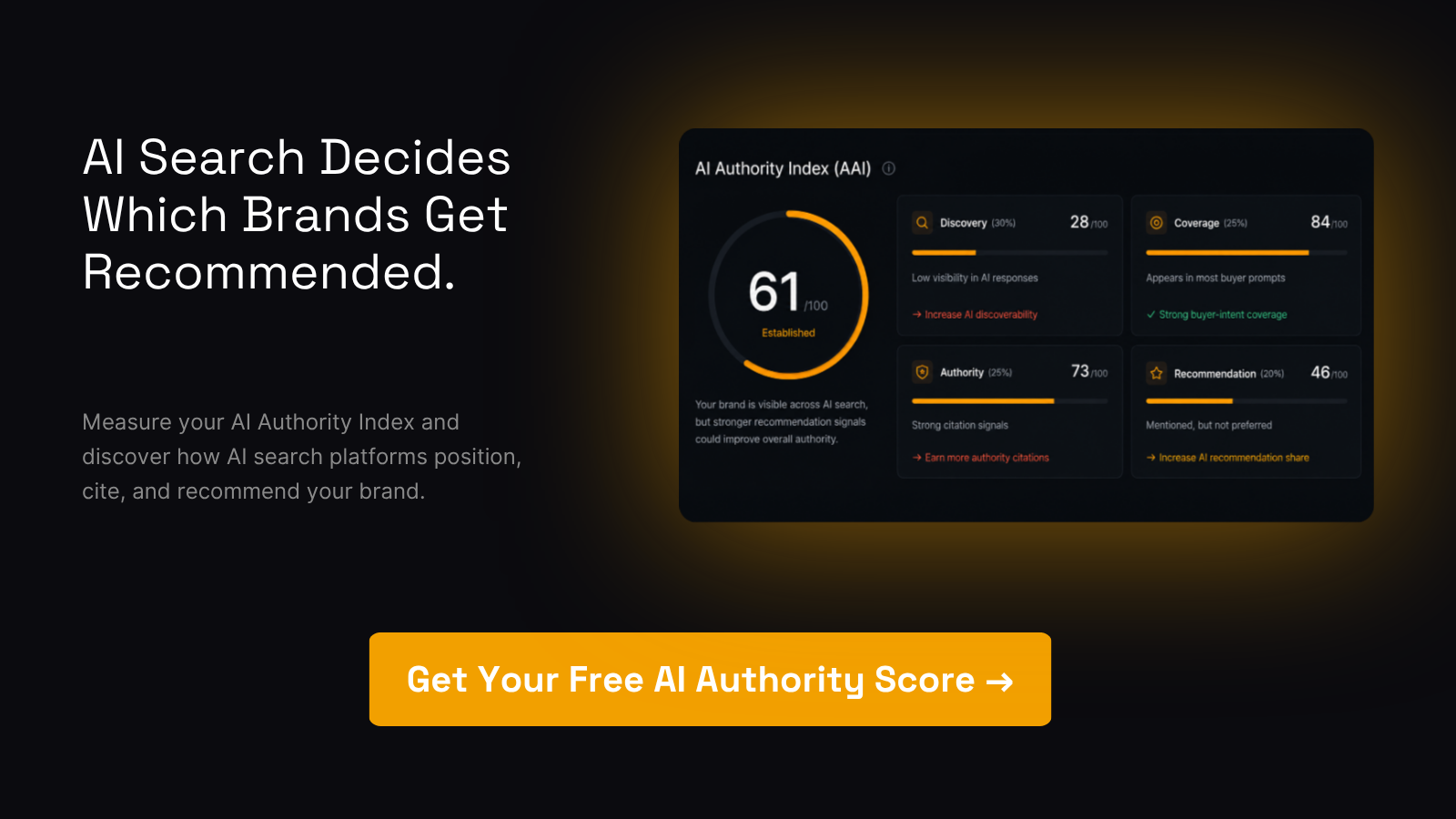
Running prompt audits by hand every month works until you are tracking a handful of competitors across four assistants and losing track of which source drove which citation. AuthorityLayer was built for that exact gap: it benchmarks how ChatGPT, Claude, Gemini, and Perplexity describe and recommend your brand against named competitors, and turns raw mentions into a prioritized list of what to fix first.
What you get with a program in place:
- Ongoing tracking of recommendation rate and citation share across engines, without rebuilding a prompt set from scratch each month.
- An AI Authority Index score that benchmarks your visibility against competitors in your category.
- Prioritized, evidence-backed recommendations instead of a generic checklist.
If you want a baseline before committing to anything, start with the Free AI Visibility Scan. Teams ready to run a monthly program can start on the Starter plan at $99 per month through AuthorityLayer.
Where to go for the primary documentation
For implementation, work from the source docs rather than secondhand summaries. OpenAI's product feed and ACP guide covers feed onboarding for ChatGPT's shopping features. Claude's web search tool documentation explains how dynamic filtering affects what gets cited. Google's generative AI guidance lays out the SEO fundamentals Gemini still depends on. For a practitioner's view on how search engines decide what to surface, PHENYX's breakdown is a useful companion read alongside the official docs.
Sources
- Developers
- Get started with product feeds — OpenAI Commerce docs
- Claude web search tool documentation — Anthropic / Claude Platform
- Shopping with ChatGPT — OpenAI Help Center
- GEO for SaaS & B2B: Getting Cited by ChatGPT, Perplexity & Gemini — GeoAura
FAQ
Which AI assistant is best for getting product recommendations?
There is no single best engine because each sources answers differently: ChatGPT favors structured product feeds and shopping eligibility, Gemini depends on entity clarity in Google's Knowledge Graph, and Claude rewards long, citation-dense pages. A team aiming for broad visibility needs to address all three rather than optimizing for one.
How do I get my first 100 SaaS customers?
Early customers typically come from direct outreach, founder-led sales, and communities where your buyer already spends time, combined with a clear, public pricing page that removes friction from evaluation. Building third-party proof early, even a handful of genuine reviews, also helps both human buyers and AI assistants trust the product sooner.
How do I make an AI assistant recommend my product?
Make sure bots can crawl and read your key facts without JavaScript, publish answer-first comparison and use-case pages, and build genuine third-party proof through reviews and editorial coverage, since assistants recommend what they can verify externally. Where available, structured product feeds like OpenAI's Agentic Commerce Protocol give ChatGPT direct access to your product data instead of relying on scraped pages.
How do I effectively market a SaaS product for AI visibility?
Combine classic SEO fundamentals, which Google explicitly recommends for generative features, with a deliberate push for third-party coverage on review platforms and in industry publications. Tracking recommendation rate and citation share with a repeatable prompt audit, the kind AuthorityLayer runs through its AI Authority Index, tells you which of those efforts are actually working.