Decide ChatGPT Ads or Organic AI in 30 Days: CMO Budget Framework
CMOs: Use a 30/60/90 visibility plan and measurement playbook to choose when to buy ChatGPT ads or invest in organic AI.
· 8 min read

Most marketing teams should run both channels at once rather than picking one: ChatGPT ads for fast, intent-driven capture and organic AI visibility for durable recommendation share. OpenAI confirms ads sit on a separate stack from generative answers, while Google gives site owners direct controls over whether their content feeds AI features. The rule of thumb: use ads when you need visibility this quarter, and use organic work when you need to be the answer a year from now.
Key Takeaways
Organic AI visibility builds long-term authority, while ChatGPT ads deliver quick, targeted exposure; both are essential for a balanced marketing strategy.
| Point | Details |
|---|---|
| Use paid ads for immediate visibility | Paid ChatGPT ads provide quick exposure, full control over targeting, and are best for product launches and demand capture. |
| Develop high-quality, crawlable content | Organic AI inclusion depends on content that is unique, helpful, and easily crawlable, which fosters sustained recommendation share. |
| Measure KPIs separately but review together | Track ad impressions, click-throughs, and conversions separately from organic citation frequency and recommendation share for comprehensive insights. |
| Allocate budget based on intent and timing | Assess whether to run short-term ad pilots or invest in long-term organic growth depending on current brand presence and competitive landscape. |
| AuthorityLayer offers ongoing AI visibility tracking | We provide benchmarking, prioritized action lists, and recurring reports to help optimize your AI presence and guide budgeting decisions. |
Table of Contents
- ChatGPT ads vs organic AI visibility at a glance
- How ChatGPT advertising actually works
- How organic AI visibility actually works
- Measuring what each channel actually delivers
- A decision framework for allocating budget
- Turning this into a 30/60/90 day visibility plan
- Get a clear read on your AI visibility before you spend on ads
- FAQ
ChatGPT ads vs organic AI visibility at a glance
Paid and organic AI channels solve different problems, and treating them as substitutes is the most common budgeting mistake we see. Paid ChatGPT placements buy immediate exposure in a conversation; organic visibility earns a spot in the model's synthesized answer, which carries more implicit trust because it looks like a recommendation rather than a sponsorship.
The two channels also diverge sharply in how people respond to them. Google users who hit an AI-generated summary clicked a traditional search result in just 8% of visits, compared with 15% when no summary appeared, and links placed inside the AI summary itself were clicked in only 1% of visits, according to Pew Research Center. That changes what "success" looks like for organic AI placement: fewer clicks, more brand impression.
- Paid ChatGPT ads: bought placement, immediate delivery, full creative and targeting control, measured by clicks and conversions.
- Organic AI visibility: earned inclusion, built over weeks or months, controlled through content quality and structure rather than bids, measured by citation frequency and recommendation share.
- Best outcomes for ads: product launches, time-boxed promotions, demand capture from users already comparing options.
- Best outcomes for organic: category authority, being cited as the default recommendation, protecting market position against competitor mentions.
How ChatGPT advertising actually works
OpenAI is testing ads inside ChatGPT, and its own documentation is unusually direct on one point: ads do not influence ChatGPT's answers. Ad serving runs on a separate ad stack from the model that generates responses, and OpenAI's help center reiterates that advertisers cannot purchase inclusion in an organic citation or alter what the model says. Ads are chosen based on conversation context and advertiser-provided signals, then clearly labeled as sponsored and visually separated from the response.
Pricing cannot buy what organic earns: the only confirmed route to organic citation is content quality and crawlability, not ad spend, per OpenAI's testing announcement.
- Ads are currently tested on Free and Go tiers; Plus, Pro, and Business tiers remain ad-free.
- Advertisers receive aggregated performance reporting only and never see user chat content.
- Ad placement and labeling rules keep sponsored content distinct from the generative response.
The operational takeaway for creative teams: landing pages and ad copy need to work on their own merit, since there is no mechanism to nudge the model's organic output alongside a buy.
How organic AI visibility actually works
Organic inclusion in an AI answer depends on retrieval, not ranking in the old sense. Assistants pull from indexed content, fan out related queries, and synthesize a response from the sources that best match the question, which is why crawlability and content clarity matter as much as they ever did in search. Google's own guidance confirms its generative AI features are rooted in core ranking systems and gives site owners Search Console controls to decide whether their pages feed those features at all. Google's developer documentation adds that this retrieval depends on content being unique, helpful, and crawlable, meaning most foundational SEO practices still apply.
- High-quality, specific content that directly answers a question tends to get pulled into synthesis more often than generic marketing copy.
- Transcripts, structured data, and clear factual statements give models cleaner material to cite.
- Unlinked brand mentions across the web still feed model training and retrieval, even without a backlink.
- A prompt audit across common buyer questions reveals where your content gets pulled in and where a competitor fills the gap.
The behavioral shift matters here too. Because AI summaries draw fewer clicks, 26% of pages with an AI summary ended the user's session without any further click, versus 16% for pages without one, according to Pew Research. Funnels built around click-through alone will undercount organic AI's actual contribution to brand consideration.
Measuring what each channel actually delivers
Ad performance and organic AI visibility need separate scorecards, then a shared view of business impact.
- Ad KPIs: impressions, view-through rate, ad-driven conversions, and privacy-aware attribution that respects the aggregated reporting OpenAI provides to advertisers.
- Organic KPIs: recommendation share, citation frequency across prompts, prompt-level impressions, and downstream or assisted conversions rather than raw click-through.
- Audit cadence: run synthetic queries on a recurring schedule to see how often and how favorably your brand appears, since organic AI visibility shifts as models retrain and retrieval sources change.
- Credit assignment: map each KPI back to a business goal (pipeline, awareness, retention) before comparing paid and organic performance side by side.
Pro Tip: Run the same ten buyer questions through ChatGPT monthly and log whether your brand appears, in what position, and next to which competitors, using an approach similar to this measurement playbook.
A decision framework for allocating budget
Before spending on ads, audit your organic narrative with expert help in Local Services Ads & Google Guaranteed setup. Placing paid creative next to an AI answer that already recommends a competitor creates friction rather than lift.
- Check your intent profile: if buyers are actively comparing options now, ads capture that demand faster than organic ever will.
- Check time-to-value: a product launch or seasonal promotion favors a short ad pilot over a multi-month content effort.
- Check current recommendation share: if you rarely appear in organic AI answers for your category, that gap outweighs any ad spend until it's addressed.
- Check competitive ad presence: if competitors already dominate sponsored placements, matching them may be necessary just to stay visible.
Three practical modes follow from those checks. Hatch and buy fits new entrants with no organic footprint: run a 30-day ad pilot with careful auditing before scaling spend. Scale and hybrid fits brands with partial organic presence: layer ads on top of an active AI visibility content sprint. Defend and invest fits category leaders losing ground to challengers' ads: prioritize organic reinforcement and reserve ad spend for defensive, narrow campaigns.
Turning this into a 30/60/90 day visibility plan
A baseline audit comes first. Running a free AI visibility scan establishes where your brand currently stands on recommendation share and which prompts trigger a mention at all, which gives you a number to improve against rather than a guess.
- Days 1 to 30: establish baseline recommendation share and identify the prompt categories where competitors get cited instead of you.
- Days 31 to 60: fix the highest-impact gaps first, typically weak content grounding, missing transcripts, or thin Q&A pages that fail to answer buyer questions directly.
- Days 61 to 90: benchmark against named competitors to see which content or product changes actually moved recommendation share, using a process like this competitive intelligence analysis.
- Ongoing: run synthetic query checks on a fixed schedule and track movement through a recurring report rather than one-off spot checks.
Get a clear read on your AI visibility before you spend on ads
We built AuthorityLayer to answer the exact question this article raises: where does your brand actually stand in ChatGPT, Gemini, Claude, and Perplexity answers, and what should you fix first. Our platform benchmarks your recommendation share against named competitors and turns the gap into a prioritized action list instead of a vague audit.
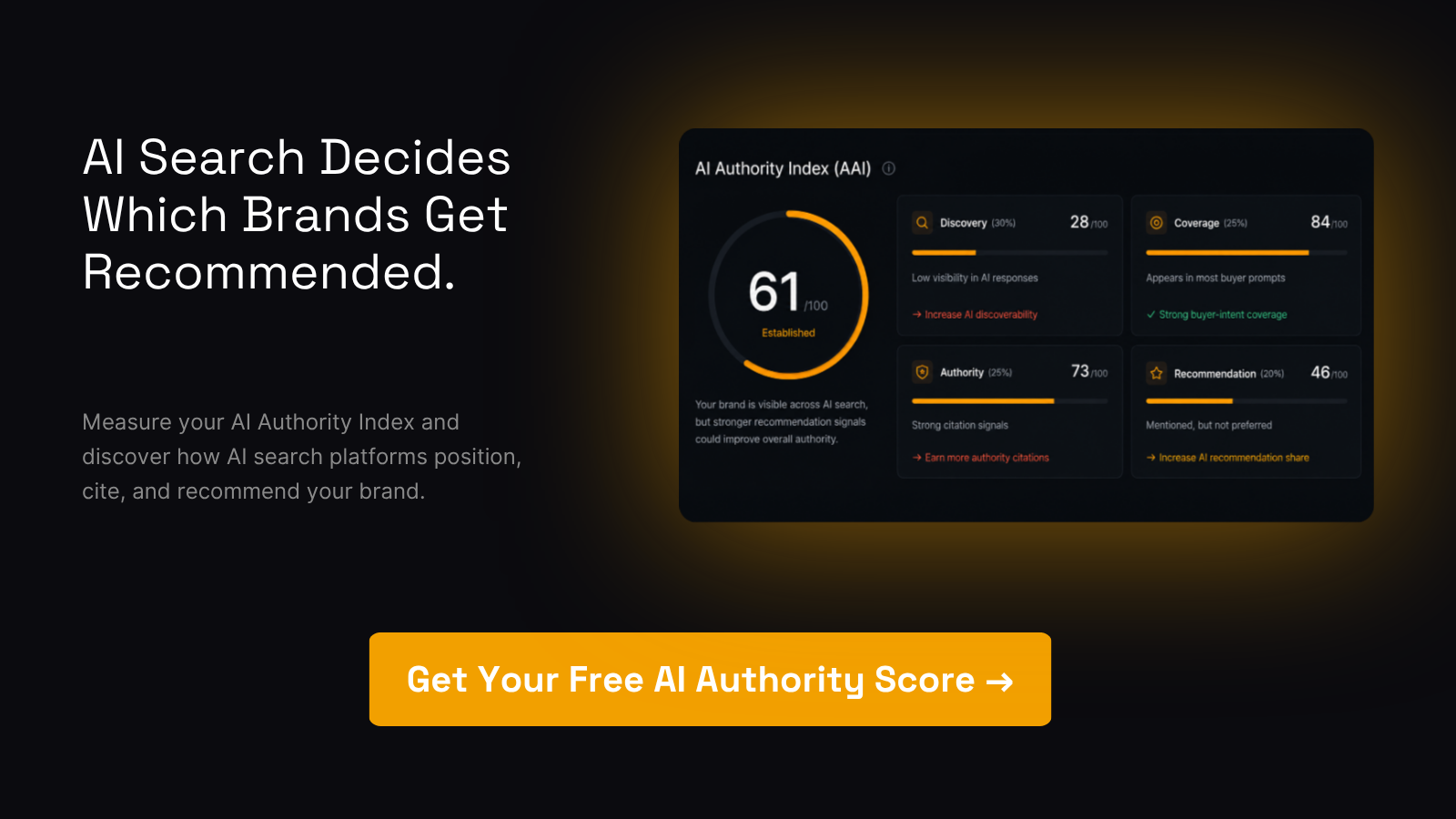
Start with our Free AI Visibility Scan to see your current baseline, then move to Starter at $99 per month or Growth at $349 per month for ongoing benchmarking and monthly reporting. After signup, expect a baseline audit, a prioritized fix list, and recurring visibility tracking you can bring straight to your next budget conversation.
FAQ
What does ChatGPT advertising look like?
ChatGPT ads appear as clearly labeled, sponsored placements that run on a separate ad stack from the model generating answers, according to OpenAI. They currently show up on Free and Go tiers, while Plus, Pro, and Business remain ad-free, and advertisers only receive aggregated performance data rather than access to chat content.
Is SEO dead now with AI?
No. Google's own guidance confirms its generative AI features are built on core ranking systems, meaning crawlable, unique, high-quality content still drives whether you get cited. What changed is the behavior around it: AI summaries draw far fewer clicks, so measuring citation frequency and recommendation share matters as much as tracking traffic.
Is SEO considered paid or organic?
SEO is organic by definition: it earns visibility through content quality and site structure rather than paying for placement. ChatGPT and Google AI features both draw on the same organic signals SEO has always optimized for, which is why strong SEO fundamentals carry over directly into AI visibility work.
Is SEO still worth it in 2026?
Yes, though the payoff looks different than click volume alone. Pages with an AI summary saw traditional link clicks drop to 8% of visits versus 15% without one, and 26% of those sessions ended without any further click, per Pew Research. That makes SEO's role shift toward earning citations and recommendation share rather than raw traffic, which still carries real business value.