CMOs: Get Specialists Cited in ChatGPT and Measure Recommendation Share
Measurement first playbook for CMOs to get specialists cited in ChatGPT. Run five checks, add truthful schema, and track recommendation rate.
· 13 min read

Getting recommended by ChatGPT when a patient searches for a specialist comes down to four things: letting OpenAI's crawler access your pages, publishing dedicated clinician and service pages with visible, checkable facts, adding truthful structured data for each physician and location, and measuring results through prompt testing and referral tracking with utm_source=chatgpt.com. Skip any one of these and a practice becomes invisible to the model no matter how strong its reputation is offline.
TL;DR:
- Ensure your website's pages for clinicians and locations are accessible to OpenAI's crawler, with no blocking in robots.txt and proper server response codes.
- Create dedicated, verifiable pages for each clinician and location, including structured data with accurate, visible information like credentials, specialties, and contact details.
- Regularly monitor AI visibility metrics such as prompt share, citation quality, and referral sessions, using repeated tests and automated prompt audits to identify trends.
- Keep your website's data current by syncing updates from practice management systems to avoid outdated citations, especially for availability and insurance acceptance.
- Focus on factual, specific schema markup and structured data that answer narrow queries, avoiding broad claims, to improve AI citation effectiveness while maintaining compliance.
Table of Contents
- A checklist typically spanning a few weeks to a few months to earn AI eligibility
- Setting up measurement and monitoring that CMOs can trust
- Technical prerequisites your developers need to check
- Building content and structured data that AI can cite
- Keeping databases current with what ChatGPT retrieves
- Strategies for optimizing clinician profiles for AI search
- How ChatGPT's recommendation process actually works
- Staying compliant while pursuing AI visibility
- Making AI recommendation share a metric the board reviews
- See your current AI visibility with a Free AI Visibility Scan
- Sources
- FAQ
A checklist typically spanning a few weeks to a few months to earn AI eligibility
Most healthcare marketing teams treat this as a content project when it is really a joint effort between marketing, IT, and compliance. The order below reflects dependency: crawler access has to happen before content work matters, and content has to exist before measurement means anything.
- Confirm OAI-SearchBot is not blocked in robots.txt, then check server and CDN logs for its requests and response codes.
- Publish one page per specialist and one page per location, each carrying visible credentials, services offered, and direct contact or booking methods.
- Add JSON-LD using the most specific schema types available (MedicalOrganization, IndividualPhysician, and a LocalBusiness subtype) rather than generic markup.
- Verify every priority page is indexable, has a correct self-referencing canonical tag, and is listed in an updated sitemap.
- Implement UTM tagging in analytics so any session carrying utm_source=chatgpt.com is captured as its own channel.
Pro Tip: Run the sitemap and robots.txt checks before the content team starts writing. Fixing a crawl block after twenty new clinician pages go live means redoing the QA pass twice.
Setting up measurement and monitoring that CMOs can trust
A single test run tells you almost nothing. OpenAI itself frames ChatGPT Search as probabilistic retrieval rather than a controllable listing, which means the right unit of measurement is repeated share across many runs, not a pass or fail on one prompt.
Start with KPIs that map to business outcomes rather than vanity metrics:
- Prompt visibility: the share of tested prompts where the practice or a named clinician appears at all.
- Recommendation share: how often the practice appears relative to every other specialist mentioned across repeated runs.
- Citation quality: whether the model links a specific clinician or service page, or only a generic homepage.
- ChatGPT referral sessions: sessions arriving with utm_source=chatgpt.com, cross-referenced against downstream appointment requests.
Build a prompt set of several queries that mirror how patients actually search: by specialty, by symptom, by insurance accepted, by language, and by location. Publishers and Developers guidance confirms that ChatGPT referral links carry the utm_source=chatgpt.com parameter, which lets you isolate those sessions in your analytics platform, though it will not capture every AI-influenced visit that arrives without a clean referral tag.
A recurring prompt audit, not a one-time check, is what turns AI visibility into a trend line instead of a guess, and a prompt audit framework built around several queries is a practical starting size for most specialty groups. Automate the runs on a fixed cadence and report trend movement rather than any single result.
Technical prerequisites your developers need to check
Before any content or schema work pays off, the host and CDN configuration has to actually let OpenAI's crawler through. This is infrastructure work, not marketing copy, and it usually surfaces gaps nobody flagged during the last redesign.
- Confirm OAI-SearchBot requests return a 200 response and are not silently dropped by a WAF rule or bot-management setting; per OpenAI's own guidance, a blocked crawler means ChatGPT may only surface a bare link or title from third-party sources instead of your own page content.
- Audit for accidental noindex tags, mismatched canonical URLs, and confirm every priority page appears in the sitemap that gets submitted to search consoles.
- Check that credentials, specialty, and contact details render in the initial server response rather than being injected only by client-side JavaScript, since a crawler that does not execute scripts will miss them.
- Preserve the chatgpt.com referral parameter through any redirect chains, and make sure no tracking setup exposes patient-identifying query strings in logs or dashboards.
Pro Tip: Ask your dev team to pull raw CDN logs filtered by user agent rather than relying on a bot-detection dashboard summary. Aggregated reports sometimes hide the specific pages a crawler was blocked from reaching.
Building content and structured data that AI can cite
The pages that get cited are the ones built as standalone evidence units: one page per clinician, one per location, one per service line, each answerable on its own without requiring a visitor to dig through a larger site.
- Create a canonical profile page for every clinician, a page per physical location, and a page per major service, since each becomes a separate retrievable unit.
- Use MedicalOrganization and IndividualPhysician types together with a specific LocalBusiness subtype, matching what Google's structured data guidance recommends for entity disambiguation.
- Include the properties that actually carry meaning: name, address, telephone, medicalSpecialty, and practicesAt linking the physician to the organization.
- Keep every JSON-LD claim mirrored in the visible page text. Google's structured-data policies warn that markup describing something not shown on the page can disqualify a page from rich results entirely, and the same truthfulness standard protects a page's credibility with AI retrieval.
A useful clinician page template covers the following fields consistently across every profile:
| Field | Purpose |
|---|---|
| Board certifications | Verifiable credential a patient or model can check |
| Hospital affiliations | Connects the clinician to a known institution |
| Languages spoken | Matches patient-language search variants |
| Accepted insurance plans | Answers a common qualifying question directly |
| Booking method | Gives the model a concrete next step to cite |
Schema.org's own MedicalOrganization reference documents the medicalSpecialty and practicesAt properties that connect a physician entity to the organization that employs them, which is the link many practice sites leave out entirely.
Keeping databases current with what ChatGPT retrieves
A clinician page that was accurate at launch and stale six months later is worse than no page at all, because it risks the model citing outdated information with your organization's name attached. ChatGPT does not pull from one static index, but retrieves from the live web at query time in many configurations, which means your practice management system, your credentialing database, and your public-facing pages need to stay in sync rather than drifting apart after the initial publish.
The practical fix is treating your website as a live extension of internal records rather than a separate marketing asset. When a clinician's availability changes, when a new insurance plan is accepted, or when a board certification renews, that change should flow to the public page within days, not at the next quarterly content refresh. OpenAI's own publisher guidance notes that search responses can include inline citations, which only works in your favor if the cited page reflects current reality at the moment it gets retrieved.
Practices running electronic health record or practice management systems with public API access have an advantage here: a scheduled sync job can push availability and insurance-acceptance fields to the website automatically, removing the lag that manual updates introduce. Smaller practices without that infrastructure can achieve a similar result with a shared update log and a hard deadline for pushing changes live, which matters more than the size of the technical stack behind it.

Strategies for optimizing clinician profiles for AI search
A clinician profile built for a human scanning a homepage and one built to be retrieved by an AI assistant answering a specific query are not the same document, even when they share a URL.
The profile that gets cited answers a narrow question completely: which specialty, which conditions treated, which insurance accepted, which languages spoken, and how to book, all stated plainly near the top rather than buried in a paragraph of biography. Avoid folding several clinicians into one shared bio page, since that forces the model to guess which credentials belong to which name.

Consistency across every channel matters as much as the page itself. A clinician's name, specialty, and affiliation should read identically on the practice website, on directory listings, and in any structured data, since conflicting versions of the same fact make an entity harder for a model to resolve confidently. OpenAI's search documentation notes that device or IP-based location can factor into local results, so a location page with a complete, accurate address matters even when the model is not given a specific city in the prompt.
Finally, keep the page's language close to how patients actually phrase their search: symptom-based terms alongside the formal specialty name, since a patient typing "keeps getting migraines" and one typing "neurologist" should both be able to land on the same accurate profile.
How ChatGPT's recommendation process actually works
ChatGPT does not maintain a ranked directory of specialists the way a review site does. OpenAI describes its search function as using multiple factors to surface relevant, reliable information, and explicitly states that businesses cannot secure guaranteed placement in ChatGPT Search results.
In practice, this means the model retrieves candidate sources at the moment of the query, weighs their relevance to the specific phrasing used, and favors pages that answer the question directly and verifiably over pages that talk broadly about a practice without giving specifics. A clinician page stating a medical specialty, accepted insurance, and location in structured, verifiable terms gives the retrieval process something concrete to match against a patient's symptom or location language. A vague "About Us" page gives it very little.
This is also why permanent placement is the wrong goal. Because retrieval happens per query and can vary across runs, the realistic target for a marketing team is a consistently high share of relevant test prompts returning a citation, not a fixed rank that never moves. That reframing is what separates a durable AI visibility program from a one-time optimization sprint that fades within a quarter.
Staying compliant while pursuing AI visibility
Every tactic above still has to clear the same regulatory bar that applies to any other medical advertising channel, and AI platforms do not create an exception.
Structured data describing credentials, specialties, or outcomes has to be factually accurate and match what a licensing board or hospital system would confirm, since an inflated claim in JSON-LD is still a false claim even if a patient never sees the raw markup. Google's structured-data policies explicitly caution against marking up claims the page cannot support, and the same principle protects a practice from regulatory exposure if a state medical board or advertising authority reviews the same page.
Patient privacy requirements apply to analytics tracking just as they apply to intake forms. Referral tagging with utm_source=chatgpt.com should never carry patient-identifying information in the query string, and any dashboard aggregating AI-driven traffic needs the same access controls as any other system touching protected health information. Medical advertising rules vary by jurisdiction, so claims about outcomes, rankings, or comparative superiority need review against the specific rules that apply where the practice operates, not against a generic industry template. When in doubt, the safer structured-data claim is the narrower one: a stated board certification and affiliation, verifiable and specific, does more for both compliance and AI citation than a broad claim about being the best in a region.
Making AI recommendation share a metric the board reviews
Referral volume and patient acquisition cost are both downstream of whether a specialist shows up when a patient asks an AI assistant a specific question, and most healthcare marketing teams still have no number attached to that visibility at all.
The metrics worth putting in front of a board are the same ones this playbook builds toward: AI recommendation share across a fixed prompt set, citation quality, the volume of qualified referral conversions tagged with utm_source=chatgpt.com, and a prioritized list of the specific pages or schema gaps holding visibility back. Treating this as a quarterly reporting line, the same way organic search share or paid conversion rate already gets reported, is what turns AI visibility from an experiment into an accountable channel.
— Geraldine
See your current AI visibility with a Free AI Visibility Scan
Everything in this playbook, crawler access, page-level schema, and prompt testing, is the groundwork. Knowing where your specific specialists and locations stand today against that groundwork is a separate question, and it's one AuthorityLayer answers directly.
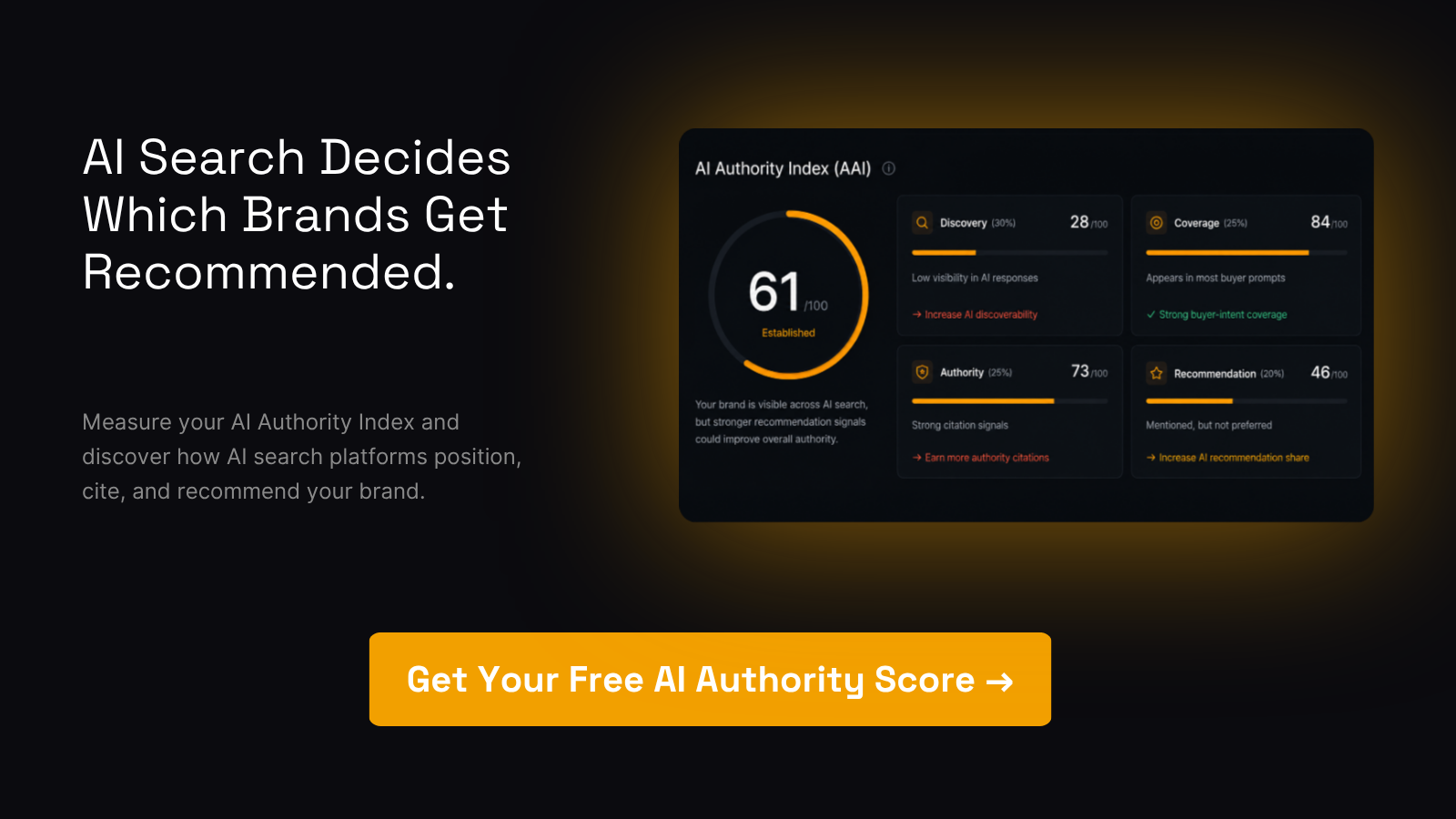
AuthorityLayer measures prompt-level visibility, calculates recommendation share, and prioritizes the specific fixes that move a practice from occasionally mentioned to consistently cited.
- A Free AI Visibility Scan shows where your clinician and location pages currently stand in AI-generated answers.
- The Monthly AI Visibility Report tracks recommendation share and citation quality over time instead of relying on a single snapshot.
- Both options are built to turn the checklist above into a number your team can report on next quarter.
Start with the Free AI Visibility Scan to see where your current pages stand before your next content sprint.
Sources
- ChatGPT Search | OpenAI Help Center
- Local Business (LocalBusiness) Structured Data | Google Search Central
FAQ
Can a practice pay to guarantee a spot in ChatGPT results?
No. OpenAI states that ChatGPT Search uses multiple factors to surface relevant information and that businesses cannot secure guaranteed placement. The realistic goal is a consistently high share of relevant test prompts returning a citation, not a fixed rank.
What happens if OAI-SearchBot is blocked on our site?
If OAI-SearchBot cannot crawl a page, ChatGPT may still surface a bare link or title sourced from third parties, but it cannot draw on your own page content for a detailed answer, according to OpenAI's publisher guidance. Checking robots.txt and CDN logs for crawler access is the first fix.
How do we track patients who find us through ChatGPT?
ChatGPT referral links carry the parameter utm_source=chatgpt.com, which OpenAI documents in its publisher guidance and which analytics platforms can isolate as its own channel. It will not capture every AI-influenced visit, so pairing it with downstream conversion tracking gives a fuller picture.
Does adding more schema markup automatically improve visibility?
No. Google's structured-data policies state that adding more properties does not by itself create eligibility, and markup must be truthful and match the visible page content. The most specific, accurate types placed on a dedicated page perform better than generic markup spread across many pages.
How often should clinician pages be updated?
There is no single published standard, but treating clinician pages as living records tied to credentialing and scheduling systems, rather than static content updated occasionally, keeps cited facts accurate. A practical cadence many teams use is a bi-monthly review for clinician pages and a quarterly review for location pages, with immediate updates whenever availability or credentials change.