Get Cited by ChatGPT in 30–90 Days: AI Visibility for Clinics
Appear in ChatGPT recommendations by fixing crawler access, adding schema, publishing answer first pages, building corroborating listings, and tracking...
· 13 min read

To appear in ChatGPT recommendations, start by confirming AI crawlers can actually reach your site, then publish answer-first, machine-readable facts about your clinic and providers. Add schema markup, tighten service pages so the first 40 to 60 words answer the question directly, build corroborating reviews and directory mentions, and run a recurring test-query routine to track whether ChatGPT actually cites you. Skip any one of these and the rest lose most of their effect.
TL;DR:
- Ensuring your site is reachable by OpenAI's crawler requires explicit permission for OAI-SearchBot in robots.txt and allowing requests from OpenAI IP ranges.
- Structuring key content with answer-first pages, proper schema markup, and clear provider and procedure information increases the likelihood of AI citation.
- Building independent, corroborating reviews and ensuring consistent mention across directories and sources enhances AI system trust and citation probability.
- Testing crawl access with user-agent-specific requests and validating schema markup with Google's tools can prevent technical barriers to AI recognition.
- Improving AI visibility involves technical site access, answer-optimized content, and ongoing monitoring of citation results over consecutive months.
Table of Contents
- How AI Assistants Decide Which Clinics to Recommend
- Crawlability and Site Access: OAI-SearchBot, Robots.txt, and Host Checks
- Schema and Structured Data Every Clinic Must Implement
- Writing Service and Provider Pages AI Assistants Will Quote
- Building Third-Party Corroboration AI Systems Can Verify
- How Do You Test and Measure AI Visibility?
- What Should Your 30-90 Day AI Visibility Checklist Look Like?
- What an AI Visibility Audit Actually Measures
- The Future of Clinic Discovery Is Less About Ranking, More About Being Quotable
- Turning This Checklist Into a Working Audit
- Sources
- FAQ
How AI Assistants Decide Which Clinics to Recommend
ChatGPT answers medical and clinic-related queries in two different modes, and the distinction matters more than most marketing teams realize. Some answers come from the model's training data, baked in during a training run and updated only when OpenAI retrains the model. Others come from live web browsing, where ChatGPT Search retrieves current pages in real time, similar to a search engine crawling the web. A clinic that wants to show up in this second mode needs its site to be reachable, current, and structured for extraction, not just well written.
ChatGPT Search documentation confirms there's no guaranteed placement. Ranking depends on multiple factors working together, and eligibility starts with basic access. Once a site clears that bar, the factors that seem to matter most are direct answerability (does the page state the fact plainly?), structured data (can the fact be parsed without guesswork?), third-party corroboration (does the claim show up elsewhere too?), and recency. A practitioner synthesis of testing across industry writeups points to the same four factors and notes something clinics often get backwards: traditional signals like backlink volume and keyword density carry far less weight here than they do in classic search rankings. A page can rank on Google for years without ever getting quoted by an AI assistant, because Google rewards authority signals accumulated over time, while ChatGPT rewards a fact it can lift cleanly and verify elsewhere.
That's the mental shift marketing teams need to make. Optimizing for AI recommendations for healthcare queries isn't a subset of SEO. It's a parallel discipline that happens to share some infrastructure.

Crawlability and Site Access: OAI-SearchBot, Robots.txt, and Host Checks
None of your content strategy matters if OpenAI's crawler can't reach the page. OpenAI's bot documentation states plainly that allowing OAI-SearchBot in robots.txt is required for ChatGPT Search to include site content. Block it, and your pages may still surface as bare navigational links, stripped of the detail that would otherwise get cited.
Run through this checklist before anything else:
- Confirm robots.txt explicitly allows
OAI-SearchBotandChatGPT-Userrather than relying on a blanket allow-all. - Check your host or CDN firewall rules and allow requests from OpenAI's published IP ranges, since some security layers block unfamiliar crawlers by default.
- Audit staging environments,
noindextags left over from a redesign, and PDF-only content that hides facts from crawlers entirely. - Submit your sitemap to Bing Webmaster Tools, since ChatGPT's web browsing often retrieves through Bing's index.
Robots.txt changes don't take effect instantly. OpenAI notes that updates can take about 24 hours to propagate through their systems, so don't panic if a fix doesn't show results the same afternoon.
Pro Tip: Test crawl access by fetching your own key pages with a plain HTTP request tool set to the OAI-SearchBot user agent string. If the response is a 403 or a redirect loop, that's your answer before you ever touch content strategy.
Schema and Structured Data Every Clinic Must Implement
Schema is what turns a paragraph of marketing copy into a fact an AI system can lift with confidence. Without it, ChatGPT has to infer meaning from prose, which is slower and less reliable than reading a labeled field.
Five schema types cover almost everything a clinic needs:
- MedicalOrganization or LocalBusiness for the clinic itself, including address, hours, and phone number.
- Physician or Person for each provider, with credentials and specialties as distinct fields.
- MedicalProcedure for each service, describing what it treats and how it's performed.
- FAQPage for question-and-answer content on service and condition pages.
- Review to expose patient feedback in a format search and AI systems can parse without scraping raw text.
Inside those schema types, prioritize the fields that carry the most citation weight: provider credentials and board affiliations, named specialties, hospital or network affiliations, treatment details, typical service duration, and the exact wording of FAQ answers. A clinic that lists "board-certified dermatologist, 12 years in practice, affiliated with [hospital name]" in structured fields gives an AI system something concrete to quote. A bio that just says "experienced and caring provider" gives it nothing.
Deep knowledge from clinic audits keeps surfacing the same problem: sites bury exactly this kind of fact inside PDFs or scanned images, where it's invisible to any crawler, human or machine. That's not a crawlability failure. It's what's sometimes called semantic fragmentation, where the information exists but the structure needed to extract it doesn't.
Once schema is live, validate it with Google's Rich Results Test or Schema.org's own validator before assuming it's working. A single typo in a property name can silently break the whole markup block.
Writing Service and Provider Pages AI Assistants Will Quote
The single highest-leverage content change most clinics can make is moving the answer to the top of the page. If a patient asks ChatGPT "what does a rotator cuff repair recovery look like," and your page opens with a paragraph about your clinic's mission before mentioning recovery timelines, an AI assistant has to work to extract the answer, and it often won't bother. Put the direct answer in the first 40 to 60 words after the heading, every time.
For provider pages, follow this order:
- State the provider's name, credential, and specialty in the first sentence.
- List board certifications, languages spoken, and hospital affiliations as scannable facts, not narrative.
- Name the specific conditions or procedures the provider handles most often.
- Close with a clear appointment call to action and a direct scheduling link.
For service pages, structure follows a similar logic: define the procedure in plain terms, state who it's for, walk through the steps in order, describe typical recovery, note real risks honestly, and end with an FAQ section that mirrors how patients actually phrase questions.
One more technical point that gets skipped constantly: avoid PDFs and image-only layouts for anything you want cited. Use accessible HTML with proper heading structure, and add ARIA roles where interactive elements exist. OpenAI's own publisher guidance recommends ARIA best practices specifically to help ChatGPT's agent tools interpret page structure correctly.
Pro Tip: Read your own service page and ask whether you could copy the first 60 words into a text message and have it fully answer a patient's question. If it can't stand alone, an AI assistant will skip past it too.
Building Third-Party Corroboration AI Systems Can Verify
A single clinic claiming its own excellence isn't corroboration. AI assistants weigh a fact more heavily when it shows up consistently across independent sources, which means directory and review management stop being an afterthought and become core infrastructure for improving clinic visibility.
Start with the basics that most clinics half-finish:
- Claim and standardize your Google Business Profile, making sure name, address, and phone number (NAP) match your website exactly.
- Claim specialty directories relevant to your field, plus any hospital or health system affiliation pages that list your providers.
- Encourage reviews that mention specific treatments or providers by name rather than generic praise, since factual detail is what gets echoed back in AI answers.
- Mark up reviews with Review schema so the ratings and text are machine-readable, not just visible to human visitors.
- Track mention growth across reputable sources over time rather than chasing a one-time spike.
Consistency matters more than volume here. A clinic with 40 reviews across five sources that all agree on the same provider names and specialties reads as more trustworthy to an AI system than one with 200 reviews scattered across mismatched listings. Corroboration reduces uncertainty, and reducing uncertainty is exactly what gets a clinic cited instead of skipped.
How Do You Test and Measure AI Visibility?
Measuring this requires a different mindset than tracking keyword rankings. Most AI visibility outcomes are binary: your clinic either gets cited in a given response, or it doesn't. There's no position three or four to climb toward.
- Build a library of patient-phrased test queries covering local intent ("best physical therapy clinic near [city]"), procedure intent ("who performs knee arthroscopy in [region]"), and symptom-driven intent ("who treats chronic migraines").
- Run each query on a fixed schedule and record whether your clinic gets cited, not cited, or cited without a link.
- Track referral traffic tagged with the
utm_source=chatgpt.comparameter, which OpenAI's publisher documentation confirms is appended automatically to web-browsing referral links. - Watch branded search lift and review growth as secondary indicators that citations are translating into actual patient awareness.
Be aware that device and account location can shift results. OpenAI notes that location signals affect local recommendation relevance, so test with location sharing both on and off to see the full range of what patients might see.
| Metric | What it tells you | Typical timeline to see movement |
|---|---|---|
| Citation rate on test queries | Whether crawl and content fixes are working | Weeks, once web-browsing indexes updated pages |
| Referral traffic (chatgpt.com tagged) | Real patient click-through from AI answers | Weeks after crawl access is confirmed |
| Branded search volume | Awareness lift from repeated AI exposure | 1 to 3 months |
| Citation in training-data answers | Deep, retraining-based visibility | Months, tied to model update cycles |
What Should Your 30-90 Day AI Visibility Checklist Look Like?
Sequencing matters. Fix access before content, and fix content before chasing reviews, or you'll waste effort optimizing pages a crawler can't even reach yet.
- Weeks 1 to 2: Resolve crawl access issues, correct robots.txt, submit your sitemap to Bing Webmaster Tools, and add core schema (MedicalOrganization, Physician) to your homepage and top five landing pages.
- Weeks 3 to 6: Rewrite your highest-traffic service and provider pages into answer-first format, add FAQPage schema to each, and claim or correct every major directory listing.
- Weeks 7 to 12: Launch a structured review-generation cadence, publish original clinic data or outcomes where you have it, and begin regular test-query sampling to establish a baseline.
- Every quarter after that: Refresh content for recency, revalidate schema after any site update, and run a fresh citation-growth push across directories and specialty networks.
Pro Tip: Don't spread this across every page on your site in week one. Pick the five pages most likely to get a patient query, fix those completely, then expand outward. A handful of fully optimized pages beats fifty half-finished ones.
What an AI Visibility Audit Actually Measures
A proper audit looks at four things: whether your site is discoverable to AI crawlers at all, how consistently your facts are corroborated across other sources, what share of relevant queries currently cite you versus a competitor, and which specific prompts are worth tracking going forward. That last piece, prompt tracking, is where most clinics have zero visibility today. They don't know what patients are actually typing into ChatGPT, let alone whether they're the answer that comes back.

Prioritized recommendations matter because clinics rarely have unlimited developer or content hours. Knowing that fixing robots.txt access will unlock more citation potential than rewriting twenty blog posts changes how a marketing team spends its next quarter. That's the gap between a generic SEO checklist and an audit built specifically around how AI assistants like ChatGPT for clinic promotion actually retrieve and rank information, grounded in observable evidence from real AI answers rather than assumptions carried over from traditional search.
The Future of Clinic Discovery Is Less About Ranking, More About Being Quotable
AI visibility for clinics isn't a replacement for SEO. It's a parallel layer that rewards a different behavior: being verifiably, boringly accurate rather than persuasive. The WHO's guidance on AI in health puts the burden of proof on health organizations to keep information accurate and checkable, and that principle should guide content strategy as much as any ranking factor does.
Clinics that treat this as a compliance checkbox will lag behind ones that treat it as a chance to publish real clinical data, provider credentials, and outcomes transparently. The National Academies' work on explainability makes a similar point: provenance and transparency build trust with both regulators and machines. Publish the verifiable fact first. Everything else follows.
— Geraldine
Turning This Checklist Into a Working Audit
Everything above is doable in house, but most marketing teams don't have a clean way to see which of these fixes actually move the needle for their specific clinic and specialty. That's the gap the Free AI Visibility Scan is built to close: it gives you a snapshot of where your clinic currently stands in AI-generated answers before you spend a quarter rewriting pages that were never the problem.
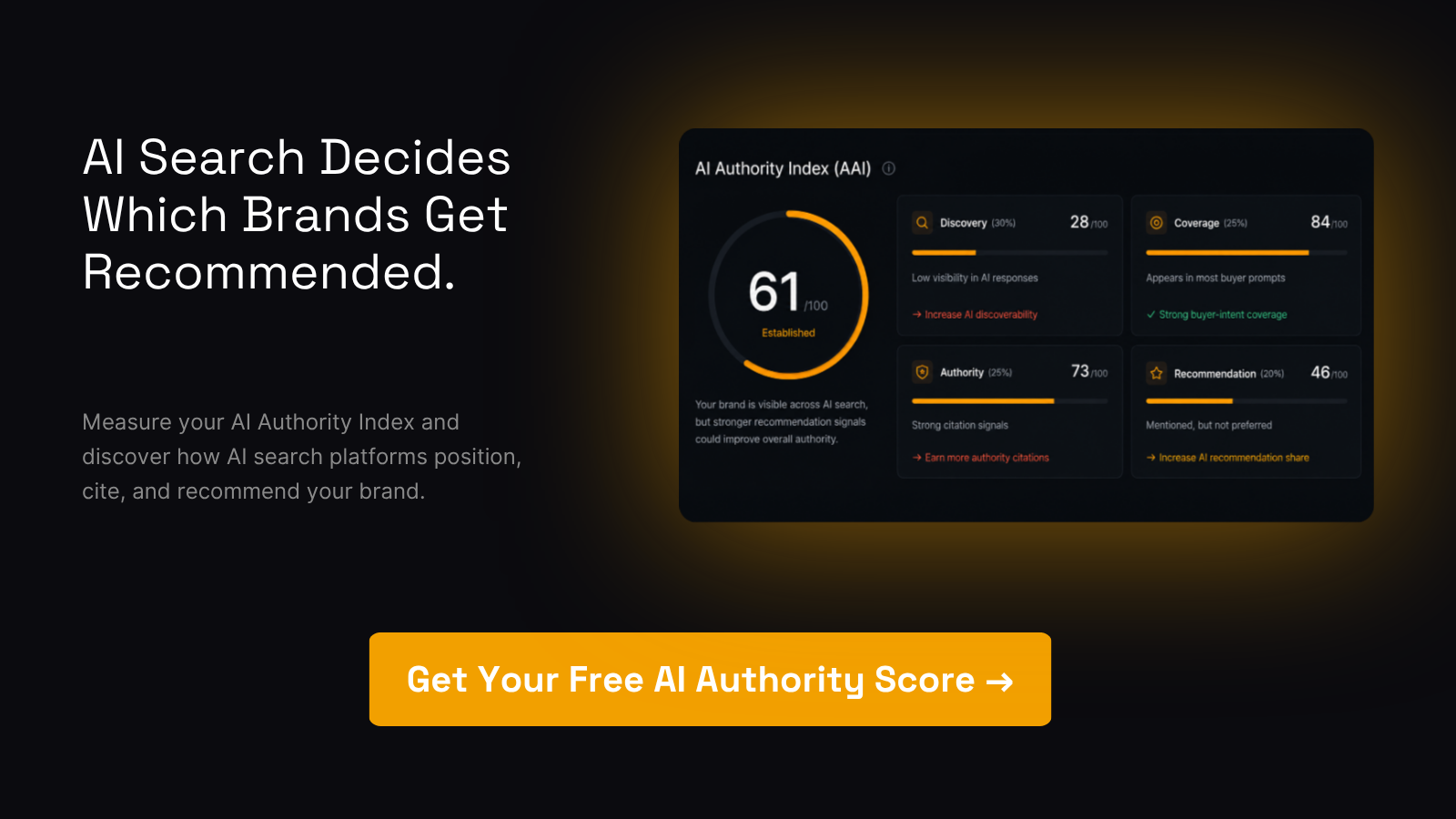
From there, the Starter Plan adds prioritized recommendations and ongoing monitoring, so instead of guessing whether your robots.txt fix or your new schema markup actually changed anything, you get a direct read on citation share over time. Authoritylayer's approach is grounded in observable evidence from real AI answers, with every score explained rather than handed to you as a black box, benchmarked against competitors chasing the same patients in the same market. For clinics managing multiple locations or specialties, the Growth plan and Enterprise plan scale the same monitoring across a larger footprint. Start with the free scan, see where your gaps actually sit, and go from there.
This article is general information, not a substitute for advice from a qualified doctor. Consult a qualified healthcare professional about your own circumstances before acting on anything here.
Sources
- OpenAI Developers — Bots documentation
- ChatGPT Search | OpenAI Help Center
- WHO calls for safe and ethical AI for health
- National Academies — Explainability and transparency in clinical AI
FAQ
How Can AI Help Spread Clinical Practice Recommendations?
AI assistants can surface clinical guidance faster than a patient searching manually, but only when clinics publish that guidance in structured, verifiable formats. The WHO stresses that health organizations carry responsibility for making sure that information stays accurate as it gets redistributed through AI systems.
How Do You Increase AI Visibility for a Clinic?
Improving clinic visibility starts with confirming AI crawlers can reach your site, then adding schema markup and rewriting key pages so the answer appears in the first 40 to 60 words. Building consistent third-party mentions and reviews across directories reinforces those facts, giving AI systems more independent confirmation to cite.
How Do You Measure AI Visibility for a Clinic?
Track a set of patient-phrased test queries on a recurring schedule and record whether your clinic gets cited or not, since AI visibility outcomes are largely binary. Pair that with referral traffic tagged by the utm_source=chatgpt.com parameter OpenAI documents and branded search lift as supporting signals. Authoritylayer's Monthly AI Visibility Report automates this sampling instead of running it manually.
Which AI Is Best for Healthcare-Related Searches?
There's no single AI platform that dominates every kind of healthcare query, since ChatGPT, Gemini, Claude, and Perplexity each pull from different retrieval and training setups. The practical answer for clinics is to optimize for crawlability, structured data, and corroboration broadly, since those same fundamentals tend to improve visibility across most major assistants at once.
What Does the Authoritylayer Starter Plan Cost?
The Starter Plan is priced at $99 per month and includes an initial audit, prioritized recommendations, and basic monitoring. Clinics can also start with the Free AI Visibility Scan before committing to a paid plan.